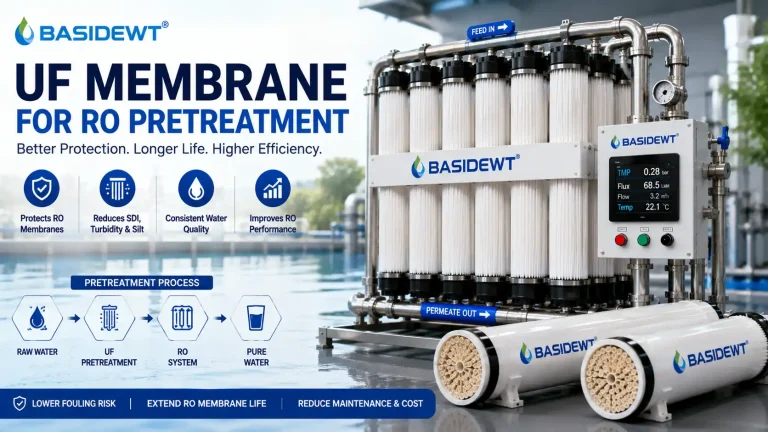
BasideWT- Whole Home Water Filtration System & Replacement


How to Choose a UF Membrane for Your Water System
Learning how to choose a UF membrane is not just a technical exercise. It affects water quality, system uptime, and long-term operating costs. Get it wrong, and you face fouling, poor flow, or premature replacement. Get it right, and your system runs efficiently for years.
This guide walks you through exactly how to choose a UF membrane, step by step. You will learn which specifications matter, how to match a membrane to your water source, and how to avoid the mistakes that cost buyers time and money. By the end, you will know how to choose a UF membrane with confidence, whatever your water system looks like.
If you want a broader introduction first, our complete UF membrane buying guide covers membrane types, working principles, and applications in more depth.
What a UF Membrane Does (Quick Recap Before You Choose)
An ultrafiltration (UF) membrane is a physical barrier that separates suspended solids, bacteria, colloids, and large molecules from water. Water passes through microscopic pores under pressure. Particles larger than the pore size stay behind.
UF sits between microfiltration and nanofiltration in terms of filtration precision. It removes turbidity-causing particles and most pathogens. However, it does not remove dissolved salts or reduce total dissolved solids (TDS). If you need a refresher on how the technology works, see what a UF membrane is and how it separates particles.
Understanding this baseline matters. It tells you what UF can and cannot do before you even start comparing specifications, and it is the first real step in how to choose a UF membrane that actually fits your application.
How to Choose a UF Membrane: Start With Your Feed Water
Many buyers start by browsing membrane catalogs. This is backwards. Instead, start by characterizing your feed water. The membrane you need depends entirely on what is in your water and how it behaves.
Key Feed-Water Factors to Test or Measure
Before selecting a membrane, gather data on these factors:
- Turbidity (NTU): Higher turbidity means more suspended solids and a greater fouling risk.
- Total suspended solids (TSS): Determines pretreatment needs.
- Silt Density Index (SDI): A common indicator of fouling potential.
- Temperature range: Affects flux and membrane material compatibility.
- pH range: Some membrane materials tolerate a wider pH range than others.
- Presence of oil, iron, or manganese: These foul membranes quickly without pretreatment.
- Microbial load: Determines disinfection and cleaning frequency.
Water from a municipal supply behaves very differently from surface water, well water, or industrial wastewater. As a result, the “right” membrane for one source may be the wrong choice for another.
Step 1: Define Your Target Contaminants
Ask a simple question first: what do you actually need to remove? UF membranes are effective against suspended solids, bacteria, protozoa, and most viruses attached to particles. They are not designed to reduce hardness, salinity, or dissolved organics.
If your main concern is dissolved salts, you likely need reverse osmosis instead, possibly with UF as a pretreatment stage. For a side-by-side comparison, review UF membrane versus RO membrane differences before finalizing your decision.
Matching the technology to the contaminant profile is the foundation of how to choose a UF membrane correctly, and it prevents an expensive, frustrating mismatch later.
Step 2: Choose the Right Pore Size
Pore size is the single most talked-about UF specification, and for good reason. It directly determines what the membrane removes and how much pressure the system needs to maintain flow.
Most commercial UF hollow fiber membranes fall in the 0.01 to 0.1 micron range. According to technical documentation on membrane separation processes, ultrafiltration membranes typically have a nominal pore size around 0.01 micron, with an operating range of roughly 0.01 to 0.05 micron.
A smaller pore size gives tighter filtration and better pathogen removal. However, it also increases resistance to flow, which can raise energy consumption and reduce throughput. A larger pore size increases flow but may let more fine particles through.
| Pore Size Range | Typical Use Case | Trade-Off |
|---|---|---|
| 0.01 micron | Drinking water, high-risk pathogen removal | Lower flow rate, higher pressure needs |
| 0.02–0.03 micron | General municipal and commercial systems | Balanced flow and removal efficiency |
| 0.05–0.1 micron | Pretreatment for RO, industrial process water | Higher flow, coarser filtration |
For a deeper technical comparison, see our breakdown of 0.01 versus 0.03 micron pore sizes and how each affects performance.
Step 3: Match the Membrane Material to Your Water Chemistry
Membrane material affects chemical resistance, mechanical strength, and lifespan. The two most common materials are PVDF (polyvinylidene fluoride) and PES (polyethersulfone).
PVDF generally offers stronger chemical resistance and better tolerance for aggressive cleaning agents like sodium hypochlorite. PES often provides higher flux at a lower operating pressure but may be more sensitive to certain oxidants over time.
Neither material is universally “better.” The right choice depends on your feed water chemistry, cleaning protocol, and budget. Our full comparison of PVDF and PES UF membrane materials explains the trade-offs in detail.
Quick Material Selection Table
| Factor | PVDF | PES |
|---|---|---|
| Chemical resistance | Higher | Moderate |
| Typical flux | Moderate | Higher |
| Cost | Slightly higher | Slightly lower |
| Best for | Aggressive cleaning cycles | High-flow, lower-fouling water |
Step 4: Confirm Configuration and System Compatibility
Most UF systems for water treatment use hollow fiber configurations because of their high surface area and compact footprint. Hollow fiber modules also support both inside-out and outside-in flow, depending on the application.
Before ordering, confirm:
- The housing dimensions match your existing system.
- The connection type (flange, threaded, or quick-connect) fits your piping.
- The fiber configuration (inside-out or outside-in) suits your feed water turbidity.
Outside-in configurations generally tolerate higher turbidity feed water better, since solids collect on the outer surface, which is easier to backwash. If you want more detail on this format, our guide to hollow fiber UF membrane design and benefits is a useful next read.
Step 5: Size the Membrane for Flow Rate and Capacity
Undersizing a membrane leads to excessive pressure, faster fouling, and shortened lifespan. Oversizing wastes money on unnecessary capacity. Getting the size right requires matching membrane surface area to your peak flow demand, not just your average flow.
To size correctly, calculate:
- Peak daily flow rate (not just average usage)
- Required permeate flux (typically expressed in LMH — liters per square meter per hour)
- Recovery rate needed for your application
- Number of membrane elements required to meet peak demand without exceeding recommended flux
Commercial systems, in particular, often see variable demand throughout the day. Therefore, size for the busiest periods, not the average.
Step 6: Check Operating Pressure and Temperature Limits
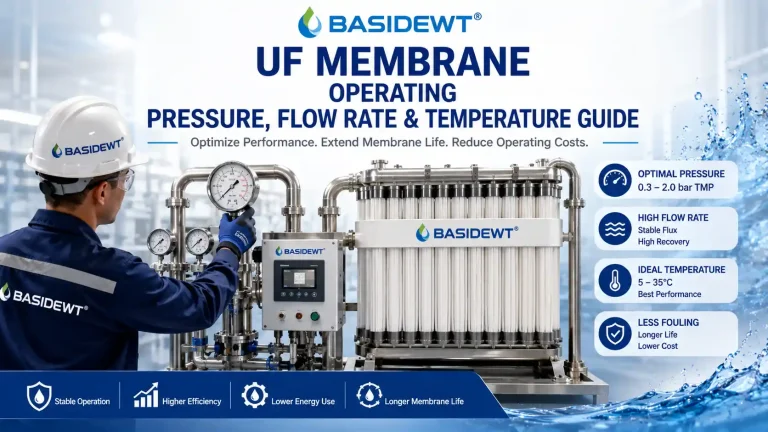
Every UF membrane has a maximum operating pressure and a recommended temperature range. Exceeding either can permanently damage the membrane structure.
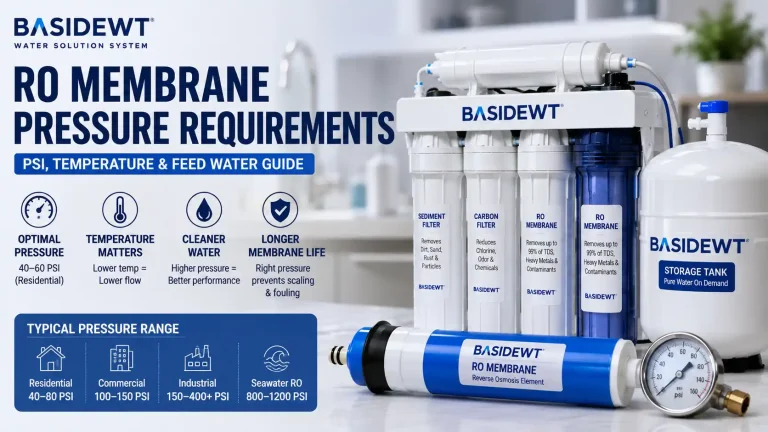
Typical UF systems operate at relatively low feed pressures, often in the range of a few bar, compared to reverse osmosis systems that require much higher pressure. Running a membrane above its rated pressure accelerates wear and increases the risk of fiber breakage.
Temperature also matters. Cold feed water increases viscosity and reduces flux, meaning you may need more membrane area to hit the same output. Hot water, on the other hand, can degrade certain membrane materials faster.
For full technical specifications on this topic, see our guide to UF membrane operating pressure, flow rate, and temperature limits.
Step 7: Plan for Pretreatment
Even the best UF membrane struggles without adequate pretreatment. High turbidity, oil, or iron content in raw water shortens membrane life and increases cleaning frequency.
Common pretreatment steps include:
- Multimedia or sand filtration to reduce large suspended solids
- Cartridge filtration as a final safeguard before the UF stage
- Chemical dosing to control scaling or oxidation, where needed
- Coagulation/flocculation for surface water with high organic content
Skipping pretreatment is one of the most common buying mistakes. It often looks like a cost-saving step upfront, but it usually leads to higher maintenance costs later.
Step 8: Understand Cleaning and Maintenance Requirements
Every UF membrane requires periodic cleaning to maintain flux and remove accumulated fouling. Two main processes handle this: backwashing and chemical cleaning-in-place (CIP).
Backwashing reverses flow periodically to dislodge particles from the membrane surface. Most systems backwash automatically every 15 to 60 minutes, depending on feed water quality. Chemical cleaning happens less often, typically weekly to monthly, and uses cleaning agents matched to the membrane material.
Before buying, ask the supplier:
- What cleaning chemicals are compatible with this membrane?
- How often does backwashing need to run for water like mine?
- What is the expected recovery in flux after a chemical clean?
For complete maintenance procedures, review our guide to UF membrane cleaning and backwashing.
Step 9: Estimate Lifespan and Total Cost of Ownership
Membrane price alone is a poor way to compare options. A cheaper membrane with a shorter lifespan or higher cleaning chemical demand can cost more over time.
When calculating total cost of ownership, include:
- Initial membrane and housing cost
- Expected lifespan under your water conditions
- Cleaning chemical consumption
- Energy cost from operating pressure
- Labor for maintenance and monitoring
- Replacement frequency and downtime cost
| Cost Factor | Why It Matters |
|---|---|
| Purchase price | Upfront capital cost |
| Expected lifespan | Determines replacement frequency |
| Energy use | Driven by operating pressure and flux |
| Cleaning chemicals | Recurring operational cost |
| Downtime | Indirect but significant cost during replacement |
How to Choose a UF Membrane for Household vs. Commercial Use
Household and commercial buyers weigh these factors differently, even though the underlying technology is the same.
Household systems usually prioritize compact size, low maintenance, and simple installation. Flow rate requirements are modest, so a smaller membrane surface area is often sufficient.
Commercial and industrial systems prioritize consistent throughput, chemical resistance, and long-term operating cost. These systems often justify a higher upfront investment in a more durable membrane material like PVDF.
Common Mistakes to Avoid When Choosing a UF Membrane
- Choosing pore size based on marketing claims alone, without testing actual feed water.
- Ignoring pretreatment needs, then blaming the membrane for fouling.
- Sizing for average flow instead of peak flow, causing pressure spikes.
- Skipping compatibility checks with existing housings and piping.
- Underestimating cleaning chemical costs when comparing total price.
- Assuming UF will reduce TDS, when it does not.
| Common Mistake | Better Approach |
|---|---|
| Sizing for average flow | Size for peak daily demand |
| Skipping pretreatment | Add multimedia or cartridge filtration upfront |
| Ignoring water chemistry | Test turbidity, SDI, and pH before ordering |
| Comparing price only | Compare total cost of ownership over the expected lifespan |
When UF Is Not the Right Choice
UF is not always the correct solution. Consider an alternative or an additional treatment stage if:
- You need to reduce dissolved salts or hardness — reverse osmosis is required.
- You need to disinfect water without physical filtration — UV treatment may be more suitable as a complement.
- Your feed water carries extremely high turbidity without any pretreatment option available.
For a broader technology comparison, see UF membrane versus UV versus RO, which outlines where each method fits best.
Practical Checklist for How to Choose a UF Membrane
Use this checklist before placing an order:
- Feed water tested for turbidity, SDI, pH, and temperature
- Target contaminants clearly defined
- Pore size matched to filtration goal
- Membrane material selected based on chemical resistance needs
- Configuration (inside-out or outside-in) confirmed
- Peak flow rate calculated, not just average
- Operating pressure and temperature within membrane limits
- Pretreatment plan finalized
- Cleaning and backwashing schedule understood
- Total cost of ownership calculated, not just purchase price
- Housing and piping compatibility confirmed
Final Buyer Recommendations
Choosing the right UF membrane comes down to matching specifications to your actual water conditions, not to the most impressive number on a spec sheet. Start with feed-water testing. Then work through pore size, material, sizing, and pretreatment in order.
If you are ready to compare options, you can browse the full UF filter membrane range to see specifications side by side. For systems that need a high surface-area, compact format, our hollow fiber UF membrane products are worth reviewing alongside your test results.
Provide your supplier with feed-water data, target flow rate, and existing housing specifications. This gives you an accurate recommendation instead of a generic one.
Frequently Asked Questions
How do I choose a UF membrane for my specific water system? Start by testing your feed water for turbidity, SDI, pH, and temperature. From there, match pore size, membrane material, and system sizing to those results — that sequence is the core of how to choose a UF membrane correctly for any application.
What is the most important factor when choosing a UF membrane? Feed water quality matters most. Pore size, material, and sizing decisions all depend on accurate data about your source water.
Can one UF membrane work for both household and commercial use? Not usually. Commercial systems need larger surface area, higher chemical resistance, and different cleaning schedules than household units.
Does a smaller pore size always mean better water quality? Not necessarily. A smaller pore size improves removal efficiency but increases pressure requirements and can reduce flow. Balance is key.
How do I know if I need pretreatment before UF? If your feed water has high turbidity, oil, or iron content, pretreatment is almost always necessary to protect the membrane and extend its life.
Is PVDF always better than PES? No. PVDF offers stronger chemical resistance, while PES often provides higher flux. The better choice depends on your cleaning protocol and water chemistry.
How often should I replace a UF membrane? This depends on water quality, cleaning frequency, and operating conditions. Testing flux recovery after cleaning cycles is the best way to judge when replacement is due.
Can UF membranes remove dissolved salts? No. UF removes suspended solids, bacteria, and colloids, but it does not reduce TDS or hardness. Reverse osmosis is needed for that.
RELATED POSTS
How Do You Clean Solar Panels?
What Size Whole House Water Softener and Filtration System Do I Need for My Home?
UF Membrane Operating Pressure, Flow Rate & Temperature Guide
RO Membrane Pressure Requirements: PSI, Temperature & Feed Water Guide

Water Filter Housing Buying Guide: How to Choose the Best Housing for Your Needs