BasideWT- Whole Home Water Filtration System & Replacement


UF Membrane Operating Pressure, Flow Rate & Temperature Guide
Getting UF membrane operating pressure right is one of the biggest factors in stable filtration performance. Too little pressure, and flow drops. Too much, and fouling accelerates. This guide explains how pressure, flow rate, and temperature work together in a real ultrafiltration system.
We already covered how a UF membrane works in an earlier article. Here, we focus on the operating side: the numbers, the relationships, and the practical decisions that keep a UF system running well.
What Is UF Membrane Operating Pressure?
UF membrane operating pressure is the force that pushes water through the membrane. This force is called transmembrane pressure, or TMP. Without enough pressure, water cannot cross the membrane fast enough to be useful.
Pumps generate this pressure on the feed side. The membrane resists flow because of its narrow pores. As a result, pressure must overcome that resistance to produce permeate, the clean water that passes through.
Operating pressure is not a single fixed number. Instead, it depends on membrane material, fiber configuration, and water quality. For background on membrane types, see our UF filter membrane buying guide.
What Is the Typical UF Membrane Operating Pressure?
Most UF systems operate at fairly low pressure compared to reverse osmosis. This is one reason UF uses less energy.
Typical values fall between 10 and 100 psi (0.7 to 6.9 bar), depending on the membrane and application. Many hollow fiber systems run comfortably in the 15 to 30 psi range during normal filtration.
The table below shows common operating ranges. Always check the manufacturer’s data sheet for exact limits, since values vary by product.
| Parameter | Typical Range |
|---|---|
| Filtration TMP | 0.1 – 0.6 bar (1.5 – 8.7 psi) |
| Maximum filtration TMP | Up to 1.5 bar (22 psi) |
| Backwash TMP | 0.3 – 2.0 bar (4.4 – 29 psi) |
| Broader UF operating window | 10 – 120 psi (0.7 – 8.3 bar) |
These ranges overlap because manufacturers design membranes differently. A hollow fiber UF membrane, for example, often runs at lower pressure than a tubular or spiral-wound design.
Feed Pressure vs Transmembrane Pressure
These two terms get confused often. However, they measure different things.
Feed pressure is the pressure of water entering the membrane module. It is measured at the inlet, before filtration happens.
Transmembrane pressure is the pressure difference across the membrane itself. It compares the feed side to the permeate side. TMP is the real driving force behind filtration, not feed pressure alone.
For this reason, operators track TMP more closely than feed pressure. A rising TMP at a constant flow rate usually signals fouling. Meanwhile, feed pressure can rise or fall for reasons unrelated to the membrane, such as pump wear or pipe restrictions.
What Is UF Membrane Flow Rate?
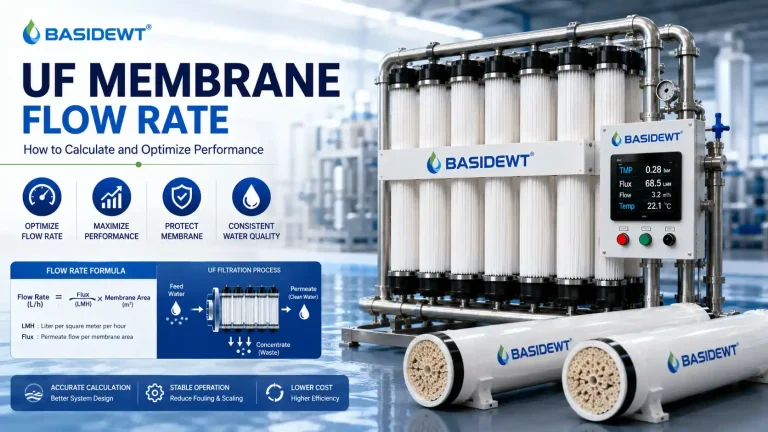
Flow rate describes how much water moves through the system over time. It is usually measured in gallons per minute (gpm) or cubic meters per hour (m³/h).
Two flow rates matter in UF filtration. Feed flow is the total water entering the system. Permeate flow is the treated water that comes out the other side.
The difference between these numbers reflects recovery rate and any concentrate or reject stream. Systems designed for high recovery aim to maximize permeate flow relative to feed flow, without pushing pressure too high.
Understanding Flux
Flux is closely related to flow rate, but it is not identical. Flux measures permeate flow per unit of membrane surface area, usually in liters per square meter per hour (LMH) or gallons per square foot per day (gfd).
Flux matters because it lets operators compare membranes of different sizes fairly. A small module and a large module can both produce useful data once flux is calculated.
Higher flux generally means more water production. As a result, operators sometimes want to push flux upward. However, flux above the membrane’s design limit accelerates fouling and shortens membrane life.
What Factors Affect UF Membrane Flow Rate?
Several variables influence flow rate beyond pressure alone. Understanding each one helps with troubleshooting.
Membrane fouling. Particles, organics, and biological growth block pores over time. As fouling builds, flow rate drops at the same pressure.
Feed water quality. Turbid or high-organic feed water reduces achievable flux. Pretreatment often improves flow stability.
Membrane pore size. Tighter pores restrict flow more than looser ones. Our article on UF membrane pore size explains this trade-off in detail.
Temperature. Cold water is more viscous, so it flows less easily. We cover this next in more depth.
System design. Module configuration, fiber length, and flow path all shape hydraulic performance.
How Temperature Affects UF Membrane Performance
Temperature has a direct effect on water viscosity. Warmer water flows more easily through small membrane pores. Colder water resists flow because it is thicker.
Research on ultrafiltration systems shows this pattern consistently. Studies of hollow fiber UF membranes found that permeate flux increased significantly as pressure rose, but flux dropped when feed water cooled, because lower temperature raised water viscosity and reduced flow.
For every drop in temperature, expect somewhat lower flux at the same pressure. Some plants compensate by raising pressure slightly during cold months. However, pressure increases have limits, since exceeding maximum TMP damages the membrane.
Established filtration research explains how temperature changes influence membrane fouling behavior and flux performance across different water types and membrane materials. This confirms that temperature is not a minor detail. It is a core operating variable.
Most manufacturers list a reference temperature, often around 20°C (68°F), for stated flux values. Always adjust expectations when actual feed temperature differs from that reference point.
Relationship Between Pressure, Flow Rate and Flux
Pressure, flow rate, and flux move together, but not in a simple straight line. At first, raising pressure increases flux almost proportionally. This is the normal operating zone for most systems.
Eventually, flux increases start to slow down even as pressure keeps rising. This happens because fouling builds faster at higher flux. The membrane surface becomes concentrated with rejected material, which resists further flow.
Push pressure too far, and flux may plateau or even decline. Operators call this the “limiting flux” condition. Running near this limit wastes energy and accelerates cleaning needs.
For day-to-day operation, most systems perform best somewhat below their theoretical maximum flux. This protects the membrane and keeps energy costs reasonable.
How Fouling Changes Pressure and Flow
Fouling is the buildup of particles, organics, or biofilm on the membrane surface. It changes both pressure and flow readings, often before it becomes visible.
In constant-flow operation, fouling shows up as rising TMP. The system pushes harder to maintain the same output. This is the most common design in municipal and industrial UF plants.
In constant-pressure operation, fouling shows up as declining flow rate. The pressure stays steady, but less water passes through as pores become blocked.
Either way, tracking these trends over time reveals fouling before it causes a full production loss. Comparing UF fouling behavior with other filtration types is covered in our UF membrane vs RO membrane comparison.
How to Optimize UF Membrane Operating Conditions
A few practical habits keep pressure and flow within a healthy range.
First, match pressure to actual feed water conditions instead of running at a fixed setpoint year-round. Second, schedule backwash and chemical cleaning based on TMP trends, not just a calendar.
Also, monitor temperature alongside pressure and flow. A flow drop during winter may reflect viscosity, not fouling. Reviewing pressure logs weekly catches slow trends that daily checks can miss.
Choosing the right membrane material also supports stable operation. Our comparison of PVDF vs PES UF membranes explains how material choice affects pressure tolerance and chemical resistance.
For facilities selecting new equipment, browsing a dedicated UF membrane product range helps match membrane specifications to expected pressure and flow requirements before installation.
Common UF Membrane Operating Mistakes
Some operating problems appear repeatedly across UF installations. Avoiding them protects membrane lifespan.
- Running at maximum rated pressure continuously, leaving no margin for fouling
- Ignoring slow TMP increases until flow drops sharply
- Skipping backwash cycles to save time or chemicals
- Assuming one pressure setting works across all seasons
- Overlooking pretreatment gaps that increase fouling load
Each mistake shortens membrane life and increases long-term operating cost. Correcting them usually costs less than emergency membrane replacement.
Practical UF Membrane Operating Checklist
Use this checklist during routine system reviews.
- Record feed pressure, permeate pressure, and calculated TMP daily
- Track permeate flow rate and compare it to baseline values
- Log feed water temperature alongside flow readings
- Watch for gradual TMP increases over several days or weeks
- Confirm backwash frequency matches actual fouling rate
- Review manufacturer limits for maximum TMP and flux
- Inspect our full UF membrane category when planning upgrades or replacements
Consistent logging turns raw numbers into useful trends. Trends, not single readings, reveal real membrane condition.
UF Membrane Pressure and Flow Troubleshooting
| Symptom | Likely Cause | Suggested Action |
|---|---|---|
| Rising TMP, flow steady | Membrane fouling | Increase cleaning frequency, check pretreatment |
| Falling flow, pressure steady | Fouling or cold feed water | Check temperature first, then inspect fouling |
| Sudden pressure spike | Blockage or pump issue | Inspect feed line and pump performance |
| Flow drops only in winter | Temperature-driven viscosity change | Adjust expectations, avoid over-pressurizing |
| TMP near maximum rating | Approaching membrane limit | Schedule cleaning or replacement soon |
Troubleshooting works best when pressure, flow, and temperature are reviewed together. A single number rarely tells the whole story.
Conclusion
UF membrane operating pressure works alongside flow rate and temperature to determine real-world performance. None of these factors stands alone.
Understanding TMP, tracking flux trends, and adjusting for temperature all help operators run stable systems. Small, consistent monitoring habits prevent large, costly problems later.
For a broader introduction to membrane fundamentals, revisit our UF filter membrane guide before making purchasing or upgrade decisions.
Frequently Asked Questions
What pressure does a UF membrane need?
Most UF membranes operate between roughly 10 and 100 psi, though many hollow fiber systems run lower. The exact figure depends on the specific membrane and feed water conditions.
What is TMP in UF membrane filtration?
TMP, or transmembrane pressure, is the pressure difference across the membrane. It represents the actual driving force behind filtration, unlike feed pressure alone.
Does higher pressure increase UF flow rate?
Yes, up to a point. Flow rate rises with pressure until fouling and concentration effects cause the increase to slow or level off.
How does temperature affect UF membrane flow?
Warmer water is less viscous and flows through the membrane more easily. Cooler water increases viscosity and typically lowers flow at the same pressure.
What causes UF membrane pressure to increase?
Fouling is the most common cause. As particles and organic matter build up on the membrane surface, the system needs more pressure to maintain the same flow.
Can low pressure reduce UF membrane performance?
Yes. Insufficient pressure reduces flux and permeate output, even when the membrane itself is clean and undamaged.
RELATED POSTS
UF Membrane Flow Rate: How to Calculate and Optimize Performance
BasideWT Whole House Water Softener
How Long Does Deionised Water Last
UF Filter Membrane: Types, Working, Pore Size, Applications, Maintenance & Buying Guide
UV Water Sterilizer Parts and Components Explained