BasideWT- Whole Home Water Filtration System & Replacement


Spotless Water System Working Principle: How RO and DI Deliver 0 PPM Water
Understanding the spotless water system working principle starts with a simple fact: water spots are not dirt, they are minerals left behind after water evaporates. A spotless water system works by stripping those minerals out before the rinse ever touches a surface, using a sequence of filtration and ion exchange stages that gradually reduce total dissolved solids to nearly zero. This article breaks down exactly how each stage functions, why the order matters, and what happens when one stage underperforms. If you already understand the basics from our complete spot-free rinse guide, consider this the deeper technical layer beneath it.
Why the Working Principle Matters More Than the Marketing Term
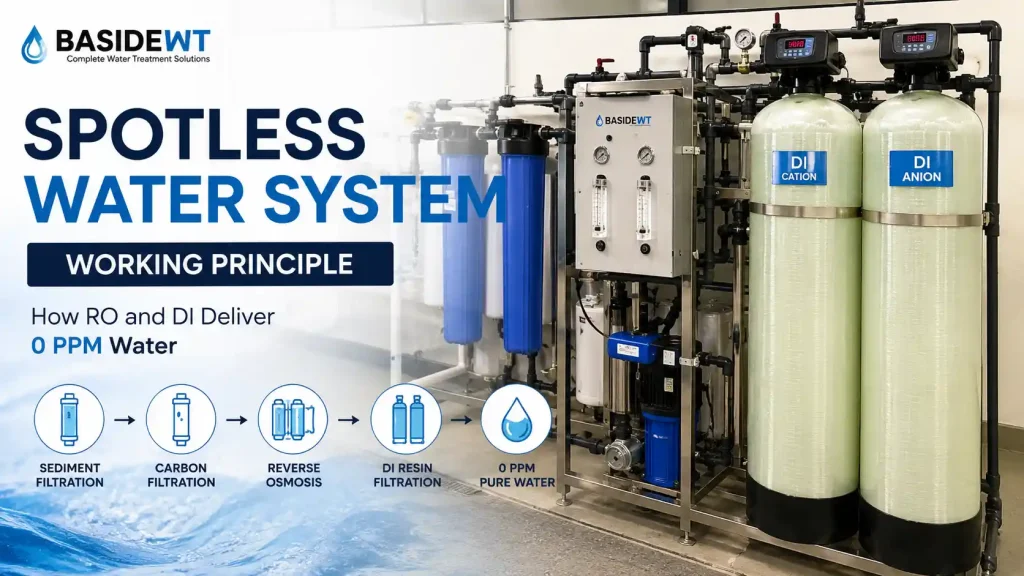
Many buyers shop for a “spot free rinse system” without understanding what is actually happening inside the tanks. That gap causes real problems later. When a system underperforms, operators often blame the equipment instead of recognizing a specific stage that has reached its limit.
Knowing the working principle changes that. It lets an operator look at a rising TDS reading and immediately know whether the issue sits in the reverse osmosis membrane, the DI resin, or somewhere earlier in the filtration chain. That diagnostic skill saves time, money, and unnecessary service calls.
Stage One: Sediment Filtration and Why It Comes First
Every spotless water system begins with a sediment filter, and this placement is not arbitrary. Raw feed water often carries sand, rust particles, and fine grit, especially in older municipal plumbing or well systems.
If this debris reached the reverse osmosis membrane unfiltered, it would physically scratch and clog the membrane surface within weeks. Sediment filtration protects everything downstream, which is why its placement is considered foundational to the entire working principle, not just a minor prefilter step.
Stage Two: Carbon Filtration and Chlorine Protection
After sediment removal, water passes through activated carbon. Municipal water suppliers add chlorine or chloramine to control bacteria, which is beneficial for drinking water safety but harmful to RO membranes over time.
Carbon filtration adsorbs these chemicals before they reach the membrane. Skipping this stage, or running it past its rated capacity, is one of the fastest ways to degrade an expensive RO membrane prematurely. Many BasideWT RO DI resin deionized water systems use oversized carbon stages specifically to extend membrane life in high-chlorine municipal areas.
Stage Three: The Reverse Osmosis Working Principle
Reverse osmosis is where the working principle becomes genuinely interesting from an engineering standpoint. Under normal osmosis, water naturally moves from a low-mineral-concentration side of a membrane toward a high-concentration side. Reverse osmosis does the opposite.
By applying mechanical pressure to the feed water, the system forces water molecules backward through a semi-permeable membrane, against the natural osmotic gradient. The membrane itself contains microscopic pores, small enough to block dissolved mineral ions while still allowing water molecules through.
The process creates two separate water streams. Permeate is the purified water that passes through the membrane. Concentrate, also called reject water, carries the removed minerals to the drain. A well-maintained RO membrane typically removes 95% to 99% of dissolved solids. As a result, only a small amount of minerals remains in the permeate stream.
Why RO Alone Rarely Reaches 0 PPM
This is where many competing explanations stop short. Reverse osmosis is highly effective, but it is not perfect. A small percentage of ions consistently pass through even a healthy membrane, which is why RO water typically tests somewhere between 5 and 30 ppm rather than true zero.
For most applications, that residual TDS is still enough to cause visible spotting once the water evaporates. This is precisely why the working principle requires a second stage.
Stage Four: The DI Resin Working Principle
Deionization finishes what reverse osmosis started, using an entirely different mechanism called ion exchange. Instead of physically filtering particles, DI resin chemically swaps ions with the water passing through it.
Inside the resin tank, tiny synthetic beads are divided into two functional types. Cation resin beads attract positively charged ions, such as calcium and magnesium, and release hydrogen ions in exchange. Anion resin beads attract negatively charged ions, such as chloride and sulfate, and release hydroxide ions in exchange.
Those released hydrogen and hydroxide ions immediately combine to form additional pure water molecules. Because this exchange happens at the ionic level rather than through physical filtration, DI resin can pull water down to genuine 0 ppm, something reverse osmosis cannot achieve on its own.
Mixed-Bed Resin vs. Separate-Bed Resin
Commercial systems typically use mixed-bed resin, where cation and anion beads sit together in the same tank for maximum polishing efficiency. Some larger installations use separate-bed configurations instead, which allow for more efficient regeneration but require more plumbing complexity. Most spot-free applications, including car washes and window cleaning fleets, are well served by mixed-bed resin due to its simplicity and consistent 0 ppm output.
How TDS Measurement Confirms the Working Principle Is Functioning
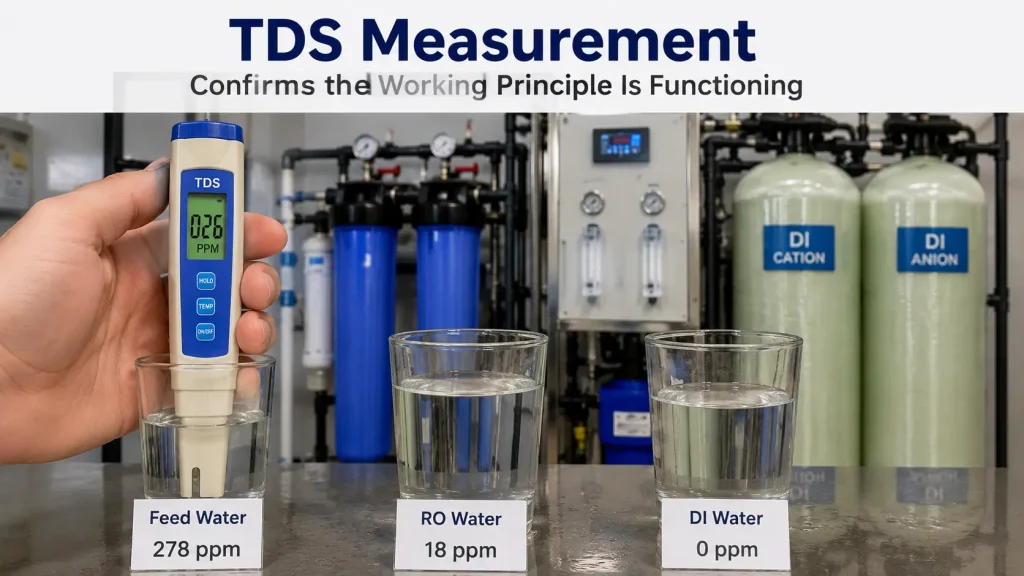
A TDS meter is the single most useful diagnostic tool for verifying that every stage is working correctly. Because TDS is measured in parts per million, even small increases are meaningful.
Feed water might read anywhere from 50 to over 300 ppm depending on regional hardness. After the RO stage, that number should drop into the single digits or low twenties. After the DI resin stage, a properly functioning system should read at or near 0 ppm.
If the post-RO reading looks normal but the final reading has climbed, the resin is nearing exhaustion. If the post-RO reading itself has risen significantly, the membrane is likely fouled or reaching the end of its service life. This layered testing approach is far more useful than checking TDS only at the final outlet.
Storage Tanks, Booster Pumps, and Flow Consistency
The working principle does not end at the resin tank. Most commercial installations include a storage tank to hold treated water, since RO production rates are often slower than peak rinse demand during busy hours.
A booster pump maintains consistent pressure and flow to the rinse nozzle. It does this regardless of the amount of treated water left in storage. Without this component, flow rate can drop during peak demand. Lower flow slows vehicle throughput and creates extra work for staff.
Real-World Applications of This Working Principle
The same underlying mechanism supports several industries beyond car washing. Detailing shops use it for final rinse stages to eliminate hand drying entirely. Window cleaning companies rely on pure water fed pole systems built on this exact RO-DI sequence to clean high-rise glass streak-free from ground level.
Solar panel maintenance crews depend on spot-free rinsing to prevent mineral film from reducing panel efficiency over time. BasideWT’s broader cleaning system and deionized water cleaning collections are engineered around this same working principle, adapted to each surface type’s specific demands.
For general reference on how mineral content in water is classified and measured, the United States Geological Survey’s water hardness overview offers useful independent context on TDS and hardness terminology (nofollow).
Common Mistakes That Break the Working Principle
Several recurring issues disrupt an otherwise well-designed system. Skipping prefilter replacement schedules puts unnecessary strain on the RO membrane, accelerating fouling. Running the system beyond its rated flow rate reduces contact time at each stage, which lowers overall purification quality even when the components themselves are healthy.
Ignoring the TDS meter is another frequent mistake, since it is the earliest indicator of declining performance, often weeks before visible spotting returns. High feed-water hardness without adequate system sizing is also common, particularly in regions with naturally hard municipal water. Finally, allowing DI resin to run well past exhaustion causes a phenomenon called ion dumping, where previously captured minerals get released back into the water stream all at once, causing a sudden spike in TDS rather than a gradual decline.
Maintenance Practices That Preserve Performance
Because the working principle depends on every stage functioning correctly, maintenance should be approached as a system rather than isolated parts. Sediment and carbon filters need scheduled replacement based on usage volume, not just a fixed calendar date. RO membranes benefit from periodic chemical cleaning to remove scale buildup, particularly in hard water regions.
DI resin should be tested regularly rather than assumed to be working simply because water is still flowing. Many commercial operators track outlet TDS daily during opening procedures, which takes less than a minute and prevents unpleasant surprises during peak hours. Storage tanks and booster pumps should also be inspected periodically for leaks, pressure drops, or bacterial growth, especially in systems that sit idle overnight.
Choosing a System Based on This Working Principle
Buyers who understand the working principle make significantly better purchasing decisions. Flow rate should match peak demand, not average demand, since undersized systems struggle most during a business’s busiest hours. Feed water testing before purchase helps determine appropriate RO and DI capacity, rather than guessing based on generic assumptions about local water quality.
Portable configurations suit mobile detailers and lower-volume operations, while fixed commercial installations, such as BasideWT’s spot free car wash system and car wash system lines, are built for continuous daily throughput. Operating cost matters just as much as upfront price, since resin and membrane replacement frequency directly affects long-term cost of ownership.
Why BasideWT Engineers Around This Exact Principle
BasideWT builds commercial systems with each stage sized specifically for real duty cycles, rather than laboratory conditions that rarely reflect daily operating demand. Every system in the spotless water system category is designed around the same core sequence covered in this article, sediment, carbon, RO, and DI resin, but scaled and customized to match feed water hardness, daily vehicle count, and available installation space.
That engineering-first approach is why BasideWT provides ongoing support for resin replacement and membrane maintenance. The company does not treat a sale as the end of the relationship. Instead, it helps customers keep their systems performing at their best. Understanding the working principle makes troubleshooting easier. Operators and the BasideWT team can identify problems quickly using TDS readings instead of guesswork.
Conclusion
The spotless water system working principle comes down to a straightforward sequence: protect the membrane with sediment and carbon filtration, remove the bulk of dissolved minerals through reverse osmosis, and polish the remaining trace minerals out through DI resin’s ion exchange process. Each stage plays a distinct role, and understanding how they work together makes troubleshooting, maintenance, and system selection far more manageable. For a broader overview of spot-free rinsing in practice, our spot-free rinse complete guide covers the full picture, while BasideWT’s spotless water system lineup puts this exact working principle into commercial-grade equipment built for daily use.
FAQs
What is the working principle of a spotless water system?
A spotless water system removes dissolved minerals from tap water using reverse osmosis and DI resin. These two stages produce highly purified water. The treated water dries without leaving spots on the surface.
Why does a spotless water system need both RO and DI resin?
Reverse osmosis removes most dissolved solids but typically leaves the water at 5 to 30 ppm. DI resin polishes the remaining minerals out through ion exchange, bringing the water down to true 0 ppm.
How does reverse osmosis actually remove minerals from water?
Reverse osmosis applies pressure to push water through a semi-permeable membrane. The membrane’s microscopic pores allow water molecules through while blocking most dissolved mineral ions, which are flushed away as concentrate.
What is ion exchange in DI resin systems?
Ion exchange is a chemical process where resin beads swap ions with the water passing through them, capturing mineral ions like calcium and magnesium while releasing hydrogen and hydroxide ions that recombine into pure water.
What TDS level indicates the system is working correctly?
Feed water often starts between 50 and 300 ppm. After reverse osmosis, readings should drop to single digits or low twenties. After DI resin, a properly functioning system should read at or near 0 ppm.
What causes DI resin to stop working?
DI resin becomes exhausted once its exchange capacity is used up capturing mineral ions. At that point, TDS readings begin climbing, and eventually the resin can release previously captured minerals back into the water in a spike known as ion dumping.
Can a spotless water system fail even if water is still flowing normally?
Yes. Flow rate and purification quality are separate issues. A system can continue producing water at normal pressure while TDS quietly climbs due to resin exhaustion or membrane fouling, which is why regular TDS testing matters more than visual inspection alone.
How often should the RO membrane be cleaned or replaced?
This depends on feed water hardness and usage volume, but periodic chemical cleaning helps remove scale buildup, while full replacement is typically needed every few years in commercial settings with consistent maintenance.
Does hard water affect how well a spotless water system performs?
Yes. Higher incoming TDS places more demand on both the RO membrane and DI resin, which is why systems installed in hard water regions often need larger capacity and more frequent resin changes than those in naturally soft water areas.
Is a spotless water system worth it for a small detailing business?
For most detailing operations, yes. Eliminating hand drying saves labor time on every vehicle, and portable spotless water systems are available for smaller-scale or mobile operations that don’t need a full fixed installation.
RELATED POSTS
UF Membrane Flow Rate: How to Calculate and Optimize Performance
How To Change Whole House Water Filter?
UV Transmittance (UVT) in Water Treatment Explained
UV Water Sterilizer for Drinking Water: Benefits, Limits and Applications
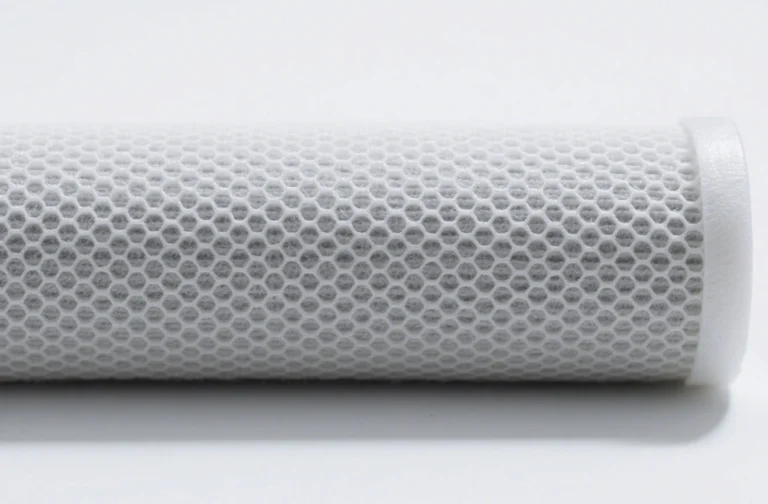
20 x 2.5 Replacement Water Filters Cartridges | High-Capacity, Universal Fit