BasideWT- Whole Home Water Filtration System & Replacement


UV Water Sterilizer for Drinking Water: Benefits, Limits and Applications
Many homeowners and facility managers ask the same question before installing new equipment: can a UV water sterilizer for drinking water actually make tap water safe to drink? The short answer is yes, but only for a specific part of the job. A UV water sterilizer is a disinfection device. It uses ultraviolet energy to damage the genetic material inside bacteria, viruses, and other microorganisms so they cannot reproduce and cause illness.
However, UV disinfection does not remove sediment, chemicals, dissolved solids, or heavy metals from water. It does not soften hard water, and it does not improve taste or odor. Understanding this distinction is the key to using UV treatment correctly in a home, restaurant, hotel, school, or commercial building.
This article explains how UV sterilization works, where it fits into a complete drinking water treatment system, and when extra treatment steps are necessary.
How UV Disinfection Works in Drinking Water Systems
A UV water sterilizer pushes water past a UV-C lamp housed inside a protective quartz sleeve. As water flows through the chamber, ultraviolet light penetrates the cell walls of microorganisms.
The UV energy damages their DNA and RNA. This stops bacteria, viruses, and protozoa from multiplying. Because the organisms can no longer reproduce, they lose the ability to cause infection, even though they are technically still present in the water.
Engineers call this process microbial inactivation. It differs from filtration, which physically traps and removes particles. UV disinfection changes what microorganisms can do. It does not change what stays dissolved or suspended in the water itself.
Why Microbial Disinfection Matters
Untreated drinking water can carry harmful microorganisms from several sources. These include:
- Surface water contamination
- Aging or damaged pipes
- Private wells with inconsistent testing
- Storage tanks that allow microbial regrowth
- Cross-contamination during maintenance work
Even water that looks clean can carry pathogens that cause gastrointestinal illness. UV treatment offers a chemical-free way to reduce this risk without adding chlorine or other disinfectants to the water.
Benefits of UV Treatment for Drinking Water
UV disinfection offers several practical advantages that explain why it has become a standard part of many drinking water treatment systems.
It works quickly. The system disinfects water as it passes through the chamber, with no extended contact time required.
It does not use chemicals. UV treatment avoids the taste, smell, and byproducts sometimes associated with chlorination.
It preserves water chemistry. UV light does not alter the mineral content, pH, or dissolved substances in water.
It requires relatively simple maintenance. Most systems need routine lamp replacement and periodic quartz sleeve cleaning.
It complements other treatment methods. UV disinfection fits naturally alongside filtration and reverse osmosis in a complete treatment train.
These benefits make UV treatment appealing for homeowners, restaurants, hotels, and facility managers who want reliable microbial control without introducing chemical residues.
Important Limitations Readers Should Understand
UV disinfection is powerful for microbial control, but it has clear boundaries. Readers should keep these limitations in mind before assuming a UV unit solves every water quality problem.
UV light does not remove sediment, rust particles, or suspended solids. Dissolved chemicals such as nitrates, heavy metals, or pesticides pass through unaffected. Calcium and magnesium hardness also remain unchanged. UV treatment likewise leaves taste, color, and odor problems caused by dissolved substances unresolved.
If a water supply has these problems, a UV sterilizer alone will not solve them. Our guide on what a UV water sterilizer removes from water offers a more detailed breakdown of what UV can and cannot remove, and explains the boundary between disinfection and contaminant removal.
Another limitation is that UV disinfection does not provide residual protection. Once water leaves the UV chamber, there is no ongoing disinfectant to prevent recontamination further downstream, unlike chlorine, which continues acting inside pipes and storage tanks.
Water Quality Conditions That Affect UV Performance
UV performance is not fixed. It depends heavily on the condition of the water passing through the system. Several factors determine whether a UV dose is strong enough to achieve reliable disinfection.
Why Water Clarity and Turbidity Matter
Cloudy or turbid water blocks UV light before it can reach microorganisms. Suspended particles create shadows that shield bacteria and viruses from exposure.
This is why clear water is essential for consistent UV performance. Our detailed explanation of how water turbidity affects UV water sterilization covers the science behind this relationship and shows why pretreatment often matters more than lamp power.
Why UV Transmittance Matters
UV transmittance, often abbreviated as UVT, measures how much ultraviolet light actually passes through water rather than being absorbed. Water with low transmittance requires a stronger UV dose to achieve the same disinfection result.
Organic matter, iron, and certain dissolved compounds can all reduce transmittance. For a closer look at this measurement and why it matters for system sizing, see our article on UV transmittance in water treatment.
UV Dose, Flow Rate, and Exposure Time
UV dose combines intensity and exposure time. A higher flow rate reduces the time water spends near the lamp, which can lower the effective dose if the system is not sized correctly.
This relationship is central to proper system design. Readers who want to understand dosing requirements in more detail can review our guide on UV dose for water disinfection, which explains how dose targets are set for different microorganisms.
Flow rate also interacts closely with pipe sizing and household or facility demand. Our article on UV water sterilizer flow rate walks through how to calculate the right flow for a given application.
Why Pretreatment Is Often Necessary
Because turbidity and transmittance directly affect disinfection performance, most drinking water systems place filtration before the UV stage rather than relying on UV alone.
Sediment filtration protects the UV chamber from particles that could block light or damage the quartz sleeve. Activated carbon filtration can reduce organic compounds that lower transmittance and cause taste or odor issues. In some cases, iron or manganese pretreatment is also necessary, since these minerals can coat the quartz sleeve over time and reduce UV output.
Our guide on UV water sterilizer pretreatment outlines which filtration steps typically come before UV disinfection and why each one matters for long-term performance.
Most residential and commercial installations treat sediment filtration as a baseline requirement. Our article on sediment filters before UV sterilizers explains the reasoning behind this in more detail.
Where UV Fits Into a Drinking Water Treatment System
UV disinfection typically sits near the end of a treatment train, after physical filtration steps have already improved water clarity. This placement protects the UV lamp and ensures that light can reach microorganisms without obstruction.
A typical residential configuration might include:
- Sediment filtration to remove particles
- Carbon filtration to address taste, odor, and organic compounds
- UV disinfection as the final microbial control step
In systems that also use reverse osmosis, designers often place UV disinfection after the RO membrane. This protects the storage tank and downstream plumbing from microbial regrowth, since RO membranes already remove most dissolved solids but do not guarantee ongoing microbial control after storage.
The table below summarizes common drinking water problems and where UV disinfection fits relative to other treatment methods.
| Drinking Water Concern | Appropriate Treatment Method | Does UV Address This Alone? |
|---|---|---|
| Bacteria and viruses | UV disinfection | Yes |
| Sediment and turbidity | Sediment filtration | No, pretreatment required |
| Chlorine taste or odor | Activated carbon filtration | No |
| Dissolved solids or heavy metals | Reverse osmosis | No |
| Hard water (calcium, magnesium) | Water softener | No |
| Microbial regrowth in storage tanks | UV disinfection at point of use | Yes, with correct sizing |
| Low UV transmittance from organics | Carbon or oxidation pretreatment | No |
This comparison shows that UV disinfection excels at one job, microbial control, while other technologies handle the remaining water quality concerns.
Residential and Commercial Applications
In homes, installers commonly place UV sterilizers at the point of entry, treating all water entering the building, or at the point of use, treating water at a single tap. Well water systems frequently rely on UV disinfection because groundwater quality can vary and municipal treatment oversight does not cover private wells. Our guide on UV water sterilizers for well water covers selection considerations specific to private wells.
In commercial and institutional settings, UV disinfection supports restaurants, hotels, schools, and food-service operations that need consistent microbial control for drinking water, ice production, and food preparation. Facility managers often pair UV systems with storage tanks to prevent bacterial regrowth during periods of low water turnover.
Water treatment companies, OEM buyers, and distributors frequently specify UV disinfection as a standard stage in packaged drinking water systems, particularly when end users prefer or require chemical-free treatment.
When UV Alone Is Enough and When More Treatment Is Needed
UV disinfection alone may be sufficient when the water source already has low turbidity, acceptable UV transmittance, and no significant chemical contamination. Already-filtered municipal water that simply needs an extra microbial safety barrier is a good example.
Additional treatment becomes necessary when water has visible sediment, elevated iron or manganese, high organic content, hardness problems, or known chemical contaminants. In these cases, readers should view UV as one stage within a larger drinking water treatment system rather than a standalone solution.
Common Mistakes and Misconceptions
One common misconception is that UV disinfection purifies water in the way a full purification system does. In reality, UV addresses only microbial risk.
Another mistake is installing a UV unit without addressing turbidity first. Cloudy water can shield microorganisms from UV exposure, reducing disinfection performance even when the lamp is functioning correctly.
Some buyers also assume that any flow rate suits any UV sterilizer size. In practice, oversized flow relative to the unit’s rated capacity shortens exposure time and can compromise disinfection. Reviewing capacity ratings and sizing guidance before installation helps avoid this problem.
Finally, some users believe UV treatment provides ongoing protection throughout the plumbing system. Since UV offers no residual disinfectant, recontamination after the treatment point remains possible if storage or piping conditions are poor.
Practical Recommendations
Before selecting a UV water sterilizer for drinking water, it helps to test the water source for turbidity, iron, manganese, and organic content. These results determine what pretreatment, if any, the system needs.
Choosing a system sized correctly for peak flow rate protects disinfection performance during high-demand periods. Regular maintenance, including lamp replacement on schedule and quartz sleeve cleaning, keeps UV output at the level needed for reliable microbial control.
For applications with more complex water quality issues, combining UV disinfection with filtration or reverse osmosis provides broader protection than any single technology alone. International technical resources, including the World Health Organization’s Guidelines for Drinking-water Quality, reinforce this multi-barrier approach as a foundation for safe drinking water management.
Conclusion
A UV water sterilizer for drinking water plays a specific and valuable role: it disinfects water by targeting bacteria, viruses, and other microorganisms without adding chemicals or changing water chemistry. This makes it a practical choice for homes, restaurants, hotels, schools, and commercial facilities that need reliable microbial control.
At the same time, UV disinfection has clear limits. It does not remove sediment, dissolved contaminants, or hardness, and it provides no residual protection after treatment. Its performance depends directly on water clarity, UV transmittance, correct dosing, and proper flow rate, which is why pretreatment is often necessary before UV disinfection can perform reliably.
Used correctly, as part of a complete drinking water treatment train, UV disinfection offers dependable microbial protection. BasideWT designs water treatment solutions that integrate UV disinfection with the right pretreatment stages for each application. If you are evaluating a UV water sterilizer for drinking water, reviewing your water quality data first will help determine the right system configuration for lasting performance.
RELATED POSTS
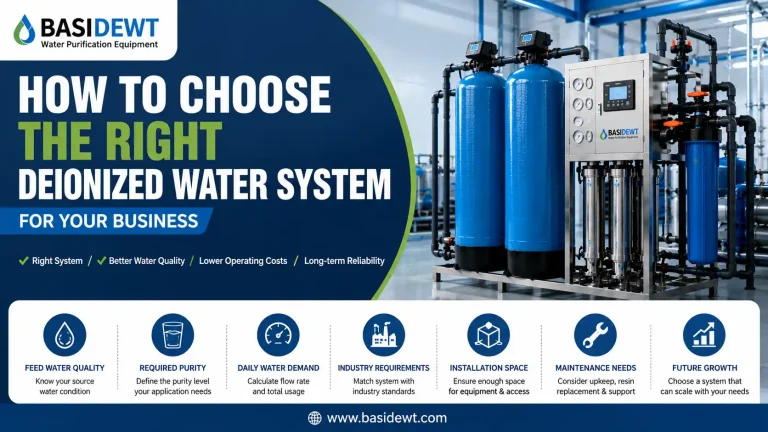
How to Choose the Right Deionized Water System for Your Business
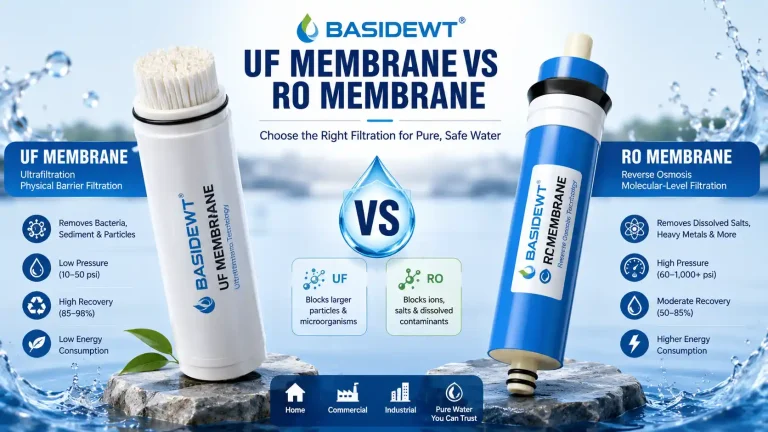
UF Membrane vs RO Membrane: What’s the Difference?
RO Membrane for Well Water: Selection, Performance & Maintenance Guide
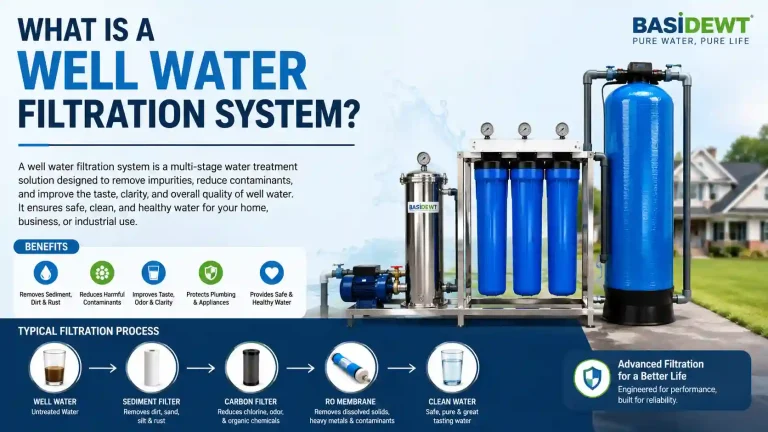
What Is a Well Water Filtration System? Complete Guide for Homeowners
Are Water Filtration Systems Worth It?