BasideWT- Whole Home Water Filtration System & Replacement


UF Membrane for RO Pretreatment: Why and When Is It Used?
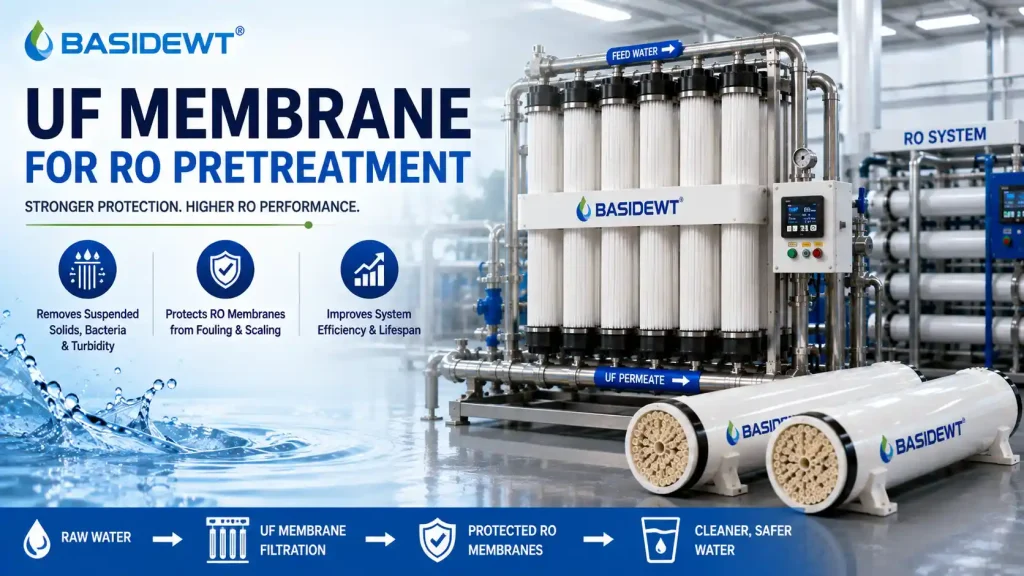
A UF membrane for RO pretreatment is used to physically remove suspended solids, colloids, turbidity, and microorganisms from feed water before it reaches a reverse osmosis system. This protects RO membranes from particulate fouling, stabilizes feed-water quality, and reduces the burden on downstream filtration. UF does not remove dissolved salts, so RO is still required to reduce total dissolved solids.
That single relationship — UF handling particles, RO handling dissolved ions — is the core of how these two membrane technologies work together. The rest of this guide explains why RO needs pretreatment in the first place, what ultrafiltration actually does before water reaches the RO stage, when UF is the right choice, and when it isn’t enough on its own.
Why RO Systems Need Pretreatment at All
Reverse osmosis membranes are built with extremely tight pores designed to reject dissolved salts and minerals. That tightness is exactly what makes them vulnerable.
RO membranes have narrow feed channels called spacers, which sit between the membrane sheets in a spiral-wound element. If raw water arrives loaded with dirt, silt, algae fragments, or bacteria, those particles settle into the spacers and onto the membrane surface. Over time, this buildup restricts flow, raises feed pressure, and lowers salt rejection.
Pretreatment exists to prevent that from happening. Its job is to condition the feed water so it meets the quality range an RO membrane manufacturer specifies, particularly for turbidity and the Silt Density Index (SDI), a common laboratory indicator of an RO feed’s fouling potential.
Without adequate pretreatment, RO systems tend to show:
- Rising feed pressure to maintain the same permeate flow
- Falling normalized permeate flow over weeks or months
- Increased frequency of chemical cleaning-in-place (CIP)
- Shortened membrane service life
- Uneven salt rejection as fouling layers develop unevenly across elements
The severity of these problems depends heavily on the source water. A well-managed municipal supply behaves very differently from a turbid river intake or a biologically active surface water source.
What UF Does Before Water Reaches RO
Ultrafiltration is a low-pressure membrane process that acts as a physical barrier. Feed water passes through hollow-fiber membranes with pores generally in the 0.01 to 0.1 micron range, small enough to block particles, colloids, bacteria, and most protozoa and viruses, while allowing water and dissolved ions to pass through.
Placed ahead of RO, a UF membrane pretreatment step typically produces:
- Consistently low turbidity, often well under 1 NTU
- Low and stable SDI values, commonly meeting the SDI15 under 5 range many RO manufacturers request
- Reduced suspended solids loading
- A meaningful reduction in microbial and particulate content reaching the RO feed
This is the essence of UF pretreatment for RO: it produces a cleaner, more predictable feed stream so the RO stage can focus on what it does best — rejecting dissolved salts and minerals — instead of also having to cope with particulate fouling.
The Basic Treatment Sequence
A typical UF-RO treatment train looks like this:
Raw water → coarse screening/strainers → UF membrane → RO membrane → post-treatment
This is a general pattern, not a fixed rule. Actual treatment trains vary depending on source-water characteristics, required capacity, and site-specific constraints. A high-organic surface water may need coagulation or oxidation ahead of UF. A well water source with low turbidity but high hardness may route UF concentrate differently or add antiscalant dosing before RO. The sequence should always be engineered around actual feed-water data, not assumed by default.
How Suspended Solids, Turbidity, and Microorganisms Affect RO
Different contaminant types stress RO membranes in different ways, and understanding those mechanisms helps explain why UF is such a common pretreatment choice.
Suspended solids and turbidity create a physical cake layer on the RO membrane surface. This layer raises the pressure needed to maintain flow and can trap other foulants within it, compounding the problem.
Colloidal material, often too fine to settle out naturally, tends to concentrate at the membrane surface as water permeates through, a phenomenon called concentration polarization. Colloids are notoriously difficult for conventional filtration to catch consistently, which is one reason membrane-based pretreatment has gained ground.
Microorganisms and biological growth can attach to the membrane surface and multiply, forming biofilms. Biofouling is often progressive and can be difficult to fully reverse with standard cleaning once established.
Organic matter, including natural organic matter from surface waters, can adsorb onto the RO membrane and contribute to organic fouling, sometimes in combination with the biological and colloidal fouling mechanisms above. A peer-reviewed study on RO organic fouling from treated wastewater effluent found that pretreatment method changed the composition of organic matter reaching the membrane, but did not eliminate organic fouling risk entirely, which is why organic loading should be assessed on a case-by-case basis rather than assumed.
A UF filter membrane addresses the first three mechanisms directly through physical size exclusion. It does not remove dissolved organic compounds particularly well, since many of those molecules are smaller than UF’s pore size.
What UF Cannot Remove — and Why RO Is Still Necessary
This is the point where some buyers misunderstand what UF pretreatment achieves. UF is a barrier against particles, not dissolved substances.
UF membranes generally cannot remove:
- Dissolved salts and total dissolved solids (TDS)
- Most dissolved minerals, such as calcium and magnesium ions
- Many dissolved metals
- Dissolved organic and inorganic chemicals at the molecular level
- Hardness-causing ions
These substances pass through UF membrane pores because they exist as individual ions or small dissolved molecules. They are much smaller than the UF membrane’s rejection range. Reducing TDS, softening water, or achieving desalination requires RO or another dissolved-solids treatment process. RO uses a dense, semi-permeable membrane to reject dissolved ions through a different separation mechanism.
This is why UF and RO are complementary rather than interchangeable. UF protects the RO membrane and stabilizes feed quality. RO performs the dissolved-solids reduction that UF physically cannot achieve. Neither one replaces the other in a system designed to produce low-TDS water.
UF vs. Conventional RO Pretreatment Methods
Multimedia filtration, sand filtration, cartridge filtration, and chemical clarification have been used as RO pretreatment for decades, and they remain valid options depending on the application. Comparing them to UF helps clarify when a membrane-based approach makes sense.
| Pretreatment Method | Typical Turbidity/SDI Control | Chemical Use | Footprint | Notes |
|---|---|---|---|---|
| Multimedia/sand filtration | Moderate; variable with feed changes | Often needs coagulant dosing | Larger, gravity or pressure vessels | Long track record; performance can drift with sudden feed changes |
| Cartridge filtration | Fine polishing only, not a standalone barrier | Minimal | Small | Usually a final safeguard, not a primary barrier |
| Chemical clarification | Good for high-turbidity or high-organic sources | Requires coagulants/flocculants, sludge handling | Larger, needs settling/clarifier | Effective for very difficult feeds, adds chemical and sludge management |
| UF membrane | Consistently low turbidity and SDI | Little to no ongoing chemical dosing for particulate removal | Compact, modular | Strong, stable physical barrier; requires periodic backwash and cleaning |
Research comparing coagulation-integrated sand filtration with coagulation-integrated ultrafiltration for seawater RO pretreatment found that both techniques were effective at eliminating particulate and microbial contaminants, consistently maintaining water turbidity below 0.1 NTU and SDI under 2, though dissolved organic matter removal remained limited for both approaches. This illustrates a useful point: UF often matches or exceeds conventional methods for particulate control, but neither UF nor conventional pretreatment alone fully solves organic fouling risk in every water source.
UF’s main practical advantages are a smaller footprint, more consistent output quality regardless of minor feed fluctuations, and reduced dependence on coagulant dosing for particulate removal. Its main trade-offs are higher upfront capital cost in some configurations and the need for periodic backwashing and membrane cleaning, topics covered in more detail in a dedicated UF membrane cleaning and backwashing guide.
How UF Pretreatment Affects RO Membrane Performance
The practical case for UF pretreatment rests on a few operational benefits, each of which depends on system design and feed-water conditions rather than being automatic.
Reduced particulate loading on the RO membrane surface can lower the rate of physical fouling, which in turn can help maintain more stable feed pressure over time.
More consistent feed-water quality matters because RO systems are sensitive to fluctuations. A feed source that spikes in turbidity after rainfall or seasonal changes puts uneven stress on RO membranes. UF tends to smooth out these variations because it filters to a defined pore size regardless of moderate feed swings.
Lower fouling risk under suitable operating conditions can reduce how often RO membranes need chemical cleaning. Field research evaluating UF-based pretreatment against conventional media filtration for scaling-prone feed water found that the pretreatment configuration including UF yielded turbidity of approximately 0.1 NTU, compared with roughly 0.5 NTU for sand filtration and hydrocyclone treatment alone, with both approaches still landing within the turbidity range generally recommended for RO desalination feed.
None of this means UF pretreatment guarantees a specific increase in RO membrane lifespan or a fixed percentage reduction in fouling. Actual outcomes depend on the source water’s specific fouling potential, the UF system’s design and maintenance, RO operating parameters such as flux and recovery, and how consistently the system is cleaned and monitored.
When UF Is a Suitable Pretreatment Choice
UF pretreatment tends to be a strong fit in these scenarios:
High-turbidity surface water sources. Rivers, lakes, and reservoirs often carry variable levels of silt, algae, and organic debris. UF’s consistent physical barrier handles these fluctuations more predictably than filtration methods that rely on media bed condition.
Commercial systems needing stable feed quality. In commercial water treatment, unplanned downtime for RO cleaning or troubleshooting is costly. A stable, low-SDI feed from UF reduces the chance of unexpected fouling events disrupting production schedules.
Municipal water with seasonal variability. Municipal supplies can shift in quality due to source changes, weather events, or upstream treatment adjustments. UF’s fixed pore size provides a consistent particulate barrier regardless of these shifts.
Industrial applications where pretreatment design directly affects RO fouling economics. In processes where RO uptime and membrane replacement costs are significant line items, a properly sized UF pretreatment stage can be justified by the operational stability it provides, even though the specific financial return depends on the facility’s own fouling history and maintenance costs.
Well water with elevated iron, manganese, or particulate content, once any necessary oxidation or filtration for dissolved iron/manganese has been addressed. UF can then serve as a consistent barrier for the resulting particulates before RO. Site-specific well water characteristics vary widely, which is discussed further in a guide focused on UF membrane use for well water.
When UF Alone May Not Be Sufficient
UF is not a universal answer to every RO pretreatment challenge. It may need to be paired with additional treatment steps, or reconsidered, in these situations:
High dissolved organic matter (DOM) loads. As shown by comparative pretreatment studies, UF’s removal of dissolved organics is often limited, particularly for low-molecular-weight, hydrophilic fractions. Waters with significant DOM may need coagulation, adsorption, or oxidation ahead of UF to protect both the UF and RO stages.
Significant scaling potential from hardness or silica. Since UF does not remove dissolved minerals, feed water with high hardness or silica still requires antiscalant dosing, softening, or other scale-control measures ahead of or alongside RO, regardless of UF pretreatment.
Severe or recurring biofouling risk. In waters with high microbial loads or nutrient content that supports regrowth, disinfection strategies or additional biological control may be necessary in combination with UF, since biofilm can still develop on downstream RO surfaces from the fraction of organisms and organic nutrients that pass through.
Feed water requiring desalination-level TDS reduction, such as brackish or seawater sources. UF is commonly used ahead of RO in these applications specifically because RO is still the stage that performs the actual salt rejection; UF’s role is strictly to protect that RO stage, not to substitute for it.
In each case, the honest answer is that UF reduces one category of fouling risk (particulate and much of the microbial load) while other fouling mechanisms, such as scaling and dissolved organic fouling, require their own dedicated countermeasures.
Selecting and Sizing a UF Pretreatment System for RO
Specifying UF as RO pretreatment is a system-design exercise, not a one-size-fits-all product choice. Engineers and buyers typically need to evaluate:
- Feed-water analysis, including turbidity, SDI, suspended solids, total organic carbon, and microbial indicators, ideally gathered across seasonal variation rather than a single sample
- Required RO capacity, since UF membrane area and flux need to be sized to reliably supply the RO system’s feed flow, including margin for backwash cycles
- Recovery rate, because UF systems consume some feed water for backwashing, which affects overall water balance calculations
- Backwash and chemical cleaning frequency, which depends on fouling tendency of the specific source water
- Operating pressure and flow, matched to the UF membrane’s rated operating pressure and flow range for the specific hollow-fiber product selected
- Membrane material and configuration, since hollow-fiber UF is the most common configuration for RO pretreatment applications, with material choice affecting chemical tolerance and mechanical robustness
- Operating temperature, as UF permeability and RO membrane performance both shift with feed-water temperature
- Space and footprint constraints, particularly relevant for commercial and industrial retrofits
- Total cost of ownership, covering membrane replacement intervals, cleaning chemical usage, and energy consumption, not just upfront capital cost
Feed-water testing should always come first. Assuming a generic UF specification without characterizing the actual source water is one of the most common design mistakes in RO pretreatment projects.
For teams comparing full system options, a commercial RO system paired with properly sized UF pretreatment is a common configuration for facilities needing consistent, higher-volume treated water output.
Practical Examples
Example 1: A river-fed commercial facility. A facility drawing from a river with seasonal turbidity spikes after rain events installs UF ahead of its RO system. The UF stage absorbs the turbidity variability, delivering consistently low-SDI water to RO regardless of short-term source fluctuations, reducing the risk of sudden fouling events during storm season.
Example 2: A municipal water reuse application. A facility treating municipal secondary effluent for reuse uses UF to remove residual suspended solids and much of the microbial load before RO. Because the source still carries meaningful dissolved organic content, the design also includes upstream measures to manage organic fouling risk, since UF alone would not fully address that mechanism.
Example 3: An industrial process water system. An industrial plant with tight uptime requirements for its RO system adopts UF pretreatment specifically to reduce the frequency of unplanned CIP events. The decision is based on the plant’s own fouling history with its previous multimedia filtration setup, not a general assumption that UF automatically fixes fouling.
Example 4: A brackish well water source. A facility with brackish well water and moderate particulate content uses UF mainly to protect RO from occasional sediment intrusion. Because the water’s real challenge is dissolved salinity, RO — not UF — remains the primary treatment stage doing the heavy lifting on TDS reduction.
These are illustrative scenarios meant to show how the decision process works, not case studies of specific installations.
UF and RO: A Complementary Relationship, Not a Substitution
The clearest way to frame the relationship is this: UF is a particulate and microbial gatekeeper, while RO is a dissolved-solids barrier. Each stage is solving a different separation problem, defined by particle size and by molecular versus ionic filtration mechanisms.
When properly matched to feed-water characteristics, UF membrane pretreatment can meaningfully reduce the physical and biological fouling burden an RO system faces, which supports more predictable operation and can reduce cleaning frequency. But UF pretreatment is only one part of a properly engineered treatment train. Scaling control, organic fouling management, and RO system design all still need to be addressed on their own terms based on the specific feed water.
Conclusion
A UF membrane is used for RO pretreatment because it provides a consistent, low-chemical physical barrier. It removes suspended solids, colloids, turbidity, and microorganisms. This protects the RO stage from particulate and biological fouling, which can reduce its performance. UF works through size exclusion. It does not remove dissolved salts. Therefore, RO remains essential when desalination or TDS reduction is required.
Whether UF is the right pretreatment choice depends on the feed-water data. Turbidity, SDI, organic content, and microbial load all play an important role. These factors determine whether UF alone is sufficient or needs to be paired with coagulation, oxidation, or scale-control measures. Proper system design, sizing, and testing also affect UF performance. The actual benefits can vary depending on site conditions.
If you’re evaluating pretreatment options for an RO project, testing your specific feed water is the right starting point before specifying any equipment. BasideWT’s team can help you review your feed-water profile and match it against suitable UF filter membrane and RO system configurations for your application.
RELATED POSTS
How to Choose the Right Water Softener System: A Complete Buying Guide
How To Remove Salinity From Water
What Is a Whole Home Water Filtration System?
What is the Difference Between Tap & Brackish Water Membranes?
Water Filter Housing for RO Systems: Types, Applications & Selection Guide