BasideWT- Whole Home Water Filtration System & Replacement


UF Membrane for Drinking Water: Benefits, Limitations & Applications
A UF membrane for drinking water removes suspended solids, turbidity, bacteria, and many protozoa through physical size exclusion. It does this without chemicals and at relatively low pressure. However, it does not reliably remove dissolved salts, most dissolved chemicals, or many viruses on its own. Whether it is suitable for your drinking water depends on your source water, the membrane’s specifications, and the rest of your treatment system.
This article explains where ultrafiltration fits in a real drinking-water setup, what it can and cannot do, and how to evaluate a UF membrane before you buy one.
Where UF Fits in a Drinking-Water Treatment Train
Ultrafiltration is a physical barrier. Water passes through thousands of hollow fibers with microscopic pores. Particles larger than the pore size stay behind; water and smaller dissolved substances pass through.
This makes UF a clarification and pathogen-reduction step, not a full purification system by itself. For a deeper explanation of the mechanism, see how a UF membrane works step by step.
In practice, UF for drinking water usually sits in one of three positions:
- As a stand-alone polishing step after basic pretreatment, for water that already has low dissolved-contaminant concerns.
- As a pretreatment stage ahead of reverse osmosis, protecting the RO membrane from fouling.
- As part of a multi-barrier system, working alongside UV disinfection or activated carbon.
Understanding which role your system needs is the first decision point. A complete UF filter membrane guide covers membrane types and configurations in more depth if you need that background first.
What UF Membranes Can Remove From Drinking Water
UF membranes typically have pore sizes around 0.01 to 0.1 micron. At this size, they physically block:
- Suspended solids and sediment
- Turbidity-causing particles
- Colloidal material
- Most bacteria
- Many protozoa, such as Giardia and Cryptosporidium cysts
- Some larger organic macromolecules and microplastic particles
Removal performance depends on the actual pore size, membrane material, module design, and how well the system is operated. A membrane rated for a certain pore size will not perform to that rating if it is damaged, poorly sealed, or fouled. Validated performance data from the manufacturer, not marketing claims alone, should guide any removal expectation.
Because removal here is mechanical rather than chemical, UF does not lose effectiveness the way carbon adsorption can. As long as the fiber integrity is intact, particle rejection stays consistent across a wide range of feed conditions.
What UF Membranes Generally Cannot Remove
This is the part many buyers overlook. UF is not a dissolved-contaminant treatment.
UF membranes generally do not reliably remove:
- Dissolved salts and total dissolved solids (TDS)
- Hardness minerals (calcium and magnesium)
- Most dissolved heavy metals
- Many dissolved organic chemicals
- Nitrates, fluoride, and similar dissolved ions
- Viruses, in many cases, because viruses can be smaller than standard UF pore sizes
Virus removal is the most misunderstood point. Some tighter UF membranes, particularly low molecular-weight cut-off variants, can achieve meaningful virus reduction. However, this depends entirely on the specific membrane’s pore size, its molecular weight cut-off, and validated test results for that exact product. A general UF membrane should never be assumed to remove viruses unless the manufacturer has documented that performance for the specific model installed.
If dissolved contaminants are a concern in your water, UF alone will not solve that problem. A membrane’s job is filtration by size, not by chemistry.
Particulate vs Dissolved Contaminants: Why the Difference Matters
This distinction drives almost every decision about UF suitability.
Particulate contaminants are physical particles suspended in water. They have a size and a shape. UF removes them because they are too large to pass through the membrane pores.
Dissolved contaminants are dissolved at the molecular or ionic level. They are not particles UF can trap. Removing them requires a different mechanism, such as reverse osmosis, ion exchange, or activated carbon adsorption.
A water source with high turbidity but low dissolved mineral content is a strong candidate for UF alone. A water source with clear appearance but high TDS or dissolved contamination needs a different primary treatment method, even though it may still benefit from UF as a pretreatment or polishing stage.
Why Water Testing Comes Before Membrane Selection
Choosing a UF membrane for drinking water without first testing the source water is one of the most common mistakes buyers make.
A water test should establish:
- Turbidity levels
- Microbial indicators, such as total coliform
- TDS and hardness
- Presence of iron, manganese, or other fouling-prone minerals
- Any known chemical contamination in the area
This information determines whether UF alone is appropriate, whether pretreatment is required first, or whether a different technology should lead the system. Skipping this step often leads to premature fouling, disappointing water quality, or a system that technically works but does not solve the actual problem.
Applicable local drinking-water quality requirements should also be checked, since acceptable contaminant levels and testing obligations vary by location and by whether the water source is public or private.
How UF Compares With Other Treatment Methods
UF is one tool among several. It is useful to understand, at a conceptual level, how it relates to the others.
| Method | Primary function | What it addresses | What it does not address |
|---|---|---|---|
| UF | Physical size-exclusion filtration | Particles, turbidity, most bacteria, many protozoa | Most dissolved salts, many dissolved chemicals |
| RO | Semi-permeable dissolved-solid rejection | Dissolved salts, most dissolved contaminants, most viruses | Nothing significant when properly maintained, though pretreatment is required |
| UV | Disinfection by radiation | Inactivates bacteria, viruses, and protozoa in clear water | Particles, turbidity, dissolved contaminants |
| Activated carbon | Adsorption | Chlorine, taste, odor, some organic compounds | Particles, dissolved salts, microorganisms |
| Sediment filtration | Coarse physical filtration | Larger sediment and debris | Fine particles, dissolved contaminants, microorganisms |
A more detailed comparison is available in UF membrane versus RO membrane, which explains the mechanism differences in depth.
UF does not normally perform the same job as RO. RO uses a much tighter, non-porous barrier to reject dissolved ions, while UF relies on pore size to exclude particles. As a result, RO is generally the appropriate choice when TDS, hardness, or dissolved chemical contamination is the primary concern.
UV and UF also work differently, and the two often complement each other. UV needs relatively clear water with low turbidity to disinfect effectively, since particles can shield microorganisms from UV light. UF can supply that clarity by removing particles first, after which UV adds a disinfection step for organisms that pass through the membrane pores or that the membrane was not rated to remove.
Activated carbon plays a different role again. It addresses taste, odor, chlorine, and certain organic compounds through adsorption rather than filtration. Carbon does not remove particles or microorganisms in a meaningful way, and it is commonly paired with UF rather than used as a replacement for it.
Not every drinking-water system needs all of these stages. The right combination depends on what the source-water test actually shows.
Applications: Where UF for Drinking Water Makes Sense
UF membranes serve drinking-water needs across several settings, each with different demands.
Residential drinking-water systems. Point-of-entry or point-of-use UF systems work well for households with turbid, sediment-heavy, or microbially variable water, particularly from surface sources or shallow wells. If your source is a well, review the considerations in UF membrane for well water, since well-water chemistry can differ significantly from municipal supply.
Commercial and institutional facilities. Offices, schools, and healthcare facilities sometimes use UF for consistent particle and pathogen reduction ahead of point-of-use dispensers, especially where source water quality fluctuates seasonally.
Food and beverage applications. Where product water quality matters for taste, clarity, or shelf life, UF can serve as a consistent clarification step, though additional treatment is typically layered in depending on the specific product requirements.
Pretreatment for reverse osmosis. This is one of UF’s strongest roles. Placing UF ahead of RO protects the finer RO membrane from fouling caused by particles and colloids, extending RO membrane life and maintaining consistent flux.
Surface-water and source-water treatment. Surface water tends to carry more suspended solids and microbial variability than groundwater. UF is frequently used here as a first physical barrier before further treatment.
It is worth separating two related but different ideas: a membrane being technically capable of filtering water, and a complete system being validated as suitable for producing safe drinking water. A membrane element by itself is a component. Drinking-water suitability depends on the full system design, correct sizing, proper sealing, sanitary materials, and ongoing operation and maintenance.
What Matters When Selecting a UF Membrane for Drinking Water
Specifications alone do not tell you whether a membrane will work well in your application. Each factor below needs to be evaluated against your actual water and your actual usage pattern.
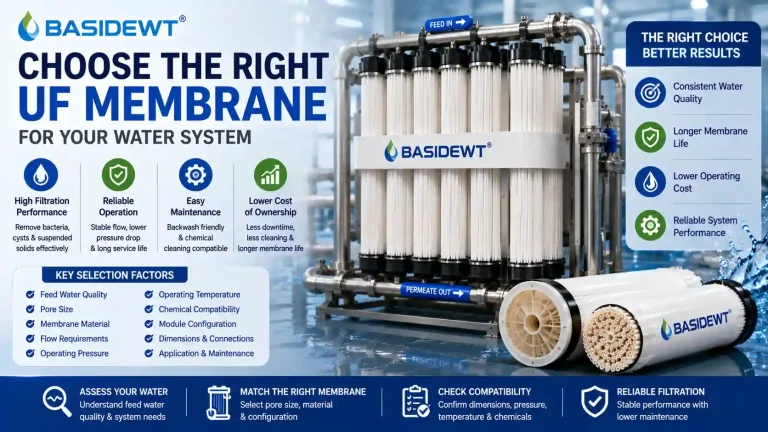
Pore size. A smaller pore size generally means finer removal but can also mean lower flow rate and higher pressure requirements. The right pore size depends on the contaminant profile in your source water. See UF membrane pore size compared for a detailed breakdown.
Membrane material. Material affects chemical resistance, mechanical strength, and cleaning tolerance. This matters most when your water requires frequent backwashing or chemical cleaning.
Membrane area and configuration. More membrane area generally supports higher flow at lower pressure, but it also affects the physical footprint and cost of the system.
Flow rate and operating pressure. These need to match your household or facility’s peak demand, not just average demand. Undersized systems struggle during high-use periods. Reference UF membrane operating pressure and flow rate for how these variables interact.
Feed-water turbidity and quality. Higher turbidity feed water shortens the interval between cleanings and increases fouling risk. This is why the water test matters before you select anything.
Required capacity and recovery. Recovery rate affects water usage efficiency. Systems with low recovery waste more water during backwash cycles.
Backwashing and cleaning requirements. Some membranes need more frequent intervention than others. This affects labor, chemical use, and downtime, especially in commercial settings.
Pretreatment needs. Some source waters need sediment or iron pretreatment before UF to avoid rapid fouling.
System compatibility and replacement availability. A membrane that cannot be replaced easily, or that is not compatible with your existing housing, adds long-term cost and downtime risk.
Total operating cost. Purchase price is only part of the picture. Cleaning chemicals, replacement frequency, energy use, and water lost to backwashing all factor into real cost over time.
For a structured walkthrough of these trade-offs, how to choose the right UF membrane goes into selection criteria in more detail. Ultimately, actual specifications must come from the membrane manufacturer’s technical documentation, not general assumptions about UF as a category.
Practical Decision-Making: Is UF Enough for Your Water?
Use this as a starting framework, not a substitute for a proper water test.
UF may be a good option when:
- Turbidity, sediment, or particle load is the main visible or tested issue
- Bacterial or protozoal contamination is a concern and dissolved-contaminant levels are acceptable
- You need a low-energy, chemical-free filtration step
- You are pretreating for RO or protecting downstream equipment
UF alone may not be enough when:
- TDS, hardness, or dissolved minerals are elevated
- Testing shows dissolved chemical contamination, such as certain heavy metals or industrial compounds
- Virus contamination is a known or suspected risk and the specific membrane’s virus-log-removal has not been validated
- Taste or odor from chlorine or organics is the primary complaint
When RO becomes more appropriate: if your water test shows meaningful dissolved-solid or dissolved-contaminant levels, RO addresses that in a way UF cannot. UF can still serve as pretreatment ahead of the RO stage.
When UV complements UF: if microbial risk is a concern and you want an added disinfection barrier beyond size exclusion, UV after UF is a common combination, since UF supplies the clarity UV disinfection needs to work well.
When pretreatment is necessary: high sediment, iron, or manganese levels in the feed water usually call for pretreatment ahead of UF to protect the membrane and extend time between cleanings.
Independent research on long-term UF operation in full-scale treatment plants has also found that membrane material choice and operating mode measurably affect performance and service life over years of continuous use, which reinforces why documented specifications and real operating data matter more than general assumptions when comparing long-term UF performance data.
What Specifications to Request From a Supplier
Before purchasing, ask for:
- Validated pore size or molecular weight cut-off, with test method referenced
- Rated flow rate at your expected operating pressure
- Recommended feed-water turbidity range
- Backwash and cleaning frequency recommendations
- Membrane material and chemical compatibility
- Warranty terms and expected service conditions
- Replacement element availability and cost
Common Mistakes Buyers Should Avoid
- Buying a UF system based on general UF benefits without testing the actual source water first
- Assuming UF removes viruses without checking documented performance for the specific membrane
- Assuming UF lowers TDS or softens hard water
- Undersizing the system for peak household or facility demand
- Ignoring pretreatment needs for high-turbidity or iron-heavy water
- Choosing a membrane with limited replacement availability, leading to higher long-term cost
Conclusion
A UF membrane for drinking water is an effective physical barrier against suspended solids, turbidity, most bacteria, and many protozoa. It does this efficiently, without chemicals, and at relatively low operating pressure.
Its main limitation is equally important to understand: UF generally does not remove dissolved salts, most dissolved chemicals, or many viruses, since these are not physically stopped by pore size alone. Whether ultrafiltration for drinking water is the right choice, or the right first stage, depends on what your source-water test actually shows, and on choosing a membrane and system that match those results.
Start with a water test, match the treatment method to what that test reveals, and confirm specifications directly from the manufacturer’s documentation rather than general assumptions about UF as a category. If you are weighing a UF membrane for drinking water against other options for your specific source water, BasideWT’s technical resources and product documentation can help you compare specifications and identify the right configuration for your system.
RELATED POSTS
RO Water System vs Distilled Water: Which Is Better for Drinking & Industrial Use?
why is my under sink water filter making noise
Water Filter System: How It Works, Types, Benefits & Buying Guide
What is a Watermaker on a Boat?
How To Make Deionised Water