BasideWT- Whole Home Water Filtration System & Replacement

RO vs DI Water for Car Wash: Which System is Better?
Water spots ruin a perfect car wash every time. They form when tap water evaporates and leaves dissolved minerals on the surface. Calcium, magnesium, and silica dry as white marks on paint, glass, and trim. The only real solution is pure water. Pure water leaves nothing behind when it evaporates.
Two technologies solve this problem: reverse osmosis (RO) and deionized (DI) water systems. Both remove dissolved minerals. Both produce cleaner water than tap. However, they work differently. They also suit different situations and budgets. This guide explains both in full detail. By the end, you will know exactly which system — or combination — is right for your car wash setup.
What Causes Water Spots on Cars?
Tap water is not pure water. It contains dissolved minerals from pipes, reservoirs, and treatment plants. Common dissolved solids include calcium, magnesium, sodium, chloride, and silica. These are invisible in water. However, when water evaporates, the minerals stay behind on the surface.
Hard water causes the worst spotting. Water hardness is measured in grains per gallon (GPG) or total dissolved solids (TDS) in parts per million (ppm). The higher the TDS, the more minerals are present. The more minerals, the worse the water spots.
According to the US Geological Survey, about 85% of homes in the United States have hard water. This means most car wash operations are working with mineral-heavy tap water every single day.
The solution is simple. Remove the dissolved minerals before the water touches the car. Both RO and DI systems do exactly this. However, they use completely different mechanisms.
What Is RO Water for Car Washing?
Reverse osmosis uses pressure to push water through a semi-permeable membrane. This membrane has microscopic pores. Water molecules pass through. Dissolved minerals, heavy metals, and contaminants cannot. They are flushed away as waste water.
RO water typically reaches 10–50 ppm TDS. Standard tap water in most areas reads 200–500 ppm. This is a significant reduction. However, RO water is not completely pure. A small percentage of dissolved solids still pass through the membrane. In areas with very high TDS tap water, RO alone may still leave very faint marks on glass.
RO systems need adequate feed water pressure. The minimum is typically 40 PSI. They also need pre-filtration. A sediment filter removes particles. A carbon block filter removes chlorine. Chlorine destroys RO membranes quickly. Pre-filtration protects the membrane and extends its lifespan significantly. A quality RO system designed for car washing includes all these stages in one unit.
RO water is ideal for:
- Professional car wash businesses with high daily volume
- Mobile detailing units needing a reliable water supply
- Window cleaning operations
- Pre-treatment before a DI polishing stage
What Is DI Water for Car Washing?
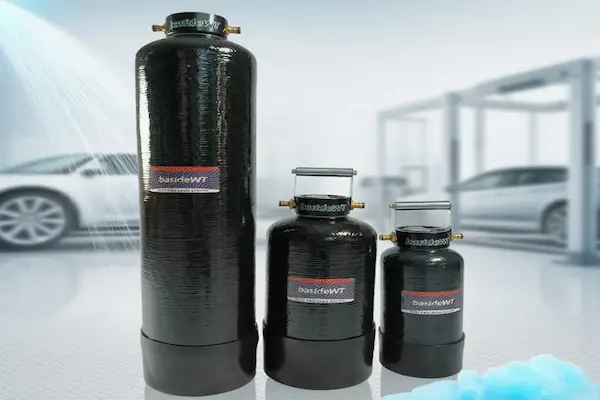
Deionization uses ion exchange resin to remove all dissolved ions from water. The resin contains charged beads. Positively charged ions like calcium and magnesium attach to negatively charged resin beads. Negatively charged ions like chloride and sulfate attach to positively charged beads. The ions released are hydrogen and hydroxide, which combine to form pure water.
DI water reaches 0 ppm TDS. It is completely ion-free. When DI water evaporates from a car’s surface, nothing is left behind. This is why it is the gold standard for spot-free car washing and window cleaning.
However, DI resin exhausts over time. Once all exchange sites are filled with minerals, the resin can no longer purify water. TDS starts rising again. The resin must then be replaced or professionally regenerated. This is the main ongoing cost of a DI-only system.
In areas with high TDS tap water, DI resin can exhaust very quickly. Without RO pre-treatment, a DI tank may last only a few days. This makes DI-only systems expensive for high-volume operations.
DI water is ideal for:
- Final rinse stage after RO pre-treatment
- Spot-free window cleaning at height
- High-end detailing where zero spotting is required
- Small mobile operations with low daily water usage
RO vs DI: Full Head-to-Head Comparison
| Feature | RO Water | DI Water |
|---|---|---|
| TDS Output | 10–50 ppm | 0 ppm |
| Spot-Free Result | Good | Perfect |
| Running Cost | Low | Medium–High |
| Flow Rate | Moderate | High |
| Setup Cost | Moderate | Low–Moderate |
| Maintenance | Pre-filter changes | Resin replacement |
| Portability | Fixed or mobile | Highly portable |
| Best Use | Pre-treatment, bulk washing | Final rinse, window cleaning |
| Electricity Needed | Yes (pump) | No |
The table shows clearly that both systems have strengths. Neither is perfect on its own for all situations. The combined RO+DI approach brings the best of both together.
Which Is Better for Car Washing?
The answer depends entirely on your water quality and daily volume.
RO alone works well when your tap water TDS is under 300 ppm. A well-maintained RO system produces water clean enough for a spot-free rinse in most conditions. It is the most cost-effective option for high-volume car wash businesses. Running costs stay low because there is no resin to replace. A complete spotless water system built around RO technology gives professional results at manageable cost.
DI alone works for small operations or mobile detailers with low daily usage. DI tanks are portable and require no electricity. However, in hard water areas, resin replacement costs add up fast. A DI-only system in a 400 ppm TDS area can become very expensive to run.
RO + DI combined is the professional standard for serious car wash and detailing operations. The RO system removes 90–99% of dissolved solids. This dramatically extends DI resin life. The DI stage then polishes the water to 0 ppm. This two-stage approach gives perfect spot-free water at the lowest long-term running cost.
Therefore, for any professional car wash business, a combined RO+DI system is almost always the correct choice.
How the Combined RO+DI System Works
Feed water enters the RO stage first. The membrane reduces TDS from 400 ppm down to 20–40 ppm. This removes the vast majority of the mineral load. The RO permeate then flows into the DI resin tank. The resin removes the remaining ions. Output water exits at 0 ppm TDS.
This combination has two clear benefits. First, it produces guaranteed spot-free water every time. Second, it protects the DI resin from rapid exhaustion. Without RO pre-treatment, DI resin in a 400 ppm area may last only 2–3 days. With RO pre-treatment reducing TDS to 30 ppm, the same resin can last weeks or months.
The long-term running cost of a combined system is far lower than DI alone. The upfront investment in an RO unit pays for itself quickly through reduced resin consumption.
Spot-Free Car Wash System: What to Look For
When choosing a spot-free car wash system, look for these key features.
Adequate flow rate. A busy car wash needs high flow. Check the system’s GPM (gallons per minute) rating. A single-bay hand wash needs 2–4 GPM. A multi-bay commercial wash needs significantly more.
Built-in pre-filtration. The system should include sediment and carbon pre-filters. These protect the RO membrane from particles and chlorine. Without pre-filtration, the membrane fails prematurely.
TDS monitoring. A quality system includes a built-in TDS display or connection point for a TDS meter. This lets you confirm water quality before it reaches the car.
Durable housing. Car wash environments are wet. The system housing must resist corrosion and physical damage. Stainless steel or high-grade plastic construction is ideal.
Compact design for mobile use. Mobile detailers need a system that fits in a van or trailer. Look for compact, lightweight units with tank storage options.
TDS Guide: What Level Is Safe for Car Washing?
Always test your output water TDS before washing. Use a TDS meter for a quick reading.
| TDS Level | Result | Action Needed |
|---|---|---|
| 0 ppm | Perfect | None |
| 1–10 ppm | Excellent | None |
| 11–30 ppm | Good | Acceptable for most surfaces |
| 31–50 ppm | Marginal | May spot on glass |
| 50+ ppm | Poor | Replace resin or check RO membrane |
Test output TDS before every use. A rising reading after the DI stage means exhausted resin. A rising reading after the RO stage means the membrane or pre-filters need attention. A TDS meter for water testing costs very little and prevents costly mistakes.
Maintenance Schedule for Car Wash Water Systems
Both systems need regular maintenance. Skipping maintenance causes TDS to rise. Rising TDS means water spots return.
RO system maintenance:
- Sediment pre-filter: Replace every 3–6 months
- Carbon block pre-filter: Replace every 6–12 months
- RO membrane: Replace every 2–3 years
- Check output TDS monthly
DI system maintenance:
- Check TDS before each use
- Replace resin when output exceeds 10 ppm
- Flush tank after long non-use periods
- Store spare resin for fast replacement
Combined RO+DI maintenance:
- Follow all RO steps above
- DI resin lasts much longer with RO pre-treatment
- Keep spare resin cartridges on hand
The full car wash system on our site includes guidance on maintenance schedules for each component. Staying on top of maintenance is the single most important factor in consistent spot-free results.
Common Mistakes to Avoid
Using DI resin without RO pre-treatment. In high-TDS areas, this exhausts resin in days. Always use RO first to reduce the mineral load.
Not checking TDS regularly. Exhausted resin and failing membranes both cause spotting. A 30-second TDS check before each use prevents problems.
Ignoring pre-filter replacement. A spent carbon filter passes chlorine directly to the RO membrane. This causes irreversible membrane damage within weeks. Replace pre-filters on time.
Using tap water for final rinse. Even one rinse with tap water undoes everything. Always use treated water for the final rinse.
Buying undersized systems. A system rated for 2 GPM cannot keep up with a 5-bay car wash. Size your system above your peak demand. Check the water filtration system specifications carefully before purchasing.
FAQ’s
Q: Can I use RO water alone for a spot-free car wash?
A: Yes, in most cases. RO water at 10–30 ppm TDS produces spot-free results on paintwork. However, on glass or in very bright light, faint marks may still appear. Adding a DI polishing stage guarantees 0 ppm and eliminates all risk of spotting.
Q: How long does DI resin last?
A: It depends entirely on your feed water TDS. Without RO pre-treatment, resin in a 400 ppm area may last only 2–3 days of moderate use. With RO pre-treatment reducing TDS to 20–30 ppm, the same resin can last several weeks or longer.
Q: Do I need electricity for a DI system?
A: No. DI systems work by gravity or low feed pressure. No pump or electricity is required. This makes them popular with mobile detailers who need portable, off-grid solutions.
Q: What is the minimum water pressure needed for an RO system?
A: Most RO systems require at least 40 PSI of feed water pressure. Below this, flow rate drops and rejection efficiency falls. If your pressure is below 40 PSI, a booster pump is recommended.
Q: How do I know when my DI resin is exhausted?
A: Check output TDS with a TDS meter. When the reading rises above 10 ppm, the resin is approaching exhaustion. Replace it before TDS rises further. Do not wait until spotting appears on cars.
Final Thoughts
RO and DI water both solve the water spotting problem. RO is the cost-effective workhorse for high-volume operations. DI delivers the gold standard of 0 ppm purity. Combined, they give you the best of both — perfect water quality at the lowest long-term running cost.
Start with a tap water TDS test. This tells you how hard your feed water is. Then choose your system based on your daily volume, budget, and quality requirements. For most professional car wash and detailing operations, RO+DI combined is the clear winner.
RELATED POSTS
How Do You Backwash a Pool with a Cartridge Filter?
What Is the Best Home Water Filter?
How To Filter Iron From Well Water
What Is Reverse Osmosis Water Filter System
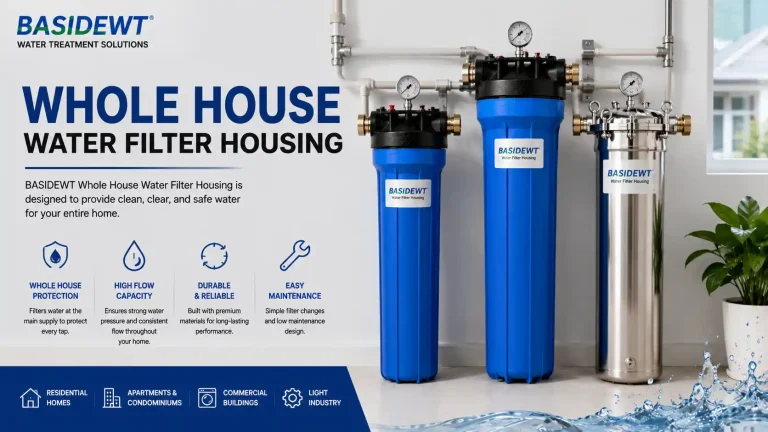
Whole House Water Filter Housing Explained: Benefits, Types & How to Choose