BasideWT- Whole Home Water Filtration System & Replacement

Deionized Water: The Complete Guide to Uses, Benefits, and Systems
Deionized water looks just like tap water, yet it behaves completely differently once it touches a surface. It dries without spots, streaks, or mineral film.
That single property makes deionized water essential across car washing, window cleaning, laboratories, and industrial equipment maintenance. Still, most online guides only explain part of the story.
This complete guide covers everything you need to know about deionized water: what it is, how systems make it, where it’s used, and how it compares to distilled and RO water. You’ll also learn how to test purity, store DI water correctly, and choose, size, and maintain the right system for your needs. Every recommendation here comes from hands-on water treatment experience, not guesswork.
What Is Deionized Water?
Deionization removes nearly all dissolved ions from water, including calcium, magnesium, sodium, and chloride. These ions are what make regular water “hard” or mineral-rich.
Once a system removes them, the water reaches a near-zero TDS reading, often under 1 part per million. Experts call this process deionization, and it relies on ion exchange resin rather than heat or physical filtration.
You’ll often see the result called DI water, ultra pure water, or mineral-free water. All three terms describe the same outcome.
Deionized water isn’t the same as “clean” water in the everyday sense. It’s chemically pure, but it can still carry bacteria or organic matter if the source water wasn’t pre-filtered.
How Is Deionized Water Made? The Ion Exchange Process
Understanding Ion Exchange Resin
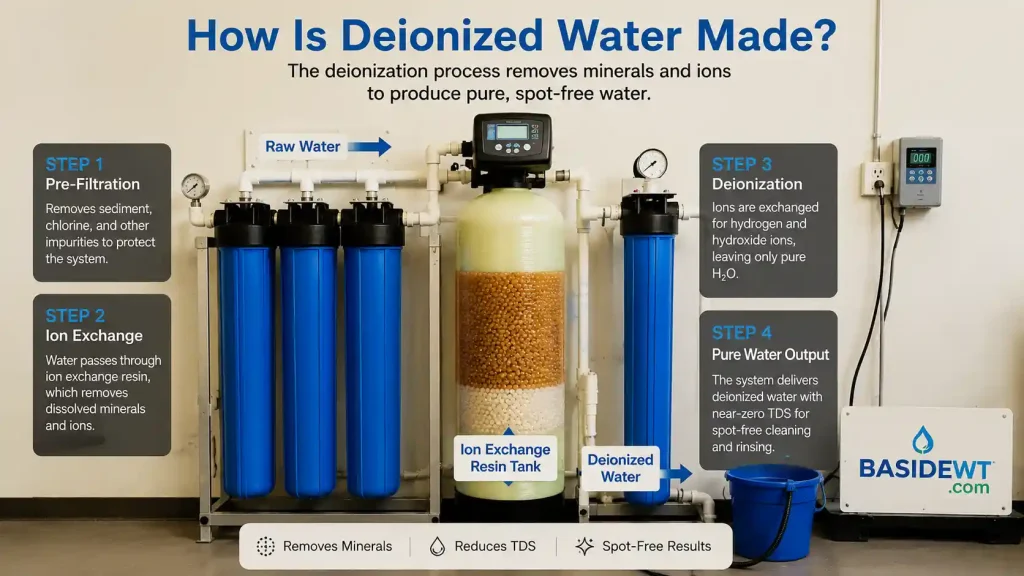
Deionization works through a process called ion exchange. Water passes through a resin tank filled with tiny charged beads.
These beads swap unwanted ions for hydrogen and hydroxide ions instead. The two combine to form pure H2O, leaving no mineral residue behind.
Most systems use mixed bed resin. This combines cation and anion resin in one tank for a single, highly efficient pass.
Step-by-Step: How Deionized Water Systems Work
- Pre-filtration removes sediment and chlorine before deionization begins.
- Water enters the resin tank, where ion exchange resin strips out dissolved minerals.
- A TDS meter monitors output, confirming the water has reached near-zero mineral content.
- Purified water exits through a hose or spot-free rinse attachment, ready to use.
- Resin is replaced or regenerated once it becomes saturated and stops performing effectively.
IMAGE SUGGESTION: Diagram showing water flowing through a resin tank, with labeled ion exchange beads swapping minerals for hydrogen ions. ALT TEXT: How a deionized water system removes minerals through ion exchange resin
If you want a full breakdown of building or maintaining your own setup, our guide on how to make deionized water walks through the process step by step.
Types of Deionized Water Systems
Not every DI system works the same way, and picking the right type matters as much as picking the right size. Four main types cover most home and commercial needs.
| System Type | How It Works | Best For |
|---|---|---|
| Portable cartridge/tank | Single disposable or refillable resin cartridge | Occasional use, car washing, small windows |
| Tank exchange | Empty tank swapped for a pre-filled one on schedule | Businesses avoiding on-site resin handling |
| Twin-tank continuous | Two tanks alternate, so one regenerates while the other works | High-volume, uninterrupted daily use |
| Multi-stage commercial | Combines pre-filtration, RO, and DI in sequence | Industrial, laboratory, or large-scale cleaning |
Portable systems suit homeowners and small detailing operations well. Larger operations, on the other hand, usually need multi-stage systems that pair RO with DI for consistent, high-volume purity.
Deionized Water vs. Distilled Water: A Quick Comparison
Both are considered “pure” water, yet they’re made in completely different ways. Distillation boils water into steam and condenses it back into liquid, which removes minerals but takes more time and energy.
Deionization, by contrast, uses ion exchange resin instead of heat. It removes ionic minerals extremely effectively, though it doesn’t guarantee removal of bacteria or organic compounds the way distillation does.
| Feature | Deionized Water | Distilled Water |
|---|---|---|
| Process | Ion exchange resin | Boiling and condensation |
| Removes minerals | Yes, very effectively | Yes |
| Removes bacteria | Not guaranteed | Yes |
| Energy use | Low | High |
| Best for | Cleaning, industrial use, labs | Drinking, medical use |
For most cleaning and industrial jobs, deionized water is the more practical, cost-effective choice. For a full breakdown of when each option fits best, see our dedicated guide on deionized water vs. distilled water.
Deionized Water vs. Reverse Osmosis (RO) Water
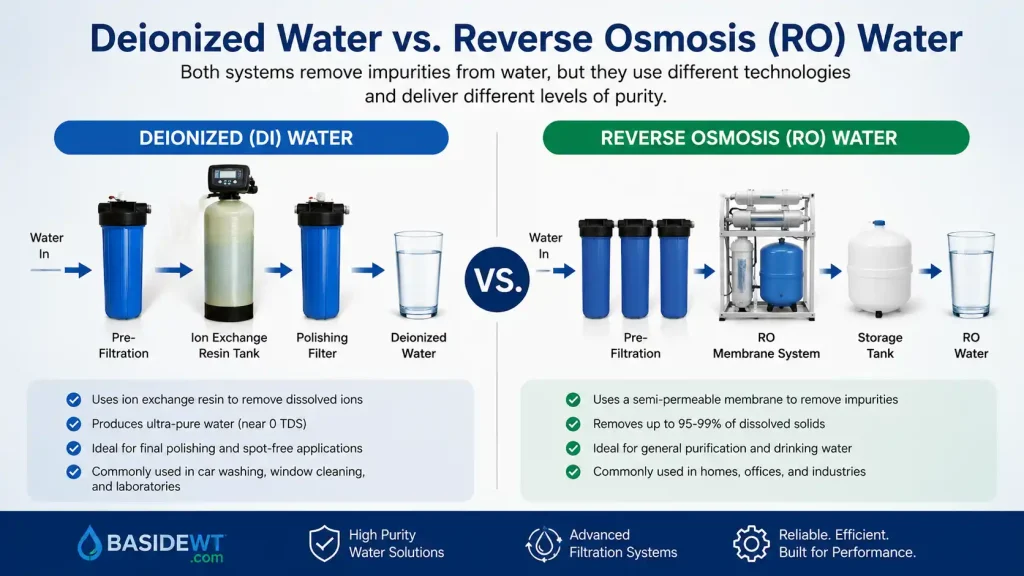
Reverse osmosis is another common purification method, and people often confuse it with deionization. RO pushes water through a semi-permeable membrane under pressure, removing most dissolved solids.
Deionization goes a step further and removes what RO leaves behind. That’s why many commercial setups combine both: RO first to cut mineral load, then DI for a final, near-zero TDS polish.
| Factor | Deionized (DI) Water | RO Water |
|---|---|---|
| Purity level | Extremely high (near 0 TDS) | High, but not zero |
| Method | Ion exchange resin | Membrane filtration |
| Water waste | Minimal | Higher, due to reject water |
| Common combo use | Often follows RO for final polish | Often precedes DI |
If you’re deciding between the two, remember they usually work best together rather than as competing options.
How to Test and Measure Deionized Water Purity
You can’t judge DI water purity by looking at it, so testing matters. A TDS meter, or better, a conductivity meter, gives you an accurate reading in seconds.
True deionized water reads close to 0 parts per million (ppm) on a TDS meter. Readings above that suggest the resin is losing effectiveness and needs attention soon.
Conductivity meters measure in microsiemens per centimeter (µS/cm) and offer more precision than basic TDS meters. Many professional setups use both together for extra confidence.
- Test at the outlet, not the source, to confirm the system is actually working.
- Check readings regularly, especially with heavy daily use.
- Log results over time to spot gradual resin decline before it becomes a problem.
Consistent testing turns guesswork into a simple maintenance routine, and it’s the fastest way to catch a failing resin bed early.
Is Deionized Water Safe to Drink?
Deionized water is technically safe in small amounts, though experts don’t recommend it as a regular drinking source. The deionization process strips beneficial minerals along with unwanted ones, and your body needs some of those minerals from daily water intake.
Deionized water can also taste flat or slightly acidic. That happens because it readily absorbs carbon dioxide from the air, forming trace carbonic acid.
Occasional use won’t cause harm. For daily hydration, mineralized or filtered tap water remains the better everyday choice.
Storing and Handling Deionized Water Properly
Deionized water doesn’t stay perfectly pure once it leaves the system. Because it’s so reactive, it quickly starts absorbing carbon dioxide and trace minerals from the air and its container.
For that reason, most applications use DI water immediately rather than storing it long-term. If storage is necessary, use a sealed, non-reactive container such as glass or high-density plastic.
Avoid storing DI water in metal containers, since it can slowly leach trace metals from reactive surfaces. For short-term storage, keep containers tightly sealed and use the water within a few days for best results.
What Is Deionized Water Used For?
Deionized water shows up in far more places than most people realize. Its zero-residue property makes it valuable anywhere spotting or mineral buildup is a problem.
| Application | Why Deionized Water Is Used |
|---|---|
| Car washing | Leaves a spot-free finish with no water spots |
| Window cleaning | Prevents streaks without manual drying |
| Solar panel cleaning | Avoids mineral film that reduces panel efficiency |
| Laboratory use | Prevents contamination in sensitive experiments |
| Equipment maintenance | Prevents scale buildup in boilers and cooling systems |
| Battery manufacturing | Ensures purity for chemical processes |
| Pharmaceutical production | Meets strict purity requirements |
Each use case relies on the same core property: deionized water leaves nothing behind as it dries or evaporates.
Benefits of Deionized Water
Why Zero-Residue Matters
Regular tap water contains dissolved minerals. When it evaporates, those minerals stay behind as visible spots or film.
Deionized water solves this problem completely. Since there are no dissolved solids left, there’s nothing to leave behind after drying.
Additional Practical Benefits
- No streaking on glass or paint, eliminating manual polishing after cleaning.
- Protects sensitive equipment from scale buildup and corrosion over time.
- Reduces cleaning time, since air-drying replaces manual wiping.
- Improves consistency in laboratory and manufacturing processes.
- Extends equipment lifespan by preventing mineral deposits in pipes and tanks.
These benefits explain why deionized water has moved from a niche industrial tool to a mainstream cleaning solution.
Deionized Water for Car Washing and Window Cleaning
This is one of the fastest-growing uses of deionized water, and for good reason. Mineral-rich rinse water almost always causes those stubborn water spots on a freshly washed car.
Deionized water eliminates that problem at the source. Vehicles can air-dry completely, without a single towel pass, and still finish spot-free.
The same principle applies to windows. Professional window cleaners increasingly use DI water with waterfed poles, skipping the squeegee entirely.
A properly sized deionized water cleaning setup makes this achievable for home and professional use alike. For vehicle-specific needs, a dedicated car wash system built around DI filtration handles higher volumes without spotting between vehicles.
Our detailed guide on DI water for car washing covers system sizing and setup specifics if you’re comparing options for regular vehicle cleaning.
How to Choose the Right Deionized Water System
Key Factors to Consider
Choosing a deionized water system isn’t just about picking the biggest tank available. The right size depends on your specific water use.
- Source water hardness determines how quickly resin becomes saturated and needs replacement.
- Daily water volume affects tank size and flow rate requirements.
- Application type (car washing, windows, lab use) determines filtration stages needed.
- Portability needs matter for mobile detailing or window cleaning businesses.
- Resin regeneration vs. replacement affects long-term running costs.
Buying Checklist
- Test your source water’s TDS and hardness level first.
- Calculate your daily or weekly water usage.
- Confirm whether pre-filtration is included or needed separately.
- Check resin tank capacity against your usage volume.
- Compare replacement resin costs across systems.
- Confirm flow rate matches your equipment, such as pressure washers or waterfed poles.
For side-by-side options across use cases, browsing the full spotless water system lineup makes it easier to match a configuration to your actual water testing results.
Deionized Water System Cost and Maintenance
| Cost Item | Typical Range |
|---|---|
| Portable DI tank (small scale) | $150–$500 |
| Mixed bed resin refill | $80–$250 |
| Commercial DI system | $800–$3,000+ |
| TDS meter | $10–$40 |
| Resin replacement frequency | Every 500–3,000 gallons, depending on source water |
Maintenance mostly comes down to monitoring TDS output. Once readings climb above zero, it’s time to replace or regenerate the resin.
Harder source water saturates resin faster. Pre-filtering with RO first can significantly extend resin life and lower long-term costs.
Common Mistakes to Avoid With Deionized Water Systems
- Ignoring TDS readings until spotting reappears, rather than monitoring proactively.
- Skipping pre-filtration, which shortens resin life dramatically on hard water sources.
- Undersizing the system for actual daily water volume needs.
- Assuming DI water is drinkable as a daily source without understanding mineral loss.
- Mixing exhausted resin with fresh resin, reducing overall system efficiency.
Avoiding these mistakes keeps both water quality and running costs predictable over time.
Expert Tips for Getting the Most From Deionized Water
Test your source water before buying any system. Hardness and existing TDS levels determine which setup actually makes sense.
Combine RO and DI stages if your water is very hard. This protects resin life and reduces how often you need replacements.
Always keep a TDS meter on hand. It’s the simplest way to know exactly when resin needs attention, rather than guessing.
NSF International recommends selecting water treatment systems based on tested water quality data, not assumptions about source purity. Testing first prevents costly oversizing or undersizing later.
Conclusion
Deionized water offers a level of purity that regular tap water simply can’t match, and now you have the complete picture of how it works. It removes dissolved minerals almost completely, leaving no spots, streaks, or residue behind.
Whether you’re washing cars, cleaning windows, or maintaining sensitive lab equipment, understanding the process helps you choose, test, and maintain the right system. Test your water first, size your system correctly, and ongoing maintenance becomes simple from there.
If you’re ready to explore options built around real usage data, BasideWT’s deionized water systems are designed around exactly these principles.
Frequently Asked Questions
What is deionized water?
Deionized water is water that has had nearly all dissolved minerals removed through ion exchange resin.
Is deionized water the same as distilled water?
No. Deionized water uses ion exchange, while distilled water uses boiling and condensation.
Can you drink deionized water?
Yes, in small amounts, but it isn’t recommended as a regular drinking source due to mineral loss.
What is deionized water used for?
It’s used for car washing, window cleaning, laboratory work, and equipment maintenance where spotting must be avoided.
How is deionized water made?
Water passes through resin tanks that swap dissolved minerals for hydrogen and hydroxide ions.
Is deionized water better than reverse osmosis water?
Deionized water is purer, but many systems combine both for the best results and longer resin life.
How much does a deionized water system cost?
Portable systems start around $150, while commercial setups can range from $800 to $3,000 or more.
How often do you need to replace DI resin?
Typically every 500 to 3,000 gallons, depending on how hard your source water is.
Does deionized water leave water spots?
No. Since it contains no dissolved minerals, it air-dries completely spot-free.
What’s the difference between deionized water and purified water?
Purified water is a broader term covering any treated water, while deionized water specifically refers to ion-exchange-treated water.
What TDS reading counts as truly deionized water?
A reading close to 0 parts per million indicates true deionized water. Readings above that suggest declining resin performance.
How long can you store deionized water?
Only a few days in a sealed, non-reactive container. It quickly absorbs carbon dioxide and loses purity once exposed to air.
What type of DI system is best for home use?
A portable cartridge or tank system suits most homeowners, offering enough capacity for car washing and window cleaning without commercial-scale cost.
RELATED POSTS

Water Filter Housing Buying Guide: How to Choose the Best Housing for Your Needs
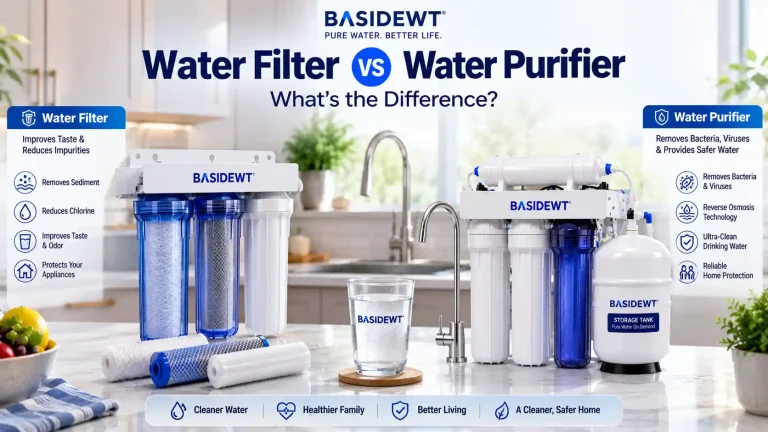
Water Filter vs Water Purifier: What’s the Difference?
Common Water Filter Housing Problems: Causes, Solutions & Prevention
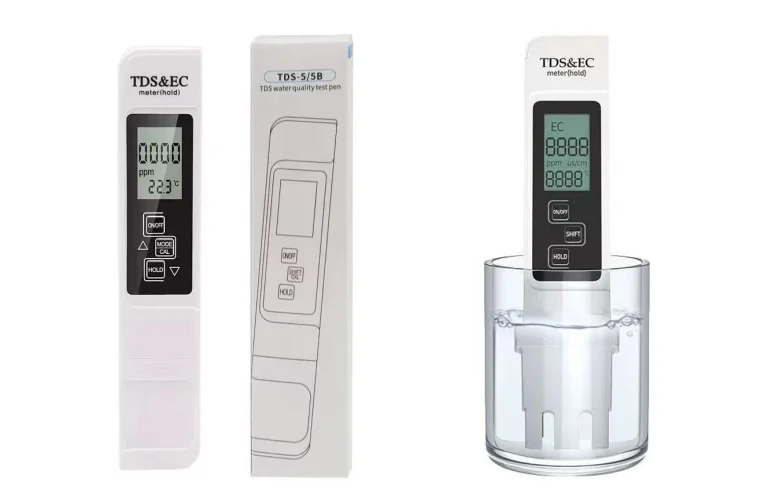
How To Use TDS Tester
How Much To Install Water Filter Under Sink?