BasideWT- Whole Home Water Filtration System & Replacement


How to Wash a Car Properly: The Complete Step-by-Step Guide
Most people think how to wash a car is simple—soap, water, sponge, done. But if you’ve ever stepped back after a wash and noticed swirl marks catching the sunlight or stubborn water spots that refuse to disappear, you already know it’s not that simple. The tools you use, the products you choose, and the order of each step all play a major role in protecting your car’s paint.
This complete guide explains how to wash a car properly, from the first rinse to the final dry, while avoiding the common mistakes that quietly damage your vehicle over time. You’ll learn the best washing techniques, how often you should wash your car, whether dish soap is safe, how touchless car washes compare with hand washing, and why deionized water is the secret to achieving a spotless, professional-looking finish.
Quick Answer
To wash a car correctly, pre-rinse to remove loose dirt, wash top to bottom with the two-bucket method and pH-balanced soap, rinse thoroughly, then dry immediately with a microfiber towel or a spot-free rinse system. Wash every 2–3 weeks under normal conditions, or weekly in harsh environments.
Table of Contents
- Why How You Wash Your Car Actually Matters
- How Often Should You Wash Your Car?
- Step-by-Step: How to Wash a Car the Right Way
- Hand Wash vs. Touchless Car Wash: Which Is Better?
- How to Wash a Car at the Carwash (Self-Service Guide)
- Choosing the Right Car Wash Soap
- Can You Use Dish Soap to Wash Your Car? Myths vs. Facts
- The Secret to a Spot-Free Rinse: Deionized Water
- DI Water vs. RO Water for Car Washing: Which Should You Choose?
- Home Car Wash Systems: Are They Worth It?
- Drying Techniques That Prevent Scratches and Water Spots
- Common Mistakes, Expert Tips, and Seasonal Maintenance
- Conclusion
- Frequently Asked Questions
Why How You Wash Your Car Actually Matters
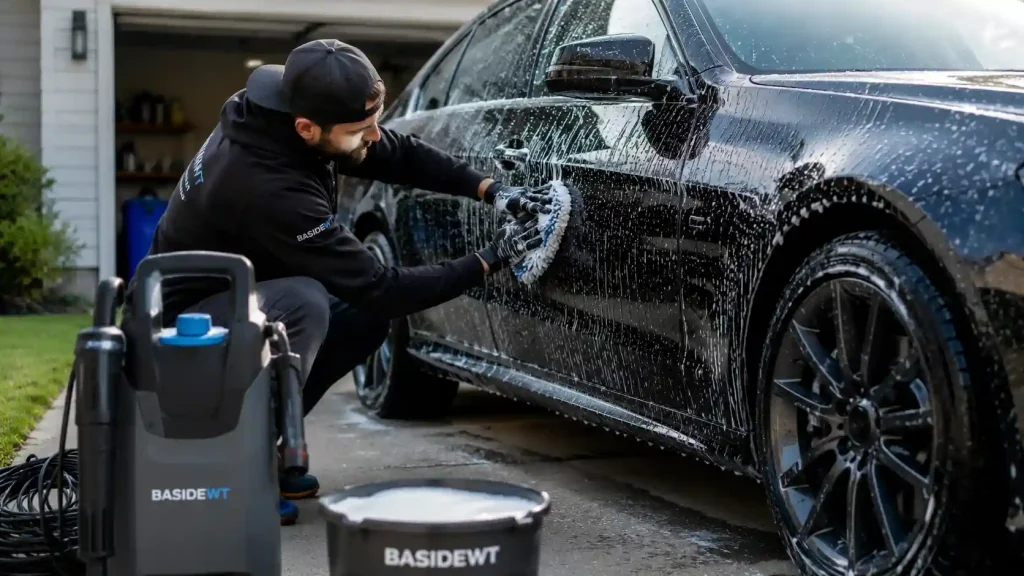
A car’s clear coat is thinner than most people realize. Every wash either protects that layer or slowly wears it down, depending on the soap, tools, and technique used. This isn’t a minor detail — it’s the entire difference between a car that still looks new after five years and one that looks tired after two.
Swirl marks, the fine spiderweb scratches visible under direct sunlight, are almost always caused by washing technique rather than age. Dirty wash mitts, harsh soap, and rough drying towels do more cumulative damage over a year of regular washing than most owners expect.
Anyone who has compared a car washed with a proper zero-residue process against one washed carelessly with a household sponge can see the difference within a single season. A spotless water system approach, where water quality is treated as seriously as soap choice, tends to produce noticeably better long-term paint condition.
The good news is that correcting this doesn’t require professional-grade equipment. It requires the right order of steps, the right products, and a bit of patience — all of which this guide walks through in detail below.
How Often Should You Wash Your Car?
The honest answer depends on where you live and how the car is used, not a fixed number of days on a calendar.
| Driving Environment | Recommended Wash Frequency |
|---|---|
| Coastal or salted winter roads | Every 1–2 weeks |
| Urban driving, moderate pollution | Every 2 weeks |
| Suburban, average conditions | Every 2–3 weeks |
| Garage-kept, low mileage | Monthly |
| Dusty or rural roads | Weekly |
Contaminants like road salt, tree sap, and bird droppings are acidic and etch into clear coat the longer they sit. According to the International Carwash Association, regular washing is one of the most effective and affordable ways to preserve a vehicle’s paint and resale value over time, and waiting too long between washes is a common cause of premature clear coat damage.
A quick test many detailers use: run a finger lightly across the hood after rain. If it feels gritty instead of smooth, contaminants have built up enough to justify washing sooner than your usual schedule.
Step-by-Step: How to Wash a Car the Right Way
Getting the order right matters as much as the products you choose. Skipping steps — especially the pre-rinse — is one of the fastest ways to introduce scratches during the wash itself.
1. Pre-Rinse to Remove Loose Dirt
Start with a full rinse using a hose or pressure washer before any soap touches the car. This knocks loose grit and debris off the surface so you’re not dragging it across the paint later with a mitt.
2. Use the Two-Bucket Method
Fill one bucket with soapy water and one with plain rinse water. Dip your mitt in the soap bucket, wash a section, then rinse the mitt in plain water before returning for more soap. This keeps dirt out of your soap bucket and off your paint.
3. Wash Top to Bottom
Start at the roof and work downward. Lower panels and wheel wells carry the heaviest grime, so washing them last prevents that dirt from spreading onto cleaner sections above.
4. Clean Wheels and Tires Separately
Wheels collect brake dust, which is abrasive and shouldn’t touch the same mitt used on paint. Use a dedicated wheel brush and wheel-safe cleaner, and always wash wheels before the body panels.
Professional detailers who wash multiple cars a day typically rely on a dedicated car wash system rather than a simple bucket and hose, since consistent water pressure and filtration noticeably speed up this whole sequence without sacrificing paint safety.
5. Rinse Thoroughly
Rinse from top to bottom again, checking panel gaps, mirrors, and trim for leftover suds. Dried soap residue can leave its own streaks and spots if it isn’t fully rinsed away.
6. Dry Immediately and Correctly
Water left to air-dry on a car almost always leaves mineral spots behind. Dry immediately with a microfiber towel, or better yet, use a spot-free rinse system that removes the need for manual drying entirely.
Hand Wash vs. Touchless Car Wash: Which Is Better?
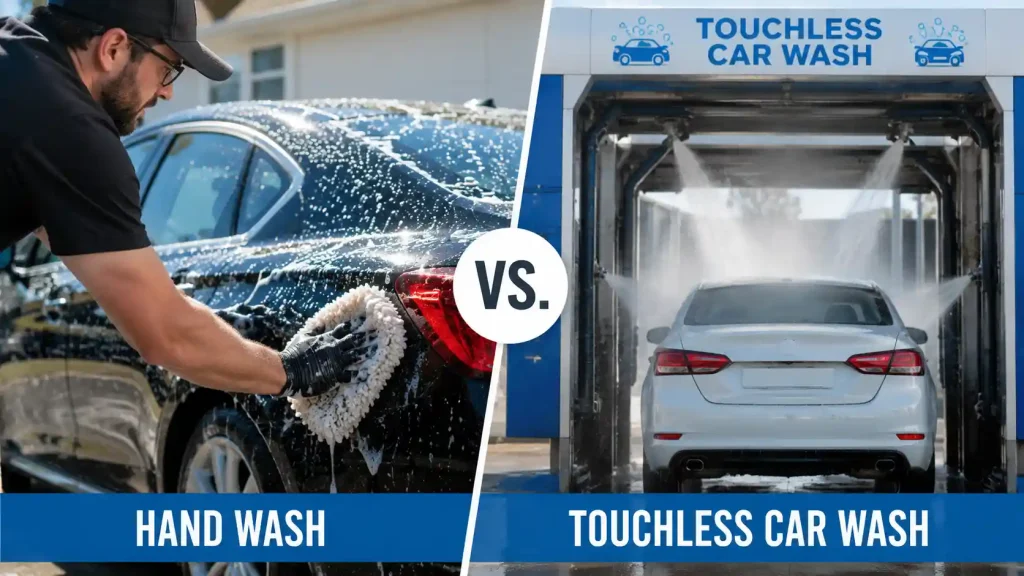
This is one of the most common questions car owners ask, and the honest answer depends on what you’re optimizing for.
| Factor | Hand Wash | Touchless Car Wash |
|---|---|---|
| Risk of swirl marks | Low, with correct technique | Very low — no physical contact |
| Cleaning power on heavy dirt | Higher | Lower, relies on chemical strength |
| Speed | Slower | Faster |
| Typical cost | Free (DIY) or moderate (detailer) | Moderate, pay-per-wash |
| Water spot risk | Depends on drying method | Depends on rinse water quality |
A touchless car wash relies on high-pressure water and strong detergents instead of brushes, cleaning without any contact that could scratch the surface. The tradeoff is real: touchless washes struggle with baked-on grime, bug residue, and heavy mud, since there’s no physical agitation to help break contaminants loose.
Hand washing, done correctly, generally cleans more thoroughly and gives you far more control. It does carry a genuine risk of introducing swirl marks, though, if you’re using a dirty mitt, harsh soap, or rushing the drying step afterward.
A practical middle ground many professionals use: a touchless pre-rinse to loosen grit first, followed by targeted hand washing only where contact is actually needed. This combines the safety of touchless cleaning with the thoroughness that only physical contact can provide.
How to Wash a Car at the Carwash (Self-Service Guide)
Self-service car washes give you more control than automatic tunnel washes, but only if you use each stage correctly and in order.
- Pre-soak or foam cycle — apply first to loosen dirt before any contact.
- High-pressure rinse — physically remove loosened grime, working top to bottom.
- Soap application — keep the wand moving to avoid concentrating pressure on one spot.
- Rinse cycle — rinse thoroughly and check panel gaps for leftover suds.
- Spot-free rinse, if available — bays offering deionized rinse water let the car air-dry without spotting, which is the biggest advantage a good bay has over washing with tap water at home.
If you’re researching nearby options, a self car wash near me search will surface plenty of locations, but not every bay actually offers genuinely spot-free rinse water. It’s worth confirming that detail before you go if a spotless finish matters to you.
Choosing the Right Car Wash Soap
Not all soap is created equal, and this is where a surprising number of car owners unknowingly damage their paint over time without realizing it.
Proper car wash soap is pH-balanced and formulated to lift dirt without stripping wax, sealant, or ceramic coating. Look for products labeled specifically for automotive use, ideally with a neutral or slightly acidic pH rather than the alkaline formulas found in most household cleaners.
| Soap Type | Best For | Paint Safety |
|---|---|---|
| pH-neutral car shampoo | Regular washing, waxed or coated cars | High |
| Foaming car wash soap | Pre-soak, loosening heavy dirt | High |
| Dish soap | Emergency degreasing only | Low — strips wax over time |
| All-purpose household cleaner | Never recommended for paint | Very low |
A good car soap produces a slick, lubricating feel when diluted. That slickness is what allows dirt to glide off the mitt instead of grinding against the clear coat while you wash.
Can You Use Dish Soap to Wash Your Car? Myths vs. Facts
Myth: Dish soap is basically the same as car shampoo, just cheaper. Fact: Dish soap is engineered to strip grease completely, which also removes wax, sealant, and ceramic coating along with the dirt.
Myth: One wash with dish soap will ruin your paint immediately. Fact: A single emergency use won’t cause lasting damage, but making it a habit accelerates fading and clear coat wear over months of repeated use.
Myth: Dish soap is fine because it’s still “just soap.” Fact: Dish soap tends to be more alkaline than automotive shampoo, and repeated exposure can dry out rubber trim and seals in addition to stripping paint protection.
If you’re genuinely out of car soap and need to wash urgently, a heavily diluted dish soap solution is an acceptable one-time substitute. Just plan on reapplying wax or sealant afterward, since whatever protection was there will likely be stripped away.
The Secret to a Spot-Free Rinse: Deionized Water
Water spots aren’t actually water damage — they’re mineral deposits left behind when regular tap water evaporates, carrying calcium, magnesium, and other dissolved solids that stay on the surface as the water dries.
Deionized water has had those minerals removed, so it evaporates without leaving residue. This is why detail shops and high-end self-service bays rely on deionized rinse water for the final pass, letting the car air-dry completely spot-free without a single towel touching the surface.
For anyone washing regularly at home, this is genuinely the single biggest upgrade available to your process. A deionized water cleaning setup attached to your hose removes the drying step almost entirely, which also eliminates the drying-related scratch risk that comes from repeated towel contact.
DI Water vs. RO Water for Car Washing: Which Should You Choose?
Both deionized (DI) and reverse osmosis (RO) water are marketed for spot-free washing, but they work differently and suit different setups depending on your water hardness and how often you wash.
RO systems filter out most dissolved minerals through a membrane and work well as a first-stage treatment for moderately hard water, though they don’t remove every trace mineral on their own. DI resin, by contrast, removes virtually all remaining ions, producing water pure enough that even a single stray drop left on the hood will dry without a mark.
Many professional setups combine both stages — RO first to reduce mineral load, then DI to finish the water to a truly spot-free standard. Our detailed comparison on RO vs DI water for car wash breaks down which configuration makes more sense based on your local water hardness and wash frequency, since a heavy-use commercial setup and an occasional home wash have very different requirements.
Home Car Wash Systems: Are They Worth It?
If you wash your own car regularly — weekly or more — a dedicated home car wash system pays for itself faster than most people expect, both in time saved and in reduced paint damage from repeated manual drying.
A proper setup typically combines a pressure or foam cannon stage with a filtration stage for the final rinse, letting the car air-dry spot-free without a single towel pass. This matters more than it sounds, since every towel pass is a chance to drag a trapped particle across the clear coat and create a fresh scratch.
| Setup Type | Typical Upfront Cost | Best For |
|---|---|---|
| Bucket and hose | Under $100 | Occasional washing, low investment |
| Foam cannon + pressure washer | $150–$400 | Weekly DIY washing, better cleaning power |
| DI/RO spot-free system | $300–$1,500+ | Frequent washing, professional detailing, zero towel drying |
For anyone comparing options, it helps to look at the best deionized water system for car washing available for your specific water hardness and wash volume — a system sized for occasional home use looks very different from one built for daily commercial washing.
Detailers and mobile wash businesses running back-to-back vehicles have different needs entirely, since water spotting between jobs simply isn’t an option. A dedicated spot free car wash system built for continuous use keeps pace with that kind of volume without sacrificing the finish on any single vehicle. For a broader cleaning setup that goes beyond just the rinse stage, a full cleaning system covers pre-soak, wash, and rinse in one integrated process.
Drying Techniques That Prevent Scratches and Water Spots
If you’re not using spot-free rinse water, drying technique becomes critical to avoiding both water spots and fresh scratches on your paint.
- Use a large, plush microfiber towel rather than a standard bath towel, since microfiber traps particles instead of dragging them across the surface.
- Blot rather than wipe where possible, especially on the hood and roof, which take the most direct sun and show swirl marks most visibly.
- Work in sections, starting at the roof and moving down, so you’re not re-drying already-dry panels unnecessarily.
- Avoid drying in direct sunlight, since water evaporates faster in the sun, which increases spotting and makes streak-free drying harder to achieve.
This same spot-free principle applies well beyond just body panels. If you also care about streak-free glass, our guide on how to clean a window with a DI tank covers the waterfed pole method professionals use for spotless windows and mirrors, using the exact same deionized water principle applied to auto glass.
Common Mistakes, Expert Tips, and Seasonal Maintenance
A short checklist of mistakes covers most of the paint damage seen in everyday driveway washing:
- Washing in direct sunlight, which dries soap and water too fast and leaves streaks.
- Using a single bucket, which recirculates dirt back onto the wash mitt with every dip.
- Washing wheels and body panels with the same mitt, transferring abrasive brake dust onto paint.
- Skipping the pre-rinse and dragging loose grit across the surface immediately.
- Using dish soap or household cleaner as a regular habit rather than an emergency substitute.
- Air-drying without a spot-free rinse, leaving mineral deposits that etch into clear coat over time.
Seasonal habits matter just as much as weekly technique. Winter road salt is aggressive and accelerates corrosion, particularly in wheel wells, so increasing wash frequency and rinsing the undercarriage becomes important. Summer bug residue and tree sap are acidic and should be removed within a day or two rather than left to bake in the sun. Spring pollen creates a fine, gritty film that’s easy to underestimate and should be treated like any other contaminant buildup.
Beyond seasonal adjustments, a few long-term habits make the biggest difference over a car’s lifetime: reapply wax or sealant every two to three months, inspect wiper blades regularly since gritty blades scratch glass, and avoid washing a car that’s been sitting in direct sun for hours, since a hot surface causes soap and water to dry unevenly. For anyone exploring a full spot-free setup for regular use, understanding DI water for car washing as a complete system, rather than just a rinse attachment, makes the long-term investment much easier to plan around.
Conclusion
Washing a car properly isn’t complicated, but it does require the right order of steps and the right materials: the two-bucket method, pH-balanced soap, careful drying, and ideally a spot-free rinse that skips the drying step altogether. Get those fundamentals right, and you’ll avoid the swirl marks and water spots that come from rushing the process or reaching for whatever soap happens to be under the sink.
Whether you’re washing by hand in the driveway, using a self-service bay, or investing in a dedicated home car wash system, the goal stays the same: a genuinely clean finish that protects your paint instead of slowly wearing it down. Start with the fundamentals in this guide, and the results will show clearly the next time your car sits in direct sunlight.
Frequently Asked Questions
How often should I wash my car?
Most cars should be washed every 2–3 weeks under normal conditions, or weekly if you’re driving on salted roads, near the coast, or on dusty rural roads.
Can I use dish soap to wash my car?
You can in an emergency, but regular use strips wax and can dry out rubber trim over time — a dedicated pH-balanced car soap is safer for long-term paint care.
What is a touchless car wash?
A touchless car wash uses high-pressure water and strong detergents instead of brushes or mitts, cleaning without physical contact to reduce the risk of scratches.
Is hand washing better than a touchless car wash?
Hand washing generally cleans more thoroughly and gives you more control, but touchless washing carries less risk of introducing swirl marks from contact.
Why does my car get water spots after washing?
Water spots are mineral deposits left behind when tap water evaporates; using deionized or reverse osmosis water for the final rinse eliminates this issue entirely.
What’s the best soap to wash a car with?
A pH-neutral car shampoo formulated for automotive paint is best, since it cleans effectively without stripping wax, sealant, or ceramic coating.
Is a home car wash system worth it?
If you wash weekly or more, a home system with a deionized or RO rinse stage typically pays for itself in time saved and reduced paint damage from manual drying.
How do I dry my car without leaving scratches?
Use a plush microfiber towel and blot rather than wipe, or better yet, use spot-free rinse water so the car air-dries without needing a towel at all.
Should I wash my wheels with the same mitt as the body?
No — wheels collect abrasive brake dust that should be cleaned with a separate wheel brush to avoid transferring grit onto your paint.
Does washing my car too often damage the paint?
No, frequent washing with proper technique and soap doesn’t damage paint — poor technique, dirty tools, and harsh soap cause damage, not wash frequency itself.
RELATED POSTS
Does Reverse Osmosis Remove Fluoride?
Whole House Water Softener Cost
How to Choose the Best Water Fed Pole System for Your Cleaning Business
RO Membrane Compatibility: How to Match a Membrane With Your System
How to Choose the Right Water Softener System: A Complete Buying Guide