BasideWT- Whole Home Water Filtration System & Replacement


Deionized Water vs Distilled Water: What’s the Real Difference?
Water purity plays an important role in industries, laboratories, automotive cleaning, marine systems, and even household applications. Two of the most commonly discussed purified water types are deionized water and distilled water. Many people often ask, is deionized water the same as distilled water? While both are purified forms of water, they are not identical.
Understanding the difference between deionized water vs distilled water can help you choose the right option for your home, business, cleaning process, or industrial application. In this guide, we’ll explain how both types of water are produced, their benefits, common uses, key differences, and mistakes people should avoid when using them.
Understanding Water Purification
Before comparing distilled vs deionized water, it is important to understand why purified water matters.
Normal tap water contains minerals, salts, dissolved solids, bacteria, chlorine, and other contaminants. In many situations, these impurities can affect performance, damage equipment, leave residue, or reduce efficiency.
That is why advanced purification systems such as Water Filtration Systems and RO Systems are widely used across industries and households.
Purified water helps improve:
- Equipment lifespan
- Cleaning quality
- Water safety
- Industrial performance
- Laboratory accuracy
What Is Deionized Water?
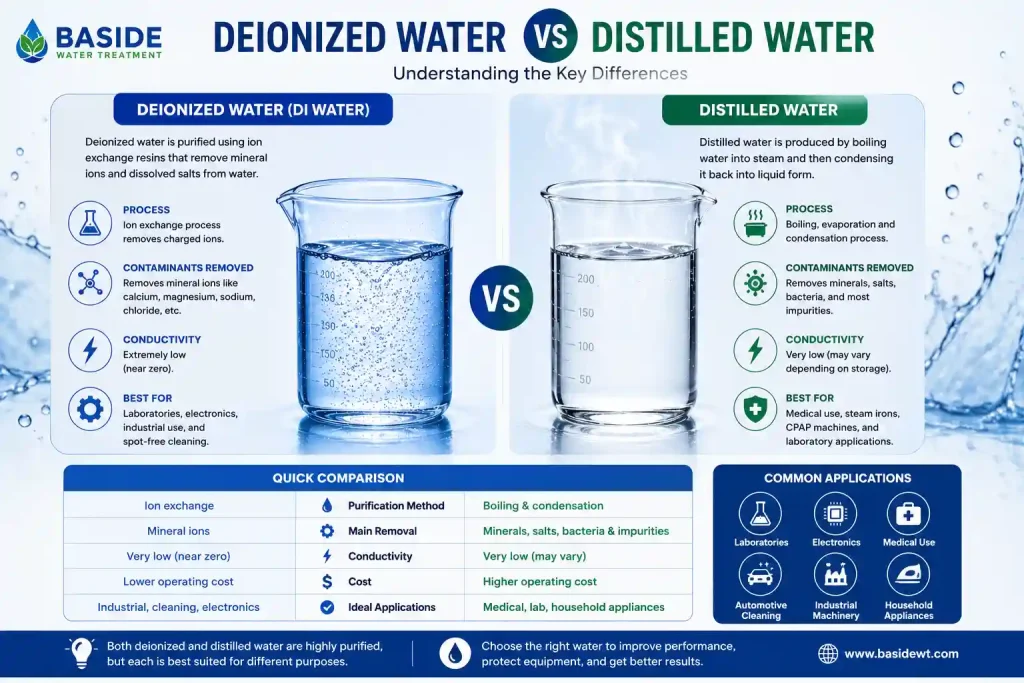
Deionized water, also known as DI water, is water that has had its mineral ions removed. This process removes charged particles like:
- Calcium
- Magnesium
- Sodium
- Iron
- Chloride
- Sulfates
The purification process uses ion exchange resins that replace unwanted minerals with hydrogen and hydroxide ions, creating highly purified water.
How Deionized Water Is Made
Deionization usually involves:
- Pre-filtration
- Reverse osmosis treatment
- Ion exchange resin purification
Many advanced purification setups combine deionization with systems like Commercial RO Water Filter Systems for better efficiency and water quality.
Common Uses of Deionized Water
Deionized water is widely used for:
- Laboratory testing
- Automotive detailing
- Electronics manufacturing
- Battery filling
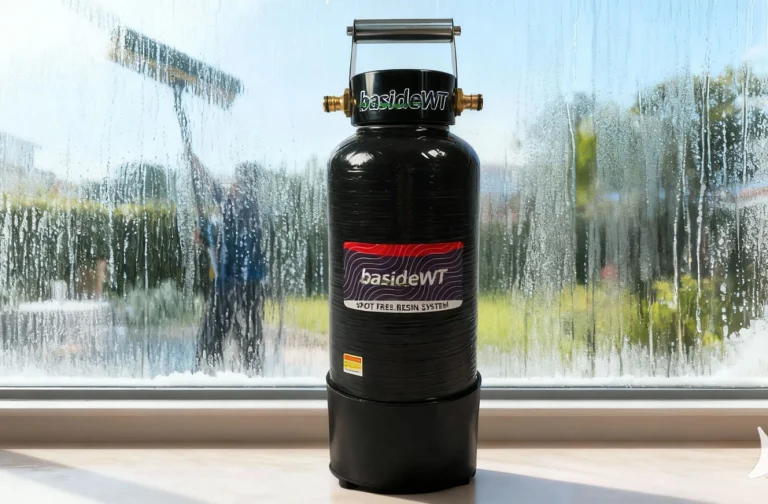
- Window cleaning
- Solar panel cleaning
- Industrial equipment
For example, professional car cleaning businesses often use Spotless Water Systems because deionized water leaves no mineral spots after drying.
What Is Distilled Water?
Distilled water is created through a process called distillation. In this process, water is boiled into steam and then condensed back into liquid form. This removes:
- Minerals
- Heavy metals
- Bacteria
- Salts
- Many contaminants
Because impurities are left behind during boiling, distilled water becomes highly purified.
How Distillation Works
The process includes:
- Heating water until it evaporates
- Separating steam from contaminants
- Cooling steam into purified water
Distillation is one of the oldest and most effective purification methods.
Common Uses of Distilled Water
Distilled water is commonly used for:
- Medical equipment
- CPAP machines
- Steam irons
- Laboratory work
- Cosmetic manufacturing
- Drinking in specific situations
- Automotive cooling systems
Many marine applications also rely on purified water systems such as Boat Watermakers for clean and reliable water production.
Deionized Water vs Distilled Water: Main Differences
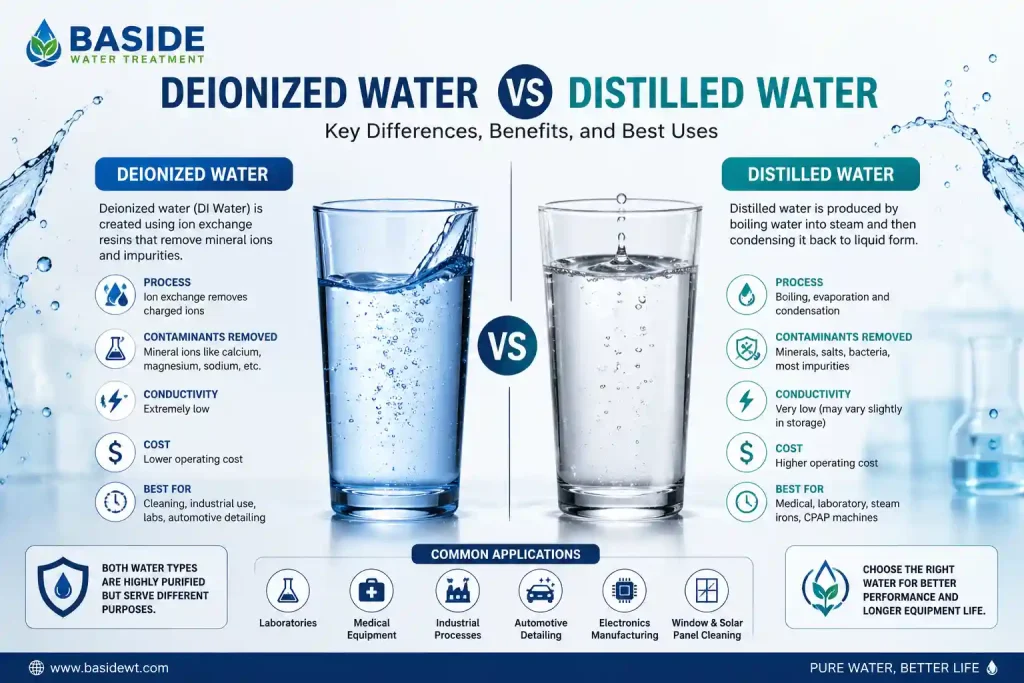
Although both types of water are purified, there are major differences between them.
1. Purification Method
Deionized Water
- Removes ions using resin exchange
Distilled Water
- Uses boiling and condensation
2. Contaminant Removal
Deionized water removes mineral ions effectively but may not eliminate all organic contaminants or bacteria unless combined with additional filtration.
Distilled water removes many contaminants through evaporation, including microorganisms and minerals.
3. Electrical Conductivity
DI water has extremely low conductivity because ions are removed.
Distilled water still may contain trace ions depending on storage conditions.
4. Production Speed
Deionization is generally faster and more energy-efficient.
Distillation requires more energy because water must be boiled.
5. Cost
Distilled water production often costs more due to heating requirements.
Deionized water systems are usually more cost-effective for large-scale industrial use.
Is Deionized Water the Same as Distilled Water?
One of the most searched questions online is: is deionized water the same as distilled water?
The answer is no.
While both are purified water types, they are created differently and used for different purposes. Deionized water focuses mainly on removing ions and minerals, while distilled water removes contaminants through evaporation and condensation.
In some applications, either option may work. However, certain industries specifically require one type over the other.
Distilled vs Deionized Water for Cleaning
In cleaning applications, especially automotive detailing and glass cleaning, deionized water is often preferred because it dries without leaving mineral spots.
Professional cleaning systems like Deionized Water Cleaning Systems are designed specifically for spot-free cleaning performance.
Distilled water can also be used for cleaning but is generally more expensive for large-scale operations.
DI Water vs Distilled Water in Laboratories
Laboratories often compare DI water vs distilled water depending on testing requirements.
Deionized Water
Best for:
- Equipment rinsing
- Glassware cleaning
- General laboratory use
Distilled Water
Best for:
- Sterile applications
- Biological testing
- Medical environments
Some laboratories combine multiple purification methods, including RO filtration, UV sterilization, and deionization.
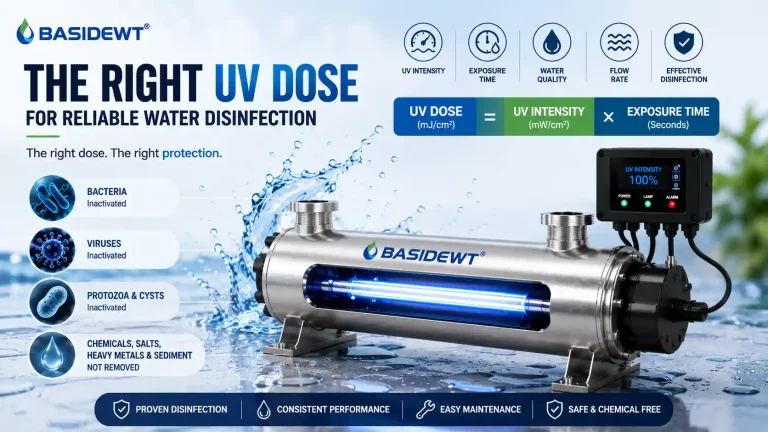
Systems like UV Water Sterilizers help improve microbiological safety in purified water systems.
Which Water Type Is Better for Drinking?
Many people ask whether distilled or deionized water is safe to drink.
Distilled Water
Distilled water is generally considered safe for drinking, although it lacks natural minerals found in regular water.
Deionized Water
Deionized water is not always recommended for drinking because deionization mainly removes ions, not necessarily bacteria or organic chemicals.
For drinking purposes, properly filtered RO water systems are usually preferred.
You can learn more about this topic from Is Reverse Osmosis Water Good for You?.
Industrial Importance of Purified Water
Industries rely heavily on purified water because mineral contamination can damage equipment and reduce efficiency.
Applications include:
- Pharmaceutical manufacturing
- Food processing
- Electronics production
- Car washing
- Power generation
- Marine systems
High-quality filtration products such as RO Membranes and Water Softener Systems play a major role in maintaining water purity.
Common Mistakes to Avoid
Many users make mistakes when comparing distilled water vs deionized water.
Assuming They Are Identical
Both types are purified differently and serve different purposes.
Using DI Water for Drinking Without Proper Treatment
Deionized water may not remove all biological contaminants.
Ignoring Equipment Compatibility
Some machines specifically require distilled water.
Using Low-Quality Filtration Systems
Poor filtration can reduce water purity and equipment performance.
Improper Storage
Purified water can absorb contaminants if stored incorrectly.
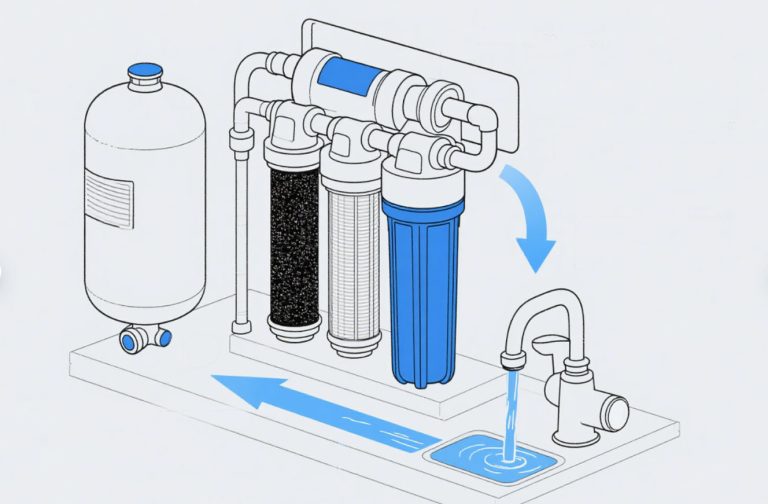
How Reverse Osmosis Fits Into Water Purification
Reverse osmosis is another major purification method often compared with distilled and deionized water.
RO systems remove:
- Dissolved solids
- Salts
- Heavy metals
- Bacteria
- Contaminants
Many businesses combine RO with deionization for ultra-pure water production.
You can also explore the detailed comparison between purification methods here:
Is Reverse Osmosis Water the Same as Distilled Water?
Choosing the Right Water Type
The best choice depends on your specific needs.
Choose Deionized Water If You Need:
- Spot-free cleaning
- Low mineral content
- Industrial rinsing
- Electronics cleaning
Choose Distilled Water If You Need:
- Sterile water
- Medical use
- Steam appliances
- Laboratory precision
Understanding your application helps you select the right purification method.
The Future of Water Purification
Water purification technology continues evolving rapidly. Modern systems are becoming:
- More energy-efficient
- More sustainable
- More automated
- Better at removing contaminants
Industries now prioritize environmentally friendly filtration systems that reduce waste while improving performance.
As water quality concerns continue growing worldwide, purified water systems will become even more important for homes, businesses, and industrial operations.
Conclusion
Understanding deionized water vs distilled water is essential for choosing the right water purification solution. While both are purified forms of water, they differ in purification methods, contaminant removal capabilities, cost, and practical applications.
Deionized water is ideal for industrial cleaning, automotive detailing, and electronics because it removes ions and leaves no residue. Distilled water, on the other hand, is better suited for medical, laboratory, and sterile applications due to its evaporation-based purification process.
Whether you are running an industrial facility, maintaining equipment, or looking for better water treatment solutions, selecting the correct purification method can improve performance, efficiency, and long-term reliability.
Businesses and homeowners looking for advanced filtration solutions can explore modern purification technologies through Baside Water Treatment for high-quality water treatment systems and purification equipment.