BasideWT- Whole Home Water Filtration System & Replacement


Spot Free Rinse: The Complete Guide to Spot-Free Car Wash Results
You just spent an hour washing your car. It looks perfect — until it dries. Then those pale, chalky rings show up all over the hood, windows, and mirrors. That’s the moment most people start searching for spot free rinse.
A spot free rinse is the final rinse step that leaves water behind without minerals. No minerals means no spots when the water evaporates. It sounds simple, and the core idea is simple, but the systems behind it, and the mistakes people make when choosing one, are not always well explained online.
This guide walks through what spot free rinse actually is, why water spots form in the first place, how the technology works at a chemical level, and how to choose a system that fits your car wash, detailing business, or home setup. We’ll also compare spot free rinse against tap water, soft water, deionized water, and reverse osmosis water, because these terms get mixed up constantly — and the differences matter for your results and your budget.
By the end, you’ll know exactly what to look for in a spotless water system, how to maintain one, and how to avoid the mistakes that waste resin and money.
What Is Spot Free Rinse?
Spot free rinse is a final rinse using water that has had its dissolved minerals removed. Ordinary tap water carries calcium, magnesium, and other minerals. When that water sits on a surface and evaporates, the minerals stay behind as a visible residue — the classic water spot.
A spot free rinse system strips those minerals out before the water ever touches the car, window, or panel. What’s left is essentially pure H₂O. Since there’s nothing dissolved in it to leave behind, the water evaporates clean. No spots, no streaks, and often no need for a final towel dry.
This is why the term shows up constantly in car wash marketing, mobile detailing packages, and window cleaning services. It’s not a gimmick — it’s a measurable water chemistry outcome, usually tracked with total dissolved solids (TDS) readings near zero.
Why “0 TDS” Matters
TDS stands for total dissolved solids, measured in parts per million (ppm). Regular tap water often reads anywhere from 50 to 400+ ppm, depending on your local water supply. A properly functioning spot free rinse system should bring that number down close to 0 ppm. That reading is the simplest way to confirm the system is doing its job, and it’s why many professional setups include a TDS meter as a built-in feature.
Why Water Spots Form After Washing a Vehicle
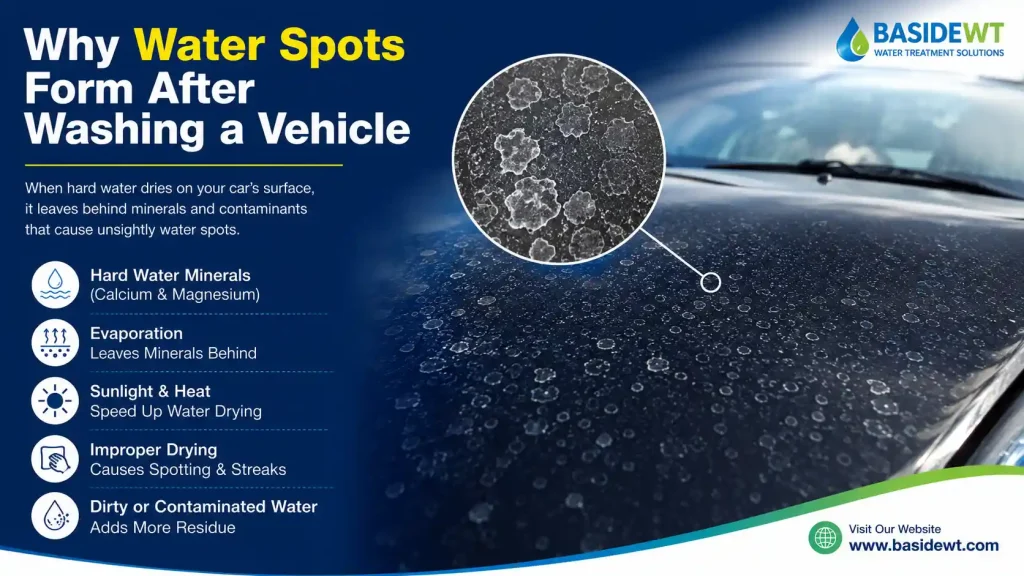
Water spots aren’t dirt. They’re mineral deposits left behind after evaporation. Here’s the short version of the chemistry:
- Tap water contains dissolved calcium carbonate, magnesium, silica, and sometimes iron.
- When water sits on a warm painted surface, it evaporates faster than the minerals can be rinsed away.
- The minerals concentrate as the water shrinks, then bond lightly to the surface as the last droplet disappears.
- What you see is a ring or a hazy film — the mineral residue left in the shape of the drop.
Hard water areas make this worse. If you’ve noticed water spots on car paint are more stubborn in some cities than others, that’s directly tied to local mineral content. Direct sun accelerates the problem because faster evaporation means less time for water to run off before minerals settle.
This is also why hand-drying with a towel only partially solves the issue. You’re removing surface water, but any water trapped in seams, mirrors, badges, or trim can still dry unassisted and leave marks.
How Spot Free Rinse Works
At the core of most spot free rinse system setups is deionization — a process that swaps out mineral ions for hydrogen and hydroxide ions, which combine to form more water instead of leaving residue.
Here’s the general flow for a typical setup:
- Tap water enters the system through an inlet hose.
- Water passes through a tank filled with mixed bed resin, a mixture of cation and anion exchange beads.
- The resin grabs positively charged ions (like calcium and magnesium) and negatively charged ions (like chloride and sulfate).
- What exits the tank is deionized water, typically reading close to 0 ppm TDS.
- That water is applied as the final rinse, either through a hose, a wand, or an integrated cleaning brush.
Because this process is purely chemical — an ion exchange reaction — most compact systems don’t need electricity. Water pressure alone pushes the flow through the resin bed, which is part of why portable spotless water system units are popular for mobile detailers and solar cleaning crews who don’t always have power on-site.
The Science Behind Mineral-Free Water
Mixed bed resin works because of ion exchange chemistry. Cation resin beads are pre-loaded with hydrogen ions (H+), and anion resin beads are pre-loaded with hydroxide ions (OH-). As hard water minerals pass through, the resin swaps its hydrogen and hydroxide ions for the incoming calcium, magnesium, and other dissolved ions. The displaced hydrogen and hydroxide ions combine to form H₂O, so the byproduct of the exchange is simply more pure water.
Over time, the resin beads become saturated — they run out of hydrogen and hydroxide ions to trade. That’s when TDS readings start climbing again, and it signals the resin needs replacement or regeneration. This is a normal part of ownership and one of the more overlooked topics in most online guides, which tend to describe the technology without explaining what happens as it wears out.
Spot Free Rinse vs Tap Water
Tap water is the baseline most people are trying to improve on. Municipal water is treated for safety, not for mineral content, so it typically still carries calcium, magnesium, and trace minerals that leave spots.
| Factor | Tap Water | Spot Free Rinse |
|---|---|---|
| Typical TDS | 50–400+ ppm | Near 0 ppm |
| Leaves spots | Yes | No |
| Requires towel drying | Usually | Rarely |
| Cost per use | Free (utility cost) | Small resin/media cost |
| Best for | Pre-rinse, soaping | Final rinse |
Tap water is fine for the wash and pre-rinse stages. It’s the final rinse where mineral content actually decides whether you get a streak-free result.
Spot Free Rinse vs Soft Water
This is one of the most common mix-ups. Water softeners don’t remove minerals — they exchange calcium and magnesium for sodium ions. Soft water is gentler on plumbing and soap performance, but sodium is still a dissolved solid. It still leaves spots when it evaporates, just different-looking ones than hard water minerals.
If your goal is spotless results, a softener alone won’t get you there. Softening addresses hardness for household plumbing and appliances; a true spot free water system addresses TDS for the final rinse.
Spot Free Rinse vs Deionized Water
Deionized water and spot free rinse are effectively the same thing when the DI process is done correctly. Deionized water, or DI water, refers to water that has had almost all of its ionic content removed through resin exchange, which is exactly what a spot free rinse system produces.
The distinction is mostly about framing: “spot free rinse” describes the use case (a rinse step that avoids spots), while “deionized water” describes the water chemistry itself. If a product page or supplier uses both terms, they’re usually describing the same underlying process.
Spot Free Rinse vs Reverse Osmosis Water
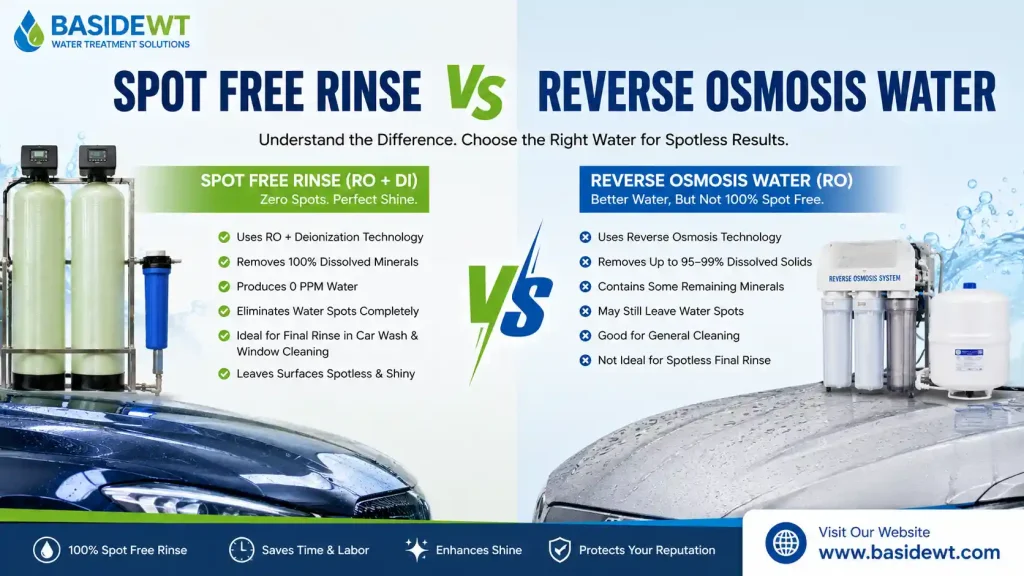
Reverse osmosis (RO) uses a semi-permeable membrane to filter out dissolved solids, bacteria, and larger particles by forcing water through under pressure. RO is excellent at bulk reduction of TDS, often removing 90–99% of dissolved solids, but it typically doesn’t get all the way to 0 ppm on its own, especially with higher-mineral source water.
That’s why many professional-grade setups pair the two technologies. Water passes through an RO DI system, where reverse osmosis handles the bulk of the mineral load first, then a DI resin stage polishes the water down to true 0 TDS. This combination extends resin life significantly, because the resin isn’t working as hard to strip minerals that RO already removed. For high-volume operations like commercial car washes, this is usually the more cost-effective long-term setup compared to DI-only systems.
You can see how this pairing works in practice with a RO/DI resin deionized water system for spotless car wash and window cleaning, which combines both stages for higher-volume use.
Benefits of Spot Free Rinse
The appeal goes beyond just avoiding water spots. A few benefits that don’t always get enough attention:
- No towel drying required. Since there’s nothing left behind to wipe away, many detailers skip the final towel pass entirely, saving labor time.
- Fewer micro-scratches. Towel drying is one of the leading causes of swirl marks on paint. Removing that step protects the finish.
- Chemical-free finish. Unlike some drying aids or waxes used to mask water spots, deionized rinse water doesn’t rely on additives.
- Consistent results in any weather. Hot, sunny days that used to guarantee spots become a non-issue.
- Better results on glass and solar panels. Streak-free glass depends entirely on mineral-free water; deionized rinse is essentially the standard method for professional window cleaners.
These benefits are the reason spot free rinse car wash setups have become a standard offering at higher-end car washes rather than a premium add-on.
Where Spot Free Rinse Is Used
Commercial Car Washes
Full-service and self-serve car washes use spot free rinse as the final stage before the vehicle exits the bay. High-volume locations typically rely on RO DI system setups rather than DI-only tanks, because the water usage is too high for resin alone to be cost-efficient.
Mobile Detailers
Detailers working driveways and parking lots need portable, no-power setups. A wheeled spotless water system with a garden hose connection fits this use case well, letting a detailer hook up to any outdoor spigot and get spot free results without hauling extra equipment. Explore a compact option in this spot free car wash system built for this kind of mobile use.
Window Cleaning
Streak-free glass has always depended on rinse water quality. Professional window cleaners use pure water fed through extension poles and brushes, letting the water do the work instead of squeegeeing every pane by hand.
Solar Panel Cleaning
Dust and mineral spots both reduce solar panel efficiency by blocking sunlight. Spot free rinse is now common in solar maintenance because it leaves panels completely clear without wiping, which matters when panels are mounted on rooftops that are hard to reach safely.
Industrial Cleaning
Manufacturing facilities use deionized water for equipment rinsing, parts cleaning, and surfaces where mineral buildup could interfere with precision components or coatings.
Choosing the Right Spot Free Rinse System
Not every setup needs the same equipment. A few questions to work through before buying:
How much water will you actually use? Occasional home car washing needs far less capacity than a mobile detailing business running multiple jobs a day.
What’s your source water TDS? Higher starting TDS means resin depletes faster. If you’re in a hard water area, factor that into your capacity planning or consider an RO DI system to extend resin life.
Do you need portability? Mobile work calls for wheeled carts and hose-based connections. Fixed installations at a shop can use larger stationary tanks.
Do you want real-time monitoring? A built-in TDS meter takes the guesswork out of knowing when resin needs replacing, rather than waiting for spots to reappear.
A well-built cleaning system with dual DI tanks is a solid middle ground for homeowners who want capacity without committing to full commercial-scale equipment.
Common Mistakes to Avoid
Ignoring TDS readings. Waiting until spots reappear on the car means you’ve already used the system past its effective capacity. Check readings regularly instead.
Mixing rinse water with hard water mid-job. If a hose gets swapped or a valve is left open, tap water can dilute your spot free rinse output without you noticing until the vehicle dries.
Undersizing the tank for the job. Buying a small DI tank for high-volume commercial use leads to constant resin changes and higher long-term costs than a properly sized RO DI system would have.
Skipping pre-filtration. Sediment and chlorine can shorten resin life. A basic sediment or carbon pre-filter ahead of the DI tank protects your investment.
Assuming DI water is safe to drink or use elsewhere. Deionized water is for rinsing and cleaning, not for drinking — it lacks the minerals your body needs and can actually pull minerals from whatever it contacts, including your mouth, if consumed regularly.
Maintenance Best Practices
Keeping a spot free rinse setup performing well doesn’t take much time, but consistency matters:
- Check TDS output weekly if you’re using the system regularly, and before any high-visibility job.
- Track approximate gallons used against your tank’s rated capacity so resin changes aren’t a surprise.
- Store hoses and connectors properly to avoid contamination between uses.
- Rinse fittings if the system sits unused for extended periods, since stagnant water can introduce bacteria into hose lines.
- Replace resin promptly once TDS creeps upward — waiting only means spots on the next job.
A deionized water cleaning tank with a visible or digital TDS readout makes this maintenance routine much easier to stay on top of.
Cost vs Long-Term Savings
The upfront cost of a spot free rinse system is easy to compare on a spec sheet, but the real savings show up over months of use. Consider what you’re offsetting:
- Labor time. Skipping towel drying on every vehicle adds up fast for a detailer doing multiple jobs a day.
- Product costs. Fewer drying aids, spot removers, and glass cleaners needed.
- Redo work. Spots discovered after a customer leaves mean a return trip or an unhappy review. Getting it right the first time protects both time and reputation.
- Resin costs vs water usage. Resin isn’t free, but for most small-to-medium operations it’s a modest recurring cost compared to labor hours saved.
For high-volume operations, pairing RO pre-filtration with DI resin, as in a full RO DI system, usually pays for itself faster than DI-only setups because resin lasts significantly longer.
Buying Guide
When comparing options, look past the marketing copy and check these specifics:
- Tank capacity in cubic feet, and how that translates to gallons at your local source water TDS.
- Flow rate (GPM), matched to your hose or wand setup so you’re not bottlenecking water pressure.
- Resin type — mixed bed resin is standard for spot free results.
- Portability features — wheels, handles, and standard hose fittings matter for mobile use.
- Monitoring tools — an inline or handheld TDS meter simplifies maintenance.
- Accessories included — brushes, adapters, and hoses can save you from buying extras separately.
If you’re outfitting a full mobile setup rather than a single tank, a combined car wash system that bundles the DI tank with a cart and cleaning brush is often more practical than assembling components individually.
Why Businesses Invest in Professional Spotless Water Systems
For a car wash, detailing service, or window cleaning company, spot free rinse isn’t just a nice-to-have — it’s a differentiator that shows up directly in customer reviews and repeat business. Customers notice when a car dries with zero effort and zero spots, and they notice when a competitor’s “wash” still leaves streaks on the windows.
Beyond the visible finish, purified rinse water reduces wear on cleaning equipment, cuts labor time per vehicle, and lowers the amount of chemical drying aids needed. For businesses scaling up, moving from a basic DI tank to a full spotless water system with RO pre-filtration is usually the point where the investment starts paying for itself through resin savings and faster turnaround per vehicle.
Final Thoughts
Spot free rinse comes down to a simple principle: water with nothing dissolved in it can’t leave anything behind. Whether you’re washing a single car in your driveway or running a commercial detailing operation, understanding how deionized water, RO filtration, and mixed bed resin work together helps you choose equipment that actually fits your workload — instead of guessing based on price alone.
If spots keep showing up no matter how carefully you dry, the fix usually isn’t a better towel. It’s the water. A properly sized spotless water system solves the problem at the source, and once you’ve seen a vehicle air-dry to a genuinely spot-free finish, it’s hard to go back to the old way.
Frequently Asked Questions
1. What is spot free rinse in simple terms?
It’s a final rinse using water that’s had its minerals removed, so nothing is left behind when it dries.
2. How is spot free rinse different from regular rinsing?
Regular tap water contains minerals that leave spots as it evaporates. Spot free rinse water has near-zero dissolved solids, so it dries clean.
3. Do I need electricity to run a spot free rinse system?
Most compact DI tank systems run on water pressure alone and don’t require electricity. Larger RO-based systems typically do.
4. How long does DI resin last before it needs replacing?
It depends on your source water’s TDS and how much water you run through the system. Higher starting TDS depletes resin faster; a TDS meter is the most reliable way to track it.
5. Can I use spot free rinse water for drinking?
No. Deionized water isn’t intended for drinking since it lacks the minerals your body needs.
6. Is deionized water the same as spot free rinse water?
Yes, in practice. Deionized water is the water chemistry; spot free rinse describes how it’s used as a final rinse step.
7. Does spot free rinse work in hard water areas?
Yes, and it’s especially valuable there. Hard water areas see more mineral buildup, so removing that mineral content before the final rinse makes the biggest visible difference.
8. Is reverse osmosis enough on its own for spot free results?
Usually not completely. RO removes most dissolved solids but rarely reaches true 0 TDS alone, which is why many systems pair RO with DI resin.
9. Can spot free rinse be used on solar panels?
Yes. It’s widely used in solar maintenance because it leaves panels clear without wiping, which helps preserve panel efficiency.
10. How do I know when my spot free rinse water isn’t working anymore?
Check TDS readings regularly. Once the reading climbs above near-zero, spots will start reappearing, signaling it’s time to replace or regenerate the resin.
RELATED POSTS
How To Remove Salinity From Water
High Flow Water Filter Housing: Applications, Benefits & Selection Guide
What Is a Well Water Filtration System? Complete Guide for Homeowners
Spotless Water System Working Principle: How RO and DI Deliver 0 PPM Water
Industrial UV Water Sterilizer: Applications and Selection Guide