BasideWT- Whole Home Water Filtration System & Replacement


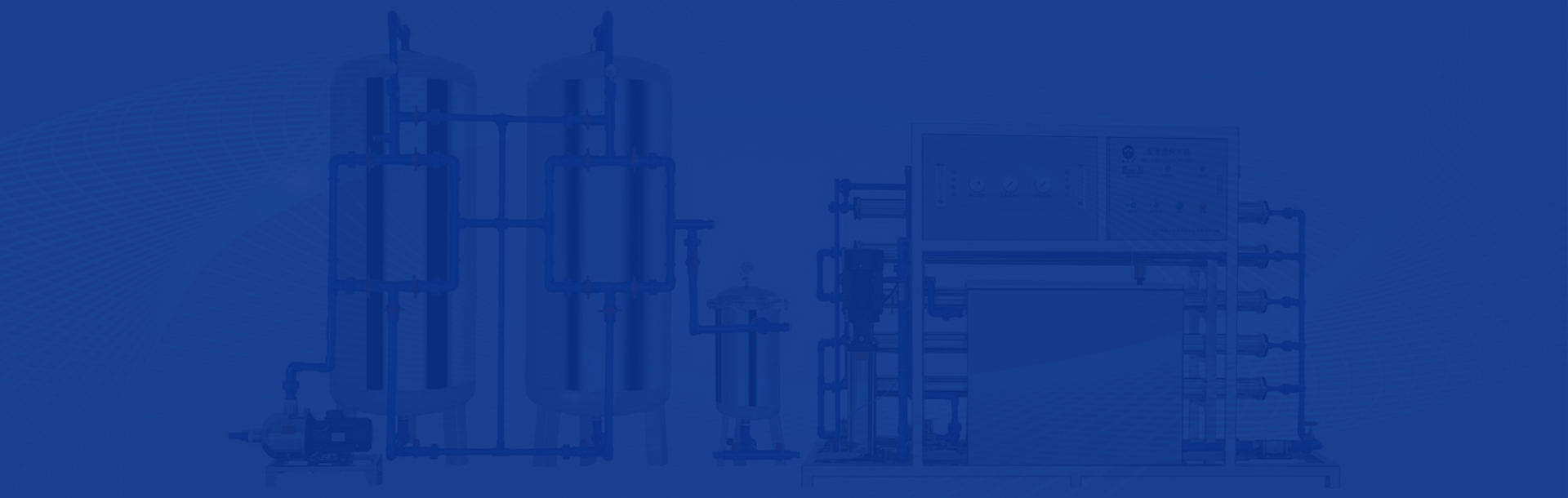
What Is a Well Water Filtration System? Complete Guide for Homeowners
If your home relies on a private well, you are responsible for your own water quality. Unlike municipal water users, you have no utility company treating your water before it reaches your tap. What comes out of your well is exactly what is in the ground — minerals, bacteria, sediment, and all.
A well water filtration system is the solution to this challenge. It treats raw well water before it enters your home. It removes contaminants that affect health, taste, odor, and appliance performance. This guide explains exactly what a well water filtration system is, how it works, what it removes, and how to choose the right one for your home.
What Is a Well Water Filtration System?
A well water filtration system is a series of water treatment stages installed at your home’s main water line. It intercepts raw well water before it reaches any tap, shower, or appliance. Each stage targets specific contaminants. Together, the stages produce water that is safe, clean, and free from the common problems associated with private wells.
This is different from a single filter under your sink. A well water filtration system treats all water entering your home — not just drinking water. Every shower, every load of laundry, every dishwasher cycle receives treated water.
Private wells are unregulated. The Centers for Disease Control and Prevention (CDC) estimates that around 13% of the US population relies on private wells for drinking water. Unlike public water systems, private wells are not subject to EPA water quality standards. The homeowner is entirely responsible for testing and treating their own water supply.
This responsibility makes a quality well water filtration system one of the most important investments a private well owner can make.
Why Well Water Is Different From Municipal Water
Municipal tap water is treated before it reaches your home. It is tested regularly. Chlorine is added to kill bacteria. Sediment is removed at the treatment plant.
Well water receives none of this treatment. It comes directly from an underground aquifer. Along the way, it picks up minerals, organic matter, bacteria, and dissolved gases from the surrounding soil and rock.
The specific contaminants in your well depend on your location, geology, and nearby land use. Common well water problems include:
Iron and manganese — Cause orange staining on sinks, laundry, and fixtures. Leave a metallic taste in water. Damage pipes and appliances over time.
Hardness minerals — Calcium and magnesium cause scale buildup in water heaters, pipes, and washing machines. They reduce soap efficiency and leave spots on dishes and glassware.
Bacteria and coliform — Surface runoff from agriculture, septic systems, and flooding can contaminate well water with harmful bacteria. E. coli and coliform bacteria are serious health risks.
Nitrates — Common in agricultural areas. Nitrates from fertilizers leach into groundwater. High nitrate levels are especially dangerous for infants and pregnant women.
Sediment — Sand, silt, rust, and particles enter wells through casing cracks or seasonal changes in groundwater. They cloud water and damage equipment.
Hydrogen sulfide — Produces a rotten egg smell. Common in wells drawing from sulfur-rich geological formations.
Arsenic — Naturally occurring in some geological regions. Arsenic in drinking water is a serious long-term health concern.
No single filter removes all of these contaminants. This is why a well water filtration system uses multiple treatment stages in sequence.
How a Well Water Filtration System Works
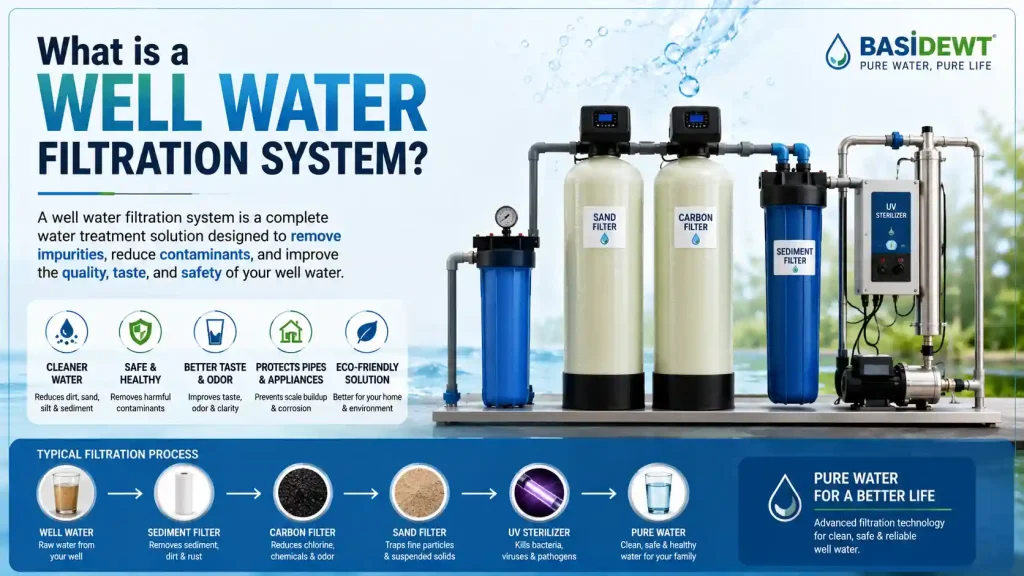
A well water filtration system works in layers. Each layer has a specific job. Water passes through each stage in order, with each stage removing different contaminants. By the time water exits the system, it has been treated at every level.
Stage 1 — Sediment Pre-Filtration
This is always the first stage. A sediment filter removes large particles — sand, silt, rust, and debris — before they reach any other equipment. This stage is critical. Sediment damages RO membranes, clogs UV lamp sleeves, and destroys softener resin beds.
A 5-micron sediment cartridge captures most particles. In very sandy or turbid well water, a two-stage sediment approach (20 micron followed by 5 micron) works better.
Stage 2 — Iron and Manganese Removal
Well water with iron above 0.3 ppm needs dedicated iron removal. Standard carbon filters and softeners cannot effectively handle high iron levels. An iron removal filter uses oxidation to convert dissolved iron into solid particles. These particles are then captured by the filter media.
Manganese is treated the same way. Both contaminants must be removed before water reaches downstream components. Iron fouls softener resin. It also coats UV lamp sleeves, blocking UV light and preventing effective disinfection.
Stage 3 — Water Softening
Hard water is extremely common in private well supplies. A water softening system uses ion exchange technology to remove calcium and magnesium. The resin bed inside the softener tank attracts hardness ions and replaces them with sodium ions. The result is soft water that does not scale pipes, water heaters, or appliances.
Softening also protects every downstream component. An RO membrane in hard water without pre-softening scales and fails within months. A water softener upstream prevents this and dramatically extends membrane life.
Stage 4 — Carbon Filtration
Activated carbon removes chlorine, chloramines, volatile organic compounds, pesticides, herbicides, and chemical taste and odor. Well water often contains hydrogen sulfide gas, which creates a rotten egg smell. Carbon filtration effectively removes this odor.
Carbon is an essential stage in any complete well water treatment system. It handles chemical contaminants that iron filters and softeners do not touch.
Stage 5 — UV Disinfection
Bacteria and viruses cannot be seen, smelled, or tasted. They require a dedicated disinfection stage. A UV water sterilizer uses ultraviolet light at 254 nanometers wavelength. This UV-C light damages the DNA of bacteria and viruses, rendering them unable to reproduce. They die and pass harmlessly through the system.
UV disinfection adds no chemicals to the water. It does not affect taste or odor. It works in seconds as water flows through the UV chamber.
This stage is non-negotiable for well water. Bacterial contamination in private wells is far more common than most homeowners realize.
Stage 6 — RO Polishing (Optional for Drinking Water)
For the highest purity drinking water, a well water reverse osmosis system adds a final purification stage at the kitchen tap. An RO membrane removes dissolved solids, heavy metals, nitrates, arsenic, fluoride, and any remaining contaminants that previous stages did not address.
RO produces water with TDS as low as 5–20 ppm. This is the closest to truly pure water available from a home treatment system.
What Does a Well Water Filtration System Remove?
A complete multi-stage well water filtration system removes:
- Sand, silt, rust, and sediment
- Iron and manganese
- Calcium and magnesium (hardness)
- Hydrogen sulfide (rotten egg odor)
- Chlorine and chemical contaminants
- Bacteria, viruses, and microorganisms
- Nitrates (with RO stage)
- Heavy metals including lead and arsenic (with RO stage)
- Volatile organic compounds and pesticides
- Turbidity and cloudiness
This comprehensive removal addresses virtually every contaminant commonly found in private well water.
How to Choose the Right Well Water Filtration System
The correct system for your home depends entirely on what is in your water. There is no universal solution. Every well is different.
Step 1 — Test Your Water
This is the most important step. Never buy any filtration equipment without testing first. A water test tells you exactly which contaminants are present and at what concentrations. This guides every equipment decision.
Test for: hardness, iron, manganese, pH, TDS, nitrates, bacteria (coliform and E. coli), arsenic, and hydrogen sulfide.
Step 2 — Identify Your Priority Contaminants
After testing, rank your contaminants by severity. Bacteria and nitrates are health-critical — they must be addressed first. Iron and hardness are quality-of-life issues that also damage equipment. Sediment protects everything downstream.
Step 3 — Match Treatment Stages to Contaminants
Use your test results to build your treatment train:
| Contaminant | Treatment Stage Needed |
| Sediment, rust, sand | Sediment pre-filter |
| Iron above 0.3 ppm | Iron removal filter |
| Hardness above 7 GPG | Water softener |
| Hydrogen sulfide odor | Carbon filtration |
| Bacteria, coliform | UV sterilizer |
| Nitrates, arsenic, heavy metals | Reverse osmosis |
| All dissolved solids | RO membrane stage |
Step 4 — Size the System to Your Flow Rate
A whole house well water filtration system must handle your peak demand. Peak demand occurs when multiple fixtures run simultaneously. A family of four with three bathrooms needs at least 12–15 GPM flow capacity.
An undersized system creates pressure drops. This means weak showers, slow-filling appliances, and frustrated family members.
Step 5 — Consider Maintenance Requirements
Every filtration system requires ongoing maintenance. Sediment cartridges need replacement every 3–6 months. Carbon cartridges every 6–12 months. UV lamps annually. Softener salt monthly. RO membranes every 2–3 years.
Choose a system with accessible components and widely available replacement parts. Our whole house well water filter system is designed for straightforward maintenance with standard cartridge sizes.
Well Water Filtration System vs Point-of-Use Filter
Many homeowners start with a single under-sink filter and wonder if that is sufficient. The answer is no — for well water, a point-of-use filter is not enough on its own.
Point-of-use filters treat water at a single tap. They are ideal for final polishing of drinking water. They do not protect your pipes, water heater, washing machine, or showers from iron, sediment, and hardness damage.
Whole house well water filtration systems treat all incoming water. Every fixture, appliance, and tap receives treated water. Pipes are protected from scaling. The water heater runs efficiently. Clothes come out cleaner. Skin and hair feel better after showering.
For well water, a whole house approach is always the correct starting point. Add a point-of-use RO system for premium drinking water quality at the kitchen tap.
Signs Your Well Water Needs Filtration
Many homeowners do not realize their well water has problems until the signs become obvious. Watch for these warning indicators:
Orange or rust-colored stains on sinks, toilets, and bathtubs indicate iron in the water. This is one of the most common well water problems.
White scale deposits on faucets, showerheads, and kettles indicate hard water. Scale also builds up inside pipes and appliances invisibly.
Rotten egg smell coming from hot water taps indicates hydrogen sulfide gas. This is a common well water odor problem.
Cloudy or sandy water indicates sediment entering the well. This can damage appliances and block screens and filters throughout the home.
Metallic taste in water indicates dissolved metals — iron, manganese, or copper from corroded pipes.
Recurring gastrointestinal illness among family members could indicate bacterial contamination. This requires immediate water testing and UV treatment.
If you notice any of these signs, test your water immediately. Do not wait for the problem to worsen.
How Often Should You Test Your Well Water?
The CDC recommends testing private well water at minimum once per year. Test more frequently if:
- You notice a change in water taste, smell, or appearance
- There has been flooding near your property
- Nearby land use has changed (new farms, construction, industrial activity)
- A family member becomes ill without a clear cause
- You have had any work done on the well casing or pump
Annual testing is a small cost compared to the health risk of contaminated drinking water. Many local health departments offer low-cost or free well water testing programs.
The Role of Each Component in a Complete System
Understanding what each component does helps you make better decisions and maintain your system correctly.
Sediment filter housing — The physical enclosure that holds sediment cartridges. A water filter housing must be rated for your operating pressure and compatible with your cartridge size.
Filter cartridges — The replaceable media inside the housing. Different cartridge types target different contaminants. A water filter cartridge choice determines what your system actually removes.
Water softener — Handles hardness minerals and some low-level iron. Contains ion exchange resin that must be periodically regenerated with salt.
UV sterilizer — Final biological safety barrier. Requires clear water upstream to function effectively. Iron and sediment in water reduce UV penetration.
RO membrane — For drinking water purity. Removes the dissolved contaminants that other stages cannot address. Protected by all upstream stages.
Frequently Asked Questions
Q: Can I drink well water without a filtration system?
A: Technically yes, but it is a significant health risk. Well water can contain bacteria, nitrates, arsenic, and other contaminants that cause serious illness. Always test your well water annually and treat based on results.
Q: How much does a well water filtration system cost?
A: A basic sediment and carbon system costs $300–$800. A complete multi-stage system with softener and UV runs $1,500–$4,000 depending on capacity and configuration. Adding an RO stage for drinking water adds $200–$600.
Q: Do I need a water softener if I have a well?
A: Only if your water hardness exceeds 7 grains per gallon (GPG). Test your water hardness first. Many wells have moderate to very hard water, making a softener essential for appliance and pipe protection.
Q: How long does a well water filtration system last?
A: The main system components — tanks, housings, and UV chambers — last 10–20 years with proper maintenance. Consumable components like cartridges, UV lamps, and softener resin are replaced on regular schedules.
Q: Does a well water filtration system remove bacteria?
A: A UV sterilizer stage removes bacteria and viruses. Sediment and carbon filters do not. If bacterial contamination is a concern, UV disinfection is a non-negotiable component of your system.
Q: How do I know what filtration system my well water needs?
A: Get a comprehensive water test first. Test results tell you exactly which contaminants are present. Then build your treatment train to address each contaminant in the correct sequence.
Conclusion
A well water filtration system is not optional for private well owners — it is essential. Your family’s health, your appliances, your plumbing, and your daily water quality all depend on treating your raw well water before it enters your home.
The right system starts with a water test. Test results guide every equipment decision. Match your treatment stages to your specific contaminants. Size the system to your household flow rate. Maintain it on schedule.
Done correctly, a complete well water filtration system delivers safe, clean, great-tasting water at every tap in your home — for 10 to 20 years or more.
RELATED POSTS
how much does a home water treatment system cost
RO Membrane Pressure Requirements: PSI, Temperature & Feed Water Guide
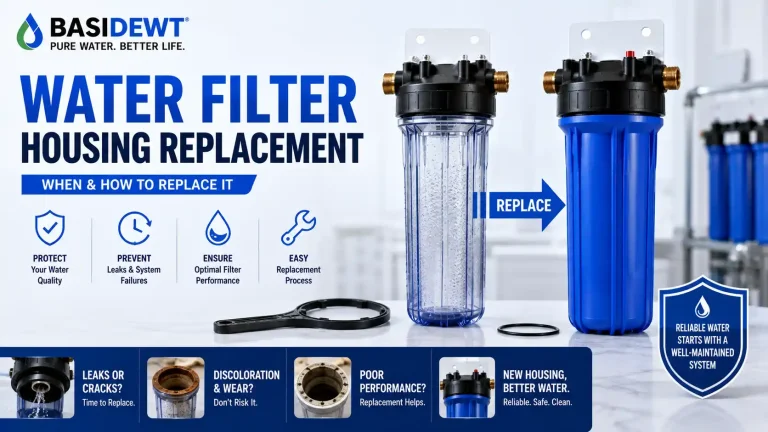
Water Filter Housing Replacement: When & How to Replace It
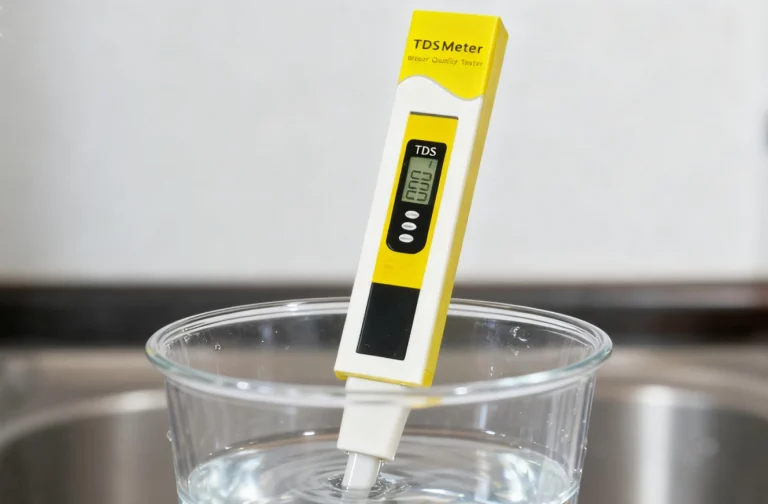
The Ultimate Guide to TDS Meters for Drinking Water
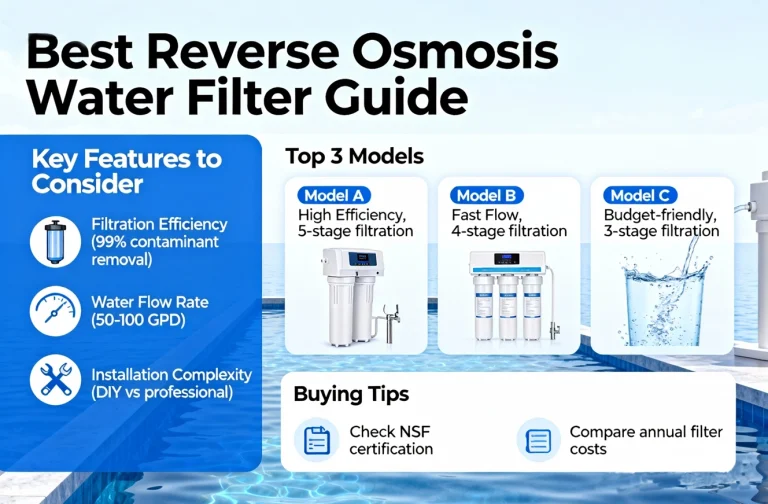
What Is The Best Reverse Osmosis Water Filter