BasideWT- Whole Home Water Filtration System & Replacement

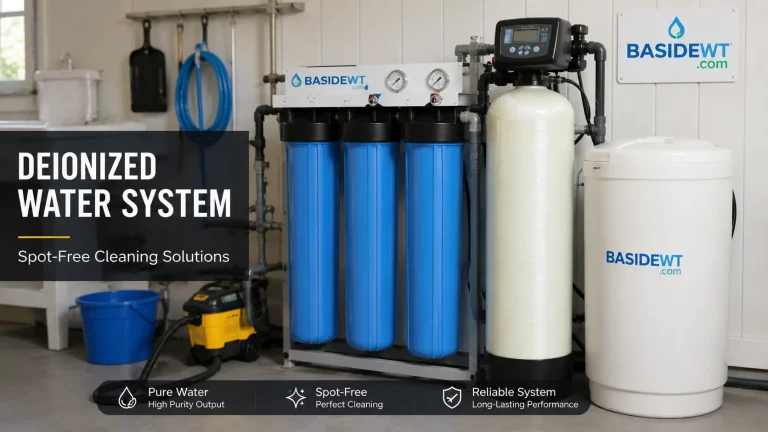
Deionized Water System: The Complete Guide for Car Wash, Window Cleaning & Industrial Use
Water looks simple. But it isn’t. Every tap, well, and city supply carries dissolved minerals you can’t see. You only notice them once they dry on a clean surface and leave a chalky ring behind.
If you run a car wash, a window cleaning business, a solar farm maintenance crew, or a manufacturing line, you already know this problem by name: water spots.
A deionized water system fixes this at the source. Instead of chasing spots with a towel after every rinse, you remove the minerals that cause them before the water ever touches the surface.
This guide covers what a deionized water system is, how it works, what it costs, how to choose one, and how to keep it running for years. We go deeper than most guides on the operational side, too.
By the end, you’ll understand the chemistry, the hardware, the maintenance schedule, and the buying decisions. That’s true whether you run a single detailing bay or a full commercial car wash line.
What Is a Deionized Water System? (Quick Answer)
A deionized water system is a water treatment unit. It removes dissolved mineral ions from water using ion exchange resin, often paired with reverse osmosis.
The result is ultra-pure water at or near 0 ppm TDS. This water air-dries without leaving spots, which is why it’s used for car washing, window cleaning, and industrial rinse work.
Key Takeaways
- A deionized water system removes dissolved minerals so rinse water dries without spots.
- Most systems use mixed-bed DI resin, which combines cation and anion resin in one tank for maximum purity.
- Pairing reverse osmosis (RO) with DI resin extends resin life and lowers cost per gallon at commercial volume.
- DI water is not the same as softened water or distilled water. Each solves a different problem.
- Replace resin based on TDS readings, not a fixed schedule, since exhaustion depends on feed water quality and volume treated.
- Car washes, window cleaning companies, solar farms, and manufacturing plants across China are among the fastest-growing users of RO/DI systems.
- The right system size depends on your feed water TDS and daily water demand, not on price alone.
Spotless Water System Explained
You’ll see the term spotless water system throughout this guide. It’s the commercial name for equipment built to produce spot-free rinse water. In practice, it almost always means an RO/DI resin deionized water system rather than a DI-only cartridge.
A true spotless water system combines reverse osmosis pretreatment with a mixed-bed DI resin stage. It also gives you a live TDS reading and is sized around your actual feed water conditions, not a generic cartridge.
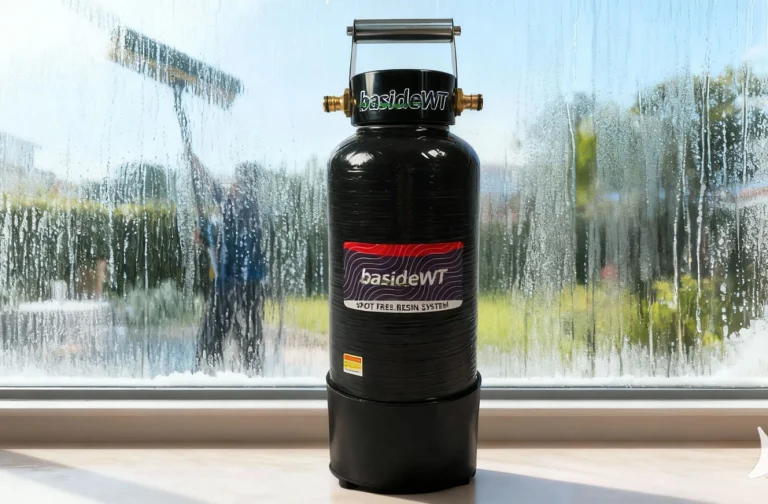
Our RO/DI resin deionized water system for spotless car wash and window cleaning was built around exactly this idea. It uses RO pretreatment for the bulk of the mineral load, a mixed-bed DI tank to polish to 0 ppm, and a built-in monitor so staff never have to guess when resin needs attention.
Keep this distinction in mind. Terms like “spotless water system,” “deionized water system,” and “DI water filter” often get used interchangeably, but they sit at different points on the same spectrum, from a small resin cartridge up to a full commercial RO/DI installation.
The Science Behind Deionized Water
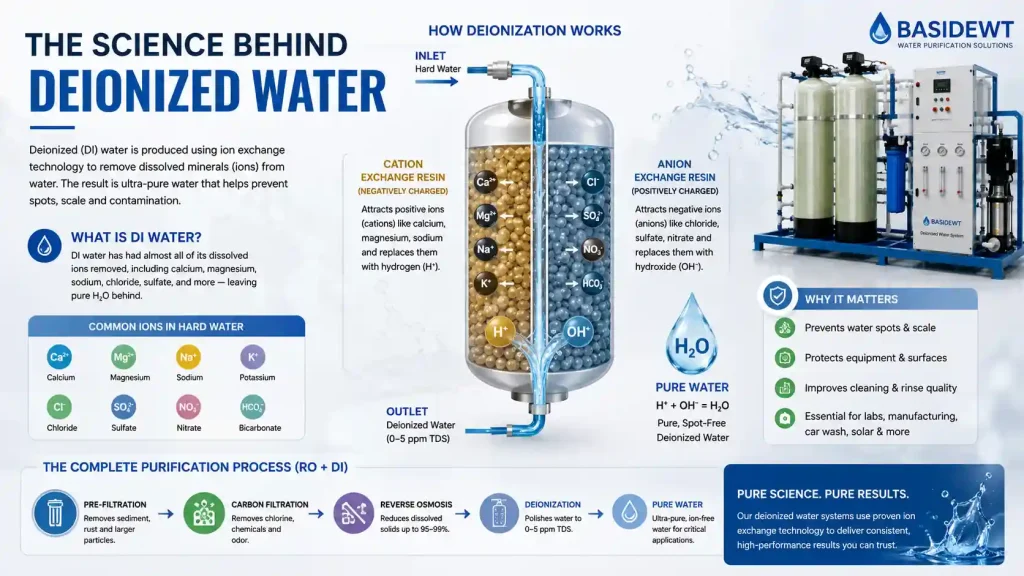
A deionized water system removes dissolved ions using ion exchange resin. These ions are the electrically charged particles left behind by minerals like calcium, magnesium, sodium, and iron. The output is deionized (DI) water, also called demineralized water, which reads at or near 0 ppm on a Total Dissolved Solids (TDS) meter.
Ordinary tap water is never pure H₂O. It carries positive ions (cations) like calcium and magnesium, and negative ions (anions) like chlorides and sulfates. These minerals make water “hard.” They’re also what leaves that white, crusty residue on shower doors and faucets.
A deionized water system passes water through beds of resin beads. These beads swap mineral ions for hydrogen (H⁺) and hydroxide (OH⁻) ions, which combine to form pure water. The minerals stay trapped in the resin.
As a result, the water evaporates without leaving a mineral trace. That’s why deionized water systems are standard equipment for spot-free car washing, streak-free window cleaning, and precision manufacturing rinse work.
A note on terms: “deionized water,” “demineralized water,” and “DI water” all mean the same thing. A “water deionizer” is the hardware. A “deionized water filter” usually means the resin cartridge or tank itself.
How Pure Is Deionized Water, Really?
We measure purity by TDS (total dissolved solids) in parts per million, or sometimes by conductivity in microsiemens. Standards like ASTM D1193 and ISO 3696 define the water purity grades labs use worldwide. Commercial DI resin is commonly made to NSF/ANSI material standards for safe use in water treatment equipment.
Municipal tap water in most Chinese cities typically ranges from 80 to 300 ppm TDS, depending on the region. Groundwater tends to run higher than surface water. A working deionized water system brings that number down to 0-5 ppm, low enough that no visible spots form as the water dries.
This is different from water that just “looks clean.” Filtered water that passed through a sediment or carbon filter can look crystal clear and still carry 200+ ppm of dissolved minerals. Why? Sediment and carbon filters remove particles and chemicals, not dissolved ionic minerals.
That distinction trips up a lot of first-time buyers. We cover it in more depth in our RO vs DI section below.
How Does a Deionized Water System Work?
At the core of every deionized water system is ion exchange resin. These are tiny plastic beads, usually made of polystyrene, treated to carry either a positive or negative charge. When water flows through a tank packed with this resin, three things happen:
- Cation resin attracts positive minerals (calcium, magnesium, sodium, potassium, iron) and releases hydrogen ions (H⁺) in their place.
- Anion resin attracts negative minerals (chloride, sulfate, nitrate, bicarbonate) and releases hydroxide ions (OH⁻) in their place.
- The released H⁺ and OH⁻ ions combine to form H₂O, plain water, while the minerals stay locked onto the resin beads.
Most systems use what’s called mixed bed resin. This means the cation and anion beads sit blended together in one tank, instead of two separate tanks (called dual-bed, more common in large industrial setups). Mixed bed resin produces higher purity water in a single pass, because the ion exchange reaction happens continuously as water moves through the beads.
The Role of Reverse Osmosis (RO) Before Deionization
For most commercial uses, especially car washes and window cleaning businesses, a standalone DI resin tank isn’t the most economical choice. Here’s why: DI resin has a fixed capacity, so the more minerals it removes, the faster it gets exhausted.
This is where reverse osmosis comes in. An RO membrane forces water under pressure through a semi-permeable membrane. The pores are small enough to block roughly 95-99% of dissolved minerals, along with bacteria, viruses, and other contaminants.
RO alone typically brings feed water down from 150-300 ppm to somewhere around 5-15 ppm, depending on membrane condition. By pairing RO pretreatment with a DI resin stage, an RO DI system, the resin only has to handle a small fraction of the mineral load.
As a result, resin life extends dramatically, often by a factor of ten or more. This is why nearly every serious commercial spotless water system uses this two-stage RO + DI architecture instead of DI resin alone. It’s also the exact design behind our RO/DI resin deionized water system for car wash and window cleaning.
Components of an RO/DI Water System
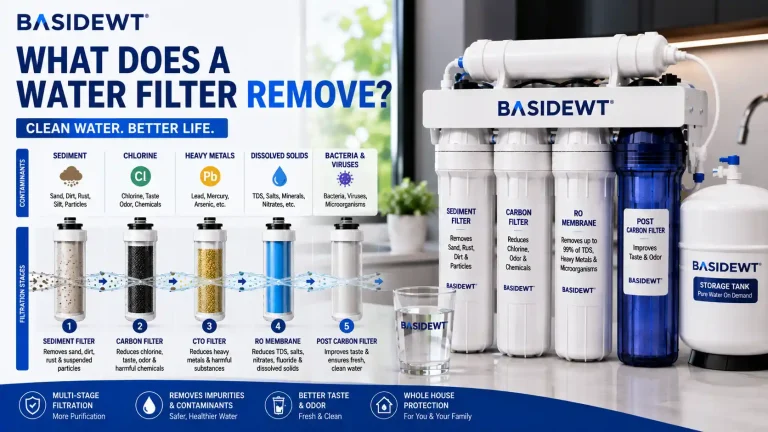
A complete commercial-grade RO DI system usually includes eight stages, in order. Here’s what each one does:
| Stage | Component | Function |
|---|---|---|
| 1 | Sediment pre-filter | Removes sand, rust, and debris before it reaches the membrane |
| 2 | Carbon pre-filter | Removes chlorine and chloramine that would damage RO membranes |
| 3 | RO membrane(s) | Removes 95-99% of dissolved solids, bacteria, and organics |
| 4 | Booster pump | Increases feed pressure, especially with low incoming water pressure |
| 5 | DI resin tank (mixed bed) | Polishes remaining trace minerals down to 0 ppm |
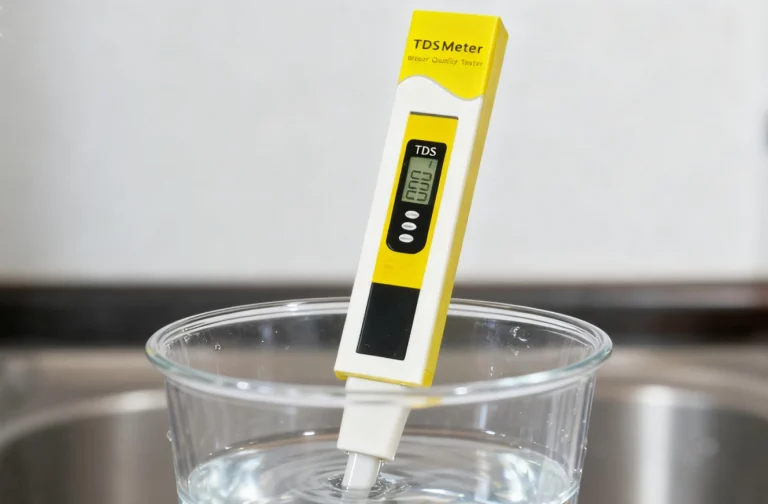
| 6 | TDS meter / monitor | Shows real-time purity so operators know when resin needs replacing |
| 7 | Storage tank (optional) | Holds treated water for on-demand use in high-volume operations |
| 8 | Distribution pump and hose reel | Delivers finished water to the wash bay or rinse station |
Smaller operations don’t always need all eight stages. A single detailing bay, a residential user, or a mobile window cleaning van can often get by with a simpler setup: a pre-filter, a DI resin cartridge, and a bypass valve with an inline TDS meter.
This skips the RO stage entirely and relies on deionized water filter cartridges. It’s cost-effective at low volumes, but gets expensive fast as usage scales up. Why? You end up paying for resin to do work an RO membrane could handle more cheaply.
Understanding DI Resin Types
Not all resin is equal. This is one area where other guides tend to skip important detail.
- Cation resin (H-form): Removes positive ions. Strong-acid cation resin is standard for most spot-free work, since it performs across a wider pH range.
- Anion resin (OH-form): Removes negative ions. Strong-base anion resin is more common in mixed beds, because it removes silica and carbon dioxide more effectively. This matters if your feed water is silica-heavy, which happens with some groundwater.
- Color-changing resin: Contains a dye that shifts color as the resin nears exhaustion, giving a visual cue without a TDS meter.
- Non-color-changing resin: Has slightly higher raw capacity, since none of the bead volume goes toward the dye. However, it requires a TDS meter for monitoring.
Neither type is objectively better. The right choice depends on whether your team prefers a visual check or a numeric reading.
Mixed Bed vs Separate Bed Resin
Mixed bed and separate bed resin solve the same problem in different ways. Here’s how they compare:
| Factor | Mixed Bed Resin | Separate (Dual) Bed Resin |
|---|---|---|
| Configuration | Cation and anion beads blended in one tank | Cation and anion beads in two separate tanks |
| Output purity | Higher, single-pass | Slightly lower per pass, needs polishing |
| Common use | Car wash, window cleaning, detailing | Large industrial and lab systems |
| Regeneration | Usually replaced, not regenerated on-site | Can be regenerated with acid/caustic on-site |
| Footprint | Compact, single tank | Larger, two tanks plus plumbing |
For car wash, window cleaning, and most commercial cleaning jobs, mixed bed resin is the practical choice. Separate bed systems make more sense for large industrial plants that regenerate resin on-site.
Reverse Osmosis vs Deionization: What’s the Real Difference?
This is one of the most searched questions on this topic. So let’s give it a clear, direct answer instead of a vague comparison.
RO is a physical process. It filters water through a membrane. DI, on the other hand, is a chemical process that exchanges ions on resin. Here’s how the two stack up side by side:
| Factor | Reverse Osmosis (RO) | Deionization (DI) |
|---|---|---|
| Removal method | Physical filtration through a membrane | Chemical ion exchange with resin |
| Removes dissolved minerals | Yes, 95-99% | Yes, effectively 100% |
| Removes bacteria/viruses | Yes | No |
| Removes organics/chlorine | Partially | No |
| Typical output TDS | 5-15 ppm | 0-5 ppm |
| Wastewater produced | Yes, 20-50% reject water | No |
| Operating cost driver | Membrane replacement, electricity | Resin replacement |
| Best used | As pretreatment or standalone for drinking-quality water | As a final polishing stage or standalone for small-volume rinsing |
RO produces very good water but generates some wastewater along the way. DI produces near-perfect water with no wastewater, but the resin gets used up and needs regular replacement.
For spot-free rinsing, DI alone can reach 0 ppm. However, if your feed water is above roughly 150-200 ppm, running DI-only gets expensive fast, since you’ll burn through resin quickly. That’s the practical reason for combining both technologies, rather than treating this as an either/or choice.
We cover this comparison in more depth, including cost modeling for different feed water conditions, in our RO vs DI water for car wash use guide.
RO vs DI vs Water Softener: Don’t Confuse the Three
Here’s a common question from first-time buyers: “I already have a water softener. Why do I still need a deionized water system?” Both technologies deal with hard water, but they solve different problems.
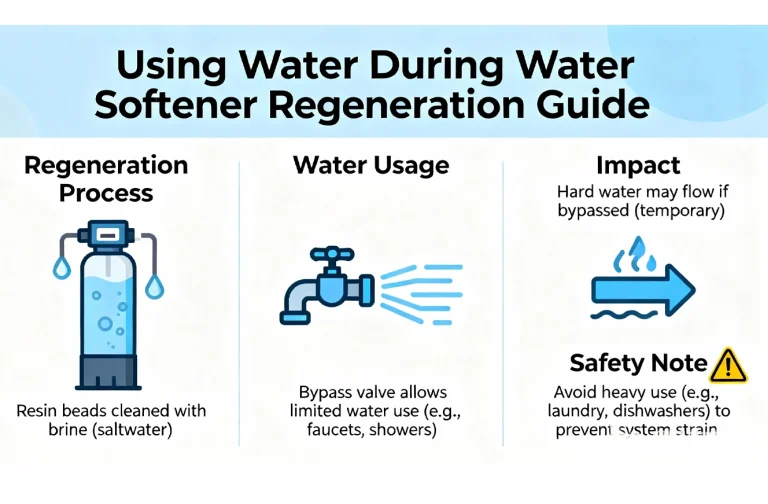
A water softener uses ion exchange too, but it only swaps hardness minerals (calcium and magnesium) for sodium ions. Sodium is still a dissolved solid. So softened water reads a high TDS; it just doesn’t form crusty limescale. Softened water alone will still leave spots when it air-dries.
| Factor | Water Softener | Reverse Osmosis (RO) | Deionization (DI) |
|---|---|---|---|
| What it removes | Calcium and magnesium only (swapped for sodium) | 95-99% of all dissolved solids | Effectively 100% of remaining ions |
| Output TDS | Still high (sodium remains) | 5-15 ppm | 0-5 ppm |
| Prevents water spots | No | Mostly | Yes |
| Common use | Protecting pipes and appliances from scale | Pretreatment or drinking water | Final polishing for spot-free rinse |
| Regeneration | Salt brine flush | Membrane replacement | Resin replacement |
Here’s the practical takeaway: a water softener protects your plumbing and cuts down on scale, but it won’t produce spot-free rinse water on its own. Many businesses actually run both, a softener to protect equipment upstream, and an RO/DI system for the final spot-free rinse. If you’re only investing in one system for rinse-water quality, deionization (ideally paired with RO) is the one that actually stops spotting.
DI Water vs Distilled Water: What’s the Difference?
Here’s another common point of confusion: is deionized water the same as distilled water? No, it isn’t. Both count as “pure” water, but they get there in different ways.
Distilled water comes from boiling water into steam, then condensing it back into liquid. This leaves minerals and most contaminants behind. Deionized water, meanwhile, comes from passing water through ion exchange resin that strips out charged minerals.
| Factor | Distilled Water | Deionized Water |
|---|---|---|
| Process | Heat and condensation | Ion exchange resin |
| Removes minerals | Yes | Yes |
| Removes bacteria/pathogens | Yes | No, not by itself |
| Energy required | High (heating) | Low (no heating) |
| Typical TDS | Near 0 ppm | Near 0 ppm |
| Production speed | Slow, batch process | Fast, continuous flow |
| Best for | Drinking water, medical use | Spot-free rinsing, industrial cleaning |
For rinse-water jobs like car washing and window cleaning, deionized water is the practical pick. It’s faster to produce at volume and doesn’t need energy-intensive heating, yet it reaches the same near-0 ppm TDS that prevents spotting. Distillation makes more sense for drinking water or medical uses, where killing pathogens matters as much as removing minerals.
Why RO + DI Produces Truly Spot-Free Water
Water spots form because dissolved minerals don’t evaporate along with a water droplet. Instead, they stay behind and concentrate into a visible residue as the droplet shrinks. The higher the starting mineral content, the more visible the spot.
At 0 ppm TDS, there’s essentially nothing left in the water to concentrate. A droplet of true deionized water can evaporate completely and leave no trace. That’s why detailers, commercial car washes, and window cleaning crews rely on this final rinse step instead of hand-toweling every surface dry.
There’s a threshold worth knowing about here: water doesn’t need to hit literal 0 ppm to look spot-free. Many pros find readings under 10 ppm look identical to 0 ppm on most surfaces. However, perfectionists working on dark vehicle paint or optical-grade glass often replace resin earlier, since darker and more reflective surfaces show even faint residue more easily.
Benefits of Deionized Water Systems
The advantages go well beyond “no more towel drying,” though that alone is often reason enough to invest. Here’s the fuller picture.
Labor savings. Hand-drying a vehicle or a bank of windows after every rinse is one of the slowest steps in a cleaning workflow. A spot-free rinse removes that step entirely, which means more jobs finished per day with the same staff.
Better final finish quality. Towel drying carries its own risk. Trapped grit on a towel can create fine scratches, called swirl marks, on vehicle paint or glass. Air-drying with deionized water removes that risk completely.
Reduced chemical use. Some businesses use spot-removing sprays as a workaround for hard water spots. A deionized water system removes the need for that step, cutting both cost and environmental impact.
Protects equipment. Mineral buildup inside pipes, nozzles, and pressure washer parts shortens equipment life. Using deionized water for final rinse stages reduces this buildup throughout the system.
Consistent, repeatable results. Manual drying quality varies by staff member and fatigue level. A properly maintained deionized water system, on the other hand, produces the same near-0 ppm output every time.
Works across many surfaces. The same core benefit, zero mineral residue, applies whether you’re rinsing vehicle paint, glass, solar panels, or stainless steel equipment.
Expert Tips From the Field
A few habits separate businesses that get years of trouble-free service from those that constantly fight spotting problems.
- Measure feed water TDS before selecting a system. Sizing without this number is guesswork.
- Replace sediment filters before membranes. A clogged sediment filter is the top cause of premature RO membrane failure.
- Monitor TDS daily, not weekly. Small shifts in feed water quality show up fastest in daily readings.
- Size systems for daily demand, not average demand. Peak days expose undersized systems first.
- Never buy based on price alone. The cheapest unit is rarely cheapest to run once you factor in resin and membrane costs.
- Keep a simple maintenance log. Recording TDS readings and filter changes makes troubleshooting much faster.
- Flush the system after any idle period. Standing water in resin beds invites biofilm growth.
Industries That Use RO/DI Water: Applications and Use Cases
Deionized water shows up across a wide range of industries. Here’s where it makes the biggest difference.
Car Wash and Auto Detailing
This is the most common commercial use. A dedicated RO DI system for spotless car wash and window cleaning usually goes in as the final rinse stage, after soap and pressure-wash steps run on regular or softened water. Only the finishing rinse uses deionized water, which keeps operating costs manageable.
Commercial car washes in China, from busy urban locations to highway service stations, increasingly add this final-rinse stage to cut labor time and deliver a more consistent finish. See our guide to DI water for car washing for workflow sequencing, and our best deionized water systems for car washing roundup for sizing comparisons.
Window Cleaning
Professional window cleaners, especially on multi-story buildings, have made deionized water combined with water-fed pole systems an industry standard. Since DI water leaves no residue, windows can be rinsed and left to air-dry with no streaks. This eliminates squeegee finishing on many jobs.
That matters most on high-rise glass, where minimizing pole or lift time saves real money. Window cleaning companies in China servicing office towers and commercial buildings are a growing segment of this market. See our resource on DI water systems for window cleaning for the pole-fed setup.
Solar Panel Cleaning
Solar panel output drops when panels carry dust or mineral spots left behind by hard water rinsing. Since solar farms often sit in dry regions with harder water, deionized rinsing avoids adding new mineral residue on top of the dust problem.
This matters more as utility-scale solar farms in China expand across the western and northern provinces, where both water hardness and panel soiling tend to run higher than average.
Industrial and Manufacturing Use
Electronics assembly, precision metal finishing, circuit board production, and pharmaceutical packaging all depend on mineral-free rinse water. For higher-volume, continuous-duty needs, a commercial RO water filtration system paired with DI polishing is typically the right setup.
Manufacturing plants across China’s coastal industrial zones, along with facilities further inland, rely on this same RO/DI architecture to protect sensitive components and finished products from mineral residue.
Laboratory Use
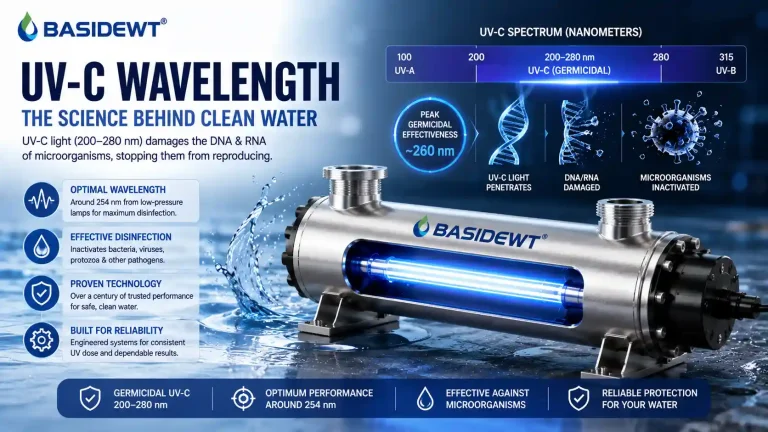
Laboratories need deionized or ultra-pure water for reagent prep and analytical work, where trace minerals can throw off results. Lab-grade systems often add extra polishing stages, like UV sterilization, beyond a standard car wash or window cleaning setup.
Pressure Washing, Marine, and RV Detailing
For pressure washing, building exteriors, driveways, boats, a deionized final rinse stops spotting from undoing an otherwise thorough wash. Boats, yachts, and RVs face an even tougher challenge: larger surfaces, more sun, and salt-laden air. Marina detailing operations and RV services increasingly use the same RO/DI approach to keep glass and gel-coat genuinely spot-free.
Food and Beverage Processing
Certain production steps, equipment rinsing, container final rinse, ingredient prep, call for low-mineral water to protect taste, clarity, and shelf life. Facilities here typically pair RO with DI polishing plus extra sanitation steps.
Best Deionized Water System for Car Washing
Since car wash and detailing use is the single largest category searching for this topic, let’s answer the question directly: what actually makes a deionized water system “best” for car washing?
Look for these features in a car-wash-focused system:
- RO pretreatment included, not just a DI cartridge, if your shop washes more than a handful of vehicles daily. This is the single biggest factor in keeping cost per gallon manageable.
- A visible, real-time TDS readout, so staff can check purity between vehicles without a separate handheld meter.
- A flow rate matched to your rinse workflow, typically 2-4 GPM for spot-free final rinse work.
- A bypass valve, so the system only engages for the final spot-free rinse. This extends resin and membrane life.
- Portability or fixed-mount options that match your bay layout, since retrofitting plumbing later causes real disruption.
Pros: eliminates hand-drying, delivers a consistent professional finish, reduces paint-marring risk, and pays back through labor savings at moderate-to-high volume.
Cons: higher upfront cost than a basic DI cartridge, periodic resin and pre-filter upkeep, and the RO stage needs a drain point for reject water.
Our RO/DI resin deionized water system for spotless car wash and window cleaning was designed around this exact checklist: RO pretreatment, mixed-bed DI polishing, real-time monitoring, and a bypass setup. This means shops don’t have to piece together separate components to hit the same result. For a broader comparison of options at different price points and volumes, see our full best deionized water system for car washing roundup.
Commercial vs Portable Deionized Water Systems
Buyers often assume “commercial” just means bigger. But the differences go beyond tank size.
| Factor | Portable DI System | Commercial RO/DI System |
|---|---|---|
| Typical user | Mobile detailer, home enthusiast, small window cleaning crew | Fixed car wash, manufacturing plant, large window cleaning company |
| Water source | Garden hose, water tank | Plumbed building supply |
| Includes RO stage | Rarely | Almost always |
| Daily capacity | A handful of vehicles | Dozens to hundreds of vehicles, or continuous industrial duty |
| Monitoring | Handheld or basic inline TDS meter | Integrated TDS monitoring, sometimes with data logging |
| Footprint | Wheeled cart, fits in a van | Dedicated utility room or bay |
| Upfront cost | Low | Moderate to high |
| Cost per gallon at scale | High | Low |
Neither option beats the other in every case; it depends on volume. A mobile detailer washing a handful of cars a week doesn’t need commercial RO infrastructure. Meanwhile, a car wash processing over a hundred vehicles a day can’t run economically on cartridge resin alone. Our commercial RO water filtration system line and spotless water system range cover both ends of this spectrum.
Who Should Buy an RO/DI System — and Who Shouldn’t
Not every business needs the full RO/DI setup. Here’s how to figure out where you fall.
Invest in an RO/DI system if:
- You run a commercial car wash, detailing shop, or window cleaning business.
- Your operation handles more than a few dozen jobs weekly.
- Your feed water TDS tests above 150 ppm.
- Hand-drying labor eats into profitability.
- You’re in a hard-groundwater region common across northern China.
- You need consistent finish quality for commercial contracts.
A simpler DI-only cartridge may be enough if:
- You’re a mobile detailer or hobbyist.
- You wash a small number of vehicles weekly.
- Your feed water TDS already tests under roughly 100-150 ppm.
- Portability matters more than raw throughput.
You may not need either yet if:
- You wash vehicles occasionally and hand-drying isn’t a real bottleneck.
- Your local water is unusually soft and rarely spots, even untreated.
For most commercial operations in the first group, our RO/DI resin deionized water system for spotless car wash and window cleaning is built specifically for that use case. It combines RO pretreatment and DI polishing in one configured unit.
How to Choose the Right Deionized Water System
Choosing the right system comes down to five practical questions. Skipping any one of these is the most common reason businesses end up with an undersized or oversized system.
1. What is your feed water TDS?
Test your incoming tap or well water with a TDS meter before you buy anything. This number drives almost every other sizing decision. Water at 100 ppm yields roughly three times more usable output from the same resin volume than water at 300 ppm.
2. What is your daily or weekly water volume?
A mobile detailer washing three cars a week has very different needs than a commercial car wash processing 150 vehicles a day. Undersized systems exhaust resin constantly, driving up cost per gallon and creating headaches. Oversized systems, on the other hand, tie up capital you don’t need to spend.
A simple way to estimate system size:
- Estimate final-rinse water use per job. A typical vehicle spot-free rinse uses roughly 2-4 gallons. A full-building window cleaning pole setup can use much more, depending on glass area.
- Multiply by your expected daily or weekly job count to get total treated-water demand.
- Match that demand against your feed water TDS. Higher TDS feed water costs more resin capacity per gallon, so the same daily volume needs a larger resin bed, or an RO stage to cut the load.
- Add a buffer of at least 20-30% for peak-season demand, since most car wash and window cleaning businesses see real seasonal swings.
Getting this calculation right up front makes the difference between a system that runs smoothly for years and one that constantly runs out of capacity mid-shift.
3. Do you need RO pretreatment?
As a rule of thumb, if your feed water TDS is above 150-200 ppm, or your usage is more than a few hundred gallons a week, pairing RO water treatment with DI resin will cost less over time than DI resin alone. The upfront cost is higher, but it pays off.
4. What flow rate do you need?
Flow rate matters more than most buyers realize. Pushing water through DI resin too fast reduces contact time, which lowers purity and shortens resin life through “channeling,” where water finds a path of least resistance instead of contacting the full bed. Most mixed-bed DI systems perform best at 2-4 GPM, so check the rated flow before assuming a higher-flow pump improves throughput.
5. Portable or fixed installation?
Mobile detailers and window cleaning crews typically need a wheeled, portable setup that connects to a garden hose or water tank. Fixed commercial installations, like car washes and manufacturing plants, are usually plumbed directly into the building’s water supply, with a dedicated bay or utility room housing the RO membranes, resin tanks, and storage.
Sizing Table: Matching System Type to Use Case
Here’s a quick reference to match your use case with the right setup:
| Use Case | Recommended Setup | Typical Feed TDS Range Suited |
|---|---|---|
| Mobile detailer, 1-5 vehicles/week | Portable DI resin cartridge with bypass valve | Up to 150 ppm |
| Small detailing shop, 10-30 vehicles/day | RO + DI with storage tank | 100-250 ppm |
| Commercial car wash, 100+ vehicles/day | Commercial RO system + large-capacity DI polishing tank | Any, with RO handling the bulk load |
| Window cleaning crew (pole-fed) | Portable or van-mounted RO + DI unit | 100-250 ppm |
| Industrial/manufacturing continuous use | Commercial RO with dual-bed or mixed-bed DI, storage and recirculation | Any, engineered per facility |
If you’re unsure which category fits your operation, our full deionized water complete guide includes a more detailed decision framework. The priority spotless water system product page also outlines configurations built for car wash and window cleaning operations of different sizes.
How Long Does DI Resin Last?
This is one of the most common questions we get. The honest answer: it depends on your feed water TDS and how much water runs through the system, not the calendar. Resin has a fixed total capacity to absorb minerals before it’s exhausted.
As a rough estimating framework, here’s what to expect:
| Feed Water TDS | With RO Pretreatment | DI Resin Alone (no RO) |
|---|---|---|
| Low (under 100 ppm) | Very long resin life, hundreds to thousands of gallons per resin charge | Long resin life, still economical for moderate volume |
| Moderate (100-250 ppm) | Long resin life, resin mainly polishing trace minerals RO left behind | Noticeably shorter life; resin doing most of the work |
| High (250-400+ ppm) | Resin life still strong since RO absorbs most of the load | Short resin life; expensive to run at any meaningful volume |
This pattern holds across every feed water condition. RO pretreatment extends DI resin life dramatically, often tenfold or more, because the resin only “polishes” a small residual load instead of stripping minerals straight from tap water. That’s the core economic argument for RO/DI over DI-only beyond light, occasional use.
Maintenance and DI Resin Replacement
A deionized water system is low-maintenance compared to most water treatment equipment. However, it isn’t maintenance-free. Neglecting resin replacement is the single most common reason systems stop performing.
How to Know When to Replace Resin
Watch your TDS meter, not the calendar. Resin exhaustion depends on the total volume of water treated and the mineral load in that water, not elapsed time. A shop running high volume in summer will exhaust resin faster than the same shop in a slower month.
As a general guideline:
- 0-5 ppm: Resin is performing well, no action needed.
- 5-10 ppm: Still generally spot-free for most surfaces, but monitor closely.
- 10-20 ppm: Time to order replacement resin. Some fine spotting may start appearing on dark or glossy surfaces.
- 20+ ppm: Resin is functionally exhausted. Replace it before continuing spot-free work.
Resin Replacement Process
- Shut off water supply to the tank.
- Relieve any residual pressure through the bypass or drain valve.
- Remove the tank lid or cartridge housing.
- Empty spent resin (many suppliers accept spent resin for regeneration or disposal).
- Rinse the tank interior to clear any sediment buildup.
- Load fresh mixed-bed resin to the manufacturer’s fill level, leaving room for bed expansion.
- Reassemble, reconnect, and flush for several minutes to rinse any fine resin dust.
- Confirm output reads near 0 ppm on the TDS meter before returning to full production use.
RO Membrane Maintenance
If your system includes reverse osmosis pretreatment, the membrane itself typically lasts 1-3 years, depending on feed water quality and usage. That’s considerably longer than DI resin. Watch for a declining reject-to-permeate ratio or rising output TDS as signs the membrane needs attention.
Pre-filters ahead of the membrane, sediment and carbon, should be replaced every 3-6 months to protect the membrane from early fouling. This is one of the most overlooked maintenance steps and a major cause of early RO membrane failure. When it’s time to replace the membrane, using a proper RO membrane replacement matched to your original system’s specs keeps flow rate and rejection rate on target.
Maintenance Schedule at a Glance
Here’s a quick reference for how often each task needs attention:
| Task | Frequency |
|---|---|
| Check TDS reading | Every shift or before each job |
| Flush system after idle periods | After any period of non-use over a few days |
| Inspect fittings and hoses for leaks | Monthly |
| Replace sediment and carbon pre-filters | Every 3-6 months, sooner in high-sediment areas |
| Replace DI resin | When TDS reading climbs into the 10-20 ppm range |
| Inspect/replace RO membrane | Every 1-3 years, based on performance decline |
| Sanitize system after extended idle storage | Before returning to service after long downtime |
General Upkeep Checklist
- Check TDS readings at the start of each shift, not just when spots appear.
- Flush the system for 10-20 seconds after periods of non-use to clear stagnant water from the resin bed.
- Store portable units upright and protected from freezing, since freezing can crack tank housings and damage resin beads.
- Inspect fittings and hoses monthly for leaks, which waste treated water and reduce system pressure.
- Avoid running feed water that sat in a metal tank or fitting for a long time, since fresh resin can pick up trace metal contamination disproportionately.
Common Problems and Solutions
Most issues with a deionized water system trace back to a handful of causes. Here’s how to spot and fix them:
| Problem | Likely Cause | Solution |
|---|---|---|
| TDS reading climbing steadily | Resin nearing exhaustion | Replace resin; check feed water TDS to estimate remaining life |
| Spots appearing despite low TDS reading | Flow rate too high, reducing resin contact time | Reduce flow to manufacturer’s rated GPM |
| Sudden jump in TDS after storage | Channeling from bed disturbance during transport/storage | Store upright, avoid pressure spikes, flush before use |
| Water tastes/smells odd | Biofilm growth in idle system | Sanitize tank and flush thoroughly; avoid long idle periods with standing water |
| Resin exhausts much faster than expected | Feed water TDS higher than assumed, or RO membrane underperforming | Retest feed water; inspect and if necessary replace RO membrane |
| Low output pressure | Clogged pre-filter or low incoming water pressure | Replace pre-filter; consider booster pump |
| Uneven color change in color-indicator resin | Channeling or uneven bed settling | Repack resin evenly; consider switching to TDS meter monitoring if this persists |
| System won’t reach 0 ppm even with fresh resin | Cross-contamination from a leaking bypass valve mixing treated and untreated water | Inspect and reseat or replace bypass valve seals |
Mistakes to Avoid When Running a Deionized Water System
Even well-built equipment underperforms when a few common mistakes creep in. Watch out for these:
- Running at too high a flow rate. This is by far the most common cause of disappointing results, and it’s an easy fix once you spot it.
- Waiting for visible spots before replacing resin. By the time spots show up, you’ve likely been producing marginal-quality water for a while. Track TDS proactively instead.
- Skipping pre-filter replacement. A clogged or exhausted pre-filter forces sediment and chlorine downstream, which shortens both RO membrane and resin life at once.
- Undersizing the system for peak-season volume. Many car washes and detailing shops see seasonal spikes. Sizing only for average demand leads to resin running out mid-shift during busy periods.
- Ignoring feed water changes. Municipal water quality can shift seasonally or after infrastructure work in your area. Retest periodically instead of assuming your original TDS reading still holds.
- Mixing treated and untreated water by accident. A worn bypass valve seal is a subtle failure that can quietly ruin your finished water quality, with no obvious symptom until spots reappear.
Cost Factors
Total cost breaks into three categories: upfront equipment, ongoing consumables, and labor and utilities.
Upfront equipment cost varies by scale. It ranges from a modest portable DI cartridge setup for a handful of vehicles a week, up to a substantial investment for a full commercial RO DI installation. RO components (membranes, pumps, housings) are typically the largest line item in a combined system.
Ongoing consumables depend mostly on resin replacement frequency, which ties directly to feed water TDS and volume treated, plus pre-filter and membrane replacement on RO-equipped systems. This is why pairing RO with DI, despite the higher upfront cost, tends to produce a lower cost-per-gallon over time for any business treating more than a modest weekly volume. RO absorbs the bulk of the mineral load, leaving resin to handle only fine polishing.
Labor and utility costs, pump electricity and the time for resin swaps and filter changes, stay comparatively small. Still, they shouldn’t be ignored for larger, continuous-duty installations.
In short: DI-only costs less upfront but more per gallon at moderate-to-high feed TDS. RO DI costs more upfront but is meaningfully cheaper per gallon once you’re treating more than a few hundred gallons weekly.
Buying Guide
Look beyond the headline price. Consider these factors before you buy:
Resin capacity and quality. Ask what resin ships with the system (mixed bed vs dual bed, color-changing vs not) and its rated capacity at a stated feed TDS.
Included monitoring. A built-in TDS meter is close to mandatory. Guessing at resin exhaustion wastes both water and results.
Flow rate rating. Confirm the rated GPM matches your intended pump and hose setup, not just general water pressure.
Portability needs. For mobile operations, check wheel quality, handle design, and total unit weight when full.
Warranty and support. This matters especially for RO components, where membrane and pump failures can halt operations if support is slow.
Upgrade compatibility. If you’re starting with DI-only but expect volume growth, check whether an RO pretreatment add-on is available. That way, you won’t need a full replacement later.
Local supplier support in China. Regional water quality varies a lot. Groundwater-fed northern regions typically run higher TDS than surface-water-fed southern cities. A supplier who understands that variation, and stays current with broader industrial water treatment standards referenced by organizations like the International Water Association, helps you size equipment correctly the first time.
Expert Recommendation
For most commercial operations, car washes, window cleaning companies, mid-sized manufacturing, we recommend starting with an RO DI combination system rather than DI-only, even if current volume seems modest. The math favors RO pretreatment once you account for resin replacement over a full year. Also, retrofitting RO into an existing DI-only setup later is far more disruptive than sizing correctly from the start.
Conclusion
A deionized water system is one of the highest-return investments a cleaning or manufacturing business can make when final rinse quality matters. By removing dissolved minerals through ion exchange, paired, for most commercial operations, with reverse osmosis pretreatment, you eliminate water spots at the source instead of fighting them later with towels or chemical spot removers.
The right system depends on your feed water TDS, your volume, and whether you need portability or a fixed installation. Whatever your scale, the fundamentals stay the same: test your water, size for realistic volume including seasonal peaks, monitor TDS instead of guessing, and replace resin and pre-filters on a schedule driven by actual usage.
Businesses across China, from commercial car washes to window cleaning crews to manufacturing facilities, are increasingly adopting deionized water systems as standard equipment rather than an optional upgrade. The reason is simple: the labor savings and finish quality improvements are hard to match with any other approach.
If you’re evaluating options, our RO DI resin deionized water system for spotless car wash and window cleaning is built specifically around the sizing and maintenance principles covered in this guide. Our team can also help you match feed water conditions to the right configuration before you buy.
For further reading on general water quality standards and treatment guidance, the World Health Organization’s water quality resources offer useful background on how dissolved solids and water treatment relate to broader water quality standards.