BasideWT- Whole Home Water Filtration System & Replacement


DI Water Filter Tanks for Window Cleaning: The Hidden Cost of Pure Water and How to Choose Wisely
If you have been researching professional window cleaning equipment(DI Water Filter Tanks), you have inevitably encountered the term “DI Water Filter Tank.” It sounds like a magic bullet—a device that turns ordinary tap water into a spotless, streak-free cleaning solution without the need for squeegees or ladders.
However, as many professionals quickly discover, the Total Cost of Ownership for a DI system varies wildly depending on your local water quality. Choosing the wrong setup can turn a profitable job into a financial drain due to constantly exhausted resin.
In this guide, we cut through the marketing noise. We will explain how deionization works, but more importantly, we will help you calculate whether you need a simple single-stage DI tank or a more expensive multi-stage system to save money in the long run.
What Is Deionization (DI) Resin and How Does It Work?
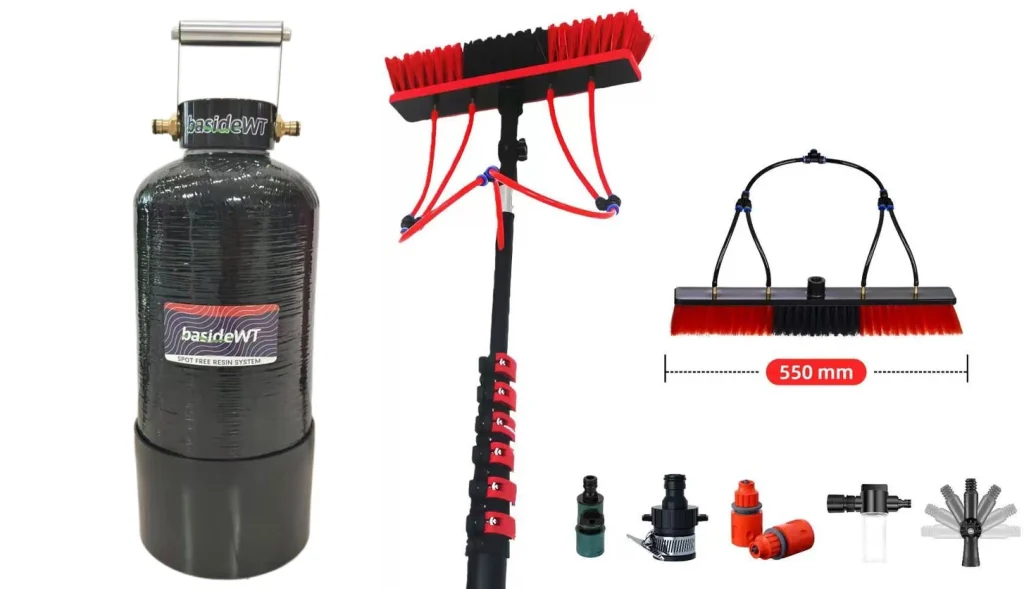
At its core, DI water filter tanks is a cylindrical vessel filled with tiny, specialized beads known as ion exchange resin. To visualize this, think of these resin beads as microscopic magnets. As tap water flows through the tank, these beads attract and capture the “charged” particles—specifically minerals like calcium, magnesium, and chloride—that cause hard water.
The magic lies in the chemistry:
Cationic beads attract positively charged ions.
Anionic beads attract negatively charged ions.
The result is ultra-pure, mineral-free water, measured as 0 Parts Per Million (PPM) on a Total Dissolved Solids (TDS) meter. Because the water is completely stripped of minerals, it becomes a “dirt magnet.” It aggressively bonds with the grime on the glass, and when it evaporates, it leaves zero residue, zero spots, and zero soap streaks behind.
The Problem: Why “Pure Water” Isn’t Always Cheap
Window cleaners often refer to “Pure Water Systems.” But here is the critical distinction many beginners miss: The lifespan of your DI resin is entirely dictated by the TDS of your incoming water.
Water-fed window cleaning relies on rinsing the glass rather than squeegeeing it. If your water has any remaining minerals (TDS above 0), it will leave spots as it dries. Therefore, ensuring you hit 0 PPM is non-negotiable.
However, the journey to 0 PPM is where the cost calculation gets serious. If you are in an area with high TDS (above 250 PPM), the resin in your tank will work overtime, grabbing onto massive amounts of minerals. This exhausts the resin quickly—sometimes in a matter of hours rather than weeks.
Single-Stage vs. Multi-Stage: Which System Is Right for You?
When shopping for a DI water filter tank, you will encounter two primary setups. Understanding the difference is crucial for your bottom line.
1. The DI-Only System (Single Stage)
This is a straightforward tank filled with DI resin. You hook it up to your hose, and the water passes through the resin once before heading up your water-fed pole.
– Upfront Cost: Low.
– Best For: Users with soft water (TDS below 100) or infrequent users who only clean a few windows a month.
– The Catch: If your TDS is high, you will burn through DI resin at an alarming rate. The ongoing cost of replacement resin will quickly surpass the initial savings.
2. The Multi-Stage System (DI as the Final Polish)
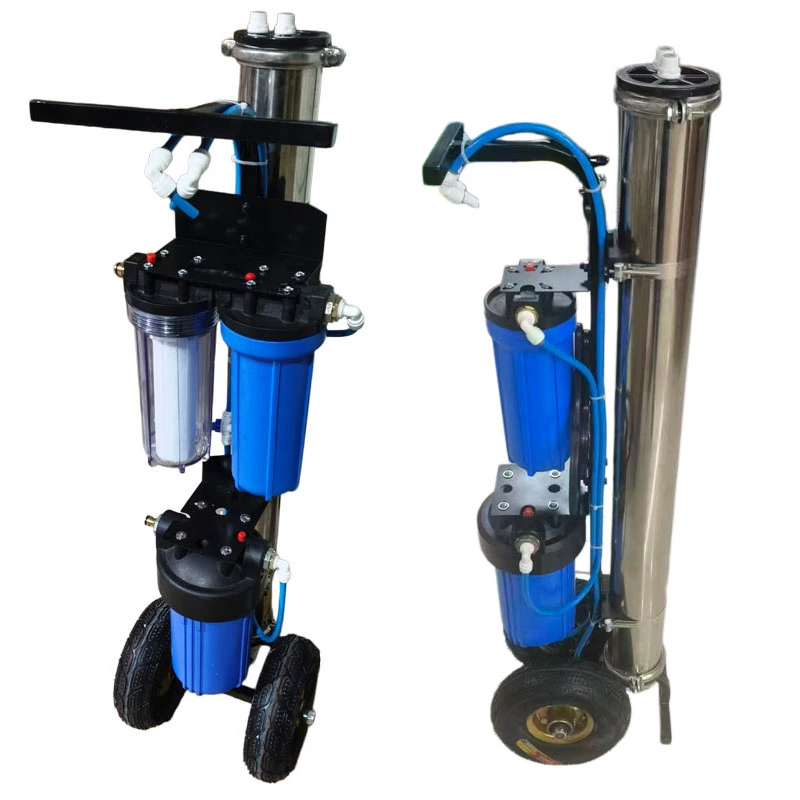
This setup typically includes a Reverse Osmosis (RO) membrane as a pre-filter before the water reaches the DI tank. For example, systems like the BasideWT Pure Water Systems pair RO with DI.
– Upfront Cost: Higher.
– Best For: Areas with hard water (TDS above 150) and daily professional use.
– The Benefit: The RO membrane does the “heavy lifting,” removing roughly 95-98% of the TDS. The DI resin then acts as the “polishing filter” to remove the remaining 2-5%, bringing the water to 0 PPM. Because the DI resin is filtering much purer water, it lasts significantly longer—saving you hundreds of dollars on replacement costs annually.
The Bottom Line: ROI on Your Filtration System
You might think a cheaper tank is a great deal, but let’s look at the math. Suppose you have tap water at 300 TDS.
– A DI-Only System will exhaust its resin after processing a few hundred gallons. You will be replacing that expensive resin weekly.
– A Multi-Stage System processes that 300 TDS down to about 10 TDS via RO. The DI resin then only needs to polish that 10 TDS to 0. Your resin will last roughly 30 times longer compared to the DI-Only setup.
Expert Verdict: If you have soft water or are an occasional user, a standard DI tank is a suitable, cost-effective option. However, if you are a professional handling commercial jobs or living in a hard-water region, the multi-stage system is a much better investment. Pay more upfront to change less resin later.
Conclusion: Smart Water, Smarter Cleaning
A DI water filter tank is the heart of modern window cleaning, enabling the safety of ground-level work via water-fed poles and delivering a chemical-free, spotless finish. But the technology is not one-size-fits-all.
By understanding your source water TDS and the difference between single-stage and multi-stage systems, you protect your business from “hidden” operational costs. Choose a DI system not just for its ability to create pure water, but for its long-term efficiency in your specific environment. Investing in the right filtration setup ensures that the only thing left behind on the glass is a pristine shine—and not a depleted budget.
RELATED POSTS
How to Choose the Right Deionized Water System for Your Business
What is an FRP Tank?
What Is a UV Water Sterilizer? Complete Beginner’s Guide
How to Change Resin in DI Tank?
Whole House Water Softening System: The Complete Buyer’s Guide for Homeowners and Facility Managers