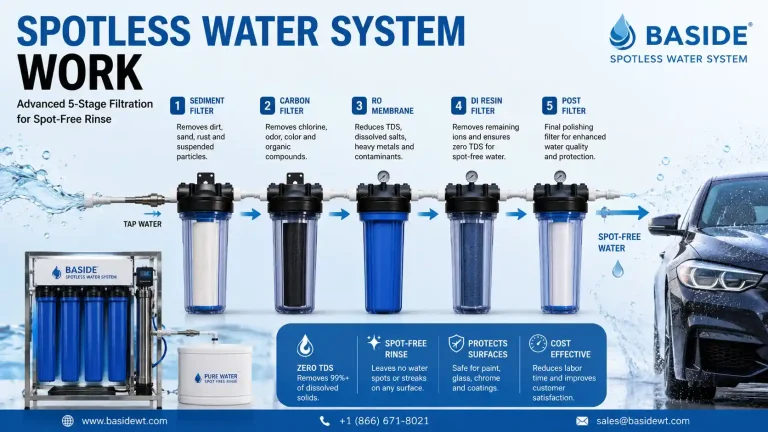
BasideWT- Whole Home Water Filtration System & Replacement


Water Filter Housing: Complete Guide to Types, Sizes, Materials & Applications
If you work with water treatment systems, you already know that filter cartridges get most of the attention. But none of those cartridges work without a proper housing to hold them in place. A water filter housing is the container that holds a filter cartridge or filter bag and keeps water flowing safely through it under pressure.
This guide covers everything you need to know about water filter housings, from the basic mechanics to advanced industrial applications. Whether you are sourcing housings for a residential project, specifying equipment for a food processing plant, or comparing suppliers for a wholesale order, this article will give you a solid foundation.
We will look at housing types, materials, sizing standards, pressure ratings, and real-world applications. Along the way, we will point you toward more detailed resources on specific topics, since a subject this broad deserves more than one article.
Let’s start with the basics.
What Is a Water Filter Housing?
A water filter housing is a pressure vessel designed to hold a replaceable filter element, such as a cartridge or filter bag, while allowing water to pass through under controlled pressure. The housing itself does not filter water. Instead, it provides a sealed, structurally sound chamber that forces water through whatever filter media sits inside.
Think of it as the frame that makes filtration possible. Without a housing, a cartridge would just sit loose in a pipeline with no way to contain pressure or direct flow.
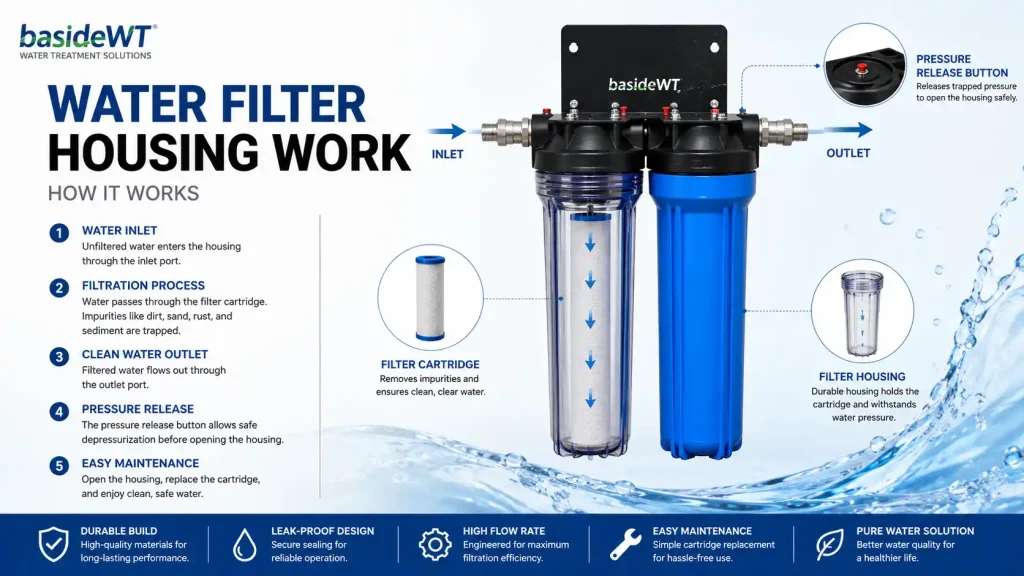
Most housings consist of a body (also called the bowl or sump) and a cap (or head), which connects to your plumbing. Water enters through an inlet port, passes through the cartridge, and exits through an outlet port as filtered water.
Because housings are reusable, only the internal filter element needs periodic replacement. This makes housings a long-term investment rather than a consumable part. We will cover this mechanism in more depth in a dedicated article, so if you want the full technical breakdown, that resource will go much deeper into flow dynamics and internal design.
Why Water Filter Housing Is Important
A housing might seem like a simple component, but its role affects the entire performance of a filtration system. Here is why it matters so much.
First, housing quality determines system reliability. A poorly made housing can crack under pressure, leak at the seals, or degrade when exposed to certain chemicals. Any of these failures can shut down production or damage equipment downstream.
Second, the housing size and design directly affect flow rate. An undersized housing restricts water flow, which lowers pressure and reduces output. This becomes especially critical in commercial and industrial settings where consistent flow is non-negotiable.
Third, housing material affects compatibility with your water source. Hot water, corrosive chemicals, or high mineral content can all shorten the life of an incompatible housing.
Finally, the right housing protects your investment in cartridges and filter media. A housing that seals properly and distributes flow evenly extends cartridge life and keeps filtration performance consistent.
In short, choosing the correct housing is just as important as choosing the correct filter cartridge. Many buyers focus entirely on micron ratings and overlook the housing that makes filtration possible in the first place.
How Does a Water Filter Housing Work?
The working principle of a water filter housing is straightforward, though the engineering behind it is more sophisticated than it looks.
Water enters the housing through the inlet port on the cap. It then flows downward into the bowl, where the filter cartridge or bag sits. As water pushes through the filter media, contaminants are trapped based on the micron rating of the element. Clean water then exits through the outlet port and continues into your plumbing system.
An O-ring, usually made of Buna-N, EPDM, or silicone, creates a watertight seal between the cap and the bowl. This seal is critical. Without it, unfiltered water could bypass the cartridge entirely, defeating the purpose of the system.
Most housings also include a pressure release button or valve on the top of the cap. This lets you safely depressurize the housing before opening it for cartridge replacement, which prevents sudden water discharge and reduces the risk of injury.
Some designs also feature a sump support foot, particularly on larger housings, which stabilizes the unit and reduces stress on the mounting bracket.
We touch on the mechanics here, but the full engineering explanation, including flow path diagrams and pressure drop calculations, deserves its own dedicated guide for readers who want that level of technical detail.
Main Components of a Water Filter Housing
Understanding the individual parts of a housing helps when troubleshooting, ordering replacement parts, or comparing products from different manufacturers.
| Component | Function |
|---|---|
| Cap (Head) | Connects to plumbing; contains inlet and outlet ports |
| Bowl (Sump) | Holds the filter cartridge or bag; bottom section of the housing |
| O-ring | Creates a watertight seal between cap and bowl |
| Pressure Release Button | Releases trapped pressure before disassembly |
| Mounting Bracket | Secures the housing to a wall or frame |
| Sump Wrench | Loosens or tightens the bowl during cartridge changes |
| Vent Valve (larger units) | Releases air trapped in the housing during startup |
| Port Threads/Flanges | Connect the housing to inlet and outlet piping |
Each of these parts plays a role in performance and safety. A worn O-ring, for example, is one of the most common causes of housing leaks, and it is also one of the cheapest and easiest parts to replace. Since a housing is only as effective as the filter cartridge inside it, matching the two correctly is just as important as the housing itself.
Types of Water Filter Housing
Not all housings are built the same way, and choosing the right type depends heavily on your application, flow requirements, and budget. Below is a breakdown of the most common types available on the market today.
Standard Housing
Standard housings are the most widely used type, typically accommodating 10-inch or 20-inch cartridges. They work well for residential point-of-use systems, small commercial setups, and light-duty filtration tasks. Standard housings are affordable, easy to source, and compatible with most standard cartridge sizes.
Slim Housing
Slim housings use a narrower cartridge, usually around 2.5 inches in diameter, which reduces flow capacity compared to standard housings. They are ideal for tight installation spaces, such as under-sink systems or compact point-of-use units where a full-size housing simply will not fit.
Big Blue Housing
Big Blue housings are the larger cousin of standard housings, typically using 4.5-inch diameter cartridges instead of the standard 2.5-inch diameter. This larger surface area allows for higher flow rates and longer cartridge life, making Big Blue housings a popular choice for whole house filtration and light commercial use. We cover whole house applications in more detail further down, and a dedicated article exploring whole house systems specifically is also worth reading if that is your focus.
Clear Housing
Clear housings are made from transparent plastic, usually polypropylene or clear PVC, which lets you visually inspect the cartridge without opening the unit. This is particularly useful for monitoring sediment buildup or confirming when a cartridge needs replacement. Clear water filter housings are common in residential and light commercial settings but are generally not recommended for high-pressure or high-temperature applications.
Blue Housing
Blue housings are opaque and typically made from more UV-resistant, impact-resistant plastic than clear versions. Because they block light, blue housings help prevent algae or bacterial growth inside the sump, which can be an issue with clear housings exposed to sunlight over time. Blue housings are a common choice for outdoor installations and long-term commercial use.
The choice between clear and blue often comes down to a tradeoff between visibility and durability, a topic detailed enough that it deserves its own dedicated comparison article.
Plastic Housing
Plastic housings, usually made from polypropylene or reinforced nylon, are lightweight, corrosion-resistant, and cost-effective. They handle moderate pressure and temperature ranges well and are the go-to choice for residential and many commercial applications. However, plastic housings generally cannot match the pressure and temperature tolerance of stainless steel.
Stainless Steel Housing
Stainless steel housings, typically constructed from 304 or 316 stainless steel, offer superior strength, higher pressure tolerance, and resistance to corrosion and high temperatures. These housings are the standard choice for industrial applications, food and beverage processing, and pharmaceutical manufacturing, where hygiene and durability are non-negotiable.
The plastic versus stainless steel decision affects cost, lifespan, and application suitability significantly, which is why we recommend exploring a focused comparison article on this topic before making a bulk purchasing decision.
High Flow Housing
High flow cartridge filter housings are engineered for large-volume water systems, using pleated or spun cartridges designed to handle significantly higher flow rates than standard cartridges of the same physical size. These housings are common in commercial buildings, hotels, industrial pretreatment systems, and municipal applications where high throughput matters more than compact size.
Because high flow systems involve specific engineering considerations around flow rate, pressure drop, and cartridge selection, a dedicated article on high flow water filter housing covers this subject with the depth it deserves.
Industrial Bag Filter Housing
Industrial bag filter housings differ structurally from cartridge housings. Instead of a rigid cartridge, they hold a flexible filter bag inside a support basket, which allows for higher dirt-holding capacity and easier handling of heavy sediment loads. Bag housings are common in industrial pretreatment, chemical processing, and applications where filtering large volumes of water with high particulate loads is a daily requirement.
These housings often come in multi-bag configurations for facilities that need to process large water volumes continuously. A separate article covering industrial applications for bag filter housings goes into far greater detail on sizing and selection criteria for this equipment.
Water Filter Housing Materials
Material selection affects durability, chemical compatibility, pressure tolerance, and cost. Here is a comparison of the most common materials used in housing construction.
| Material | Pressure Tolerance | Temperature Range | Best For | Limitations |
|---|---|---|---|---|
| Polypropylene | Moderate | Up to 125°F (52°C) | Residential, light commercial | Not ideal for high heat |
| Reinforced Nylon | Moderate to High | Up to 150°F (65°C) | Commercial applications | Higher cost than polypropylene |
| Clear PVC/Styrene | Low to Moderate | Up to 100°F (38°C) | Visual inspection needs | UV sensitive, lower durability |
| 304 Stainless Steel | High | Up to 300°F (149°C) | Industrial, food processing | Higher cost |
| 316 Stainless Steel | Very High | Up to 300°F+ (149°C+) | Pharmaceutical, chemical processing | Highest cost |
Stainless steel housings generally last longer and handle more demanding conditions, but plastic housings remain the practical choice for most residential and light commercial jobs where cost efficiency matters more than extreme durability.
Water Filter Housing Sizes Explained
Housing size is determined by two main factors: cartridge diameter and cartridge length. Getting this right matters because a mismatched housing will either restrict flow or fail to seal the cartridge properly.
Common cartridge diameters include 2.5 inches (standard and slim housings) and 4.5 inches (Big Blue housings). Common cartridge lengths include 10 inches, 20 inches, and occasionally 30 inches or 40 inches for specialized applications.
Port size is another important sizing factor. Residential housings typically use 3/4-inch or 1-inch NPT ports, while commercial and industrial housings often require 1.5-inch, 2-inch, or even flanged connections to handle higher flow volumes.
Because so many buyers get sizing wrong when ordering online or through distributors, we recommend consulting a full size guide before finalizing your specifications, particularly for bulk or OEM orders where a mistake can be costly.
Pressure Ratings and Temperature Ratings
Every housing carries a maximum working pressure rating, typically expressed in psi or bar, along with a maximum operating temperature. Exceeding either rating risks cracking the housing, blowing a seal, or causing sudden failure.
Standard plastic housings are usually rated between 100 and 150 psi at room temperature. Stainless steel housings often handle 150 to 300 psi or more, depending on wall thickness and construction grade.
Temperature ratings matter just as much as pressure. Hot water applications, such as certain food processing lines, require housings specifically rated for elevated temperatures. Using a standard plastic housing on a hot water line is a common and preventable mistake that leads to premature failure.
It is worth noting that pressure and temperature ratings interact. Most housings lose some pressure tolerance as temperature rises, so always check the manufacturer’s derating chart rather than assuming the maximum psi rating applies across all temperatures.
Because pressure rating selection ties directly into system design and safety, a dedicated article on this topic will walk through calculation methods and safety margins in more depth.
Water Filter Housing Applications
Water filter housings show up across a remarkably wide range of industries. Below is a breakdown of how housings are used in different settings.
Residential
In homes, housings typically handle point-of-entry or point-of-use filtration for sediment, chlorine taste and odor, or general water clarity. Standard and slim housings dominate this segment due to their compact size and affordability.
Whole House
Whole house systems filter all water entering a home, not just water at a single tap. These systems typically use Big Blue housings to accommodate higher flow demands across multiple fixtures running simultaneously. If you are considering a whole house setup, our dedicated whole house filtration resource covers system sizing and cartridge selection in far more detail.
Commercial
Restaurants, hotels, office buildings, and retail locations rely on commercial-grade housings to protect equipment like ice machines, espresso machines, and dishwashers from scale, sediment, and chlorine damage. These applications often call for higher flow capacity than residential systems.
Industrial
Manufacturing plants use housings for process water, cooling systems, and pretreatment ahead of reverse osmosis or other advanced filtration steps. Housings in these settings often work as one stage within a larger water filtration system, rather than as a standalone unit. Industrial settings frequently demand stainless steel construction and higher pressure ratings due to continuous operation and harsher water conditions.
Food Processing
Food and beverage facilities require housings that meet strict hygiene standards, often constructed from 304 or 316 stainless steel to prevent contamination and withstand frequent sanitization cycles.
Pharmaceutical
Pharmaceutical manufacturing demands the highest level of purity and material integrity. Housings used here often meet specific regulatory standards and use high-grade stainless steel or specialized polymers approved for sensitive applications.
Electronics Manufacturing
Semiconductor and electronics manufacturing require ultra-pure water for rinsing and processing components. Housings in this sector often work alongside deionization and reverse osmosis systems, requiring materials that do not leach contaminants into highly sensitive water streams.
Agriculture
Agricultural applications include irrigation water treatment, livestock water filtration, and greenhouse water systems. These setups often prioritize high flow capacity and durability against sediment-heavy water sources, making bag filter housings a common choice.
How to Choose the Right Water Filter Housing
Selecting a housing involves balancing several factors at once. Here is a practical framework to guide your decision.
Start with your required flow rate. Calculate peak demand for your application, then choose a housing sized to handle that flow without excessive pressure drop.
Next, consider your water pressure and temperature conditions. Match the housing’s rated pressure and temperature tolerance to your actual operating environment, with a reasonable safety margin.
Then, evaluate your water quality and contaminant load. Heavy sediment loads may point toward bag filter housings, while lower sediment applications work well with standard cartridge housings.
Factor in your available space. Standard and slim housings suit tight installations, while Big Blue and industrial housings require more clearance for cartridge changes.
Finally, weigh material requirements against your budget. Plastic housings work fine for most residential and light commercial needs, while stainless steel becomes necessary for hygiene-sensitive or high-temperature industrial applications.
Because this decision has so many variables, a dedicated buying framework article walks through each of these factors with worked examples for different scenarios.
Common Water Filter Housing Problems
Even well-made housings can develop issues over time. Here are the problems buyers and installers report most often.
Leaking at the O-ring seal is the most common complaint, usually caused by a worn, pinched, or improperly lubricated O-ring. Cracking under pressure can occur when a housing exceeds its rated pressure or temperature, or when plastic housings degrade from prolonged UV exposure.
Reduced flow rate often points to a clogged cartridge rather than a housing defect, though an undersized housing can also cause chronic flow restriction. Difficulty opening the sump usually results from over-tightening or mineral buildup on the threads, which a housing wrench helps resolve.
Algae or bacterial growth inside clear housings happens when sunlight reaches the sump, encouraging biological growth. Switching to a blue or opaque housing typically solves this issue.
A more comprehensive troubleshooting article covering diagnosis and repair steps for each of these problems is available for readers who need step-by-step guidance.
Maintenance and Cleaning Tips
Regular maintenance extends the life of both the housing and the filter cartridges inside it. Follow these practical guidelines.
Replace cartridges according to the manufacturer’s recommended schedule, or sooner if you notice reduced flow or pressure drop. Inspect O-rings during every cartridge change, and replace them if you see cracking, flattening, or brittleness.
Clean the housing bowl with mild soap and water during cartridge changes, avoiding harsh chemicals that could degrade plastic components. Lubricate O-rings lightly with a food-grade silicone lubricant before reinstalling the cap, which helps maintain a proper seal and makes future disassembly easier.
For clear housings, periodically check for algae growth and clean thoroughly if you notice discoloration. Always depressurize the housing using the release valve before attempting to open it.
A dedicated maintenance article expands on cleaning schedules and product recommendations specific to different housing materials and applications.
Installation Best Practices
Proper installation prevents many of the problems described above before they start. Keep these best practices in mind.
Always install housings with the flow direction indicated on the cap, since reversed flow can bypass the cartridge or damage the seal. Use a housing wrench to tighten the sump firmly but avoid over-tightening, which can crack plastic housings or damage O-rings.
Support larger housings, particularly Big Blue and industrial units, with a proper mounting bracket to reduce stress on the plumbing connections. Include a pressure gauge or pressure differential indicator upstream and downstream of commercial and industrial housings to monitor cartridge condition over time.
Leave enough clearance below the housing for cartridge removal and replacement, since tight installations make routine maintenance far more difficult than necessary.
Water Filter Housing Buying Guide
When sourcing housings, particularly for bulk, wholesale, or OEM orders, a few additional factors matter beyond the technical specifications covered above.
Verify certifications relevant to your market and application, such as NSF/ANSI standards for material safety in drinking water applications. Confirm cartridge compatibility with your existing filtration lineup to avoid sourcing headaches down the road.
Ask suppliers about minimum order quantities, lead times, and customization options if you need branded or application-specific housings. Request material certificates and pressure test data for industrial and stainless steel housings, especially for regulated industries like food and pharmaceutical manufacturing.
Compare warranty terms across suppliers, since housing defects can be costly if they surface after installation in a large-scale system. For buyers evaluating multiple suppliers, a full buying guide article breaks down supplier evaluation criteria in more detail.
If you are ready to explore available options, browsing a water filter housing category page will give you a practical sense of current configurations, sizes, and materials on the market.
Frequently Asked Questions
What is the difference between a cartridge housing and a bag filter housing?
A cartridge housing holds a rigid or semi-rigid filter cartridge, while a bag filter housing holds a flexible filter bag inside a support basket. Bag housings generally offer higher dirt-holding capacity, making them better suited to heavy sediment loads in industrial settings.
Can I use a plastic housing for hot water applications?
Generally, no. Standard plastic housings are rated for moderate temperatures and can crack or deform under sustained hot water exposure. Stainless steel or high-temperature-rated polymer housings are the safer choice for hot water lines.
How often should I replace the O-ring in my housing?
Inspect the O-ring every time you change the cartridge, and replace it if you notice cracking, flattening, or loss of flexibility. As a general rule, replacing the O-ring once a year is a reasonable precaution even without visible damage.
What size housing do I need for whole house filtration?
Most whole house systems use Big Blue housings with 4.5-inch by 20-inch cartridges to handle the flow demands of multiple fixtures running at once. Actual sizing depends on your household’s peak water demand.
Are stainless steel housings worth the extra cost?
For industrial, food processing, or pharmaceutical applications, yes. The higher pressure tolerance, temperature resistance, and hygiene benefits typically justify the added cost. For residential use, plastic housings usually offer better value.
How do I know if my housing is leaking from the O-ring or a crack in the housing itself?
Dry the housing exterior completely, then observe where moisture first appears. Leaks originating right at the seam between cap and bowl usually indicate an O-ring problem, while moisture appearing elsewhere on the bowl often points to a crack or structural defect.
Final Thoughts
A water filter housing might not be the most exciting part of a filtration system, but it is arguably one of the most important. The right housing protects your cartridges, maintains consistent flow, and keeps your water treatment system running reliably for years.
Whether you are outfitting a single residential system or sourcing housings for a large industrial installation, understanding types, materials, sizing, and pressure ratings puts you in a much stronger position to make the right choice.
According to NSF’s reporting on water treatment component testing in China, third-party certification against recognized standards helps verify that water system components meet internationally accepted safety criteria, which is worth keeping in mind when evaluating suppliers for any application involving drinking water.
As you continue building out your filtration knowledge, keep an eye out for the supporting articles referenced throughout this guide. Each one dives deeper into a specific topic, from sizing and pressure ratings to troubleshooting and supplier selection, and together they form a complete resource for anyone working with water filter housings.
RELATED POSTS
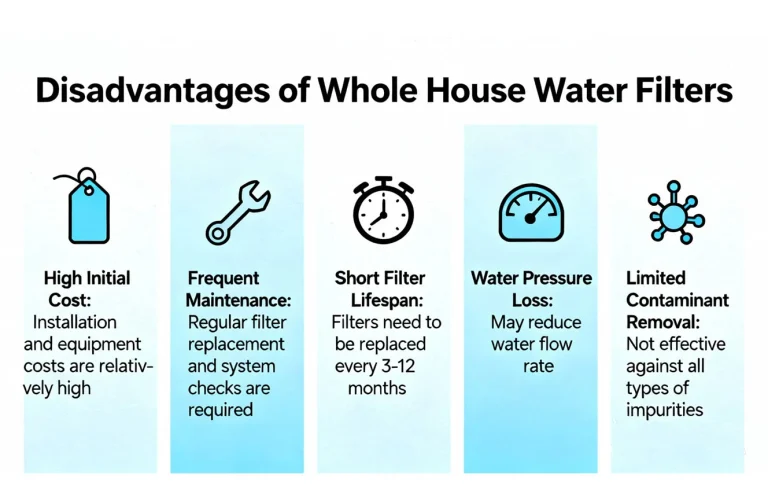
What Are The Disadvantages Af A Whole House Water Filter
Will A Water Filter Help With Hard Water?
Whole House Water Softener Cost
How to Choose a UF Membrane for Your Water System
50 GPD vs 75 GPD vs 100 GPD RO Membrane: Which Is Better?