BasideWT- Whole Home Water Filtration System & Replacement


What Is a Water Softener System? Everything You Need to Know
A water softener system is a device that removes calcium and magnesium from water through a process called ion exchange. These two minerals are the main cause of what we call “hard water,” and they create problems that range from dull laundry to clogged pipes. If you have ever noticed white spots on your dishes or scale buildup around your faucets, a water softener system is usually the solution homeowners and businesses turn to.
This guide walks you through what a water softener system actually is, why hard water needs treatment, and what these systems can do for your home, business, or facility. For a deeper look at the different types of systems, their benefits, and how to choose one, you can explore our complete water softener system guide.
What Is a Water Softener System?
A water softener system is a water treatment device that reduces water hardness by exchanging hard minerals for soft ones. In most cases, it swaps calcium and magnesium ions for sodium or potassium ions. This exchange happens inside a specialized tank filled with resin beads, and it transforms hard water into soft water before it reaches your taps.
Water softening systems are used in homes, offices, restaurants, hotels, and factories. Wherever hard water causes damage or inconvenience, a softening system offers a practical fix. Although the science behind it sounds technical, the concept is simple: hard minerals go in, soft water comes out.
Why Does Hard Water Need Treatment?
Hard water forms when groundwater passes through limestone, chalk, or other mineral-rich rock. As it flows, it picks up dissolved calcium and magnesium. The more of these minerals present, the “harder” the water becomes.
At first glance, hard water might not seem like a big deal. However, over time, it creates several real problems.
Scale buildup is one of the most visible issues. As hard water heats up or evaporates, calcium and magnesium form a chalky residue known as limescale. This scale coats pipes, faucets, and water heaters, gradually reducing their efficiency.
Soap efficiency also drops significantly in hard water. Calcium and magnesium react with soap, preventing it from lathering properly. As a result, you need more soap or detergent to get the same clean feeling, whether you are washing dishes, doing laundry, or showering.
Appliance damage tends to follow soon after. Water heaters, dishwashers, and washing machines all suffer when scale accumulates inside their components. Heating elements lose efficiency, pipes narrow, and appliances often need repairs sooner than expected. In fact, a water heater running on hard water can lose a noticeable amount of energy efficiency within just a few years, simply because scale acts as an insulating layer between the heating element and the water itself.
Because these effects build up slowly, many people do not realize how much hard water is costing them until they see the damage firsthand. A homeowner might notice their electric bill creeping upward, or a facility manager might find that a commercial water heater needs replacing years earlier than the manufacturer’s expected lifespan. In both cases, the root cause often traces back to untreated water hardness.
Water hardness is typically measured in grains per gallon (GPG) or milligrams per liter (mg/L). Water is generally considered soft below 1 GPG, moderately hard between 3.5 and 7 GPG, and very hard above 10.5 GPG. Knowing where your water falls on this scale helps determine whether treatment is necessary and how aggressive that treatment needs to be.
What Does a Water Softener System Remove?
A water softener system primarily targets the minerals responsible for water hardness: calcium and magnesium. These are the two culprits behind scale, soap scum, and mineral deposits throughout your plumbing.
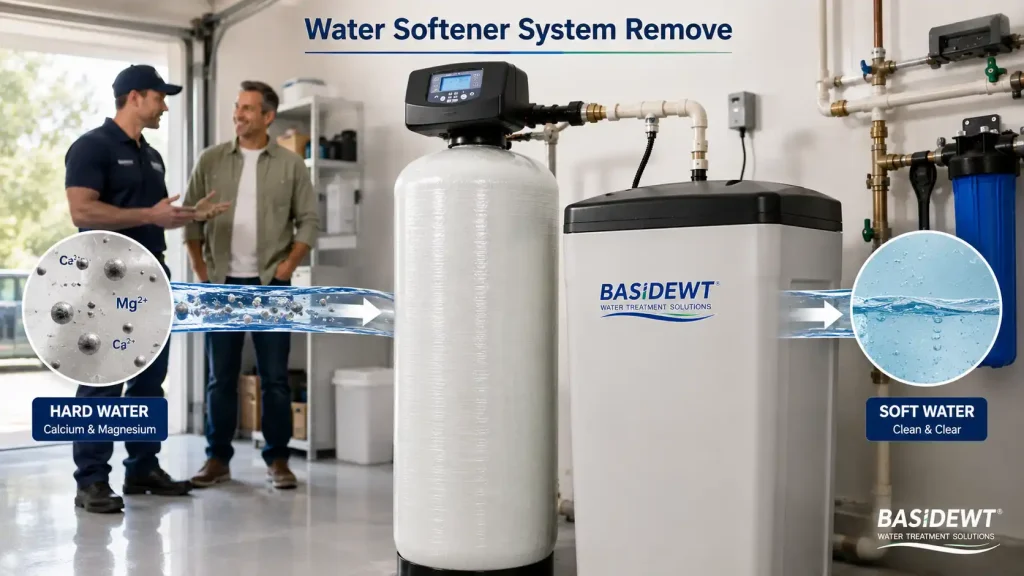
Some systems also address dissolved iron in small amounts, since iron can contribute to staining and hardness-like symptoms. That said, it is worth clarifying what a softener does not do. A standard water softening system does not remove bacteria, sediment, chlorine, or other contaminants. Those issues typically call for filtration systems instead.
This distinction matters, particularly for commercial buyers and facility managers comparing treatment options. If your water has both hardness and contamination issues, you may need a softener paired with a filtration system rather than relying on one device alone. You can browse relevant filtration solutions on our water filtration systems page if that applies to your situation.
How Does a Water Softener System Work? (Overview Only)
At its core, a water softener system relies on ion exchange. Hard water flows into a tank filled with negatively charged resin beads coated in sodium ions. Because calcium and magnesium carry a stronger positive charge than sodium, they attract to the resin beads more strongly.
As water passes through, the resin captures the calcium and magnesium, releasing sodium into the water instead. What comes out the other side is softened water, free of the minerals that cause scale and soap inefficiency.
Eventually, the resin becomes saturated and needs to be recharged. This happens through a regeneration cycle, where a salt brine solution flushes the resin bed and restores its capacity to soften more water. We cover this regeneration process step-by-step, along with sizing and maintenance tips, in our full water softener system guide.
Main Components of a Water Softener System
Although designs vary between manufacturers, most water softener systems share four core components.
The resin tank houses the resin beads where ion exchange takes place. This is where hard water enters and softened water exits.
The brine tank stores the salt solution used during regeneration. Without this component, the resin could not be recharged, and softening would eventually stop.
The control valve manages water flow and triggers the regeneration cycle at the right intervals. Modern control valves often use sensors or timers to automate this process, minimizing manual intervention.
Finally, the resin media itself consists of small polystyrene beads that perform the actual ion exchange. Over time, resin can wear down and may need replacement, though this typically happens only after years of consistent use.
Together, these components form the framework of nearly every whole house water softener, commercial water softener, or industrial water softener on the market today.
Some systems also include a bypass valve, which allows unsoftened water to flow directly to certain outdoor taps. This is useful for garden hoses or irrigation systems, since plants generally do not need softened water and softening outdoor water use would waste salt and resin capacity unnecessarily.
The way these components are sized and configured changes significantly between a small residential unit and a large industrial system. A single-family home might use a compact resin tank designed for a few hundred gallons per day, while a factory could require multiple tanks working in tandem to handle continuous, high-volume demand. Even so, the underlying mechanics stay consistent across every scale of operation.
Common Applications
Water softener systems serve a wide range of settings, each with different demands.
In residential settings, a whole house water softener treats all the water entering a home. This protects appliances, improves soap lathering, and makes cleaning easier throughout the house. Homeowners in areas with naturally hard groundwater often see the biggest improvements after installation.
Commercial applications differ slightly. A commercial water softener typically serves restaurants, hotels, laundromats, and office buildings. These businesses rely heavily on consistent water quality, since hard water can interfere with everything from coffee machines to industrial dishwashers.
Industrial applications push these systems even further. An industrial water softener often handles much larger water volumes, supporting manufacturing processes, boilers, and cooling systems where scale buildup can lead to costly downtime.
Regardless of the setting, the underlying goal stays the same: protect equipment and improve water quality by removing hardness minerals before they cause damage.
Consider a hotel, for example. Guests expect soft, clean water in showers and sinks, while the property’s laundry facilities depend on consistent water quality to keep linens looking fresh and free of gray, dingy residue. A single hard-water problem can affect both guest satisfaction and operational costs at once.
A manufacturing plant faces a different but equally important challenge. Boilers and cooling towers rely on precise water conditions to function safely and efficiently. Even small amounts of scale inside a boiler can reduce heat transfer, increase fuel consumption, and eventually lead to equipment failure. For this reason, many plants treat softening as a non-negotiable part of their maintenance strategy rather than an optional upgrade.
Distributors and importers evaluating water softener systems for resale often need to understand these varied use cases too. A product that works well for a residential customer may not meet the flow rate or durability requirements of a commercial kitchen or industrial facility, which is why matching system type to application matters as much as the technology itself.
Benefits of Using a Water Softener System
The advantages of softened water extend well beyond convenience.
Better water quality is the most immediate benefit. Soft water feels different, cleans more effectively, and leaves fewer residues on dishes, glassware, and fixtures.
Appliances also tend to last longer with soft water. Since scale no longer accumulates inside water heaters, dishwashers, and washing machines, these appliances run more efficiently and require fewer repairs over time.
Cleaner plumbing follows naturally. Pipes stay clearer without a mineral buildup, which helps maintain steady water pressure and reduces the risk of clogs.
Reduced scale is perhaps the most noticeable change around the home. Faucets, shower heads, and glass surfaces stay cleaner for longer, cutting down on scrubbing and maintenance.
Finally, improved soap performance means you use less detergent, soap, and shampoo to get the same results. This can lead to modest savings over time, even though the primary benefit is convenience and comfort.
Beyond these core advantages, many people notice softer skin and hair after switching to treated water, since hard water can leave behind mineral residue that dries out skin and dulls hair over time. Clothes washed in soft water also tend to retain their color and softness longer, because hard minerals no longer trap themselves in the fabric fibers during washing.
For commercial operations, these benefits translate directly into cost savings. Restaurants that soften their water often report fewer service calls for dishwashers and ice machines, both of which are particularly vulnerable to scale buildup. Facilities that rely on steam systems or boilers can also extend the lifespan of expensive equipment simply by removing hardness minerals before they enter the system.
Is a Water Softener System Right for You?
Not every property needs a water softener, but many do. If you live in an area with known hard water, or if you have noticed scale buildup, reduced soap lathering, or appliance issues, a softener is worth considering.
Homeowners moving into a new property should test their water hardness first. Distributors, importers, and water treatment companies often help clients make this determination based on regional water data and specific usage needs.
For commercial and industrial buyers, the decision usually comes down to equipment protection and operational efficiency. If hard water is affecting boilers, cooling towers, or foodservice equipment, a properly sized softening system can prevent costly downtime and extend equipment life.
Facility managers and engineers evaluating water treatment options for larger buildings should also weigh water volume, hardness levels, and existing infrastructure. According to Pentair’s educational resources on the ion exchange process, softening remains one of the most reliable long-term solutions for treating scale in commercial and foodservice settings, particularly where consistent, high-volume treatment is required.
Conclusion
So, what is a water softener system? At its heart, it is a straightforward solution to a common problem: hard water. By exchanging calcium and magnesium for sodium through ion exchange, these systems protect your plumbing, extend appliance life, and improve everyday water quality.
Whether you are a homeowner dealing with scale buildup, a facility manager protecting industrial equipment, or a distributor sourcing solutions for clients, understanding how a water softener system works is the first step toward better water. If you are ready to explore your options in more depth, our complete guide to water softener systems covers types, installation, and buying considerations in detail. You can also browse our range of water softener systems to find a solution that fits your specific needs.
RELATED POSTS
UV-C Wavelength for Water Sterilization Explained
What Is an RO Water System? Everything You Need to Know
Water Filter Housing for RO Systems: Types, Applications & Selection Guide
RO Water System vs Distilled Water: Which Is Better for Drinking & Industrial Use?
What Is Membrane Technology In Water Treatment