BasideWT- Whole Home Water Filtration System & Replacement


UF Membrane Pore Size: 0.01 vs 0.03 Micron Explained
UF membrane pore size determines what a filter can physically block and what it lets through. Ultrafiltration membranes work at an extremely fine scale, far smaller than what the human eye can detect. Two common ratings show up again and again in product spec sheets: 0.01 micron and 0.03 micron.
These numbers look similar at first glance. However, the difference between them can affect filtration performance, flow rate, and how a system handles fouling over time. Understanding this difference helps you choose a membrane that actually fits your water source and your equipment.
What Is UF Membrane Pore Size?
Pore size refers to the physical openings within a membrane’s structure. Water and dissolved substances pass through these openings, while larger particles get retained on the surface or within the membrane layers.
A micron is a unit of measurement equal to one-millionth of a meter. To put that in perspective, a human hair measures roughly 70 microns wide. UF membranes typically operate in a range of 0.01 to 0.1 micron, which places them well below what unaided vision can perceive.
Manufacturers publish micron ratings so buyers can compare filtration capability across different products. These ratings usually appear as “nominal” rather than “absolute.” A nominal rating estimates the size range a membrane is designed to target under typical conditions. An absolute rating, by contrast, guarantees retention of a specific particle size under tested conditions.
This distinction matters. Two membranes with the same stated micron rating may still perform differently depending on their material, structure, and manufacturing process. For this reason, pore size alone should never be the only factor in a purchasing decision. If you want a broader look at how these membranes are built and rated, the UF filter membrane buying guide covers the full range of specifications worth reviewing.
What Does 0.01 Micron Mean?
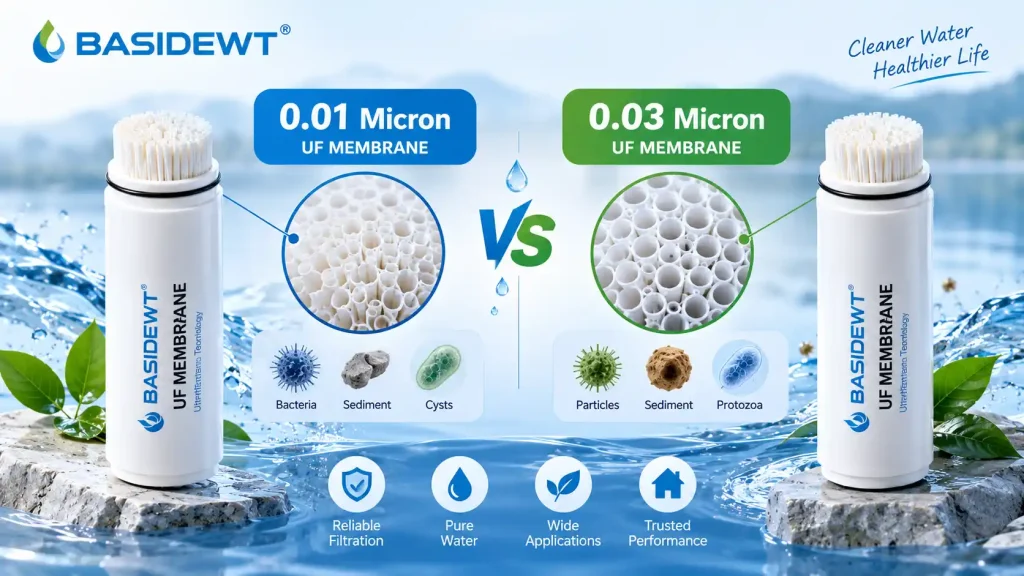
A 0.01 micron UF membrane sits at the finer end of standard ultrafiltration ranges. It targets smaller suspended particles, along with certain bacteria and protozoa, depending on the specific organism and membrane design.
In practice, this rating often appears in applications where feed water carries fine turbidity or where stricter microbial control matters. Drinking water systems, pretreatment stages ahead of reverse osmosis, and certain municipal setups commonly use finer UF ratings for these reasons.
That said, a 0.01 micron rating does not guarantee complete virus removal. Viruses are generally much smaller than bacteria, and most standard UF membranes are not designed or certified as absolute virus barriers. Manufacturer test data, not the micron number alone, should confirm any specific removal claim.
Finer pore sizes can also mean a somewhat higher resistance to flow under equal pressure, though actual results depend heavily on membrane material and feed-water conditions.
What Does 0.03 Micron Mean?
A 0.03 micron UF membrane sits slightly higher on the pore-size scale. It still qualifies as a fine filtration barrier and effectively targets suspended solids, sediment, larger bacteria, and many protozoa, again depending on the specific membrane and manufacturer testing.
This rating often works well in applications where feed water is moderately clean or where flow rate matters more than the very finest level of particle rejection. Industrial process water, certain pretreatment stages, and general-purpose filtration systems frequently specify 0.03 micron membranes.
Compared with finer 0.01 micron options, a 0.03 micron membrane may allow slightly higher flow under similar pressure conditions. In some cases, it may also show a lower fouling rate when handling feed water with moderate suspended-solids content, since larger pore openings are less prone to rapid surface blockage.
As with any UF rating, 0.03 micron membranes do not remove dissolved salts or reduce total dissolved solids through standard size-based separation.
0.01 vs 0.03 Micron UF Membrane: What’s the Difference?
The table below summarizes how these two common ratings compare across practical considerations.
| Factor | 0.01 Micron | 0.03 Micron |
|---|---|---|
| Relative fineness | Finer separation | Slightly coarser separation |
| Particle retention | Smaller suspended particles and finer colloids | Suspended solids, sediment, larger colloids |
| Bacteria removal | Effective for most bacteria, subject to design | Effective for most bacteria, subject to design |
| Protozoa removal | Generally effective | Generally effective |
| Virus reduction | Not guaranteed; varies by product | Not guaranteed; varies by product |
| Flow tendency | Can require more pressure for equal flow | Can allow higher flow under similar pressure |
| Fouling tendency | May foul faster with high-turbidity feed water | May tolerate moderate turbidity somewhat better |
| Typical use cases | Drinking water, RO pretreatment, stricter quality needs | Industrial process water, general filtration, higher-flow needs |
These are general tendencies rather than fixed rules. Actual performance always depends on the specific membrane material, structure, and the manufacturer’s tested specifications.
Does a Smaller UF Membrane Pore Size Mean Better Filtration?
Not automatically. A finer pore size does improve physical particle separation in most cases, but “better filtration” depends on what the system actually needs to accomplish.
Feed-water quality plays a major role. A source with heavy sediment or organic load can foul a fine membrane quickly, regardless of its micron rating. In this situation, adequate pretreatment often matters more than choosing the smallest available pore size.
Required water quality matters too. If the application only needs turbidity reduction and general suspended-solids control, a 0.03 micron membrane may fully meet that goal without the added pressure demand of a finer rating.
Flow demand is another consideration. Systems that need high throughput may find that a slightly larger pore size supports that goal more efficiently, assuming the target contaminants still get removed.
Membrane material and system design also shape real-world results. Two membranes with the same micron rating, but different materials or hollow-fiber structures, can perform quite differently under the same operating conditions. In short, pore size is one input among several, not a standalone measure of quality.
What Contaminants Can Different UF Pore Sizes Remove?
UF membranes separate contaminants primarily by physical size. The table below outlines what typical UF pore sizes can address and what falls outside their capability.
| Contaminant | UF Removal Capability |
|---|---|
| Sediment and suspended solids | Generally removed effectively |
| Turbidity | Generally reduced effectively |
| Bacteria | Generally removed, subject to membrane rating and design |
| Protozoa (e.g., Giardia, Cryptosporidium) | Generally removed, subject to membrane rating and design |
| Colloids | Often removed, depending on particle size |
| Some larger microorganisms | Often removed |
| Viruses | Not reliably removed by standard UF; varies by product certification |
| Dissolved salts and TDS | Not removed by standard ultrafiltration |
| Dissolved minerals | Not removed by standard ultrafiltration |
Ultrafiltration operates on physical size exclusion. Dissolved substances, including salts and many minerals, pass through UF membranes because they exist at a molecular scale far below any UF pore rating. Reverse osmosis or other treatment methods address those contaminants instead.
UF Membrane Pore Size and Flow Rate
Pore size influences flow, but it does not determine flow on its own. Several other variables interact with it in a working system.
Feed pressure pushes water through the membrane, and required pressure often increases as pore size decreases. Membrane area also matters, since a larger surface area can offset the flow resistance of a finer pore rating.
Feed-water quality affects flow indirectly. Water with more suspended solids or organic matter can reduce effective flow over time as material accumulates on the membrane surface. Temperature plays a role as well, since colder water is generally more viscous and can reduce flow rate at a given pressure.
Fouling ties all of these factors together. As particles build up, effective flow drops regardless of the original pore size. For this reason, manufacturer flow-rate data under specified test conditions gives a more reliable picture than pore size alone.
UF Membrane Pore Size and Fouling
Fouling occurs when particles, organic matter, or biological growth accumulate on or within the membrane. This buildup reduces flow and increases the pressure needed to maintain output.
Suspended solids and colloids contribute heavily to fouling, particularly in membranes with finer pore ratings that trap smaller particles more readily. Organic matter can also accelerate fouling, especially in surface-water sources.
Proper pretreatment reduces this risk significantly by removing coarse material before it reaches the UF stage. Regular cleaning and periodic backwashing help maintain membrane performance over the system’s operating life. These maintenance steps deserve their own detailed discussion, which the cluster’s dedicated cleaning resources cover in more depth.
Which Is Better: 0.01 or 0.03 Micron UF Membrane?
Neither rating wins in every scenario. The right choice depends on the application.
A 0.01 micron membrane often makes sense for drinking water treatment, RO pretreatment where strict quality control matters, or applications with stricter regulatory or contamination-control requirements. Systems where water clarity and microbial control take priority over maximum flow tend to favor this rating.
A 0.03 micron membrane often suits industrial process water, general pretreatment where feed water is already reasonably clean, or systems where higher flow and lower fouling risk take priority over the finest possible separation. Many commercial applications with moderate water-quality requirements perform well with this rating.
In practice, engineers often weigh feed-water testing data, required output quality, and system throughput needs before settling on a rating. Reviewing how these membranes fit within the broader filtration process, as outlined in the step-by-step explanation of UF membrane operation, can help clarify how pore size interacts with the rest of the system.
How to Choose the Right UF Membrane Pore Size
Selecting a pore size involves more than picking the smallest number on a spec sheet. Consider these factors before making a decision:
- Feed-water quality – Test your source water for turbidity, organic content, and particulate load.
- Target contaminants – Identify exactly what needs removal, whether sediment, bacteria, protozoa, or general clarity issues.
- Required water quality – Match the pore size to your actual output standard, not an arbitrary preference for finer numbers.
- Required flow rate – Confirm the membrane can deliver the throughput your system needs.
- Operating pressure – Check that your available pressure supports the chosen membrane’s rated performance.
- Temperature – Account for seasonal or process-related temperature variation, since it affects flow and viscosity.
- Membrane material – Compare material types, since performance varies even among membranes with identical pore ratings.
- Membrane configuration – Review hollow-fiber or other structural designs relevant to your system.
- Pretreatment – Plan for adequate pretreatment to protect the membrane and extend its service life.
- Manufacturer performance data – Rely on tested flow, pressure, and rejection data rather than the micron rating in isolation.
Buyers who compare full specification sheets, rather than a single number, generally end up with systems that perform more consistently over time. For readers who want foundational context before diving into these decisions, the beginner’s guide to UF filter membranes offers a useful starting point.
Frequently Asked Questions About UF Membrane Pore Size
What is the typical pore size of a UF membrane? Most UF membranes range between roughly 0.01 and 0.1 micron, though exact figures vary by manufacturer and product line.
Is 0.01 micron better than 0.03 micron? Not universally. A 0.01 micron rating offers finer separation, but 0.03 micron may better suit applications that prioritize flow rate and fouling resistance.
Can a 0.01 micron UF membrane remove bacteria? Yes, in most cases, subject to the specific membrane’s design and manufacturer testing. Confirm rejection data before relying on this for critical applications.
Can UF membrane pore size remove viruses? Standard UF membranes do not reliably guarantee virus removal. Some specialized products carry specific virus-reduction certifications, so check the manufacturer’s documentation.
Does UF remove TDS? No. Ultrafiltration separates by physical size and does not remove dissolved salts or reduce total dissolved solids. Reverse osmosis handles that function instead.
Does smaller pore size reduce UF membrane flow? It can, since finer openings often require more pressure to maintain equal flow. However, membrane area, material, and feed-water quality also influence actual flow rate.
How do I choose the right UF membrane micron rating? Base your choice on feed-water quality, target contaminants, required output, and flow needs, then confirm the decision against manufacturer performance data rather than the micron number alone.
Final Verdict
UF membrane pore size describes the physical scale at which a membrane separates particles from water. The 0.01 and 0.03 micron ratings both fall within standard ultrafiltration performance, but they suit different priorities.
A 0.01 micron membrane offers finer separation and often fits applications with stricter quality requirements. A 0.03 micron membrane often supports higher flow and can show better resistance to fouling in moderately clean water sources.
Neither rating is automatically superior. The right choice depends on your feed-water conditions, required output quality, flow demand, and the full specification profile of the membrane itself. Reviewing manufacturer data alongside your system’s actual operating needs remains the most reliable way to select the right UF membrane pore size for your application.
RELATED POSTS
RO Membrane Compatibility: How to Match a Membrane With Your System
How Often Should You Change Your Water Filter

Water Filter vs Water Purifier: What’s the Difference?
RO Membrane Replacement: When, Why & How to Replace It
How Much Does a Reverse Osmosis System Cost