BasideWT- Whole Home Water Filtration System & Replacement


How Much Is a Water Softener? Complete 2026 Cost Guide
Hard water is one of the most common household problems. It leaves scale on pipes. It wears out appliances faster. It also makes soap less effective. An estimated 85% of U.S. households deal with some degree of hard water. Millions of homes across the United States, China, and beyond deal with these effects every day. Many homeowners do not realize a water softener could fix most of it. Pricing one out is also far more straightforward than the sales quotes make it seem.
So how much is a water softener? The short answer: most homeowners pay between $1,200 and $3,800 installed in 2026, according to data from Angi, HomeGuide, and Aquasure. The unit alone runs $700 to $3,500. Budget box-store systems start around $400 to $800. Dealer-installed premium systems can reach $5,000 or more.
This guide breaks every cost factor down clearly. You will find real 2026 price data, an explanation of how the technology works, and a comparison of system types. You will also get an honest look at how Culligan, Kinetico, Fleck, and other major brands price and warranty their systems. Rental vs. buying vs. financing math is covered, along with whether a softener qualifies for any tax credit or rebate. A full maintenance schedule and a breakdown of the hidden costs most buyers miss round out the guide. By the end, you will know exactly what to budget.
Quick Answer: How Much Is a Water Softener in 2026?
Unit cost: $700 – $3,500 (residential) Installation: $500 – $1,200 (standard installs) Total installed: $1,200 – $3,800 (national average) Annual running cost: $100 – $300 (salt + maintenance) Commercial / industrial: $5,000 – $25,000+
How Much Is a Water Softener in 2026?
Based on 2026 data from Angi, HomeGuide, Aquasure, and Mid Atlantic Water, the national average installed cost is $1,500. Most homeowners fall in the $1,200 to $3,800 range. That figure includes the unit, installation labor, materials, and basic setup. It does not include ongoing salt and maintenance costs, which are covered separately below.
There are three real price tiers in today’s market. Box-store systems from brands like GE, Whirlpool, and Rheem cost $400 to $800 for the unit. They use lower-quality components and typically last 5 to 8 years. Mid-range direct-purchase systems are the most popular category. They cost $800 to $2,000 and last 10 to 15+ years with proper maintenance. Dealer-installed systems from Culligan, RainSoft, and EcoWater cost $2,500 to $5,000 or more. Buyers pay a significant premium for the dealer’s service infrastructure and sales process.
| System Tier | Unit Price (2026) | With Installation | Expected Lifespan |
|---|---|---|---|
| Box Store (GE, Whirlpool, Rheem) | $400 – $800 | $900 – $1,600 | 5 – 8 years |
| Mid-Range Direct Purchase | $800 – $2,000 | $1,200 – $3,200 | 10 – 15+ years |
| Dealer-Installed (Culligan etc.) | $2,500 – $5,000+ | $3,000 – $6,000+ | 10 – 20 years |
| Commercial / Industrial | $5,000 – $15,000+ | $7,000 – $25,000+ | 15 – 25+ years |
Manufacturer-direct pricing offers a meaningful advantage for facilities and importers sourcing equipment from China. BasideWT manufactures residential and industrial water softeners in Changsha, Hunan. Their range covers single-column residential units, dual-tank industrial systems, and combined softener and RO configurations, all available with custom specs and export packaging. Pricing is quote-based, which suits commercial buyers and international importers far better than fixed retail pricing.
Key Takeaways — 2026 Water Softener Cost
- National average installed cost: $1,500 (Angi 2026 data)
- Most homeowners spend $1,200 – $3,800 total installed
- Box-store units cost less upfront but more long-term
- Annual running costs: $100 – $300 for salt and basic maintenance
- Commercial systems start at $5,000 and go much higher
- Standard water softeners do not qualify for federal energy tax credits, though some utility rebates exist (see below)
Do You Actually Need a Water Softener? Signs of Hard Water
Before budgeting for a system, it’s worth confirming the problem is actually hard water. Common signs include white, chalky scale around faucets and showerheads. Soap and shampoo may not lather or rinse cleanly. Dishes and glassware often come out of the dishwasher spotted or cloudy. Laundry can feel stiff or look dull over time. Skin and hair may feel unusually dry after showering. Appliances like water heaters, dishwashers, and washing machines sometimes fail earlier than their rated lifespan too.
A municipal water quality report or a home test kit ($10–$30) will confirm your hardness level in grains per gallon (GPG). Anything above 7 GPG is generally considered hard enough to justify a softener. Above 15 GPG is considered very hard.
Softener or Filter? Know the Difference First
It’s worth distinguishing a softener from a filter early on, since the two solve different problems and buyers sometimes shop for the wrong one. A water softener removes hardness minerals — calcium and magnesium — through ion exchange. It does not remove chlorine, sediment, bacteria, or heavy metals; that’s the job of a filtration system. If your water has an odor, discoloration, or contamination concerns in addition to hardness, you likely need both a softener and a filter rather than either one alone.
Water Hardness Scale: How Hard Is Your Water?
Hardness is officially classified by the concentration of dissolved calcium and magnesium. It’s usually reported in milligrams per liter (mg/L) or parts per million (PPM), which are equivalent units. It can also be reported in grains per gallon (GPG), the unit most softener manufacturers use. According to the U.S. Geological Survey’s water hardness classification, water at 0–60 mg/L is considered soft. Water at 61–120 mg/L is moderately hard, 121–180 mg/L is hard, and anything above 180 mg/L is very hard. Converted to the GPG scale that softener sizing tables use, roughly 17.1 mg/L equals 1 GPG, so a reading of 180 mg/L works out to about 10.5 GPG.
Regional geology drives most of the variation. Areas sitting on limestone and dolomite bedrock — much of the U.S. Midwest, Southwest, and parts of northern China — routinely test above 15 GPG. Regions with volcanic or granite bedrock and high rainfall, like the Pacific Northwest, often test below 3 GPG. Knowing where your household falls on this scale is the single most useful number for sizing a system correctly, since it feeds directly into the grain-capacity calculation covered later in this guide.
How a Water Softener Actually Works
Understanding the mechanism behind a water softener makes it much easier to judge whether a quote is fair. A salt-based softener works through ion exchange. Hard water flows through a tank filled with resin beads coated in sodium ions. Calcium and magnesium ions swap places with the sodium as they pass over the resin. The hardness minerals stick to the resin, and softened water — carrying a small amount of sodium instead — continues on to your plumbing.
Regeneration: Why Softeners Need Salt
Over time, the resin bed fills up with captured calcium and magnesium and needs to “regenerate.” A concentrated brine solution, made from the salt in the brine tank, flushes through the resin during this cycle. It strips off the accumulated hardness minerals and washes them down the drain, then recoats the resin with fresh sodium ions so the cycle can start again. This is why softeners need a periodic salt refill and a drain connection. It’s also why the control valve — the component that decides when and how a regeneration cycle runs — has such a large effect on both performance and long-term running cost.
Salt-free conditioners work differently. Instead of removing minerals, they use a catalytic media, commonly template-assisted crystallization, to change the mineral structure so it can’t stick to surfaces. That’s why they don’t require salt or a drain connection. They also don’t technically reduce hardness the way ion exchange does.
How Much Is a Water Softener System by Type?
The type of system you choose affects both the upfront cost and the long-term running expenses. Each technology works differently, and price reflects those differences in performance and maintenance needs. Understanding your options protects you from buying the wrong system for your water conditions.
Salt-based ion exchange softeners are the most popular and most effective type. They use resin beads to remove calcium and magnesium through ion exchange, then regenerate with salt. Single-tank models cost $500 to $3,000. Dual-tank models provide uninterrupted soft water during regeneration and cost $1,700 to $5,000 installed. Salt-free systems — more accurately called water conditioners — cost $1,500 to $4,500 installed. They do not remove hardness minerals. Instead, they change the mineral structure so it does not stick to surfaces. They suit moderate hardness levels and low-maintenance priorities.
| System Type | Installed Price Range (2026) | Removes Hardness? | Annual Running Cost |
|---|---|---|---|
| Salt-Based Ion Exchange (Single Tank) | $900 – $3,000 | Yes | $100 – $200 (salt) |
| Salt-Based Ion Exchange (Dual Tank) | $1,700 – $5,000 | Yes | $150 – $300 (salt) |
| Salt-Free / Water Conditioner | $1,500 – $4,500 | No (conditions only) | Very low |
| Magnetic / Electronic | $30 – $300 | No | Minimal |
| Whole-House Combined System | $2,000 – $6,000+ | Yes | Salt + service |
Magnetic and electronic systems are the cheapest option, but scientific support for their effectiveness is limited. They are best avoided unless your hardness is very mild. For most homes and commercial facilities, a quality salt-based system with a reliable control valve delivers the most consistent results. Well water with high iron content usually calls for something more specific. A single-column water softener that handles both hardness and iron in one unit, rated for 500–1,000 LPH flow, fits hotel, commercial, and household applications better than a residential-only unit.
How Much Is a Water Softener for a House?
Home size is one of the biggest drivers of water softener cost. Larger homes use more water daily, which means the softener needs a higher grain capacity to handle the load between regeneration cycles. Buying too small causes frequent regeneration, which wastes salt and water. Buying too large wastes money on unnecessary capacity.
A small home with one to two people needs a 16,000 to 24,000 grain system. These cost $700 to $1,500 installed. A medium home with three to four people in a moderate hardness area needs a 32,000 grain system, typically $1,200 to $2,500 installed. Large homes with five or more people, or households with very hard well water, often need 48,000 to 64,000 grain units. Installed costs for these run $1,800 to $4,000.
| Home Size / Household | Recommended Grain Capacity | Installed Cost (2026) |
|---|---|---|
| 1–2 people / Small home | 16,000 – 24,000 grains | $700 – $1,500 |
| 3–4 people / Average home | 32,000 grains | $1,200 – $2,500 |
| 5+ people / Large home | 48,000 – 64,000 grains | $1,800 – $4,000 |
| Well water / Very hard water | 64,000+ grains | $2,500 – $5,000+ |
Well water households often need extra pre-filtration for iron and manganese. These add $200 to $500 to the total project cost. In hard water regions — including much of northern China and the central and southwest United States — the higher grain systems pay for themselves quickly. The savings come through reduced appliance wear and lower energy bills. BasideWT’s water softener sizing guide walks through the full grain-capacity calculation step by step, if you want to work through the math for your own household before requesting quotes.
Water Softener Installation Costs Explained
Installation adds meaningfully to the total cost, and this is where many buyers get surprised. The unit itself is only part of the expense. Getting it properly connected to your home’s plumbing involves labor, materials, and sometimes electrical work. According to Thumbtack data cited by multiple 2026 sources, the national average installation cost is around $958. The typical range runs $564 to $1,692. Complex installs with pipe rerouting or drain relocation can push past $2,000.
DIY installation is possible for homeowners with solid plumbing skills. The process involves connecting the system to the main supply line, adding bypass valves, running the drain line, filling the brine tank, and programming the control valve. Material cost for a DIY install is $50 to $200 beyond the unit price. Mistakes during installation can be costly, though — particularly with the bypass valve or drain connection, where errors can cause water damage or void the unit warranty. Many buyers who try DIY first end up paying a plumber to fix the install anyway. BasideWT’s step-by-step installation guide covers the full DIY process in detail, including where most first-time installs go wrong.
| Installation Type | Cost Range (2026) | Notes |
|---|---|---|
| DIY (materials only) | $50 – $200 | Requires intermediate plumbing skill |
| Standard professional install | $500 – $1,200 | Most common scenario, Thumbtack avg $958 |
| Complex install (pipe work, drain relocation) | $1,200 – $2,000+ | Older homes, awkward locations |
| Commercial / Industrial install | $2,000 – $10,000+ | Requires water treatment specialist |
Hidden installation expenses include drain line extensions, dedicated electrical outlets, and municipal permits. Permits cost $50 to $200 where required. Some older homes also need pipe section replacements before a softener can be connected. Always get a full written quote before work begins. Confirm whether permits, inspection fees, and cleanup are included in the price.
How Much Is a Culligan Water Softener vs. Kinetico?
Culligan and Kinetico are the two most recognized names in residential water softening, but they’re far from the only options. Understanding how the market is structured helps more than comparing two brand names in isolation.
The Three Ways Brands Actually Sell Softeners
Nearly every water softener brand sells through one of three channels, and the channel matters more than the logo on the tank. Dealer brands — Culligan, Kinetico, RainSoft, EcoWater, Hague, Puronics — sell through in-home visits. Their quote-based pricing typically runs $2,500 to $8,000 or more. Online direct-purchase brands — SpringWell, SoftPro, US Water Systems, and similar manufacturers — publish fixed prices, generally $1,200 to $2,700, and you arrange your own installation. Big-box brands like Whirlpool, Morton, GE, and WaterBoss sell at retail for $500 to $800, and several of them share similar internal components. Underneath nearly all of them sits an industry-standard control valve, most commonly a Fleck or Clack valve, attached to a resin tank of standard ion-exchange resin. Component quality, not brand marketing, is usually the better thing to shop on.
Culligan, Kinetico, and Fleck: Price and Warranty Compared
Culligan Pricing
Culligan operates through a dealer network and does not publish fixed prices online. Based on widely reported homeowner quotes, Culligan systems typically cost between $2,000 and $5,000+ installed, and that wide range reflects regional dealer pricing variation and the tier of system selected. Culligan’s own website states their systems range from $500 to $10,000, with a typical professional-grade system around $5,000. The price includes dealer installation and access to their local service network.
Kinetico Pricing
Kinetico systems are non-electric, use a twin-tank design, and regenerate on demand. Most Kinetico units cost $1,500 to $5,000+ installed. Repairs require Kinetico-certified technicians, which can add to long-term service costs.
Fleck Pricing
Fleck is best known as a control-valve manufacturer rather than a finished-system brand. It also sells complete budget-friendly systems such as the 5600SXT, typically $600 to $1,600 — a common choice for buyers who want a Fleck valve without paying dealer markup.
Price and Warranty Comparison Table
| Factor | Culligan | Kinetico | Fleck-Based / Direct Purchase |
|---|---|---|---|
| Installed Price Range | $2,000 – $5,000+ | $1,500 – $5,000+ | $900 – $3,000 |
| Installation Included? | Yes (dealer) | Yes (dealer) | Separate cost |
| Uses Electricity? | Yes | No | Varies by model |
| Repair Flexibility | Dealer network | Certified tech only | Open — any plumber or self-repair |
| Typical Tank/Valve Warranty | Lifetime tank, limited (~5-yr) parts | Lifetime tank, ~5-yr parts | 5–10 years, varies by manufacturer |
| 10-Year Total Cost Estimate | $3,500 – $8,000+ | $3,000 – $7,000+ | $1,500 – $4,000 |
Understanding Warranty Coverage
Warranty terms are worth reading carefully rather than assuming “lifetime” means everything is covered. Most dealer brands offer lifetime coverage on the resin tank itself but cap parts and labor coverage at 1 to 5 years. Coverage is frequently contingent on annual professional maintenance and proper salt levels, and missing that requirement can void the warranty. Direct-purchase and online brands often publish more specific, itemized warranty terms, which makes it easier to compare what you’re actually getting before you buy.
Manufacturer-Direct Purchasing
Manufacturer-direct purchasing removes the dealer markup entirely for international buyers and importers. BasideWT supplies water softeners factory-direct from Changsha, China, covering residential single-column units, industrial 10T/H systems, and combined softener and RO configurations. Contact is available at sales@basidewt.com or +86-13548779363 for custom quotes.
Water Softeners for Commercial and Industrial Use
Commercial and industrial buyers face a very different cost structure than homeowners, since capacity, flow rate, and duty cycle all scale up together. A residential system is rated for a household’s daily grain removal. A commercial system for a hotel, restaurant, laundromat, or manufacturing facility has to keep up with continuous or near-continuous flow without ever running out of soft water.
That typically means dual-tank or multi-tank configurations, so one tank can regenerate while another stays online. Larger brine tanks and industrial-grade control valves built for higher cycle counts are also standard. Installed pricing for these systems generally starts around $5,000 and can reach $25,000 or more. The final number depends on flow rate (measured in liters or gallons per hour), the number of tanks, and whether iron or manganese pre-filtration is required alongside softening. Facility managers and importers who need this scale of equipment can review BasideWT’s whole-house and industrial water softener range. It covers single-column residential units up through dual-tank industrial and combined softener-plus-RO configurations built to order.
Is Renting a Water Softener Worth It?
Renting a water softener is a popular option offered by Culligan and similar dealer networks. Monthly rental fees typically run $25 to $50 per month, which usually includes the equipment, installation, and sometimes salt delivery and service visits. At first glance, this seems like a low-risk way to get soft water without a large upfront cost. The long-term math rarely favors the renter, however.
At $35 per month, renting costs $420 per year and $4,200 over ten years — for equipment you never own. A quality mid-range purchased system installed costs $1,500 to $2,500 total. The purchased system pays for itself after three to four years. From that point on, the only ongoing costs are salt ($60 to $120 per year) and occasional maintenance. Over ten years, buying typically costs $2,000 to $3,500 less than renting.
| Factor | Renting | Buying |
|---|---|---|
| Upfront Cost | None or minimal | $1,200 – $3,800 installed |
| Monthly Cost | $25 – $50 | ~$8 – $20 (salt only) |
| 5-Year Total | $1,500 – $3,000 | $1,500 – $2,500 |
| 10-Year Total | $3,000 – $6,000 | $1,800 – $3,500 |
| Ownership at End | None | Full ownership |
Renting makes sense only if you plan to move within one to two years or truly cannot absorb the upfront cost. Financing is often a better middle ground when the upfront cost is the main obstacle but ownership still matters. Many dealer brands and some online retailers offer 0% or low-interest financing plans that spread the purchase price over 12 to 60 months. This avoids the “never own it” problem of renting while easing the cash-flow burden. Read the financing terms closely, since promotional 0% periods can convert to high deferred interest if the balance isn’t paid off in time. Buying outright or financing delivers significantly better value than renting for anyone staying in their home beyond two to three years.
Are Water Softeners Tax Deductible? Rebates and Incentives
A standard water softener does not qualify for federal energy-efficiency tax credits. The Inflation Reduction Act’s residential energy credits apply to items like heat pump water heaters, heat pumps, solar, and insulation — not water treatment equipment. There is no federal credit to claim for a softener purchase. Some homeowners assume otherwise because softened water does modestly reduce water-heater energy use. That indirect benefit doesn’t make the softener itself eligible.
A few narrower incentives do exist, though. Some utility companies and regional water authorities offer rebates in hard-water areas, typically in the $50 to $200 range, because reducing scale buildup lowers strain on municipal infrastructure and water-heating demand. Check with your local utility or water district for current programs. A softener installed in a rental property you own can generally be depreciated as a capital improvement over its useful life. That lowers taxable rental income over time, and a tax professional can confirm how it applies to your specific situation. Outside of these narrow cases, plan your budget around the full retail and installation cost rather than expecting a credit to offset it.
How Much Resin Is in a Water Softener?
Resin is the core functional material inside a water softener. The quantity of resin directly determines the grain capacity — how much hardness the system can remove before it needs to regenerate. Most residential softeners contain between 0.75 and 2 cubic feet of cation exchange resin. Smaller 24,000-grain systems typically hold 0.75 cubic feet. Standard 32,000 to 48,000-grain systems hold 1 to 1.5 cubic feet. High-capacity units for large homes or light commercial use contain 2 cubic feet or more.
Resin life under normal conditions is 10 to 15 years. High iron content, chlorine exposure, and poor maintenance shorten this significantly. Water that feels less soft or a rising TDS reading in the output are both clear signs. So is finding small resin beads at the tap — all point to resin replacement. Replacing 1.5 cubic feet of resin including labor typically costs $150 to $300. Buying resin in bulk directly from a supplier reduces this cost considerably for facilities managing multiple units.
Factors That Affect Water Softener Prices
Several variables push the final cost up or down. Understanding them helps you evaluate quotes accurately and avoid paying for features or capacity you do not need. The most significant cost drivers are grain capacity, brand channel, control valve quality, and installation complexity.
Water hardness level is the first factor to nail down. The harder your water, the higher the capacity you need, and that directly increases equipment cost. In parts of northern China and the US Midwest and Southwest, hardness regularly exceeds 20 GPG, pushing buyers toward larger, more expensive systems. According to the Water Quality Association (WQA), homes in high-hardness areas spend significantly more on appliance repairs and energy than homes with softened water. That makes the investment case for a proper system very strong.
Control valve quality is a cost factor that many buyers underestimate. The valve manages every regeneration cycle. Cheap timer-based valves regenerate on a fixed schedule whether the resin needs it or not, which wastes salt and water. Demand-based digital valves track actual water usage and only regenerate when needed. That saves 30 to 50 percent on salt consumption over time and typically means fewer repairs over the system’s lifespan. BasideWT’s water softener control valves are available in manual and automatic configurations for both residential and industrial systems, for buyers replacing an aging valve or building a custom system.
Hidden Costs Most Homeowners Forget
The purchase price and installation fee are visible upfront. What catches buyers off guard are the ongoing costs that accumulate quietly over years of ownership. Budgeting for these gives you a much more accurate picture of true total cost.
Salt is the most consistent ongoing expense. Most homes use 20 to 50 pounds of salt per month, depending on water hardness, household size, and system efficiency. At $5 to $10 per 40-pound bag, this adds up to roughly $60 to $120 per year. Potassium chloride, the sodium-free alternative, costs $20 to $30 per bag and pushes annual costs to $300 to $500 for equivalent softening. BasideWT’s water softener salt guide breaks down the options if you’re not sure which salt type fits your situation. Regeneration cycles also use 25 to 65 gallons of water each, adding $20 to $50 per year to the water bill.
Service visits and repairs are costs many buyers overlook entirely. Plan for a professional inspection every two to three years at $100 to $200 each. Control valve replacement, eventually needed on older systems, runs $150 to $600 depending on the model and labor cost. Resin replacement adds another $150 to $300 every 10 to 15 years. A realistic maintenance budget of $100 to $200 per year covers most scenarios and prevents surprise expenses.
Water Softener Maintenance Schedule
Spreading maintenance out on a schedule, rather than reacting only when something goes wrong, makes the difference in system lifespan. It’s what actually gets a system to the 15-to-20-year end instead of the 5-to-8-year end. Check the brine tank salt level each month, and refill it if it’s below roughly one-third full. Glance at the tank for salt bridging while you’re there — that hardened crust stops the salt from dissolving properly. Clean the venturi/injector and check the resin bed for visible fouling every three to six months. Control valve settings should be verified against your current household water usage once a year or two, since usage patterns shift as household size or fixtures change. A professional inspection every two to three years covers resin condition, valve seals, and bypass function. Resin replacement, meanwhile, is normal wear to plan for every 10 to 15 years rather than a surprise repair.
Staying ahead of this schedule is also what keeps most manufacturer warranties valid, since many dealer warranties are explicitly conditioned on documented annual maintenance. BasideWT’s maintenance guide covers what to check at each interval and how to spot early warning signs before they turn into a control valve or resin replacement.
Is Softened Water Safe to Drink?
This question comes up often once buyers start comparing costs. Salt-based softening does add a small amount of sodium to treated water in exchange for the calcium and magnesium it removes. For most people, that added sodium is minimal compared to a typical diet, and softened water is safe to drink. People on strict sodium-restricted diets sometimes leave one cold-water tap — usually the kitchen — unsoftened. Others pair the softener with a reverse osmosis system at the drinking-water tap, which removes sodium along with other dissolved solids. BasideWT’s guide on whether softened water is safe to drink covers the fuller health breakdown and common myths in more depth.
How to Choose the Right Water Softener
The right water softener matches your actual water conditions, daily usage, budget, and tolerance for maintenance. Buying on price alone almost always results in either an undersized system that struggles to keep up, or an oversized one that wastes salt and water. A few clear steps protect you from both mistakes.
Start with a water test. Home test kits cost $10 to $30. Professional lab tests cost $30 to $100 and give more complete results, including iron, pH, and TDS alongside hardness. Your hardness reading in GPG, combined with your daily household water usage, gives you the grain capacity calculation. Multiply the number of people in your home by 70 gallons (typical daily use per person), then multiply by your hardness in GPG. That gives your daily grain removal need. Multiply by 7 to size the system for a week between regenerations.
What to Compare Before You Buy
Focus on five things when comparing systems. Salt efficiency matters first — a better-rated system uses less salt per regeneration, which lowers annual running costs noticeably over time. Control valve quality matters too, since demand-based regeneration saves meaningfully more than timer-based. Warranty terms deserve a close read: confirm exactly what is covered, for how long, and whether annual maintenance is required to keep coverage valid. Parts availability is easy to overlook, but proprietary systems can lock you into expensive brand-specific parts, while open systems where any plumber can source components cost less to maintain long-term. Purchase channel rounds out the list. Decide upfront whether you’re comparing dealer, online-direct, or big-box pricing — comparing a dealer quote against a big-box unit price without accounting for installation and service is the most common source of sticker shock.
It’s worth knowing what’s actually repairable if a component fails down the line rather than the whole system. BasideWT’s troubleshooting guide covers the most common failure points and which ones are a quick fix versus a full replacement.
Conclusion
Understanding how much a water softener costs in 2026 means looking beyond the unit price. The full picture includes system type, grain capacity, and installation labor. It also includes ongoing salt and maintenance costs, brand and purchase-channel differences, and the hidden expenses that catch most buyers off guard.
The real numbers: most homeowners pay $1,200 to $3,800 installed. Installation alone averages around $958 nationally. Annual running costs add $100 to $300 for salt and routine maintenance. A purchased system almost always costs thousands less than renting over a ten-year lifespan. Standard federal tax credits do not apply, though local utility rebates occasionally do. The savings on appliance repairs, energy bills, detergent use, and plumbing maintenance typically exceed the initial investment over that same ten-year period.
The Four Decisions That Matter Most
Confirm you actually have hard water first, and size the system correctly based on a real water test and your actual daily usage. Choose a control valve and system quality that deliver demand-based regeneration rather than fixed-schedule cycling. Understand which purchase channel — dealer, online-direct, or big-box — you’re comparing before you compare prices. Factor in total cost of ownership last, including warranty terms and parts availability, not just the price tag on the box. A system with a better valve, more reliable resin, and open parts availability often costs less over its lifetime than a cheaper alternative that regenerates inefficiently and requires proprietary repairs.
These principles apply everywhere. It doesn’t matter if you are a homeowner in the US, a facility manager in China, or an international buyer sourcing equipment for resale or installation. Do your water test first, size correctly, and choose quality components from a reputable supplier. BasideWT’s overview of what a water softener is is a good starting point for a plain-language primer on the technology before you start comparing quotes. That combination delivers reliable soft water and a system that serves you well for a decade or more.
Frequently Asked Questions
How much is a water softener?
In 2026, a water softener costs $700 to $3,500 for the unit alone, depending on type and capacity. With professional installation, most homeowners spend $1,200 to $3,800 in total. The national average installed cost is around $1,500, based on Angi and Thumbtack data. Budget box-store units start around $400 to $800 but have shorter lifespans than mid-range systems.
How much is a water softener system?
A complete water softener system — including the mineral tank, brine tank, resin, and control valve — costs $700 to $3,500 at retail in 2026. Add $500 to $1,200 for standard professional installation. High-capacity whole-house systems for large homes or commercial use can exceed $5,000 before installation.
How much is a water softening system?
Water softening systems and water softeners refer to the same category of equipment. Ion exchange systems cost $900 to $3,000 installed for residential use. Salt-free conditioner systems cost $1,500 to $4,500 installed. The average total installed cost across all types is approximately $1,500 to $3,800 in 2026.
How much is a new water softener?
A new residential water softener in 2026 costs $700 to $3,500 for the unit. Entry-level systems from box stores start below $800 but carry shorter lifespans. Mid-range direct-purchase units from $800 to $2,000 represent the best value for most households. Add $500 to $1,200 for professional installation to reach the full project cost.
How much is a water softener for a house?
For a typical family home, expect to spend $1,200 to $3,800 total including installation. Small homes with one to two people can use a system in the $700 to $1,500 installed range. Large homes with five or more people, or homes with very hard well water, may need systems costing $2,500 to $5,000 installed. Additional pre-filtration for iron adds $200 to $500 to well water projects.
How much is a Culligan water softener?
Culligan systems typically cost $2,000 to $5,000+ installed through their dealer network. Culligan’s own site notes that professional-grade systems average around $5,000. Pricing varies significantly by region and dealer. Culligan also offers rentals at $25 to $50 per month, which includes equipment, installation, and service but results in higher total spending over time than purchasing outright.
How much is a Kinetico water softener?
Kinetico water softeners cost $1,500 to $5,000+ installed. Their non-electric, twin-tank on-demand design is a key advantage. The main drawback is that repairs require Kinetico-certified technicians, which limits service flexibility and can increase long-term maintenance costs compared to open-platform systems.
Is renting a water softener worth it?
Renting is rarely cost-effective beyond two years. At $30 to $50 per month, you spend $1,800 to $3,000 over five years and $3,600 to $6,000 over ten years for equipment you never own. A purchased system of comparable quality installed at $1,500 to $2,500 typically pays for itself in three to four years. Renting only makes financial sense for short-term stays or when upfront funds are not available; financing a purchase is usually a better middle ground.
Do water softeners qualify for a tax credit or rebate?
No, standard water softeners do not qualify for federal energy-efficiency tax credits under current IRA guidelines. Those credits apply to items like heat pump water heaters, not water treatment equipment. Some utilities offer modest rebates ($50–$200) in hard-water regions, and rental-property owners can typically depreciate a softener as a capital improvement.
Is softened water safe to drink?
Yes, for most people. Salt-based softening adds a small amount of sodium in exchange for removing calcium and magnesium, which is not significant for most diets. People on sodium-restricted diets sometimes leave one tap unsoftened or add a reverse osmosis system at the drinking-water point of use.
How much resin is in a water softener?
Most residential softeners contain 0.75 to 2 cubic feet of cation exchange resin. Smaller 24,000-grain systems hold around 0.75 cubic feet. Standard 32,000 to 48,000-grain systems hold 1 to 1.5 cubic feet. High-capacity units hold 2 cubic feet or more. Resin typically lasts 10 to 15 years under normal conditions and costs approximately $50 to $100 per cubic foot to replace, plus labor.
How long does a water softener last?
A well-maintained water softener lasts 10 to 20 years. Quality mid-range systems with reliable valves often reach 15 years or more. Budget box-store units typically last only 5 to 8 years before the valve or tank fails. Regular maintenance — salt refills, brine tank cleaning, and periodic resin treatment — is the single biggest factor in extending system life beyond the average.
RELATED POSTS
How Does Water Treatment Work? A Complete Guide
Quick Connect Fitting | Universal 1/4″ and 3/8″ RO Water Filter Parts
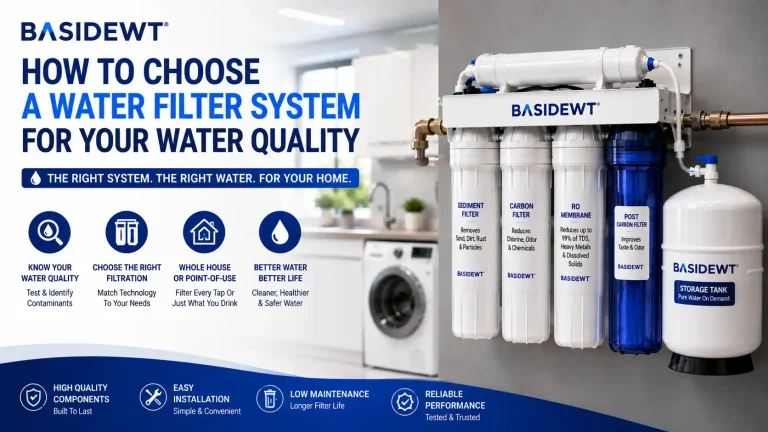
How to Choose a Water Filter System for Your Water Quality
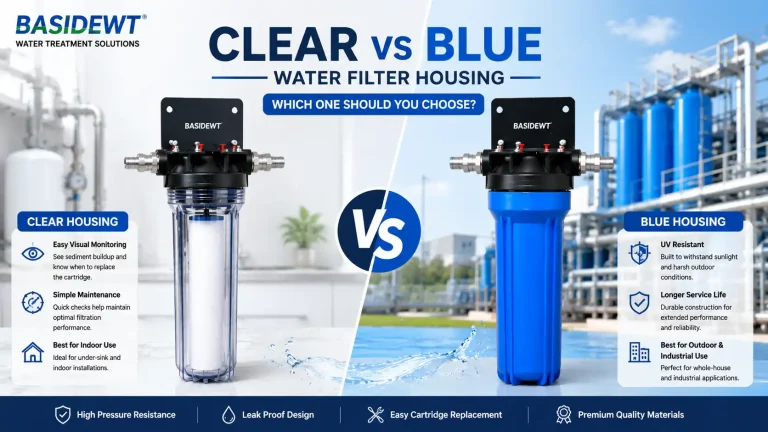
Clear vs Blue Water Filter Housing: Which One Should You Choose?
How to clean a window with a DI tank and waterfed pole!