BasideWT- Whole Home Water Filtration System & Replacement


How Water Turbidity Affects UV Water Sterilization
Water turbidity and UV sterilization are directly connected because suspended particles in water can block, scatter, or absorb UV-C light before it reaches microorganisms. When water carries silt, algae, rust, or organic debris, those particles can shield bacteria and viruses from the UV dose they need to become inactivated. This is why water that looks only slightly cloudy can still allow some pathogens to pass through a UV system without receiving enough exposure.
Understanding this relationship helps homeowners, engineers, and facility managers make better decisions about pretreatment, filtration, and system design. This article explains why turbidity matters, how it interacts with UV light, and what practical steps can improve UV disinfection performance.
What Turbidity Means in Water Treatment
Water turbidity describes how cloudy or hazy water appears because of suspended particles. These particles scatter light, which is why turbid water looks murky instead of clear.
Turbidity is measured in Nephelometric Turbidity Units, commonly written as NTU. A higher NTU value means more particles are suspended in the water, and light scatters more as it passes through.
Common sources of turbidity include:
- Silt and clay washed in after rainfall
- Rust particles from aging pipes
- Algae and organic debris
- Fine sediment stirred up from a well or storage tank
Turbidity is not the same as contamination. Clear water can still contain harmful microorganisms, and turbid water is not automatically unsafe. However, turbidity often signals conditions that make disinfection harder to achieve consistently.
Why Clear-Looking Water Can Still Affect UV Performance
Water turbidity can affect UV performance even when water looks reasonably clear to the eye, because fine particles may still interfere with UV disinfection.
Very small particles, sometimes just a few micrometers wide, can scatter or absorb UV-C light without making water look visibly cloudy. This is one reason operators should not rely on appearance alone when evaluating source water for UV treatment.
Testing turbidity with proper instruments gives a more accurate picture than visual inspection. This becomes especially important for private wells, surface water sources, and systems without consistent municipal treatment records.
How Suspended Particles Interact With UV Light
UV disinfection works by delivering enough UV-C energy to damage the DNA or RNA of microorganisms, preventing them from reproducing. For this to work, the light must actually reach the organism.
Suspended particles interfere with this process in three main ways:
- Absorption – Some particles absorb UV energy directly, reducing the amount of light available to reach microorganisms.
- Scattering – Particles can deflect UV light in random directions, weakening the intensity that reaches the target area.
- Shielding – Microorganisms can become physically attached to or embedded within particles, blocking direct UV exposure.
Research on particle-microorganism association has shown that when bacteria or viruses adhere to suspended particles, disinfection efficiency drops even at higher UV doses, because the shielded organisms simply do not receive enough direct exposure.
Microbial Shielding Explained
Shielding happens when a particle physically blocks part or all of a microorganism from UV-C rays. A pathogen embedded inside a clay particle, for example, may only have part of its surface exposed to light.
This partial exposure can be enough for the organism to survive, even if the surrounding water receives a UV dose that would normally be sufficient. This is a key reason why understanding how a UV sterilizer works step by step helps clarify why exposure time and water clarity both matter for reliable results.
Turbidity vs. UV Transmittance: An Important Distinction
Turbidity and UV transmittance are related, but they measure different things. Confusing the two is a common mistake.
| Measurement | What It Represents | What It Tells You |
|---|---|---|
| Turbidity (NTU) | How much light scatters due to suspended particles | An indirect indicator of water clarity |
| UV Transmittance (UVT %) | The percentage of UV-C light that passes through water over a set distance | A direct measure of how much UV energy actually reaches the target depth |
Water can have relatively low turbidity and still show reduced UV transmittance if it contains dissolved organic compounds, iron, or tannins that absorb UV light without necessarily scattering it. For a deeper technical breakdown, this guide on UV transmittance in water treatment explains how UVT is measured and why it affects UV chamber design.
In short, turbidity is one contributing factor to lower UV transmittance, but it is not the only one. Organic matter, color, and certain dissolved minerals can also reduce UVT even when particle counts are low.
Why Water Turbidity Can Reduce UV Exposure
Every UV system is designed to deliver a specific UV dose, which combines UV intensity and exposure time. When turbidity is high, less UV energy reaches the water passing through the chamber.
This creates a gap between the UV dose the system is designed to deliver and the dose microorganisms actually receive. Reviewing how UV dose for water disinfection is calculated makes it easier to see why even small reductions in effective exposure can matter for consistent results.
Reduced exposure does not necessarily mean disinfection fails completely. It means the margin of safety built into the system design becomes smaller, which is why pretreatment matters more as turbidity increases.
Turbidity’s Relationship With UV Wavelength and Intensity
UV-C disinfection relies on a specific wavelength range, typically around 254 nanometers, to damage microbial DNA effectively. Turbidity does not change the wavelength itself, but it does affect how much of that wavelength reaches the target water.
Higher turbidity reduces the practical intensity of UV light as it travels through the water column. This guide on UV-C wavelength for water sterilization explains why this specific wavelength range is chosen for disinfection purposes.
Similarly, UV intensity and its effect on disinfection performance shows how lamp output, chamber design, and water clarity work together. Turbidity is one variable in that equation, not the entire picture.
Common Turbidity Conditions and Their Practical Impact
The table below outlines general patterns operators may encounter. These are illustrative examples, not universal thresholds, since actual UV performance depends on system design, flow rate, and water chemistry.
| Water Condition | Likely UV Impact | Recommended Response |
|---|---|---|
| Brief cloudiness after rainfall | Temporary reduction in UV transmittance | Monitor and retest once conditions stabilize |
| Persistent low-level turbidity | Gradual reduction in effective UV dose over time | Evaluate sediment filtration before UV |
| Sudden turbidity spike from a well | Sharp drop in UV transmittance | Pause use and investigate the source |
| Fine colloidal particles with clear appearance | Possible shielding despite visual clarity | Test turbidity and UVT directly, don’t rely on appearance |
Sediment, Organic Matter, and Their Influence on Treatment
Sediment and turbidity often occur together, but they are not identical. Sediment refers to physical particles like sand, silt, or rust that settle over time. Organic matter includes decomposed plant material, algae byproducts, and humic substances.
Organic matter can discolor water and absorb UV light even when turbidity readings are moderate. This is why some naturally colored water sources show lower UV transmittance than turbidity alone would suggest.
A facility drawing from a surface reservoir, for example, might see seasonal increases in organic content during warmer months, even without a major change in particle count. This kind of variation is a common reason commercial systems schedule regular water testing rather than relying on a single annual check.
Why Pretreatment May Be Necessary
UV light disinfects microorganisms, but it does not physically remove suspended particles from water. This distinction matters because UV alone cannot solve a turbidity problem.
Pretreatment addresses the particles themselves before water reaches the UV chamber. Reviewing the parts and components of a UV water sterilizer helps illustrate why the UV chamber is only one part of a complete treatment system, not a standalone solution for poor water clarity.
Common pretreatment approaches include:
- Sediment filtration to remove larger particles
- Cartridge filtration for finer suspended solids
- Settling or clarification for heavily turbid surface water
- Multi-stage filtration when both sediment and organic matter are present
Choosing the right pretreatment depends on particle size, source water variability, and flow rate requirements.
A Practical Process for Evaluating Turbid Source Water
Operators facing turbid or variable source water can follow a structured evaluation process:
- Identify the source of turbidity. Determine whether it comes from rainfall runoff, aging infrastructure, algae, or well conditions.
- Check whether turbidity is temporary or persistent. Occasional cloudiness after storms differs from a chronic condition.
- Test both turbidity and UV transmittance. These readings together give a clearer picture than either measurement alone.
- Review existing pretreatment. Confirm whether current filtration is sized correctly for the particle load.
- Evaluate flow rate and UV system specifications. Higher flow rates reduce contact time, which becomes more critical when water clarity is inconsistent.
- Reassess after any source water change. Seasonal shifts, new wells, or plumbing changes can all alter turbidity levels.
Illustrative Scenarios
A household on a private well may notice cloudy water after heavy rainfall due to surface runoff entering the aquifer. Testing helps determine whether this is a short-term event or a sign of a compromised well seal.
A commercial facility drawing from a variable surface source might experience gradual turbidity increases across a season. In this case, reviewing filtration capacity before the UV stage helps maintain consistent water clarity for disinfection.
An industrial process line may depend on stable UV transmittance for regulatory or quality reasons. Here, pretreatment performance directly affects how reliably the UV stage can meet its intended disinfection target.
These examples are hypothetical and intended to illustrate general principles, not specific outcomes for any single system.
What UV Systems Can and Cannot Do About Turbidity
UV sterilizers are designed to inactivate microorganisms, not to clarify water. Readers exploring what a UV water sterilizer actually removes from water will find that UV targets biological contaminants specifically, while particles, sediment, and dissolved substances require separate treatment methods.
This is a common misconception worth addressing directly: installing a UV system does not eliminate the need for filtration when source water is turbid. The two technologies work together, with filtration protecting the UV stage and UV addressing microbial risk.
Independent research on unfiltered drinking water systems has reinforced this point, showing that particle characteristics and surface charge, not turbidity readings alone, strongly influence how effectively UV disinfection performs once water reaches the treatment stage, according to a peer-reviewed study on unfiltered water quality and UV disinfection. This finding supports the idea that turbidity is one useful indicator among several, not a complete predictor of disinfection outcomes.
Turbidity Is One Factor Among Several
It’s worth repeating that turbidity does not act alone. UV dose, flow rate, lamp condition, chamber design, and water chemistry all influence final disinfection performance.
No single turbidity value guarantees success or failure. A system properly sized for its flow rate and UV transmittance range can often handle moderate turbidity variations, while an undersized or aging system may struggle even with relatively clear water.
This is why professional evaluation matters more than relying on generic turbidity thresholds found online.
Bringing It Together
Turbidity and UV sterilization performance are closely connected because suspended particles can scatter, absorb, or shield microorganisms from UV-C light. Even water that looks clear can carry fine particles capable of reducing effective UV exposure.
Addressing turbidity starts with understanding its source, testing both turbidity and UV transmittance, and reviewing whether pretreatment matches the water’s actual condition. UV disinfection remains a highly effective tool for microbial control, but it performs best when paired with appropriate filtration and a system sized for real-world water conditions.
BasideWT works with residential, commercial, and industrial customers to evaluate water conditions and match UV treatment approaches to the realities of the source water involved. For water sources with variable clarity, a combined pretreatment and UV strategy remains the most reliable path toward consistent disinfection performance.
RELATED POSTS
UV Water Sterilizer Capacity: GPM, LPM and m³/h Explained
Does UV Treatment Remove Chlorine From Water?

What is a TDS Meter?
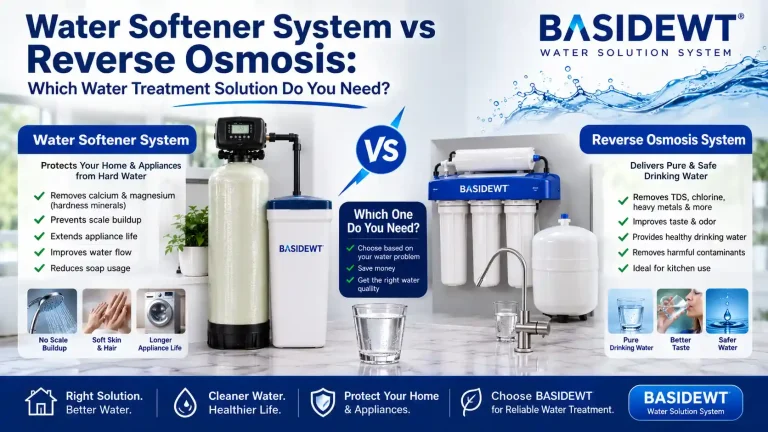
Water Softener System vs Reverse Osmosis: Which Water Treatment Solution Do You Need?
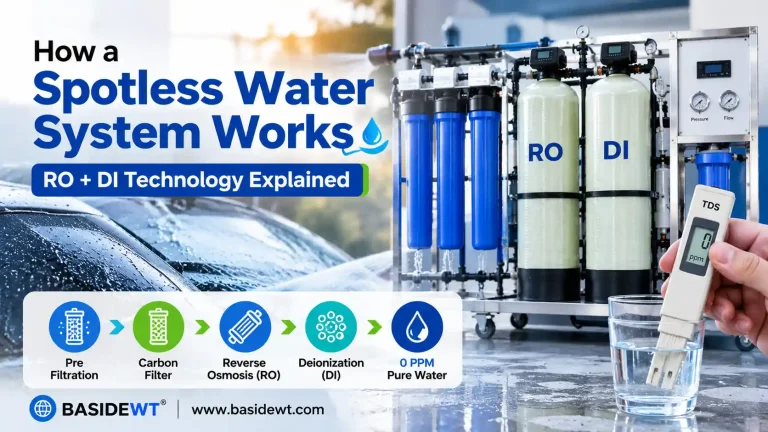
Spotless Water System Working Principle: How RO and DI Deliver 0 PPM Water