BasideWT- Whole Home Water Filtration System & Replacement


UV-C Wavelength for Water Sterilization Explained
UV-C wavelength refers to the specific band of ultraviolet light, roughly 200–280 nanometers (nm), that carries enough energy to damage the DNA and RNA of microorganisms. In water sterilization, this wavelength range is what makes bacteria, viruses, and other pathogens unable to reproduce, which is the core principle behind every UV water sterilizer system. Wavelength alone does not disinfect water. It works together with UV intensity, exposure time, and water quality to deliver an effective dose.
This article explains what UV-C wavelength means, why certain wavelengths are more effective than others, and how wavelength fits into the bigger picture of water disinfection performance.
What Makes a Wavelength “Germicidal”?
Not every part of the UV spectrum kills microorganisms equally well. Germicidal effectiveness depends on how strongly a wavelength is absorbed by nucleic acids, the DNA and RNA inside a microbial cell.
When UV-C light hits these nucleic acids, it forms molecular bonds called pyrimidine dimers. These dimers distort the genetic structure of the microorganism. As a result, the organism can no longer replicate, even though it may not be physically destroyed.
This absorption effect is strongest within a specific wavelength range. Published kinetic research on UV-C water disinfection shows that germicidal action peaks near 260 nm and drops sharply outside the 200–280 nm range. That is why manufacturers of germicidal lamps and UV-C LEDs target this window rather than the wider UV-A or UV-B bands.
The UV-C Spectrum in Water Treatment
UV-C covers wavelengths from about 200 nm to 280 nm. Within this range, different wavelengths behave differently in water treatment applications.
| Wavelength Range | Common Name | Typical Use |
|---|---|---|
| 200–230 nm | Far UV-C | Emerging research, air and surface studies |
| 230–280 nm | Near UV-C | Standard water and air disinfection |
| ~253.7 nm | Low-pressure mercury lamp output | Most common in residential and commercial UV water systems |
| 255–280 nm | UV-C LED range | Point-of-use and compact systems |
Most conventional UV water sterilizer products rely on wavelengths close to 254 nm, since this is where widely used lamp technology performs most efficiently.
Why 254 nm Is the Long-Standing Reference Point
Low-pressure mercury lamps emit most of their energy at 253.7 nm, commonly rounded to 254 nm. This wavelength sits close to the germicidal peak near 260 nm, so it inactivates a broad range of bacteria and viruses effectively.
There is a practical reason for this, not just a biological one. Mercury vapor naturally emits strongly at this wavelength, so lamp manufacturers did not need to engineer a different output. That efficiency, combined with over a century of use, made 254 nm the reference point for germicidal UV performance.
It is worth noting that 254 nm is close to, but not exactly at, the theoretical germicidal peak. Some studies point to a slightly higher peak effectiveness around 260–265 nm, though the difference in real-world disinfection outcomes is generally small for most water treatment applications.
UV-C LEDs and Newer Wavelength Options
UV-C LED technology has introduced more flexibility in wavelength selection. Unlike mercury lamps, which are fixed near 254 nm, LEDs can be manufactured to emit at various points across the UV-C band, typically between 255 nm and 280 nm.
This flexibility brings trade-offs. LED output and efficiency change depending on the target wavelength, and different semiconductor materials are needed for different ranges. Some water treatment manufacturers select LED wavelengths based on:
- Compact system design, since LEDs eliminate mercury and warm-up time
- Instant-on operation for point-of-use systems
- Longer rated lifespan compared to conventional lamps
None of this means an LED-based system automatically disinfects better than a mercury-lamp system. Actual inactivation still depends on how much UV energy reaches the microorganism, not only which wavelength produces it. Readers comparing lamp-based and LED-based options may also want to review the core parts inside a UV sterilizer, since lamp type affects sleeve design, housing, and maintenance needs.
How Wavelength Relates to UV Dose and Intensity
Wavelength determines how effectively UV light damages microbial DNA. It does not, by itself, determine whether disinfection succeeds. That outcome depends on UV dose.
UV dose combines two factors:
- UV intensity — how much UV energy the lamp or LED delivers per unit area
- Exposure time — how long the water is exposed to that energy as it flows past the light source
A system using an ideal germicidal wavelength can still under-perform if intensity is too low or exposure time is too short. This is why product literature usually references dose, measured in mJ/cm², alongside wavelength. For a deeper explanation of how this calculation works, see our guide to UV dose for water disinfection.
Why Wavelength Alone Does Not Guarantee Sterilization
A common misconception is that choosing the “best” germicidal wavelength is enough to guarantee safe water. In practice, several other factors influence whether a UV system performs as intended:
- UV transmittance (UVT): Water that absorbs or scatters UV light reduces how much energy reaches microorganisms, regardless of wavelength.
- Flow rate: Faster flow means less exposure time at the same wavelength and intensity.
- Quartz sleeve condition: A dirty or scaled sleeve blocks UV output before it ever reaches the water.
- Lamp aging: Mercury lamps lose output over their operating life, even though the wavelength they emit stays largely the same.
- Reactor design: How water moves past the UV source affects whether every part of the flow receives adequate exposure.
These factors explain why two systems using the same wavelength can produce different real-world disinfection results. Manufacturer specifications, tested under defined conditions, remain the most reliable way to judge expected performance.
Wavelength Considerations by Application
Wavelength selection is rarely a standalone decision. It is usually built into the system a buyer chooses, rather than something adjusted independently.
Residential systems typically use low-pressure mercury lamps near 254 nm. This wavelength is well-proven for point-of-entry whole-house treatment and point-of-use taps, where water quality is generally consistent and UVT is high.
Commercial water treatment applications, such as those serving restaurants, offices, or small facilities, often use the same 254 nm wavelength but at higher intensities or longer contact chambers to handle greater flow volumes.
Industrial applications, including process water and wastewater treatment, may involve lower UVT water. In these cases, engineers sometimes evaluate UV-C LED systems at slightly longer wavelengths, since some studies suggest improved penetration characteristics in challenging water matrices. This is illustrative of current engineering considerations, not a guaranteed outcome for every installation.
Buyers comparing residential and industrial-grade options may find it useful to first understand how a UV water sterilizer works step by step, since the disinfection process itself stays consistent even as system scale changes.
Wavelength and What UV Light Can Actually Treat
UV-C wavelength inactivates microorganisms, but it does not change water chemistry or remove particles. Buyers sometimes confuse UV disinfection with filtration or purification. Since wavelength only addresses biological contamination, it helps to understand what a UV water sterilizer does and does not remove before assuming UV alone solves every water quality issue.
It also helps to distinguish sterilization from purification more broadly. If you are unsure which term applies to your system, our comparison of UV sterilizers versus UV purifiers clarifies the terminology used across the industry.
Bringing It Together
UV-C wavelength for water sterilization is the foundation of germicidal UV technology, but it works as one part of a complete system. The 200–280 nm UV-C range, and particularly the region around 254 nm, damages the DNA and RNA of microorganisms so they cannot reproduce. Newer UV-C LED technology has expanded wavelength options within this same band, offering design flexibility without changing the underlying germicidal principle.
What ultimately determines disinfection performance is the combination of wavelength, UV intensity, exposure time, water transmittance, and system design. A well-engineered UV system accounts for all of these factors together, not wavelength in isolation.
At BasideWT, we design UV water treatment solutions with this complete picture in mind, matching wavelength, dose, and system components to real operating conditions rather than a single spec sheet number. If you are evaluating UV-C wavelength for water sterilization for a residential, commercial, or industrial project, understanding how these factors interact is the first step toward choosing a system that performs reliably over time.
RELATED POSTS
RO Water System for Well Water: Benefits, Challenges & Complete Buying Guide
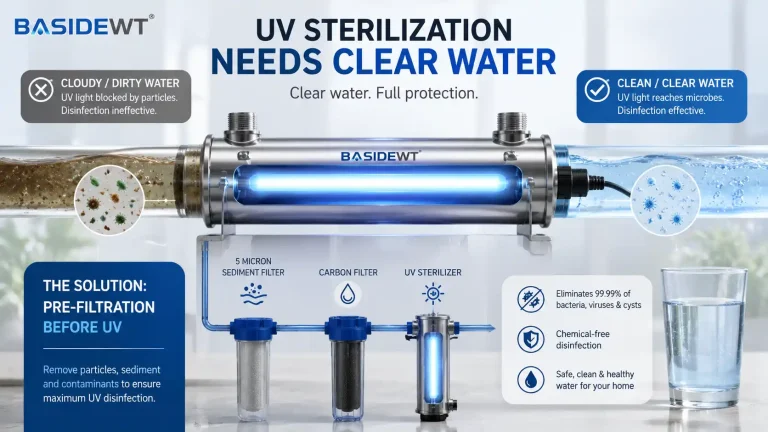
Can UV Sterilization Work With Cloudy or Dirty Water?
How to Choose the Right Deionized Water System for Your Business
Water Filtration Systems For Boats|BasideWT
How Often Should You Change a Water Filter? Signs It Needs Replacing