BasideWT- Whole Home Water Filtration System & Replacement


How Long Does an RO Membrane Last? Lifespan & Replacement Guide
How long does an RO membrane last? Most reverse osmosis membranes last 2 to 5 years before they need replacement. That range isn’t arbitrary. It reflects how fast a membrane fouls, scales, or chemically degrades under real feed-water conditions, not just the number stamped on the box.
A membrane running on soft, low-TDS water with a healthy carbon pre-filter can easily reach the top of that range, sometimes longer. The same membrane exposed to hard water, chlorine, or a worn-out sediment filter can fail in half the time. Lifespan isn’t fixed. It’s the result of water quality, operating conditions, and how well the system around the membrane is maintained.
This guide explains what actually shortens or extends membrane life, how to recognize genuine membrane failure, how to test a membrane before you replace it, and how to tell membrane problems apart from other RO system issues that only look like membrane failure.
Residential vs Commercial RO Membrane Lifespan
Membrane lifespan depends heavily on how much water passes through it and what’s in that water. Residential and commercial systems face different demands, so their typical replacement cycles differ too.
| Application | Typical Lifespan | Main Influencing Factors |
|---|---|---|
| Residential RO (low TDS, good pre-filtration) | 3–5 years | Light daily use, stable feed water, regular filter changes |
| Residential RO (hard water, high TDS) | 1–3 years | Scaling risk, higher mineral load, more frequent fouling |
| Commercial or light commercial RO | 2–4 years | Higher daily throughput, variable feed water |
| Industrial or high-volume RO systems | 1–3 years, sometimes shorter | Continuous operation, higher fouling potential, stricter output requirements |
These figures describe typical outcomes, not guarantees. Two identical membranes installed in different homes can have very different service lives depending on the water feeding them.
Residential RO Membrane Lifespan
In a typical household, an RO membrane processes a modest daily volume, so wear tends to come more from water chemistry than from sheer usage. If your feed water has low sediment, low chlorine exposure, and moderate hardness, a membrane can comfortably run for three to five years before rejection rates start to drop.
Homes on well water or municipal supplies with higher mineral content usually see shorter membrane life unless a water softener or added pre-treatment is in place ahead of the RO system. If you’re still deciding which membrane fits your household’s water demand, it helps to understand what an RO membrane is and how it fits into a filtration system before comparing lifespan expectations.
Commercial RO Membrane Lifespan
Commercial systems run more water through the membrane on a regular basis, which increases exposure to fouling material even if the water quality itself is similar to a residential source. Higher throughput means more frequent contact with sediment, organics, and dissolved solids.
Commercial membranes process much larger water volumes and often operate continuously, increasing cumulative exposure to fouling and scaling. Proper pretreatment and regular performance monitoring are therefore especially important. Facilities that monitor permeate flow and rejection rate consistently can often catch early performance decline and plan replacement before output quality suffers. Tracking these numbers over time is also the most reliable way to answer how long does an RO membrane last for a specific commercial installation, rather than relying on a general industry average.
How Long Does an RO Membrane Last? The Key Factors
Membrane lifespan isn’t set by one factor. It’s the combined effect of water chemistry, operating conditions, and maintenance habits working on the membrane at the same time.
Feed-Water TDS and Membrane Lifespan
Total dissolved solids (TDS) directly affect how hard a membrane has to work. Higher feed-water TDS means more dissolved material is present in the water that reaches the membrane surface. On its own, though, high TDS doesn’t automatically cause scaling. Whether scaling actually forms depends on the specific minerals dissolved in the water, their concentration relative to their solubility limits, the system’s recovery rate, water temperature, and how the membrane is operated. Two systems with the same feed-water TDS can behave very differently if one runs at a higher recovery rate or has harder water chemistry.
For general background on how reverse osmosis membranes function and separate contaminants from feed water, the Water Quality Association’s reverse osmosis fact sheet is a useful reference point.
Lower TDS feed water generally places less osmotic pressure on the membrane, although membrane lifespan also depends heavily on hardness, scaling potential, chlorine exposure, fouling, pressure, temperature, and pretreatment. This is one reason the same membrane model can perform very differently in two different homes.
Chlorine and Oxidizing Chemicals
Most residential RO membranes are thin-film composite (TFC) membranes, and TFC material is chemically sensitive to chlorine and other oxidizers. Continuous or repeated chlorine exposure breaks down the membrane’s active layer, reducing its ability to reject dissolved solids.
This is why a functioning carbon pre-filter matters so much. It removes chlorine before the water reaches the membrane. When that pre-filter is exhausted and not replaced on schedule, chlorine can pass through and cause damage that shows up as declining rejection performance within a matter of months, not years.
Water Pressure
RO membranes are designed to operate within a specific pressure range. Understanding the pressure and feed-water requirements that keep a membrane operating correctly is useful groundwork before troubleshooting lifespan concerns.
Low feed pressure reduces permeate output and can allow more dissolved solids to pass through, which looks like membrane failure even when the membrane itself is fine. Operating above the membrane manufacturer’s rated pressure, on the other hand, can stress the membrane structure and surrounding system components, and may shorten service life over time.
Water Temperature
Cold water reduces permeate production because lower temperatures increase water viscosity, making it harder for water to pass through the membrane at a given pressure. This isn’t membrane damage. It’s a normal performance characteristic, but it does mean output and apparent rejection can shift seasonally.
Consistently high temperatures, on the other hand, can accelerate membrane aging and, in some cases, exceed manufacturer temperature limits, which does shorten usable life.
Fouling and Scaling
Fouling happens when organic matter, biological growth, or fine particulates build up on the membrane surface and restrict water flow. Scaling happens when dissolved minerals, mainly calcium and magnesium, precipitate onto the membrane as hard deposits.
Both reduce permeate flow and can lower rejection performance over time. Neither is necessarily permanent damage in the earliest stages, but left unaddressed, both shorten the membrane’s functional lifespan significantly.
Sediment Loading and Pre-Filter Condition
Sediment is one of the most common causes of premature membrane wear, and it’s also one of the easiest to prevent. A worn or clogged sediment pre-filter allows particulates to reach the membrane surface, where they accumulate and reduce flow.
Replacing sediment and carbon pre-filters on schedule is one of the simplest ways to protect membrane life. In many cases, a membrane that appears to be failing is actually being starved of protection by pre-filters that should have been changed months earlier.
System Usage Patterns
A membrane that sits idle for long periods without proper storage or sanitization can develop biological growth, which shortens its usable life once the system is back in service. Conversely, membranes under continuous heavy use accumulate fouling material faster simply because more water, and more contaminant load, passes through them.
Neither light use nor heavy use is inherently better for lifespan. What matters is whether the system is maintained appropriately for its actual usage pattern.
Membrane Quality and Manufacturer Specifications
Not all membranes are built to the same standard, and manufacturer specifications outline the operating limits, expected flow rates, and rejection performance a membrane should deliver under normal conditions. Choosing a membrane suited to your system’s size and expected flow requirements matters just as much as water quality when it comes to long-term performance.
Manufacturer lifespan estimates assume operation within recommended pressure, temperature, and feed-water limits. Running a membrane outside those parameters, even briefly, can shorten its practical service life regardless of build quality.
How to Extend RO Membrane Life
Several practical habits meaningfully extend membrane life without requiring any special equipment.
- Replace sediment and carbon pre-filters on the manufacturer’s recommended schedule, not just when performance visibly drops.
- Address chlorine exposure at the source if your carbon pre-filter is undersized for your system’s flow rate.
- Keep feed pressure within the manufacturer’s specified range.
- Avoid letting the system sit unused for extended periods without proper flushing or storage.
- Address hardness with appropriate pretreatment, such as water softening, and manage high TDS according to the membrane manufacturer’s recommended feed-water limits.
- Monitor TDS readings periodically rather than waiting for a visible problem.
None of these steps guarantee a specific lifespan, but they consistently reduce the fouling, scaling, and chemical stress that cause premature membrane failure.
Signs Your RO Membrane Is Failing
A membrane rarely fails suddenly. It usually shows measurable performance decline first, which is why regular monitoring matters more than watching for a dramatic breakdown.
High Permeate TDS
A rising TDS reading in the filtered water is one of the clearest indicators that a membrane’s rejection performance is declining. If TDS in the permeate climbs noticeably compared to when the membrane was new, and pre-filters are in good condition, the membrane itself is likely the cause.
Reduced Water Production
A drop in how much filtered water the system produces over a given time can indicate membrane fouling or scaling restricting flow. This symptom alone isn’t conclusive, though, since low feed pressure or a failing booster pump can cause the same effect.
Slow Tank Filling
If the storage tank takes noticeably longer to fill than it used to, that’s often the first symptom people notice. It can point to membrane restriction, but it’s also commonly caused by tank pre-charge pressure problems, a clogged flow restrictor, or low feed pressure, which is why this symptom needs further checking before assuming membrane failure.
Changes in Rejection Rate
Rejection rate describes how effectively the membrane blocks dissolved solids. A membrane’s rejection rate and what typically affects it can shift due to scaling, fouling, or chemical damage, and tracking this number over time is one of the most reliable ways to catch early membrane decline before water quality visibly suffers.
How to Test an RO Membrane Before Replacing It
Before assuming a membrane needs replacement, it’s worth confirming the problem is actually coming from the membrane rather than another part of the system.
TDS Testing and Rejection Rate Calculation
Use a TDS meter to measure both the feed water and the permeate (filtered) water. The rejection rate is calculated as:
Rejection Rate (%) = [(Feed TDS − Permeate TDS) / Feed TDS] × 100
For example, if feed water measures 300 ppm and permeate measures 15 ppm, rejection rate is roughly 95%. Most residential membranes are rated for rejection somewhere in the 90–99% range when new, depending on the specific membrane model and its manufacturer specifications. A gradual, sustained drop in this number, especially alongside reduced flow, is a stronger indicator of membrane wear than any single symptom on its own.
Testing feed and permeate TDS at the same time, under similar pressure and temperature conditions, gives a more reliable comparison than testing at different times of day or after recent filter changes.
Membrane Problems vs Other RO System Problems
Many symptoms blamed on a “failing membrane” are actually caused by something else in the system. Replacing the membrane in these cases doesn’t fix the underlying issue and wastes money on a part that wasn’t the problem.
| Symptom | Could Indicate Membrane Failure | Could Also Indicate |
|---|---|---|
| Rising permeate TDS | Membrane degradation or scaling | Faulty or bypassed pre-filter |
| Slow tank filling | Membrane fouling restricting flow | Weak tank pre-charge, clogged flow restrictor, low feed pressure |
| Low water production | Fouled or scaled membrane | Cold feed water, low pressure, failing booster pump |
| Odd taste or odor | Rarely the membrane itself | Exhausted carbon filter, stagnant water in the storage tank, sanitation or biofilm issues |
| Inconsistent output | Membrane wear | System leak, incorrect installation, air in the lines |
Working through this list before ordering a replacement membrane often reveals that a pre-filter change, a pressure adjustment, or a tank repair solves the problem without touching the membrane at all.
Can an RO Membrane Be Cleaned or Restored?
In some cases, yes. Membrane cleaning solutions can remove certain types of scale and organic fouling, temporarily restoring flow and, in mild cases, improving rejection performance. Cleaning tends to work best when fouling is caught early and the membrane hasn’t sustained chemical damage from chlorine exposure.
For residential systems, cleaning isn’t always practical or worthwhile. Low-cost residential membranes often cost close to what a cleaning kit and the associated downtime would cost, so replacement is frequently the simpler option at home. Controlled membrane cleaning is more common in commercial and industrial RO systems, where larger, more expensive membranes justify the process and where cleaning is carried out under closer monitoring. Any cleaning attempt should always follow the specific membrane manufacturer’s instructions for approved chemicals, concentrations, and procedures, since the wrong cleaning agent can damage the membrane rather than restore it.
Cleaning is not a permanent fix, and it doesn’t reverse chemical degradation of the membrane material itself. If rejection rate stays low after cleaning, or if TDS continues climbing shortly afterward, the membrane has likely reached the end of its usable life rather than simply needing a cleaning cycle.
A Practical Decision Framework: Should You Replace Your RO Membrane?
Rather than replacing a membrane at the first sign of a problem, work through the system methodically.
- Check feed-water conditions. Confirm current TDS, hardness, and chlorine levels haven’t changed significantly since installation.
- Inspect pre-filter condition. Replace sediment and carbon filters if they’re overdue, then re-test performance before assuming the membrane is at fault.
- Measure feed and permeate TDS. Use these readings to calculate current rejection rate.
- Compare rejection rate to the membrane’s original specification. A significant, sustained drop points toward the membrane itself.
- Compare permeate flow to expected performance for your membrane’s rated output under current pressure and temperature.
- Check system pressure and water temperature to rule out conditions that mimic membrane failure.
- Consider membrane age and operating history. A membrane well past typical lifespan with declining numbers across the board is a stronger replacement candidate than a newer membrane with an isolated symptom.
- Decide between cleaning, further troubleshooting, or replacement based on what the numbers actually show, not just how the system feels day to day.
If this process points clearly to the membrane, choosing a correctly sized replacement from a reliable RO membrane selection matched to your system’s original specifications is the most straightforward next step.
Does RO Membrane Age Matter More Than Performance?
Age alone shouldn’t decide whether a membrane gets replaced. A membrane’s actual condition matters more than how many years it’s been in service.
Evaluate a membrane by its rejection rate, permeate TDS, flow rate, operating pressure, water temperature, and the feed-water quality it’s been exposed to, all measured against the manufacturer’s original specifications. A newer membrane can fail early if it’s been exposed to chlorine, heavy scaling, aggressive fouling, or poor pre-filtration. An older membrane operating on clean, well-treated water can still perform within spec well past the typical replacement window.
Age is a useful reference point for when to start checking performance more closely. It shouldn’t be the sole reason to replace a membrane that’s still testing well. In other words, how long does an RO membrane last matters less than how well it’s currently performing.
When Should You Replace an RO Membrane?
Replace an RO membrane when its measured performance, not just its age, shows a genuine, sustained decline that basic troubleshooting doesn’t fix. Look for:
- High permeate TDS that stays elevated after confirming pre-filters are current and feed conditions are normal.
- A significant, sustained drop in rejection rate compared to the membrane’s original specification.
- Persistently low permeate flow that doesn’t improve after checking pressure, temperature, and pre-filter condition.
- The membrane reaching or exceeding its expected service life, combined with declining numbers across TDS, rejection rate, and flow.
- No recovery after troubleshooting or cleaning, where cleaning is applicable, meaning performance stays poor even after addressing pressure, pre-filters, and other system factors.
- Evidence of chemical damage or severe fouling and scaling that cleaning cannot reasonably reverse.
If several of these apply at once, replacement is the practical next step rather than continued troubleshooting.
Conclusion
So, how long does an RO membrane last? Typically 2 to 5 years, but that number depends entirely on the conditions it operates under. Feed-water TDS, chlorine exposure, pressure, temperature, fouling, scaling, and how consistently pre-filters get replaced all shape how long a specific membrane will actually perform well.
Before replacing a membrane, check the fundamentals first. Confirm pre-filter condition, measure feed and permeate TDS, calculate rejection rate, and rule out pressure or tank issues that can mimic membrane failure. A membrane genuinely at the end of its service life will show a sustained drop in rejection rate and flow that doesn’t improve after basic troubleshooting.
Understanding what shortens membrane life, and taking a few consistent maintenance steps, is usually enough to get a membrane closer to the longer end of its expected lifespan rather than the shorter one.
RELATED POSTS

Can You Drink Softened Water? Safety, Health Benefits & Common Myths
How Often Do I Need to Change My Filters?
UV Dose for Water Disinfection: How It Works and Why It Matters
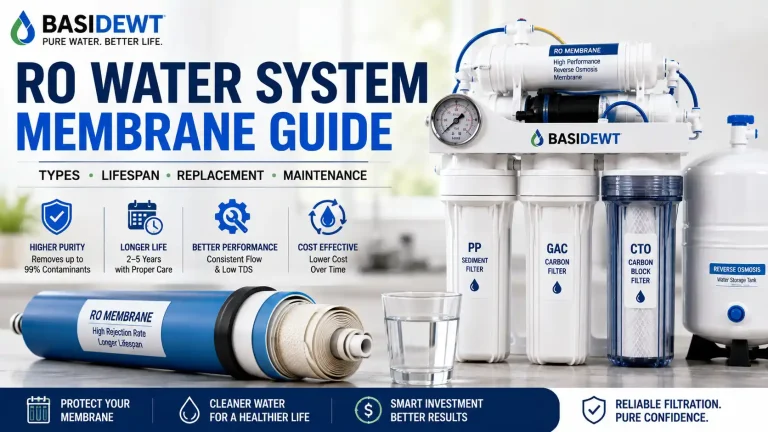
RO Water System Membrane Guide: Types, Lifespan, Replacement & Maintenance
Commercial Water Fed Pole Systems: Choosing Equipment for Professional Cleaning