BasideWT- Whole Home Water Filtration System & Replacement

Self Car Wash Near Me: Everything You Need to Know to Get a Perfect Clean Every Time
You’ve just spotted a self car wash bay nearby and you’re wondering: is this worth it? Will it actually get my car clean? What do I need to bring? And — perhaps most frustratingly — why does my car still have water spots every single time I wash it?
These are the questions that don’t show up in the quick Google Maps result when you search ‘self car wash near me.’ But they matter a lot, because the difference between a mediocre wash and a genuinely clean, spot-free finish usually comes down to a few things most people don’t know about.
This guide covers everything: how self-service car washes work, how to get the best results from them, what causes those annoying water spots, and what the professionals use to eliminate them completely. Whether you’re a first-timer or a regular, you’ll leave with a cleaner car — and an understanding of why the water itself makes all the difference.
What Is a Self-Service Car Wash and How Does It Work?
A self-service car wash — also called a coin-operated car wash or DIY car wash bay — is a drive-in facility where you wash your own vehicle using professional-grade equipment. You pay for time (usually in increments of one to three minutes), and in return you get access to a high-pressure hose, foam brush, soap dispenser, rinse mode, and sometimes a wax or spot-free rinse setting.
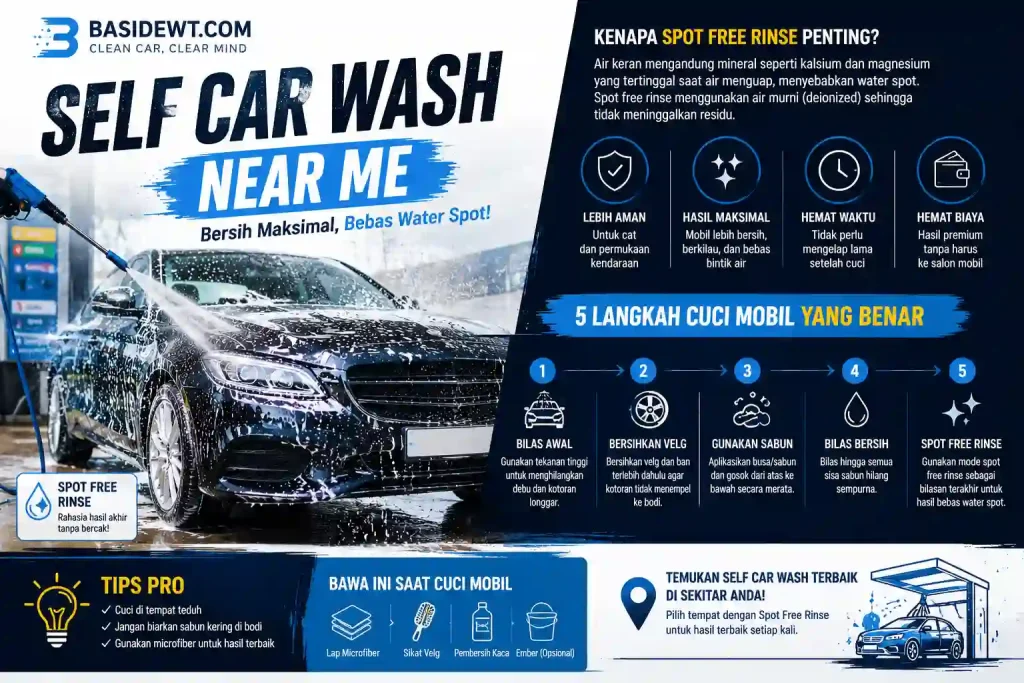
Unlike automated tunnel washes where the machine does everything, you’re in control at a self-service bay. That’s both the advantage and the challenge. Done right, a self-wash produces noticeably better results than most automated washes — because you’re applying the right amount of pressure in the right places, and you’re not dragging dirty brushes across your paintwork.
Typical Modes Available at Self-Service Bays
- Pre-soak / High-pressure rinse — loosens surface dirt before contact washing
- Foam brush / Soap — applies detergent for manual scrubbing
- Tire cleaner — stronger degreaser specifically for wheels and tires
- Rinse — removes soap residue with clean water
- Spot-free rinse — the most important mode, covered in detail below
- Wax or protectant — a polymer spray applied during the final rinse stage
Pro Tip: Always end with the spot-free rinse if the bay offers one. This single step makes more difference to the final appearance of your car than any other part of the wash process.
The Real Problem Nobody Talks About: Water Spots
Here’s something frustrating that happens to almost everyone who uses a self-service car wash: you put in the time, you soap and rinse thoroughly, you drive home — and within an hour of the car drying, there are water spots all over the paintwork. Sometimes worse than before.
This isn’t user error. It’s a water quality problem. And it’s the single most overlooked factor in car washing results.
Tap water — even clean, municipal tap water — contains dissolved minerals. Calcium and magnesium are the main culprits, but iron, silica, and other dissolved solids also play a role. When water evaporates from your car’s surface, these minerals don’t evaporate with it. They stay behind, bonded to the paint, glass, or chrome as white, chalky deposits — water spots.
In areas with hard water (high mineral content), this problem is significantly worse. But even moderate water can leave spots on dark-colored vehicles where they’re most visible.
Why Some Car Washes Leave Better Results Than Others
The car washes that consistently produce spot-free results use one thing the others don’t: a final rinse with purified, deionized water. Deionized water — often called DI water or spot-free water — has had its mineral content removed. When it evaporates, there’s nothing left behind. No spots. No residue. Just clean, dry paintwork.
The ‘spot-free rinse’ mode you see at better self-service bays is exactly this: deionized or reverse osmosis treated water applied as the final stage. If you’re choosing between two nearby self-service car washes, this feature alone is worth prioritizing.
Self Car Wash vs. Other Options: Which Is Right for You?
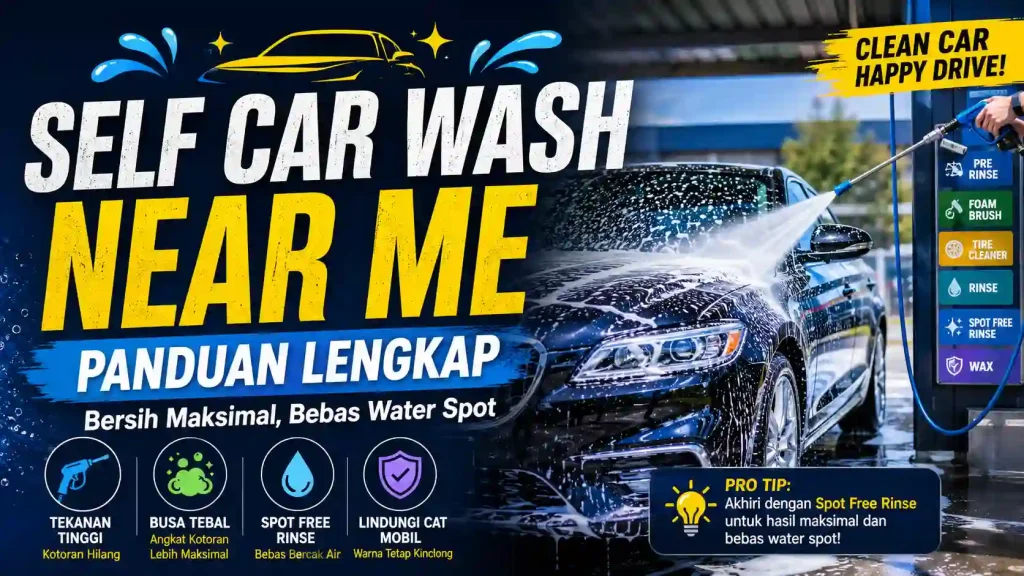
Not sure whether a self-service bay is the right choice for your situation? Here’s an honest comparison:
| Wash Type | Cost | Time | Result Quality | Best For |
| Self Car Wash Bay | $2–$8 | 15–30 min | Good | Regular maintenance |
| Automatic Tunnel Wash | $8–$20 | 5–10 min | Average | Quick clean, time-pressed |
| Full-Service Detailing | $50–$200+ | 1–4 hours | Excellent | Deep clean, special occasions |
| Home DIY Wash | $0–$5 | 30–60 min | Good–Excellent | Control over process |
| Touchless Auto Wash | $10–$15 | 5–10 min | Fair | Light dust/dirt only |
For most regular car owners, a self-service bay hits the sweet spot: better results than an automated tunnel wash, at a fraction of the cost of professional detailing, with full control over the process. The main downside is time and effort — it takes 20–30 minutes of active work rather than sitting in your car while a machine does it.
How to Get the Best Results at a Self-Service Car Wash: Step by Step
Following a proper sequence makes a significant difference in both the quality of the clean and the risk of scratching the paintwork.
What to Bring
- Microfiber drying towel (avoid chamois leather — it drags dirt across the surface)
- Wheel brush or separate mitt (keep it away from the paintwork)
- Glass cleaner if you want streak-free windows
- Coins or payment method (most modern bays accept cards)
The Correct Wash Sequence
- Pre-rinse: Start with high-pressure rinse. Work top to bottom — roof, windows, hood, sides, lower panels, wheels last. This removes loose dirt before any contact.
- Wheels first: Clean wheels before the bodywork. Brake dust is highly abrasive. If it gets on your mitt and then your paintwork, it causes fine scratches.
- Foam/soap: Apply soap generously, working top to bottom. Let it dwell for 30–60 seconds before contact washing.
- Scrub: Use the foam brush or your own mitt for the bodywork. Gentle, overlapping strokes. Avoid scrubbing in circles — linear strokes reduce swirl marks.
- Rinse: Thorough rinse from top to bottom. Make sure all soap is removed, especially around mirrors, door handles, and trim.
- Spot-free final rinse: If available, always use this last. Don’t dry or wipe after spot-free rinse — let it air dry or use a blower. Wiping can introduce new contamination.
- Dry: If no spot-free rinse is available, dry immediately with a clean microfiber towel to prevent water spot formation.
Common Mistake: Many people rinse with regular water after the spot-free rinse, undoing all its benefits. The spot-free rinse must be the absolute last water contact with the vehicle.
The Spot-Free Secret: What Professionals Actually Use
Professional detailers, car showrooms, and high-end car wash operations all share one common practice: they use purified water for the final rinse. Whether that’s deionized water, reverse osmosis treated water, or a combination of both, the principle is the same — removing mineral content from the water eliminates water spot formation at the source.
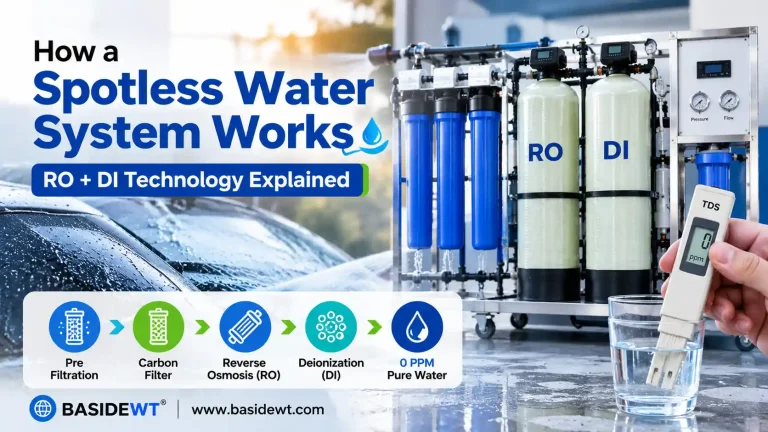
This same technology is now available for home and commercial use. A spot-free car wash system is essentially a compact water purification unit that removes dissolved solids from your tap water before it contacts your vehicle. The output is water with near-zero TDS (Total Dissolved Solids) — water that evaporates cleanly without leaving anything behind.
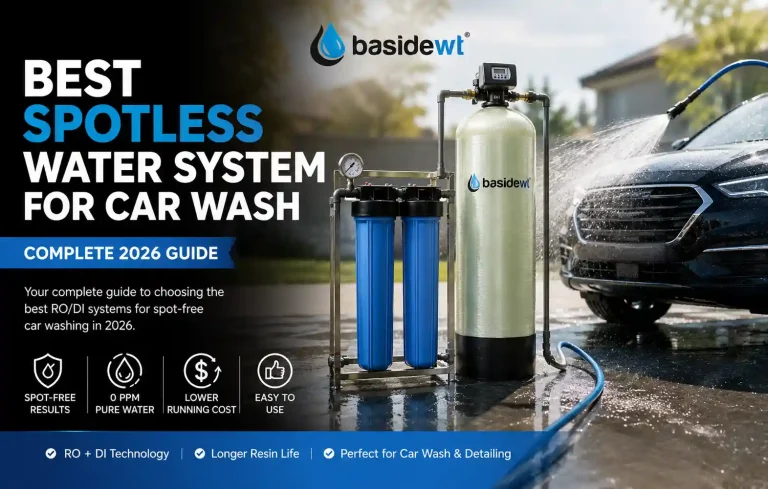
If you’re a car enthusiast, a professional detailer, or someone who simply wants consistently spot-free results at home, Basidewt’s spot-free car wash system offers a purpose-built solution that connects to your standard garden hose and delivers purified water on demand — no more water spots, ever.
How Spot-Free Water Systems Work
Most home and commercial spot-free rinse systems use one of two core technologies, or a combination of both:
Reverse Osmosis (RO)
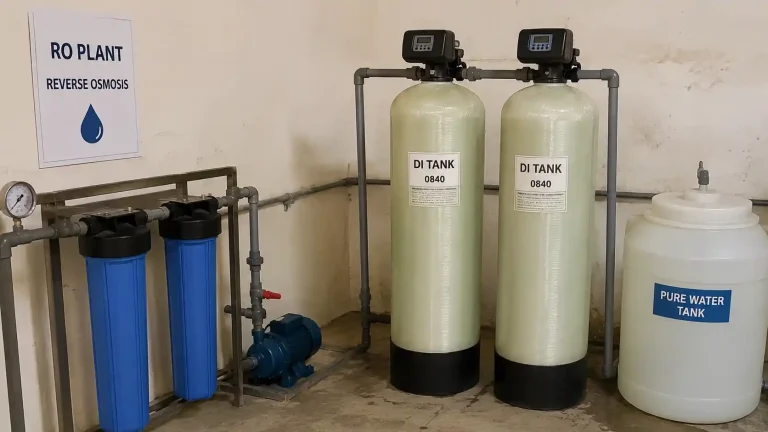
Water is pushed through a semi-permeable membrane under pressure. The membrane blocks dissolved minerals, salts, and most other contaminants while allowing pure water molecules to pass through. The result is water with dramatically reduced TDS — typically 5–50 mg/L compared to 200–500 mg/L in typical tap water.
For those interested in the broader applications of RO technology, Basidewt’s complete RO system range covers everything from compact residential units to high-capacity commercial systems.
Deionization (DI)
Water passes through ion exchange resin beds that capture dissolved ions and replace them with hydrogen and hydroxide ions, which combine to form pure water. DI water typically achieves near-zero TDS — often 0–5 mg/L — which is ideal for the final rinse stage where even trace minerals can leave spots on dark paint.
The Basidewt spotless water system combines both technologies for maximum purity, making it suitable for everything from daily car washing to professional detailing operations.
How to Find the Best Self Car Wash Near You
When you search ‘self car wash near me,’ you’ll typically get a map listing of several options within a few miles. Here’s how to quickly evaluate which one is worth your time:
What to Look For
- Spot-free rinse option — the most important feature for a quality finish
- Clean bays — a well-maintained facility suggests the equipment is serviced regularly
- Adequate pressure — you should feel good resistance when holding the wand
- Foam brush availability with clean heads — dirty brushes transfer grime to paintwork
- Good drainage — standing water and flooding in bays suggests drainage problems
- Adequate lighting — essential if you wash in the evening or early morning
Red Flags to Avoid
- Foam brush heads that are visibly dirty or matted — guaranteed to scratch
- Weak pressure — suggests pump problems or heavily shared lines
- No rinse-only mode — makes it hard to properly flush soap
- Timer that runs down while you’re still inserting coins — a common frustration at poorly designed bays
Smart Tip: Check Google Maps reviews specifically for mentions of ‘water spots’ or ‘spot-free rinse.’ Reviewers who care about this detail tend to be the most reliable guides to actual wash quality.
Hard Water and Car Washing: Why Your Location Matters
Water hardness varies significantly by region. If you live in an area with naturally hard water — common across much of the American Midwest, Southwest, and many parts of Europe and the Middle East — you’ll notice water spots forming more aggressively, even after careful washing.
Hard water areas are also where self-service car wash bays are most inconsistent. Some invest in proper water treatment equipment for their spot-free rinse systems; others use only softened water (which removes hardness minerals but leaves sodium behind, which can also leave deposits); and some don’t treat the rinse water at all.
If you’re in a hard water area and consistently disappointed with self-service car wash results, the solution isn’t a different technique — it’s the water. A home spot-free rinse system that treats water before it contacts the car is the most reliable way to get consistent results regardless of what comes out of the tap.
Taking It Home: Setting Up Your Own Spot-Free Car Wash System
Many car enthusiasts and professional detailers reach a point where they’d rather wash at home, on their own schedule, with their own equipment. The main obstacle has traditionally been water quality — without proper treatment, home washing just recreates the water spot problem.
That’s changed significantly with compact, affordable spot-free rinse systems designed specifically for home and light commercial use. These units connect directly to a standard garden hose, treat the incoming tap water through DI resin or RO filtration, and deliver spot-free water at the end of your wash process.
The economics make sense for regular washers. A good spot-free system costs less than a year’s worth of professional detailing appointments and delivers comparable results on every wash.
For car detailing professionals or enthusiasts wanting commercial-grade performance at home, Basidewt’s car and window cleaning system range includes systems purpose-built for both automotive and residential window cleaning applications — two of the most demanding use cases for spot-free water.
Common Self Car Wash Mistakes to Avoid
Washing in direct sunlight
This is perhaps the most widespread mistake. Direct sun heats the car surface and causes water and soap to evaporate before you can rinse it off properly. This leaves soap residue baked into the paintwork — which is far harder to remove than ordinary water spots. Wash in shade or during cooler parts of the day whenever possible.
Using the same brush head for wheels and bodywork
Wheel surfaces collect brake dust, which is highly abrasive iron particulate. If you use the bay’s foam brush on your wheels and then on your paint, you’re dragging abrasive particles across the clear coat. Always clean wheels first with a separate tool, or avoid the foam brush for wheels entirely and use high-pressure rinse only.
Skipping the pre-rinse
Applying soap or touching the car before a thorough high-pressure pre-rinse traps loose dirt and grit against the paintwork during the scrubbing stage. Every piece of grit that gets dragged across the paint under pressure is a potential scratch. The pre-rinse removes this risk before any contact washing begins.
Rushing the process
Self-service bays charge by time, which creates an incentive to rush. Rushing leads to incomplete rinses, soap left in crevices, and poor overall results. Budget enough time — typically 15–25 minutes for a thorough wash — and insert enough coins upfront rather than scrambling mid-wash.
Drying with the wrong material
Terry cloth towels, old t-shirts, and chamois leather all drag across the paintwork and can cause fine scratches over time. Microfiber towels are the correct tool — they lift water away from the surface rather than pushing it around. Use a dedicated car-wash microfiber, not one that’s been used for household cleaning.
Ignoring the rinse water quality
As covered throughout this article, the water itself is the most overlooked variable in car washing results. No amount of good technique compensates for mineral-laden rinse water on a hot day. If your local self-service bays consistently produce water-spotted results, a home spot-free system addresses the root cause rather than just managing the symptoms.
When to DIY and When to Go Professional
Self-service car washes are excellent for regular maintenance — keeping the car clean between more thorough treatments. But there are situations where a professional touch makes more sense:
Stick with Self-Service When:
- You wash regularly (every 1–2 weeks) and just need maintenance cleaning
- The car has light surface dirt, dust, or pollen buildup
- You enjoy the process and want control over how your car is treated
- Budget is a priority and the car doesn’t need correction work
Consider Professional Detailing When:
- You’re dealing with heavy oxidation, swirl marks, or paint defects
- The car needs interior deep cleaning beyond what self-service allows
- You’re preparing to sell or have just bought a used vehicle
- The car hasn’t been properly washed in months and has heavy contamination
The two approaches aren’t mutually exclusive. Many car owners use self-service washes weekly for maintenance and book professional detailing once or twice a year for more thorough treatment.
Final Thoughts: Getting the Most from Every Car Wash
Finding a good self car wash near you is just the starting point. What separates an average result from a genuinely clean, spot-free finish is understanding the process: proper sequence, the right tools, avoiding common mistakes — and above all, understanding that the water itself determines whether you’ll have spots when the car dries.
For occasional washes, finding a self-service bay with a quality spot-free rinse mode is the simplest solution. For regular washers, enthusiasts, or professionals who want consistent results every time regardless of local water quality, a dedicated spot-free rinse system is the investment that pays for itself quickly.
Either way, knowing what to look for — and what to avoid — puts you well ahead of the average car owner who wonders why their car never looks quite right after a wash.
Ready to eliminate water spots from your car washing routine for good? Explore Basidewt’s complete spotless water and car washing solutions — from compact DI units for home use to professional-grade systems built for high-volume detailing operations.
Quick Answers: Self Car Wash FAQs
How much does a self-service car wash cost?
Most self-service bays charge $2–$8 for a standard wash, typically sold in 2–3 minute increments. A thorough wash usually requires $4–$6 worth of time. Some locations charge flat rates rather than per-minute pricing.
Is a self-service car wash better than an automatic wash?
For paint care, generally yes. Automatic tunnel washes with physical brushes can cause fine scratches and swirl marks over time. A self-service wash with proper technique is gentler on the paintwork and usually produces cleaner results in crevices and detail areas.
Why does my car still have spots after washing at a self-service bay?
Water spots after washing are almost always caused by mineral content in the rinse water. The minerals stay on the surface when the water evaporates. Using the spot-free rinse mode (if available) or drying immediately with a microfiber towel after the final rinse are the two best solutions.
Can I use a self-service car wash on a freshly waxed car?
Yes, though you should avoid the foam brush if the wax is very fresh (within 24 hours). High-pressure rinse and spot-free rinse are fine. The soap at most self-service bays won’t strip a fully cured wax coating, but repeated washing does gradually reduce wax protection — plan to reapply every 4–8 weeks.
What is the spot-free rinse at a car wash?
Spot-free rinse is a final rinse stage using purified water — either deionized or reverse osmosis treated — with mineral content removed. Because there are no dissolved solids in the water, nothing is left behind when it evaporates. The result is a completely clean, residue-free surface with no water spots.
RELATED POSTS
RO Membrane GPD: What Does 50, 75, 100 & 200 GPD Mean?
Commercial Water Fed Pole Systems: Choosing Equipment for Professional Cleaning
What Cartridge Water Filter Removes Sodium?
Spotless Water System Working Principle: How RO and DI Deliver 0 PPM Water
Best Spotless Water System for Car Wash: Complete 2026 Guide