BasideWT- Whole Home Water Filtration System & Replacement

Water Fed Pole System: Complete Guide to Pure Water Window Cleaning
A water fed pole system cleans windows using purified water and an extendable pole. There’s no ladder involved. There’s no squeegee, either. Instead, the system relies on water purity itself to leave glass spot-free.
Once you understand why that works, the rest of the decisions become much easier. This guide walks through how the system works, what its parts do, and how to choose, use, and maintain one.
What Is a Water Fed Pole System?
A water fed pole system has three main parts: a telescoping pole, a soft brush head, and a water source connected by hose. Purified water flows up through the pole and out through the brush. The operator scrubs the glass, then rinses it with the same water.
After that, the glass simply air dries. Because the water contains almost no dissolved minerals, it doesn’t leave behind the spots that tap water usually causes as it evaporates. This is the whole idea behind spot-free window cleaning. It isn’t a chemical trick. It’s the physical absence of the substances that normally cause spots.
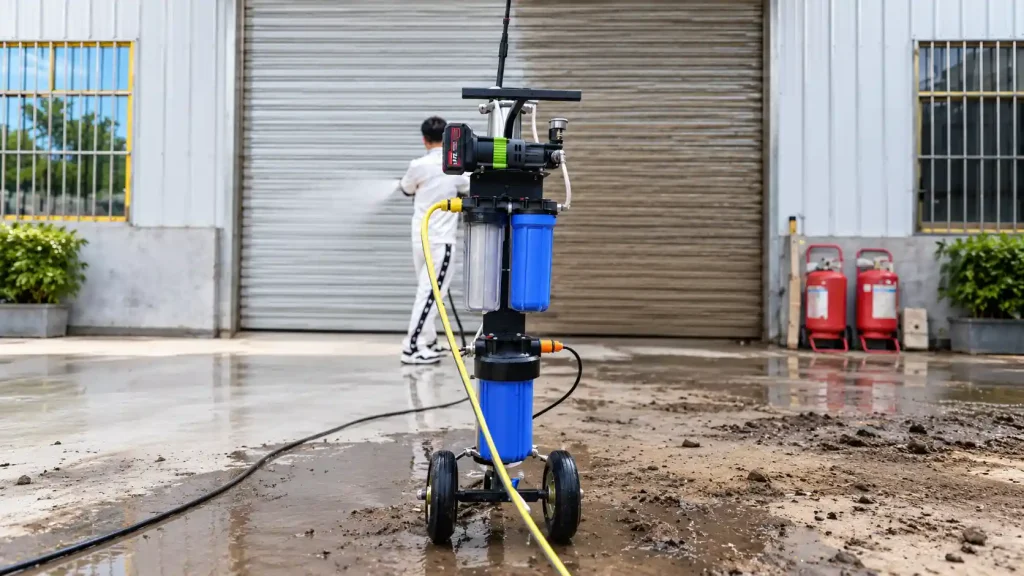
The method works well for several situations:
- Ground-level and low-rise residential windows
- Storefronts and street-level commercial glass
- Mid-rise commercial buildings, using longer poles
- Solar panel cleaning, where mineral-free water protects panel efficiency
- Skylights and other glass that’s awkward or unsafe to reach by ladder
That said, it isn’t usually a substitute for rope access or cradles on very tall buildings. Extended-reach poles have pushed that ceiling higher over the years, but there’s still a practical limit.
Why Pure Water Cleans Glass Without Soap
Ordinary tap water contains dissolved minerals like calcium and magnesium. These are measured together as Total Dissolved Solids, or TDS. When tap water evaporates off a window, it leaves those minerals behind as spots and streaks.
This is exactly why traditional window cleaning depends on a squeegee. The water has to be removed mechanically before it evaporates, because the water itself isn’t clean enough to leave nothing behind.
Purified water works differently. Once TDS drops close to zero, there’s almost nothing left when the water evaporates. So the glass can air dry naturally and still come out clear. As a result, a water fed pole system doesn’t usually need detergent. The brush’s scrubbing action, combined with low-TDS water, is generally enough to loosen and rinse away dirt.
How Much TDS Is Low Enough?
Most professionals treat 0 parts per million as the ideal target. However, readings up to roughly 10-12 ppm are commonly considered acceptable for spot-free results on most glass, especially in warm or dry climates where evaporation happens fast.
Above that range, spotting risk increases. This is particularly true in humid conditions, where water sits on the glass longer before drying.
Main Components of a Water Fed Pole System
A complete system is built from a handful of parts. Each one plays a specific role, so understanding them makes it easier to diagnose problems later.
| Component | Function |
|---|---|
| Telescoping pole | Extends the brush and water delivery to working height; usually carbon fiber or fiberglass |
| Brush head | Scrubs the glass and releases water evenly while cleaning |
| Hose | Carries purified water from the source up through, or alongside, the pole |
| Water purification unit | Removes dissolved minerals via RO, DI resin, or both |
| Pump | Boosts pressure and flow, especially for longer poles or commercial use |
| Water tank or vehicle system | Stores treated water for mobile use |
| TDS meter | Confirms the water is pure enough to avoid spotting |
Not every job needs every component. For example, a homeowner cleaning single-story windows might only need a simple garden-hose-fed pole with a compact filter. A commercial contractor working multiple properties a day, on the other hand, is more likely to run a van-mounted system with tanks and a pump.
Water Purification Options: RO, DI, and Combined Systems
Purification is what makes pure water window cleaning possible in the first place. It’s also where most equipment decisions actually happen.
Reverse Osmosis (RO)
Reverse osmosis forces source water through a semi-permeable membrane. This filters out most dissolved solids. RO systems handle higher volumes efficiently, because the membrane lasts a long time relative to how much water passes through it. Even so, it needs periodic replacement, and the process produces some wastewater.
Deionization (DI)
Deionization uses ion-exchange resin to strip out nearly all remaining dissolved ions. It typically brings water down to, or very close to, 0 ppm. However, DI resin has a finite capacity. Once it’s exhausted, TDS readings climb, so the resin needs recharging or replacing.
DI alone works well for lower-volume jobs or as a final polishing stage. Its resin cost per liter tends to be higher when it’s treating raw mineral-heavy water directly.
Combined RO/DI Systems
Combined systems use RO to remove the bulk of the mineral load first, then finish with DI resin. Because RO handles the heavy lifting, the DI stage lasts much longer than it would on raw tap water. This is why combined RO/DI setups are common in professional and commercial work, where consistent 0 ppm output and lower resin costs both matter.
For readers evaluating dedicated purification equipment on its own, a deionized water cleaning system generally follows this same RO/DI logic, sized for higher commercial output.
The right choice mostly comes down to source water quality and volume. Harder water places more demand on purification, which is one reason testing source water before buying equipment is worth doing.
TDS Meters and Water Quality Monitoring
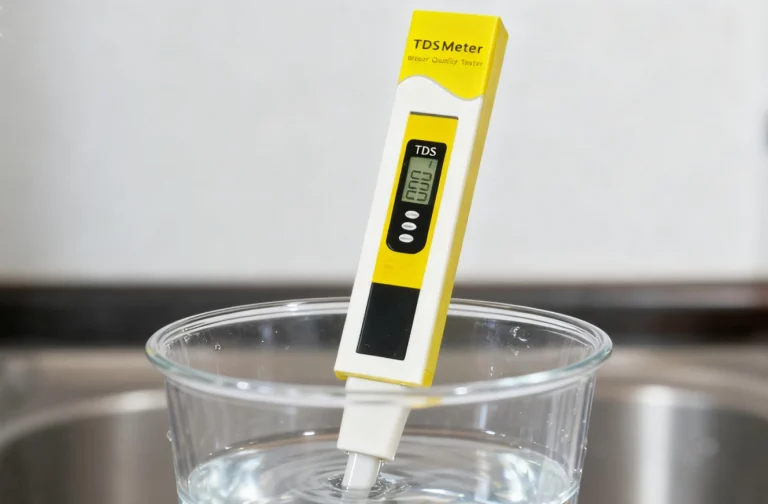
A TDS meter measures dissolved solids in water, usually in parts per million. In practice, it serves two purposes. First, it confirms purified water is actually pure enough before a job starts. Second, it helps track performance over time, so the operator knows when resin needs recharging or a membrane needs replacing.
Checking TDS regularly prevents a common problem: starting a job with water that tests fine, then finishing with visible spotting because the resin quietly ran out partway through. A TDS meter costs very little compared to redoing a job. That’s why most professional operators test water as a standard habit, not an optional extra.
Hoses, Pumps, and Water Delivery
Water travels from the purification unit or tank, through a hose, up the pole, and out through the brush. Two factors matter most here.
Flow rate determines how quickly the brush rinses a section of glass before moving on. Too low, and dirt doesn’t fully rinse away. Too high, and water use climbs unnecessarily.
Pressure matters more as pole length increases, since water has to travel further and higher. Gravity or a garden-hose connection alone often isn’t enough for longer poles. That’s why battery-powered or vehicle-mounted pumps are common on professional setups.
Hoses usually route internally through the pole on higher-end equipment. This reduces snagging and keeps things tidy, though external routing still shows up on simpler, lower-cost poles.
Pole Reach and Working Height
Pole length is one of the most practical buying decisions, because it directly determines what jobs a system can handle. Poles commonly range from around 2-3 meters for compact residential use up to 20+ meters for commercial work. Most are built in telescoping carbon fiber sections, which balance light weight against rigidity at full extension.
Longer poles need to stay light per section. Otherwise, they become difficult to control accurately once fully extended overhead. For this reason, pole material and weight distribution often matter more than raw maximum length. A well-balanced 15-meter pole can be easier to use than a poorly balanced shorter one.
The Cleaning Workflow, Step by Step
The exact steps vary by job size, but the general workflow stays consistent:
- Test the water and confirm it reads at or near 0 ppm TDS before starting.
- Extend the pole to the working height needed.
- Scrub the glass with the brush while water flows continuously.
- Rinse thoroughly, keeping water flowing after scrubbing to flush loosened dirt.
- Move to the next section, working in a logical order to avoid missed spots.
- Let the glass air dry, without wiping, since a cloth can reintroduce minerals or lint.
- Recheck TDS periodically during longer jobs, especially with DI-only systems.
Benefits and Limitations
A water fed pole system has real advantages. Still, it isn’t the right tool for every job.
Benefits
Eliminating ladders reduces a meaningful safety risk, both residentially and commercially. In addition, the system covers large glass areas faster than hand-squeegeeing, particularly on multi-pane or textured glass. It also leaves a spot-free finish without detergent runoff, which matters near landscaping or where runoff is restricted.
Limitations
Heavy grime, paint splatter, or construction residue often need pre-scraping first, since pure water alone won’t lift them. Wind is another factor: a fully extended pole is harder to control in gusty conditions. Finally, jobs without easy water access need a van-mounted tank system, and very tall buildings still require access equipment beyond pole reach.
| Factor | Traditional Squeegee Cleaning | Water Fed Pole System |
|---|---|---|
| Working height | Limited by ladder safety | Extended by pole length, often without ladders |
| Drying method | Mechanical (squeegee) | Air drying, relying on water purity |
| Detergent use | Common | Usually unnecessary |
| Speed on large glass areas | Slower per pane | Generally faster on continuous surfaces |
| Best suited for | Small areas, detail work | Exterior glass, multi-story or hard-to-reach areas |
Residential Applications
For homeowners, a water fed pole system is most useful for exterior windows above ground level. Second-story glass, conservatory roofs, and skylights are good examples, since they’d otherwise need a ladder. A compact pole with a simple filter or portable RO/DI unit is usually enough at this scale. A pump or large tank generally isn’t necessary.
Commercial and Professional Applications
Commercial use scales up in both volume and equipment. Storefronts, office buildings, retail centers, and multi-tenant properties are common jobs for professional cleaning businesses. Property maintenance teams increasingly treat pole systems as routine upkeep rather than one-off service.
Dense Urban and High-Rise Markets
In markets with dense commercial and residential high-rise development, accessible mid-rise glass volume is significant. This pattern is common across much of China, as well as many other rapidly urbanized regions. As a result, efficient pole-based cleaning is particularly relevant for contractors and property managers working in these areas.
Storefront glass, curtain-wall lower floors, and residential common-area windows are typical recurring jobs. Here, a well-equipped pole system often saves meaningful time compared to ladder-based methods.
Solar Panel Cleaning
Solar panel maintenance is a growing use case, too. Mineral deposits from ordinary water can measurably reduce panel output over time. Because of this, purified-water cleaning tends to be a better option than tap water washing.
Scaling Beyond a Single Pole
For contractors moving beyond one pole and a portable filter, a full setup functions as an integrated car and windows cleaning system. It combines a purification unit, pump, tank, hose reel, and pole. The same purified water source can often support vehicle and glass cleaning from one van-mounted rig. This dual-use approach appeals to mobile detailing and cleaning businesses serving more than one service line from a single investment.
Equipment Selection and System Sizing
Matching equipment to actual work volume, rather than defaulting to the largest available setup, tends to produce better results. A few questions help narrow the decision:
- What pole reach do most jobs actually need? Residential work rarely needs more than 10-12 meters. Commercial contracts may justify longer, more rigid poles.
- What’s the source water quality? Harder water increases purification demand, which affects whether RO alone, DI alone, or a combined setup makes sense.
- What’s the daily water volume? A few residential jobs a week has very different needs than a commercial route covering several large properties daily.
- Is water access reliable on-site? If not, a self-contained tank and pump setup becomes necessary.
A spotless water system approach, built around actual job volume instead of oversized equipment, tends to be more cost-effective for businesses scaling gradually. That’s because resin and membrane costs scale with both water hardness and volume treated.
Maintenance and Common Mistakes
Regular maintenance keeps a system performing consistently. It also prevents the most common failure point: gradual TDS creep that goes unnoticed until spotting shows up on finished glass.
Resin and Membrane Replacement
DI resin has a finite capacity and needs recharging once exhausted. RO membranes degrade gradually and need replacement depending on water hardness and volume treated. Relying on visual clarity alone is a mistake, since clarity has nothing to do with dissolved minerals. Only a TDS reading confirms the water is actually spot-free ready.
Hose and Pole Care
Hoses should be checked periodically for kinks or wear, particularly at pole joints where flexing concentrates. Poles should be rinsed and dried after use, especially carbon fiber sections, to avoid grit buildup at telescoping joints.
Brush Maintenance
Bristles wear down with use. They should be replaced once they stop making even contact with glass, since uneven contact causes streaking regardless of water purity.
Common Operator Mistakes
Skipping the TDS test before starting a job is a frequent mistake. Rushing the rinse stage is another, since it leaves dirt behind before the water dries. Using poles beyond their rated reach in windy conditions reduces control and accuracy. Underestimating water volume for larger jobs is common too, leading to mid-job tank refills that slow everything down.
Safety Considerations
Pole systems reduce ladder use, but they introduce their own risks. Fully extended poles, especially carbon fiber ones, can conduct electricity. So maintaining safe clearance from overhead power lines is essential, not optional.
Wind conditions should be assessed before working at height, since control drops significantly as pole extension increases. On commercial sites, coordinating with building management around pedestrian areas below the work zone is standard practice. This helps avoid dripping water or debris creating a hazard.
When a Water Fed Pole System Is the Right Choice
A water fed pole system tends to make sense in a few situations: when glass sits high enough to otherwise require a ladder, when the surface area is large enough that squeegee work would be slow, or when a spot-free finish without detergent residue matters, such as near sensitive landscaping or solar installations.
On the other hand, it’s less suited to heavily soiled glass needing scraping first, very small single-pane jobs where a squeegee is faster to set up, and extremely tall buildings beyond practical pole reach.
Final Buying Considerations
Before purchasing, it helps to think through a few things. Pole length should match actual working height, not aspirational height. Water source availability on typical job sites determines whether a portable filter or a full tank-and-pump setup is needed. Source water hardness drives purification method and ongoing costs. Expected volume matters too, since resin and membrane costs scale with water actually treated, not just system capacity.
For commercial businesses, choosing between an integrated system and a modular one, where the purification unit, pump, and pole are purchased and upgraded separately, mostly depends on whether the work is expected to grow.
In Water fed pole systems have become a standard method in professional window cleaning. The core principle is simple: pure water needs no drying. That makes it reliable and scalable, from a single residential pole to a full commercial fleet setup.
Understanding the purification method, matching pole reach to real job needs, and maintaining the system consistently are what separate a spot-free result from a frustrating one. For operators who want a deeper look at safe pole handling and working-at-height practices, established safety guidance for water-fed pole operation is a useful next read.
RELATED POSTS
Water Filter Housing Replacement: When & How to Replace It
Water Filter Housing Buying Guide: How to Choose the Best Housing for Your Needs
Deionized Water System Maintenance: How to Keep Your DI System Performing at Its Best
Whole House Water Softener Cost
The Ultimate Guide to TDS Meters for Drinking Water