BasideWT- Whole Home Water Filtration System & Replacement



How Does a Water Fed Pole Work?
A water fed pole works by sending purified water through a lightweight telescopic pole to a brush head. The brush loosens dirt on the glass. The water then rinses the surface clean and dries without leaving mineral spots behind. The system uses water as the cleaning agent. It skips soap, squeegees, and ladders entirely. Purification plays the central role in how good the final result looks.
That single idea explains most of what makes a water fed pole system different from traditional window cleaning. To really understand how it works, though, it helps to walk through each stage. We’ll cover where the water comes from, how purification works, how water travels up the pole, and why it can dry without streaks or spots.
What a Water Fed Pole Actually Is
A water fed pole is a hollow, telescopic pole with a hose running through it. A brush head sits at the tip. The pole connects to a water supply, usually through a purification system. This setup lets a cleaner scrub and rinse windows from ground level instead of climbing a ladder.
Manufacturers usually build the pole from lightweight materials such as carbon fiber or a carbon-fiberglass blend. Carbon fiber sections stay stiffer and lighter. This matters more as pole length increases, since a long pole needs enough rigidity to keep the brush under control several stories up.
A standard pole carries a squeegee or cloth. A water fed pole skips that step entirely. The brush scrubs and rinses at the same time, and the water carries the dirt away as it flows down the glass.
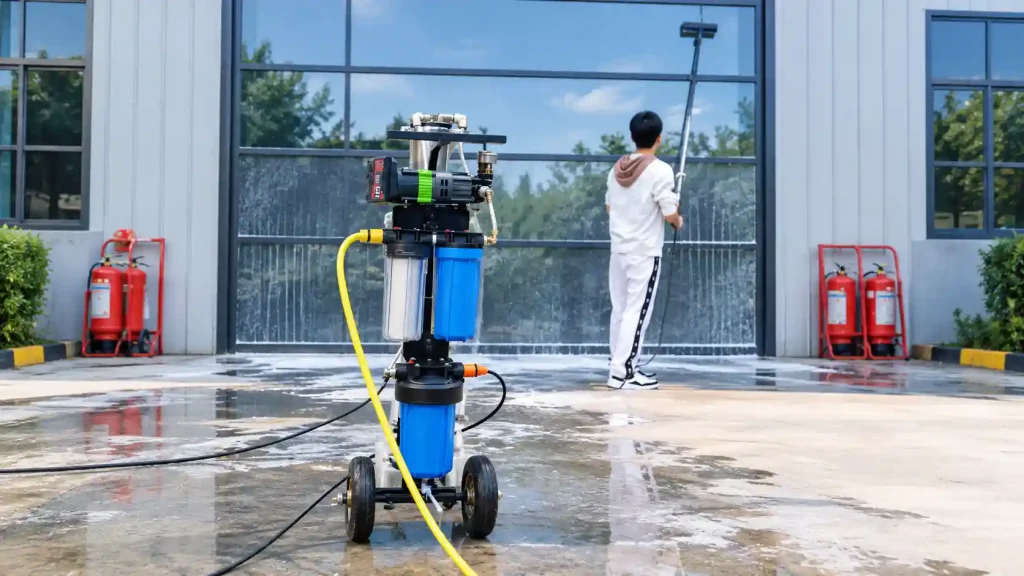
Traditional Pole vs Water Fed Pole
| Feature | Traditional Window Pole | Water Fed Pole |
|---|---|---|
| Cleaning method | Soap and squeegee | Purified water and brush |
| Drying step | Manual wipe or squeegee | Water evaporates without spotting |
| Reach | Limited by arm and pole length | Extended reach with internal hose |
| Water used | Tap water with soap | Purified water (RO/DI) |
| Ladder needed for upper floors | Often yes | Usually no |
How the System Works, From Water Source to Glass
A complete water fed pole system follows a fairly consistent sequence. The exact equipment varies by job size, but the steps stay the same:
- Water comes from a source, typically a tap, a static tank, or a mains connection.
- The water passes through a purification stage, most often reverse osmosis, deionization, or both.
- A pump or mains pressure feeds purified water into a hose.
- The hose runs through the pole up to the brush head.
- The brush agitates the glass while water flows out through built-in jets.
- Water and loosened dirt run down the glass and drip away.
- The glass dries on its own. Little or nothing remains in the water to leave a residue.
Each stage depends on the one before it. If the purification stage falls short, the final drying stage won’t look clean. Good brush technique can’t fix that on its own. This relationship between purification and appearance sits at the heart of how a water fed pole works.
Our complete water fed pole system guide covers the wider picture of equipment types, setups, and use cases. This article stays focused on the mechanics of how the process works.
How Water Purification Affects the Cleaning Result
Tap water carries dissolved minerals such as calcium, magnesium, and various salts. These minerals stay invisible while the water is liquid. Once the water evaporates, though, the minerals stay behind on the glass as a visible residue. People usually call this residue a water spot.
Purified water solves this problem at the source. It removes dissolved minerals before the water ever touches the glass. With little or nothing left behind, the water can evaporate cleanly.
Reverse Osmosis (RO)
Reverse osmosis pushes water through a semi-permeable membrane under pressure. The membrane blocks most dissolved solids, bacteria, and other contaminants. Water molecules still pass through. RO systems remove a large percentage of dissolved minerals from incoming water. They work especially well when the source water starts out high in mineral content.
RO alone doesn’t always bring mineral levels down to zero. That’s where deionization often steps in.
Deionization (DI)
Deionization uses resin beads that exchange ions in the water for hydrogen and hydroxide ions. Those ions then combine to form more water. This process removes the charged particles behind hardness and mineral buildup. DI resin achieves very low mineral readings particularly well. The resin does have a finite capacity, though, and needs replacement or regeneration once exhausted.
Many professional setups pair RO with DI resin. The RO stage removes the bulk of dissolved solids first. This extends the working life of the DI resin, since less work remains by the time water reaches it. Commercial window cleaners often rely on this two-stage approach, since it keeps water quality consistent over long working days.
RO vs DI
| Aspect | Reverse Osmosis (RO) | Deionization (DI) |
|---|---|---|
| How it works | Filters water through a membrane | Exchanges ions using resin |
| Typical result | Removes most dissolved solids | Can achieve very low TDS readings |
| Maintenance | Membrane replacement over time | Resin replacement or regeneration |
| Common role | First-stage purification | Polishing stage after RO |
Why TDS Matters
TDS stands for Total Dissolved Solids. Most window cleaners rely on this measurement to judge whether purified water is doing its job. A small handheld meter measures TDS in parts per million (ppm).
A lower TDS reading means fewer dissolved minerals remain in the water. That lowers the odds of spotting as the glass dries. Many professionals aim for a reading close to zero before starting a job, especially on jobs where the glass will air dry without a final wipe.
Purification performance changes over time, so checking TDS regularly matters. RO membranes gradually lose efficiency. DI resin becomes exhausted with use. A TDS meter for water testing gives a quick, objective way to confirm the water stays pure enough before it reaches the pole, rather than guessing based on how clean previous jobs looked.
How Purified Water Reaches the Pole
Once the water gets purified, it still needs a way to reach the brush head several meters up. This part of the system usually follows one of two approaches.
Mains-fed systems rely on natural pressure from a building’s water supply. The water pushes through the purification unit and up the hose. These setups suit lighter, everyday jobs where a nearby tap is available.
Pump-fed or tank-fed systems use a pump to push water from a storage tank through the purification stage and up the pole. This approach helps when no mains connection is nearby, or when a job needs a large, controlled volume of purified water. Cleaning a row of storefronts or a commercial building with no exterior tap are good examples.
In both cases, the hose runs through the hollow center of the pole itself. It doesn’t get taped or clipped to the outside. This keeps the setup streamlined and cuts the risk of the hose snagging on window frames, ledges, or fixtures during use.
How the Pole, Hose, and Brush Work Together
The pole positions the brush accurately against the glass while carrying water up to it. Most poles extend in sections. This lets the operator adjust the working length to match the height of the window.
At the top of the pole, the brush head connects to the hose. It typically has water jets built into its bristles or base. As the operator scrubs the glass, water releases steadily through these jets. Cleaning and rinsing happen at the same time rather than as two separate steps.
Brush bristles stay soft enough to avoid scratching glass but firm enough to loosen dust, grime, and light residue. On heavier soiling, the operator may spend more time agitating a section before finishing with a clean rinse pass.
How Dirt Is Loosened From Glass
Dirt on glass usually mixes dust, airborne particles, and sometimes a thin oily film from pollution or handling. The brush’s mechanical scrubbing action breaks this layer loose from the surface. The constant flow of purified water then carries the loosened particles away before they can resettle.
The water flows continuously rather than sitting still and getting wiped around. This lowers the risk of smearing dirt across the glass, a common problem with cloth-and-squeegee methods on very dirty windows.
Why Purified Water Can Dry Without Conventional Spotting
This is usually the hardest part to believe the first time you see it: the glass stays wet and simply air dries, with no squeegee or wiping.
The explanation comes back to what’s dissolved in the water. Ordinary tap water leaves mineral deposits behind as it evaporates. That’s what causes the familiar spotted, cloudy look on air-dried glass. Purified water, whether from RO, DI, or both, carries very little dissolved mineral content. With almost nothing left to deposit, the water can evaporate and leave the glass looking clear.
This only holds true when the water is genuinely pure. Old or poorly maintained purification equipment, or equipment that simply isn’t hitting a low enough TDS reading, can still let spotting happen. The process looks identical from the outside. This is one reason experienced cleaners check TDS regularly instead of assuming performance stays consistent forever.
Why Proper Rinsing Still Matters
Even pure water needs good rinsing technique. If a section of glass doesn’t get rinsed thoroughly after scrubbing, loosened dirt or soap residue from a pre-clean step can stay behind and dry in place. That creates streaks that have nothing to do with water purity.
A consistent final pass with clean, purified water over the whole pane helps make sure nothing gets left behind to dry unevenly. On larger panes, working top to bottom, one section at a time, reduces the chance of missing an area.
How High Windows Can Be Cleaned From Ground Level
Reach is one of the main reasons commercial and high-rise cleaners adopted this method. Poles can extend well beyond what a ladder or standard extension pole could safely manage. That lets an operator clean upper-floor windows while staying on solid ground.
This carries an obvious safety advantage. Many multi-story buildings no longer need ladders or scaffolding for routine window cleaning. That’s part of why water fed pole window cleaning has become common for office buildings, shopfronts, and residential properties with second or third-story windows, especially in dense urban areas where ladder access is often restricted or impractical.
Very tall buildings still need other access methods. But for a large share of low-rise and mid-rise commercial and residential windows, a water fed pole system covers the job without extra equipment.
Factors That Affect Cleaning Performance
Several variables shape the final result, beyond simply owning a water fed pole:
- Water purity (TDS level): Higher TDS readings raise the risk of spotting, especially in direct sun or warm weather where water evaporates quickly.
- Source water quality: Water with naturally high mineral content puts more demand on the purification stage and may need more frequent resin changes.
- Weather conditions: Fast evaporation in hot, sunny conditions can sometimes outpace even properly purified water. Working in shade or during cooler parts of the day can help on difficult jobs.
- Brush maintenance: Worn or dirty bristles clean less effectively and can even redeposit dirt onto the glass.
- Technique: Rushing the scrub or rinse stage, or skipping sections, leads to inconsistent results no matter how good the water is.
Common Mistakes That Reduce Effectiveness
A few recurring issues account for most disappointing results with water fed pole systems:
- Skipping the TDS check before a job. Assuming the water is still pure, without testing it, is one of the most common causes of unexpected spotting.
- Letting resin run past its capacity. DI resin doesn’t fail gradually in an obvious way. Performance can drop off suddenly once capacity runs out.
- Rinsing too quickly. Moving the brush on before the glass gets a proper final rinse leaves residue behind.
- Working in direct, intense sun on hot days. Even good quality water can spot if it evaporates too fast, so timing matters on certain jobs.
- Ignoring brush condition. A brush that’s picked up grit or hardened debris can scratch or smear instead of clean.
Maintenance and Equipment Considerations
Purification performance isn’t permanent. It ties directly to how well the equipment gets maintained. RO membranes gradually lose efficiency and need periodic replacement. DI resin has a finite capacity and needs swapping or regenerating once exhausted. A rising TDS reading usually confirms this, rather than a fixed schedule.
Anyone considering their own setup should understand one key difference. A full spotless water system builds around RO and DI stages together. Simpler water softener resin setups reduce hardness but don’t lower TDS the same way. The right choice depends on source water quality, job volume, and how consistently spot-free the result needs to be.
When Different Purification Setups May Be Appropriate
Not every job needs the same level of purification. A single-stage DI setup may suit light residential use with reasonably good source water. Commercial cleaners working across many buildings, or anyone dealing with harder source water, often benefit from a combined RO and DI resin deionized water system. This setup keeps TDS lower over longer runs and cuts how often resin needs replacing.
The right setup comes down to matching purification capacity to how much water a job actually uses, rather than assuming more equipment always helps.
How the Complete System Fits Together
Looked at as a whole, a water fed pole system is a chain of dependent stages. Source water goes through purification. Purified water travels through a hose inside the pole. The brush applies it to the glass while scrubbing. The low mineral content lets the glass dry without spotting. Weak performance at any single stage, whether poor purification, a worn brush, or rushed rinsing, shows up in the final result.
Understanding that chain separates a system that consistently produces clear, spot-free glass from one that only works some of the time.
When a Water Fed Pole System Makes Sense
Water fed pole systems tend to make the most sense in a few common situations. Windows above what a person can safely reach with a standard pole are one example. Properties with a lot of glass to cover in one visit are another. Settings where ladder work isn’t practical or allowed round out the list. This covers a wide range of residential and commercial properties, from multi-story homes to office buildings and storefronts in dense urban environments.
For smaller, ground-level jobs with just a few accessible windows, a traditional squeegee approach may still work faster. The value of a water fed pole system grows as reach, glass area, and the number of repeat cleaning visits increase.
Our car and windows cleaning system category shows how this fits alongside other purified-water cleaning applications, covering related equipment for both vehicle and glass cleaning tasks.
Conclusion
A water fed pole works by combining purification and mechanical cleaning into one continuous process. Reverse osmosis, deionization, or both reduce dissolved minerals to a level low enough that the water can dry on glass without leaving spots. That purified water travels through a hose inside the pole to a brush head, which scrubs the glass while rinsing it at the same time.
The final result depends less on any single component and more on how well the whole chain performs together. Source water quality, purification capacity, TDS monitoring, brush condition, and rinsing technique all play a part. Keeping TDS low and equipment well maintained keeps results consistent, especially on larger or more demanding jobs.
For readers who want to understand more about why dissolved minerals cause spotting in the first place, this university physics Q&A on why dissolved salts left behind by ordinary water cause window spotting offers a clear, independent explanation of the underlying chemistry.
RELATED POSTS
Pure Water Window Cleaning: Equipment, Process and Benefits

Is Reverse Osmosis Water Good for You? A Complete Guide to RO Water Benefits and Safety
How Does a Water Filter Housing Work? Complete Step-by-Step Guide
Is Reverse Osmosis Water the Same as Distilled Water?
UV Water Sterilizer vs RO: What’s the Difference and Which Is Better?