BasideWT- Whole Home Water Filtration System & Replacement


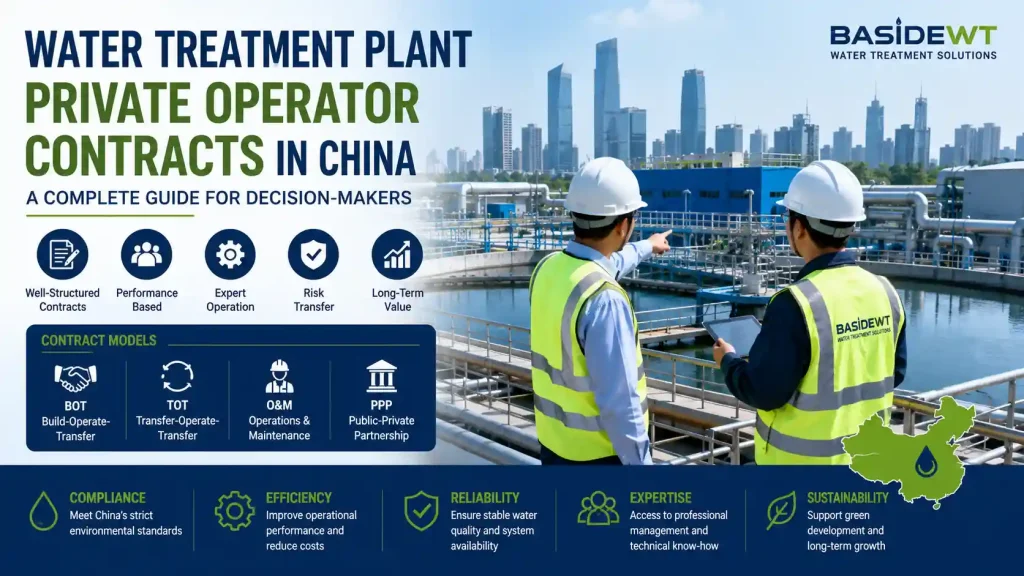
Water Treatment Plant Private Operator Contracts in China: A Complete Guide for Decision-Makers
China’s water infrastructure market has never been more complex — or more commercially significant. Municipalities and industrial parks face mounting pressure to improve water quality, cut environmental liability, and comply with tightening regulations. As a result, many are turning to a proven model: bringing in private companies to run water treatment plants under formal contractual arrangements.
Water treatment plant private operator contracts sit at the intersection of public policy, commercial law, environmental compliance, and engineering practice. For decision-makers on either side — public authority or private operator — understanding how these contracts work is essential before signing anything.
This guide explains exactly how private operator contracts function in China’s water sector, what separates successful arrangements from failed ones, and what equipment and operational requirements operators must plan for on the ground.
What Are Water Treatment Plant Private Operator Contracts?
A water treatment plant private operator contract is a formal agreement. Under this agreement, a private company takes responsibility for operating, maintaining, and managing a water treatment facility. In most cases, the private operator does not own the plant. Instead, a government authority or industrial facility owner retains ownership while the operator manages day-to-day performance.
These arrangements exist under several different models. Each model carries a different risk and responsibility profile. However, all of them share one core principle: the private operator is accountable for meeting defined performance standards.
BOT — Build, Operate, Transfer
Under a BOT contract, the private company finances, builds, and operates the plant. The concession period typically runs 20 to 30 years. After that period, ownership transfers back to the government authority. BOT offers the longest revenue visibility. However, it also demands the highest upfront capital from the private operator.
TOT — Transfer, Operate, Transfer
In a TOT arrangement, an existing publicly owned plant transfers to a private operator for a fixed period. The operator pays an upfront fee for the operating rights. Then they manage the facility and recover costs through tariffs or service fees. China has used this model extensively to improve underperforming facilities. It also enables governments to monetize existing infrastructure without building something new.
O&M — Operations and Maintenance Contracts
O&M contracts represent the simplest structure. Here, the private operator handles day-to-day operations and maintenance only. The facility owner retains ownership and capital expenditure responsibility. In return, the operator receives a service fee tied to performance metrics. Industrial wastewater facilities and smaller municipal systems commonly use this model.
PPP — Public-Private Partnership
Broader PPP arrangements combine elements from all of the above models. They typically involve more complex risk-sharing mechanisms. The Chinese government has actively promoted PPP to accelerate water infrastructure investment. Consequently, this model reduces direct fiscal pressure on local government budgets.
How Do Private Operator Contracts Work in Practice?
The operational reality of a private operator contract begins well before signing. First, both parties conduct a detailed facility assessment. This covers incoming water quality, required discharge standards, equipment condition, and the gap between current performance and contractual requirements.
Once the contract starts, the private operator takes on a broad set of responsibilities:
- Daily operation of all treatment processes — pre-treatment, biological treatment, filtration, disinfection, and sludge management
- Routine and preventive maintenance of pumps, membranes, filters, and control systems
- Chemical procurement and dosing management
- Real-time monitoring and regulatory reporting to environmental authorities
- Staff management, including operator training and certification
- Emergency response to process upsets and equipment failures
- Capital expenditure planning for major equipment replacement
Performance measurement drives the entire contract. Effluent quality — benchmarked against China’s discharge standards — serves as the primary KPI. In addition, secondary metrics typically track system availability, energy consumption per cubic meter treated, and chemical usage efficiency.
Key Point: China’s Ministry of Ecology and Environment requires real-time online monitoring for facilities above defined discharge thresholds. Operators must maintain these systems and guarantee data integrity. Falsifying monitoring data carries serious legal penalties.
Benefits and Importance of Private Operator Contracts
Growth in private operator contracts across China’s water sector reflects genuine incentives on both sides. Governments gain specialist expertise. Private companies gain stable, long-term revenue. Furthermore, end users benefit from better-treated water.
For Government and Facility Owners
Professional water treatment operators bring accumulated technical knowledge that most government departments simply cannot replicate. A company managing dozens of facilities develops superior procurement relationships, trained personnel, and operational processes. As a result, treatment performance improves while operating costs fall.
In addition to expertise, private operators absorb compliance risk. When a facility misses discharge standards, the contractual and financial consequences fall on the operator first. This risk transfer motivates municipalities facing tighter environmental enforcement to favor private operation.
For Private Operators
Long-term government contracts offer rare revenue stability. A 25-year BOT concession with defined tariff structures gives operators a predictable cash flow base for investment planning. Moreover, the high barriers to entry — technical expertise, regulatory compliance, capital investment — protect existing operators from easy competition once they win a contract.
For Water Quality Outcomes
Professionally operated facilities consistently outperform government-run counterparts on measurable quality indicators. The World Bank’s research on water utility performance across developing economies — including China — consistently shows that private operation improves operational efficiency and water quality outcomes. However, this holds true only when contract design is sound and regulatory oversight remains active.
Applications and Industry Use Cases in China
China’s private water treatment operator market spans municipal, industrial, and commercial sectors. Understanding where these contracts appear most frequently helps both operators and equipment suppliers focus their efforts effectively.
Municipal Wastewater Treatment
Chinese municipalities — particularly at prefecture and county levels — have used TOT and PPP arrangements actively since the early 2000s. For example, companies including Beijing Enterprises Water Group, China Everbright Water, and Sound Global have each built substantial facility portfolios under private operation. Together, these operations process tens of millions of cubic meters per day. China has consequently become one of the world’s most significant markets for municipal water treatment private operation.
Industrial Park Wastewater Treatment
Industrial parks — a defining feature of China’s manufacturing landscape — typically run centralized wastewater treatment facilities that serve multiple tenant companies. Park operators often hire specialist private contractors who understand the contaminant profiles from industries like textiles, chemicals, electroplating, food processing, or pharmaceuticals.
Moreover, the contractual structure in industrial parks usually involves both the park management authority and individual industrial tenants. This multi-party arrangement demands careful contract drafting and clear responsibility allocation for unusual wastewater loads.
Drinking Water Treatment
Private operation of drinking water plants remains less common in China than wastewater treatment. The greater political sensitivity of potable water supply explains this gap. However, BOT arrangements for new drinking water capacity in fast-growing secondary cities have attracted both domestic and international water companies. In particular, stringent quality requirements under China’s GB5749 national standard place high demands on operator technical capability and equipment selection.
Key Equipment Components in Private Operator Contracts
Private operators maintain the equipment that drives treatment performance. Understanding key components — and their replacement and maintenance requirements — is therefore critical for operators bidding on contracts and for equipment suppliers serving this market.
Membrane Systems
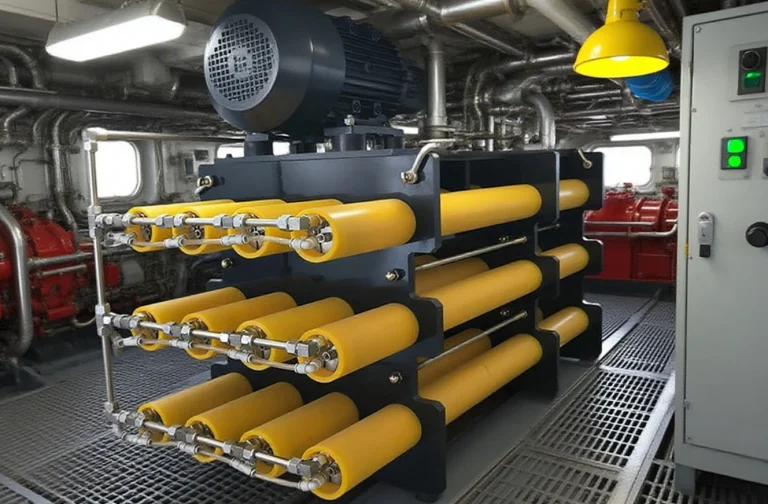
Membrane bioreactors, ultrafiltration systems, and reverse osmosis units sit at the core of modern advanced treatment plants. Membrane replacement represents a significant recurring cost in every private operation contract. Consequently, operators treat the specification, sourcing, and management of membrane replacements as a core operational competency.
For RO-based treatment systems, the quality of replacement RO membranes determines both ongoing treatment performance and replacement frequency. In China’s component market, counterfeit or underspecified membranes are a real risk. Over the long term, premium-grade membranes consistently cost less than budget alternatives when factoring in replacement cycles and downtime.
Filtration Equipment
Pre-treatment filtration, post-treatment polishing filters, and sludge dewatering equipment all demand regular maintenance. Filter housings, cartridges, and bag filters rank among the highest-consumption items in any treatment facility. Operators who standardize across multiple sites gain significant procurement advantages.
For high-volume industrial applications, industrial bag filter housings designed for continuous operation reduce maintenance downtime. Furthermore, standardizing on well-supported equipment simplifies spare parts management across a portfolio of facilities.
Dosing and Chemical Systems
Chemical dosing systems handle coagulation, pH adjustment, antiscalant protection, and disinfection. Precision and reliability are non-negotiable here. A dosing pump failure or chemical supply interruption directly undermines treatment performance and compliance. Consequently, operators maintain redundant dosing capability at every critical injection point.
Monitoring and Control Infrastructure
Online instrumentation tracks flow, pH, conductivity, turbidity, and dissolved oxygen continuously. In China, environmental authorities require real-time data transmission to government monitoring platforms. This means monitoring system reliability is a compliance issue, not merely an operational convenience. Additionally, accurate data supports contract performance reporting and protects operators in dispute situations.
Accurate flow measurement underpins both compliance reporting and operational efficiency. Reliable water flow meters calibrated to China’s national measurement standards are, therefore, a non-negotiable component of any compliant treatment facility.
Common Challenges and How to Address Them
Feed Water Quality Variability
Industrial wastewater influent quality can shift dramatically. In particular, industrial parks with diverse tenant industries generate highly variable loads. An operator may design and bid a contract based on a defined influent specification, however the actual influent often proves more challenging. Consequently, this mismatch is one of the most common causes of financial underperformance and contract disputes.
The solution starts with robust influent monitoring from day one. Clear contractual provisions for exceedances protect the operator. Additionally, pre-treatment systems designed with adequate margin for realistic worst-case conditions prevent costly surprises.
Tightening Discharge Standards
China consistently raises its discharge standards. An operator holding a 25-year concession signed in 2010 may now face requirements that the original contract design never contemplated. Managing this regulatory evolution requires proactive contract renegotiation, targeted equipment upgrades, or the addition of new treatment stages. Furthermore, operators who build modular treatment configurations find it far easier to adapt than those locked into fixed-capacity systems.
Tariff and Payment Risk
Some municipal contracts set tariff payments below actual operating costs. In other cases, local government counterparties delay payments and create cash flow stress. This structural risk demands careful evaluation during contract due diligence. On the other hand, contracts with realistic tariff structures — including cost adjustment provisions as standards tighten — produce sustainable long-term operations for both sides.
Staffing and Technical Capability
Qualified water treatment operators remain in short supply across many parts of China. Operators managing multiple facilities struggle to recruit, train, and retain competent technical staff. However, companies that invest systematically in operator training and certification programs outperform those relying on ad hoc hiring. As a result, structured training has become a genuine competitive differentiator in contract performance.
Common Mistakes to Avoid
Underestimating Capital Expenditure
Operators who bid aggressively to win contracts often underestimate capex needs over the full contract term. Membrane replacement cycles, pump refurbishment, instrument calibration, and civil maintenance all accumulate. Ultimately, operators who ignore these costs in their bids find themselves caught between deteriorating performance and insufficient remediation funds.
Skipping Due Diligence on Existing Equipment
In TOT contracts, operators inherit existing infrastructure. Equipment that appears functional may be approaching end-of-life. Membrane systems with years of accumulated fouling may need immediate replacement. Therefore, operators who skip thorough equipment condition assessments during due diligence regularly inherit costs they never budgeted for.
Weak Influent Quality Provisions
A contract that omits explicit influent quality parameters creates serious operator risk. Industrial tenants may discharge contaminants well beyond what the treatment system handles. Without clear contractual protection — defined influent specs, individual source monitoring requirements, and defined remedies for exceedances — operators absorb these costs silently. Otherwise, they face disputes that damage both relationships and contract economics.
Single-Source Equipment Dependencies
Operators who build facilities around proprietary equipment from a single supplier create costly dependencies over time. Standardizing on equipment with multiple qualified suppliers reduces this risk. Moreover, maintaining adequate spare parts inventory for critical items further insulates operators from supply disruptions.
Future Trends and Market Outlook in China
China’s private water treatment operator market is entering a new phase. The first generation of major BOT and TOT contracts — signed in the early 2000s — are now approaching or passing their concession end dates. As a result, both new opportunities and transition challenges are emerging simultaneously.
Contract Renegotiation and Extension
As long-term contracts expire, facility owners and operators negotiate extensions or new concession arrangements. These renegotiations will define the economics of China’s private water treatment sector for the next decade. Operators who documented their performance rigorously throughout the contract term enter these negotiations from a position of strength.
Environmental Standard Escalation
China will continue to raise effluent standards during the 15th Five-Year Plan period. In particular, nitrogen, phosphorus, and emerging contaminant limits will tighten further. Operators running systems designed for earlier standards will face upgrade requirements. However, those with flexible, modular treatment configurations will adapt with far less disruption and cost.
Digital and Smart Operations
Leading operators now deploy AI-assisted process optimization, IoT-based predictive maintenance, and automated regulatory reporting. These tools reduce staffing costs and improve compliance reliability. Furthermore, smart operations are becoming a key differentiator in contract bidding. Facility owners increasingly recognize that digital capability reduces their regulatory exposure.
Consolidation Among Private Operators
The market is consolidating. Smaller operators with limited capital and technical depth are merging with or selling to larger platforms. This creates scale advantages in equipment procurement, technical staffing, and regulatory management. Consequently, large operators entrench their position in new contract competitions while smaller firms find it increasingly difficult to compete.
As the International Water Association notes in its analysis of water utility performance globally, the most successful private operators combine technical excellence with strong contract management and robust compliance systems. In China’s increasingly sophisticated market, this combination has become the minimum requirement for long-term success, not a differentiator.
Conclusion: Making Private Operator Contracts Work
Water treatment plant private operator contracts have become a cornerstone of China’s water infrastructure model. Overall, they succeed when contract design is sound, equipment is reliable, operators bring genuine technical capability, and the regulatory framework sets clear performance expectations.
However, they fail when financial assumptions are unrealistic, when operators source equipment without regard for quality, or when influent quality goes unmanaged. In these situations, the costs fall on everyone involved.
The practical takeaways for decision-makers are clear. First, invest in thorough due diligence before signing. Second, ensure contracts explicitly address the risk areas that most commonly cause disputes. Third, standardize on reliable, well-supported equipment to reduce maintenance uncertainty. Finally, build operational capability — in training and monitoring — from day one, not as an afterthought.
For operators and facility owners evaluating treatment equipment for private operation contracts — from membrane systems and filtration components to complete commercial RO water treatment systems — equipment reliability and supplier support capability are just as important as initial purchase price when determining long-term contract performance.