BasideWT- Whole Home Water Filtration System & Replacement


Whole House Water Softening System: The Complete Buyer’s Guide for Homeowners and Facility Managers
Your pipes are narrowing. Your water heater is working harder than it should. The showerhead looks like it has a calcium growth problem. And somehow, no matter how much soap you use, it never quite lathers properly.
These are not random household frustrations. They are the predictable, measurable consequences of hard water — water that carries elevated concentrations of dissolved calcium and magnesium from underground aquifers, riverbeds, or municipal supply networks.
Hard water is one of the most common and least-discussed water quality problems affecting residential and commercial properties across China, Southeast Asia, the Middle East, and large portions of North America. According to the World Health Organization, water hardness above 200 mg/L (approximately 11.7 grains per gallon) can cause significant scaling and infrastructure damage over time.
The solution is well-established: a whole house water softening system installed at the point where water enters your property. What is less clear — for many homeowners and facility managers — is how to choose the right system, avoid common sizing mistakes, and understand what the long-term cost of ownership actually looks like.
That is what this guide covers, thoroughly and practically.
What Is a Whole House Water Softening System?
A whole house water softening system is a water treatment unit installed on the main water supply line entering a property. Unlike point-of-use filters under a kitchen sink, this system treats every liter of water that flows to every tap, appliance, and fixture in the building.
The phrase “whole house” is significant. It means the water heater receives soft water. The washing machine, the shower, the irrigation system, the boiler — everything downstream of the treatment unit benefits from reduced mineral content.
This is what makes a whole house water softening system fundamentally different from portable countertop filters, pitcher filters, or single-tap cartridge systems. Those solutions address one point of use. A whole house system addresses the entire plumbing infrastructure at once. To understand the full scope of what this means for your home, this detailed guide on what a water softener actually does explains the mechanism and scope in accessible terms.
How Ion Exchange Actually Works
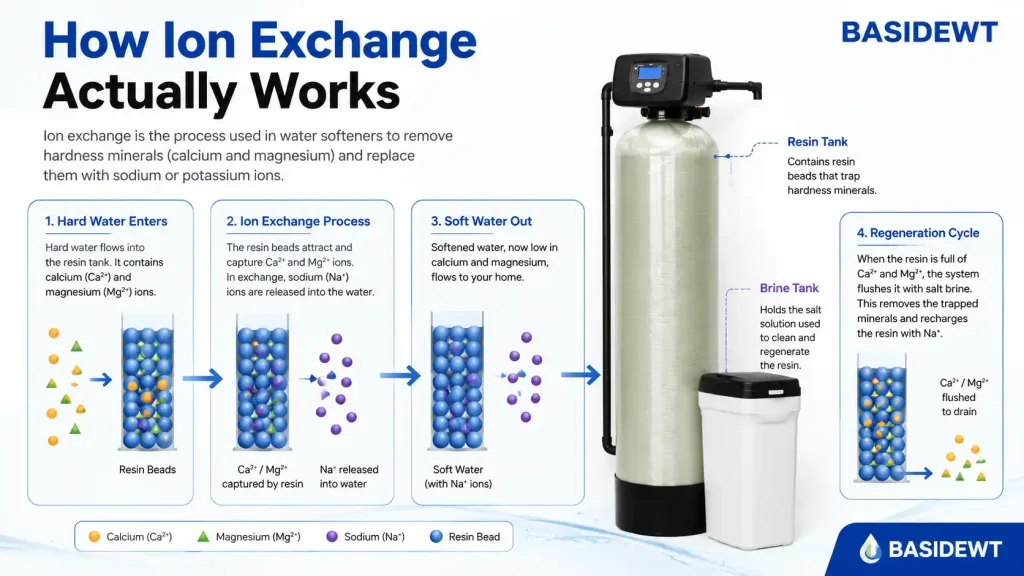
The most widely used technology in water softening is ion exchange. Understanding how it works removes the mystery from the process and helps you make better decisions about system selection.
Inside the softener’s resin tank, thousands of tiny polystyrene resin beads carry a negative electrical charge. This charge naturally attracts positively charged ions — specifically the calcium (Ca²⁺) and magnesium (Mg²⁺) ions that cause water hardness.
As hard water flows through the resin bed, the resin beads capture calcium and magnesium ions and release sodium (Na⁺) ions in exchange. The water exiting the resin tank has the same volume and pressure as before — but its hardness-causing ions have been replaced with sodium ions that do not form scale or interfere with soap chemistry.
Over time, the resin beads become saturated with calcium and magnesium and can no longer exchange efficiently. At this point, the system initiates a regeneration cycle. Highly concentrated salt water (brine) from a separate brine tank is flushed through the resin. The high sodium concentration forces the calcium and magnesium off the resin beads and flushes them to drain. The resin is then rinsed and recharged, ready to resume softening.
This regeneration cycle is automatic in modern systems and typically runs overnight when water demand is lowest. Properly sized systems regenerate every 5 to 10 days.
Hard Water: How Bad Is Your Water, Really?
Before buying any softening system, you need to know your actual water hardness level. This single measurement drives almost every system specification decision.
Water hardness is measured in grains per gallon (GPG) or milligrams per liter (mg/L). Here is the standard classification scale:
| Hardness Level | GPG | mg/L (ppm) |
|---|---|---|
| Soft | 0–3.5 | 0–60 |
| Moderately hard | 3.5–7.0 | 60–120 |
| Hard | 7.0–10.5 | 120–180 |
| Very hard | Above 10.5 | Above 180 |
In many parts of northern and western China, water hardness regularly exceeds 300 to 500 mg/L — classified as very hard and posing serious risk to plumbing, appliances, and industrial equipment over time. Cities with limestone-rich geology or heavy agricultural activity in groundwater catchments often show the highest hardness readings.
You can obtain your water hardness level through several methods:
- Municipal water quality report: Most water utilities publish annual quality data. Check the hardness figure directly.
- Home test kit: Basic strip tests provide approximate readings within minutes.
- Professional water analysis: A certified laboratory test gives the most accurate results, particularly important for well water or in areas where municipal quality reports are inconsistent.
Knowing your TDS (total dissolved solids) alongside hardness is also useful. High TDS water often benefits from a combination of softening and additional filtration, which is worth exploring when evaluating a whole house water filtration system.
Signs Your Home or Facility Needs a Whole House Water Softening System
Hard water announces itself in specific, recognizable ways. If you notice any of the following, your water hardness level is likely high enough to warrant treatment:
White or yellowish scale deposits on faucets, showerheads, kettle heating elements, and around drain openings. This is limescale — calcium carbonate that precipitates when hard water is heated or evaporates.
Reduced water pressure at taps and showers. Scale builds up inside pipes over years, narrowing the interior diameter and restricting flow. In severe cases, pipes need replacement.
Inefficient water heating. A 1.5mm layer of scale on a water heater element increases energy consumption by approximately 12 percent, according to studies on heat transfer efficiency in scaled heating systems. In industrial hot water systems, the impact is magnified further.
Soap and detergent not lathering properly. Calcium and magnesium ions react with soap to form calcium stearate — the white, insoluble scum visible in bathrooms and on laundry. This reaction consumes soap without producing useful lather, increasing detergent consumption by 30 to 50 percent in hard water areas.
Stiff or scratchy laundry. Hard water deposits mineral residue in fabric fibers during washing, making textiles feel rough and causing colors to fade faster than they should.
Dry or irritated skin and hair after showering. Hard water minerals interfere with moisturizing products and can disrupt the skin’s pH balance over time. Many people notice a significant improvement in skin feel within days of switching to softened water.
The Real Benefits of Whole House Water Softening
The benefits of installing a whole house softening system are concrete and quantifiable — not just a matter of comfort.
Appliance Lifespan Extension
Water heaters, dishwashers, washing machines, and boilers all operate with significantly longer service lives in soft water environments. Scale builds up on heating elements, valves, and heat exchangers in hard water, accelerating wear and causing premature failures. Industry data consistently shows that appliances in soft water environments last 30 to 50 percent longer on average.
Energy Cost Reduction
Scale acts as an insulating layer on heating elements. The thicker the scale, the harder the element must work to transfer heat to the water. Removing existing scale and preventing future buildup directly reduces energy consumption. For commercial facilities with large hot water systems, this can represent meaningful annual savings.
Plumbing Protection
Copper and galvanized steel pipes in hard water areas accumulate scale deposits over years and decades. Once scale hardens inside pipes, it is extremely difficult to remove without chemical treatment or physical replacement. A whole house softener prevents scale formation at the source, protecting the entire piping network indefinitely.
Soap and Detergent Savings
Soft water lathers more efficiently and rinses more completely than hard water. Many households find they use 30 to 50 percent less soap, shampoo, and laundry detergent after installing a water softener — a running operational saving that partially offsets the cost of the system over time.
Water Quality for Sensitive Processes
For industrial buyers, commercial laundries, food and beverage processors, hotel operations, and healthcare facilities in China and internationally, softened water is often a prerequisite for consistent process quality. Mineral-free rinse water, scale-free steam generation, and reliable equipment performance all depend on water hardness control.
Salt-Based vs Salt-Free Systems: Understanding the Difference
This is one of the most frequently misunderstood decisions in home water treatment.
Salt-based ion exchange softeners genuinely remove hardness minerals from the water. Calcium and magnesium are physically replaced by sodium ions. The water leaving the system contains no hardness minerals. This is true softening.
Salt-free conditioners (also called template-assisted crystallization or TAC systems, or electromagnetic descalers) do not remove hardness minerals. Instead, they attempt to modify the physical structure of calcium and magnesium crystals so they are less likely to adhere to pipe surfaces. The minerals remain in the water. The water is not technically softened — it is conditioned.
Salt-free systems have real appeal in certain contexts: no salt to purchase, no regeneration wastewater, simpler maintenance. However, they are generally considered effective primarily at water hardness levels below 250 mg/L. Above that, ion exchange softening delivers reliably superior results.
If your water hardness exceeds 180 mg/L, a genuine ion exchange water softening system is almost always the more effective and durable choice. You can explore the science behind both approaches in this dedicated resource on how to filter hard water at home.
How to Size a Whole House Water Softening System
System sizing is where most buyers make mistakes. An undersized system runs out of capacity before its scheduled regeneration, allowing hardness breakthrough. An oversized system wastes salt and water on unnecessarily frequent regeneration cycles.
Correct sizing requires three numbers:
1. Water hardness in grains per gallon (GPG) Convert mg/L to GPG by dividing by 17.1. For example, 300 mg/L ÷ 17.1 = 17.5 GPG.
2. Daily water consumption in liters or gallons A useful baseline is 150 to 200 liters per person per day for residential properties. For commercial or industrial facilities, actual metered consumption data is always preferable to estimates.
3. System grain capacity Multiply daily consumption (in gallons) by hardness (in GPG) to get daily grain demand. Multiply by the desired regeneration interval in days (typically 7 to 10 days) to determine the minimum grain capacity required.
Example:
- 4-person household
- Daily consumption: 800 liters (approximately 210 gallons)
- Water hardness: 350 mg/L = 20.5 GPG
- Daily grain demand: 210 × 20.5 = 4,305 grains per day
- For a 7-day regeneration interval: 4,305 × 7 = 30,135 grains minimum capacity
In this case, a 32,000 or 40,000 grain capacity system is appropriate.
For a well-designed whole house water softener system to perform reliably over its full service life, proper sizing at the outset is essential. Resizing after installation is expensive and disruptive.
Installation Considerations
A whole house water softening system is installed at the main water supply entry point — typically in a utility room, garage, basement, or meter room. The unit requires:
- Inlet and outlet connections to the main supply pipe (typically 25mm or 32mm BSP in residential applications)
- A drain line to carry regeneration wastewater to a floor drain or standpipe
- Power supply for the control valve timer or demand meter (most systems require a standard 220V socket nearby)
- A brine tank location adjacent to the resin tank, with enough clearance for salt loading
Installation is typically completed by a plumber or water treatment technician in two to four hours for a standard residential system. Post-installation, the system requires a startup flush and programming of the control valve for your specific hardness level and regeneration schedule.
Maintenance Requirements
A salt-based whole house water softening system requires straightforward but regular maintenance:
Salt replenishment: Check the brine tank monthly. Salt level should be maintained at roughly half to two-thirds full. Do not let the tank run completely empty — this causes the resin to exhaust without regenerating and can allow hard water to pass through.
Salt type: Use high-purity evaporated salt pellets or solar salt rather than rock salt. Lower-purity salts contain insoluble impurities that accumulate as sediment in the brine tank, requiring manual cleaning.
Resin inspection: Quality ion exchange resin lasts 10 to 20 years under normal conditions. Annual output testing with a TDS meter or hardness test strip confirms the resin is performing correctly.
Brine tank cleaning: Clean the brine tank every two to three years to remove salt bridges (salt crust forming above the water line) and sediment accumulation.
Pre-filter maintenance: If a sediment pre-filter is installed upstream of the softener (highly recommended in areas with turbid or iron-containing water), replace cartridges on the manufacturer’s recommended schedule.
More detailed guidance on routine care is available in this resource covering whole house water softener maintenance and operation.
Common Buying Mistakes to Avoid
Buying on brand name without checking grain capacity. A well-known brand in a size too small for your household will perform poorly regardless of reputation.
Ignoring iron content in well water. Standard ion exchange resin handles ferrous (dissolved) iron up to approximately 2 to 3 mg/L. Above this level, iron causes resin fouling and early failure. Well water should always be tested for iron content before selecting a softener.
Choosing salt-free conditioning for very hard water. If your hardness exceeds 250 mg/L, a salt-free conditioner will likely not provide adequate scale protection for appliances and pipes.
Skipping a pre-sediment filter. Turbid water or water with suspended particles will clog and damage the resin bed over time. A basic 10 to 20 micron sediment filter upstream of the softener is inexpensive insurance.
Buying the minimum viable system. Given that a quality softening system should last 15 to 20 years, undersizing to save initial cost often costs more over time through hardness breakthrough, increased salt use, and earlier replacement.
How to Choose the Right System for Your Situation
For a single-family home with municipal water and hardness between 150–300 mg/L: A demand-initiated regeneration system in the 32,000 to 48,000 grain range is typically correct for a 3 to 5 person household. Demand-initiated systems regenerate based on actual water usage rather than a fixed time schedule, optimizing salt and water efficiency.
For a large property, apartment building, or commercial facility: Systems above 64,000 grains or duplex configurations (two resin tanks alternating in service) maintain continuous soft water supply without regeneration interruption. Correct system specification requires actual water consumption data and a professional survey.
For areas with very hard water above 400 mg/L: Consider a system with higher cross-linked resin (10% crosslink vs the standard 8%) for greater hardness capacity per unit volume and longer resin life. Also consider whether a combined softening and RO system addresses both hardness and overall TDS — a common requirement in industrial applications and in regions with heavily mineralized groundwater.
A detailed cost comparison and long-term ROI analysis for different system types is available in this guide on whole house water softener system costs and value.
Why Water Testing Must Come Before Any Purchase
This point deserves emphasis. No responsible water treatment professional recommends a specific system without first understanding the source water chemistry.
A water test determines:
- Hardness level — the primary sizing variable
- Iron content — dictates whether additional pre-treatment is required
- pH — acidic or very alkaline water affects resin life
- TDS — indicates whether softening alone is sufficient or combined treatment is needed
- Chlorine or chloramine levels — high disinfectant concentrations can degrade resin over time
Home test kits provide adequate initial guidance for hardness. But for industrial applications, well water systems, or any situation where the investment is significant, a certified laboratory analysis is the appropriate starting point.
According to the Water Quality Association’s guidelines on residential water treatment, proper water testing before system selection is the single most important step in achieving a satisfactory outcome from any home water treatment investment.
FAQs
Does softened water taste salty?
Most people do not detect any taste change. The sodium added during ion exchange is proportional to the hardness removed. At moderate hardness levels (below 300 mg/L), the increase in sodium is typically 20 to 50 mg/L — well below the taste threshold for most people and well within safe drinking water guidelines. Those on low-sodium diets can use potassium chloride regenerant instead of sodium chloride, which adds potassium rather than sodium to the softened water.
Can I install a whole house water softener myself?
Competent DIY plumbers can install standard systems with proper preparation. However, incorrect installation — particularly failing to provide adequate bypass valves, proper drain connections, or suitable electrical supply — creates operational problems and can void warranties. For most homeowners, professional installation is the more reliable option.
How much water does a water softener waste during regeneration?
A standard regeneration cycle uses 150 to 300 liters of water depending on system size and regeneration efficiency. High-efficiency demand-initiated systems minimize this by regenerating only when necessary based on actual water usage.
How long does the resin last?
Quality ion exchange resin from reputable manufacturers lasts 10 to 20 years with proper maintenance. Early resin failure is usually caused by oxidant damage (from high chlorine), iron fouling, or mechanical damage from high-velocity flow. Annual testing of output hardness confirms resin remains effective.
Do I still need a water filter if I have a water softener?
These are different technologies addressing different problems. A softener removes hardness minerals but does not remove sediment, chlorine, organics, bacteria, or heavy metals. A comprehensive home water treatment setup typically combines softening with at least sediment pre-filtration and, for drinking water, an under-sink reverse osmosis or carbon filter for taste and purity.
Is a whole house water softening system suitable for well water?
Yes, but with important caveats. Well water often contains iron, manganese, hydrogen sulfide, and sediment in addition to hardness. Each of these can damage standard softening resin. A professional water analysis of the well water is essential before selecting a system, and additional pre-treatment is commonly required.
Conclusion
Hard water is a manageable problem. The infrastructure exists — in the form of proven ion exchange technology — to eliminate scale, extend appliance life, reduce detergent costs, and improve water experience throughout an entire property, beginning the day of installation.
The decisions that determine whether you get excellent results or mediocre ones come before you buy. Know your water hardness. Calculate the correct grain capacity. Choose appropriate resin quality. Include pre-filtration. Program regeneration correctly.
A whole house water softening system, properly selected and correctly installed, is a 15 to 20 year investment that pays for itself through reduced maintenance costs, lower energy consumption, and extended appliance lifespan. For most properties in hard water areas, it is not a luxury — it is straightforward infrastructure protection.
If you are ready to compare specific system configurations, the whole house water softener system range at BASIDE covers residential, commercial, and industrial requirements with OEM options for importers and distributors.
RELATED POSTS
RO Membrane Pressure Requirements: PSI, Temperature & Feed Water Guide
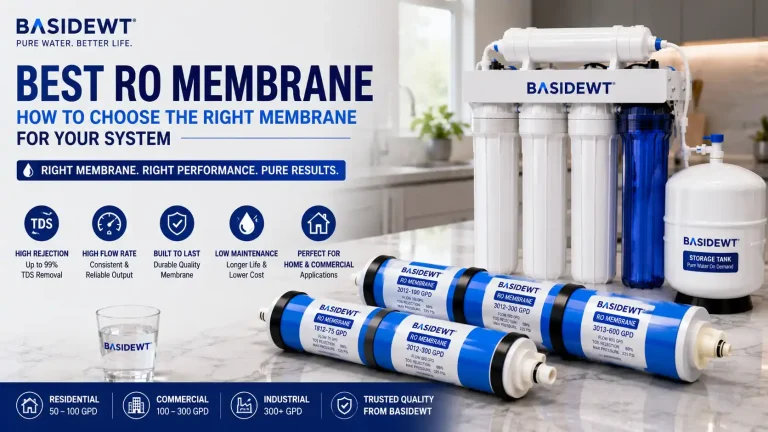
Best RO Membrane: How to Choose the Right Membrane for Your System

The Ultimate Guide to Reverse Osmosis Water: Pros, Cons, and Is It Right for You?
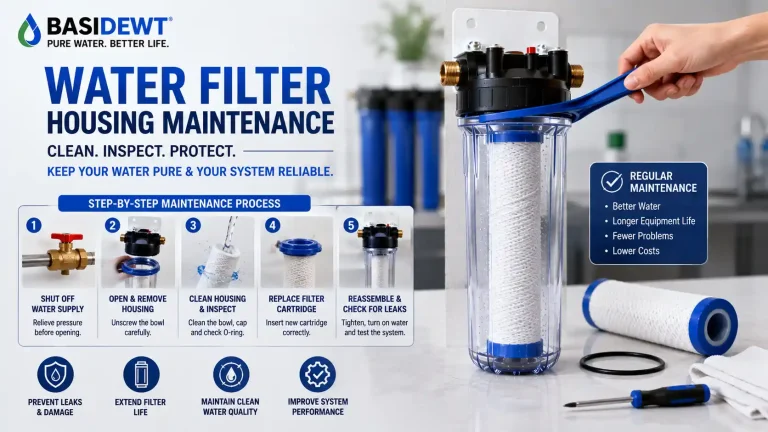
Water Filter Housing Maintenance: Cleaning, Inspection & Care Guide
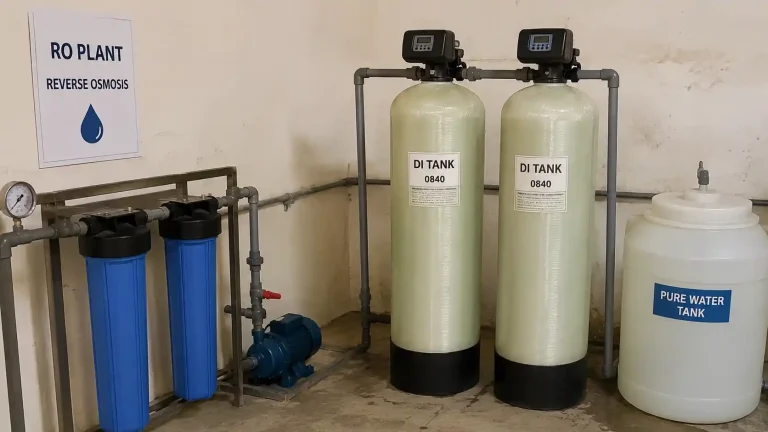
How Does a Spotless Water System Work? A Complete Technical Guide