BasideWT- Whole Home Water Filtration System & Replacement


Why Do Cars Get Water Spots After Washing?
Cars get water spots after washing because the rinse water carries dissolved minerals, mainly calcium and magnesium, that stay behind once the water evaporates. Even a careful wash can leave a car covered in cloudy circles within minutes. Many owners assume they simply dried the vehicle too slowly. In reality, the real cause sits in the water itself, not in the towel. This guide walks through the chemistry, the damage risk, and the fixes that professional car washes, detailers, and fleet operators actually use to get consistent, spot-free results.
What Are Water Spots on Cars?
Water spots are the pale, ring-shaped or hazy marks left on paint, glass, and chrome after water dries on the surface. They form because tap water is never pure. It carries a mix of dissolved solids, commonly measured as TDS, or total dissolved solids.
When a water droplet sits on a hood or windshield, the water itself evaporates first. The minerals cannot evaporate, so they stay concentrated in a small circle exactly where the droplet used to be. That concentrated mineral ring is the spot you see.
This is a purely physical and chemical process. It has nothing to do with how “clean” the car looked right after the wash.
Why Do Cars Get Water Spots After Washing?
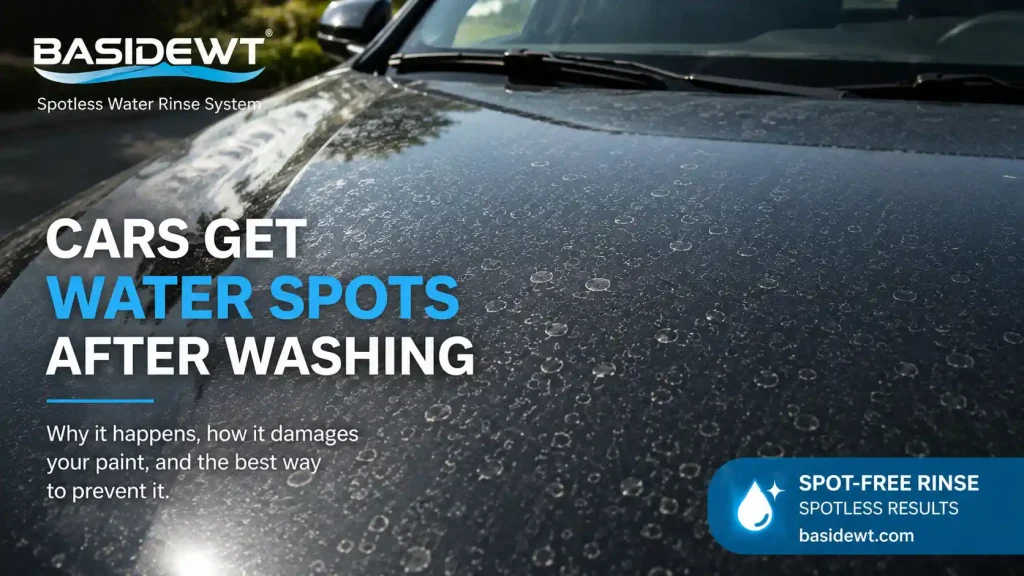
This is the question every car wash owner, detailer, and fleet manager eventually asks. The short answer: your rinse water contains too many dissolved minerals for the volume of water evaporating off the panel.
Three conditions combine to create the problem:
High mineral content. Municipal and well water in most regions carries calcium carbonate, magnesium, silica, and trace metals. The harder the water, the more minerals per gallon.
Slow or incomplete drying. The longer water sits on a surface, the more time minerals have to concentrate before the last droplet evaporates.
Surface temperature and airflow. Warm panels and low humidity speed up evaporation, which paradoxically makes spotting worse because it leaves less time to remove water mechanically before it dries on its own.
Understanding this cause-and-effect relationship is the foundation for every prevention method covered later in this guide, including spot-free rinse systems used across professional car wash operations.
What Minerals Cause Water Spots?
Not all dissolved solids behave the same way once water evaporates. A few specific minerals are responsible for most visible spotting.
Calcium and Magnesium
Calcium and magnesium carbonate are the primary drivers of hard water. Together they define water hardness, and they crystallize into the chalky white residue most people picture when they hear “water spots.”
Silica
Silica is less commonly discussed but often more stubborn. It can bond tightly to glass and clear coat, producing spots that resist standard car wash soap and require mechanical or chemical polishing to remove.
Iron and Trace Metals
In areas with older plumbing or iron-rich groundwater, trace iron can oxidize on the surface, leaving faint orange or brown staining alongside standard mineral spotting.
TDS meters are the standard tool for measuring the combined concentration of these minerals. Most detailers and commercial washes target rinse water below 30 ppm TDS, and true spot-free results usually require single-digit TDS levels.
How Hard Water Damages Car Paint
A single water spot is cosmetic. Repeated exposure over weeks and months is a different story.
Mineral deposits are alkaline. Left on a hot panel under direct sun, they can slowly react with the clear coat, etching a shallow mark into the surface itself. At that point, the spot is no longer sitting on top of the paint. It has become part of the paint’s texture, and washing alone will not remove it.
This progression from cosmetic residue to physical etching is exactly why water quality management is treated as a serious engineering concern in industrial and municipal contexts, not just a detailing inconvenience. China’s national groundwater quality standard, published by the Ministry of Ecology and Environment, classifies water hardness levels precisely because mineral concentration affects so many downstream industrial uses, including surface finishing and equipment protection.
For car wash and detailing businesses, that same principle applies at a smaller scale. Rinse water hardness is not a minor detail. It is a direct input into paint longevity and customer satisfaction.
Why Sunlight Makes Water Spots Worse
Sunlight does two damaging things at once.
First, it accelerates evaporation, which shortens the window a detailer has to dry the car before minerals concentrate and dry in place. Second, UV exposure heats the panel, and heat speeds up any chemical reaction between alkaline mineral deposits and clear coat.
This is why experienced detailers avoid washing in direct midday sun whenever possible, and why any wash performed outdoors benefits from fast, even rinsing rather than a slow, section-by-section approach.
Temporary vs Permanent Water Spots
Not every spot requires aggressive correction. It helps to separate the two categories early, because treating a temporary spot like a permanent one wastes time and product.
Temporary spots sit on the surface. They usually wipe away with a quick detail spray, a microfiber towel, or a light acidic cleaner such as a diluted vinegar solution. If the spot has been on the car for a few hours or less, it is very likely temporary.
Permanent spots, sometimes called water etching, have already reacted with the clear coat. They often feel slightly rough to the touch and remain visible even after washing and drying. These require polishing, and in severe cases, clear coat correction.
Can Water Spots Damage Clear Coat?
Yes, and this is the point many general car care articles underexplain. Clear coat is a thin polymer layer designed to protect the base color coat and provide UV resistance. It is not immune to chemical attack.
Mineral deposits are mildly alkaline, and heat acts as a catalyst. Repeated drying and direct sunlight can slowly damage the clear coat. The mineral ring may etch a shallow mark into the surface over time. As a result, the water spot reflects light differently and still looks visible even after washing the vehicle.
In some cases, glass is more vulnerable than paint. Silica-based deposits can bond tightly to the surface over time. This can leave windshields with a permanent haze after years of repeated exposure to hard water without protective treatment.
How to Remove Water Spots Safely
For fresh, temporary spots, a mild approach works best:
Use a pH-balanced detail spray or a diluted white vinegar solution, applied with a clean microfiber towel. Work in straight lines rather than circles, and avoid letting any cleaning solution dry on the surface, since that simply reintroduces the same evaporation problem you are trying to solve.
For deeper or older spots, a light clay bar treatment followed by machine polishing is usually necessary. This is detailed further in our comparison of spot-free rinse versus hand drying, which breaks down why manual correction is far more time-consuming than prevention.
Whatever method is used, the goal should always be prevention first. Removing spots repeatedly is a maintenance cost. Preventing them is a one-time investment.
Common Mistakes That Make Water Spots Worse
A few habits quietly make the problem worse rather than better.
Washing under direct sun without a fast drying plan gives minerals time to concentrate before the water fully evaporates. Air-drying instead of towel-drying skips the mechanical removal step entirely, letting every drop dry exactly where it landed. Reusing the same rinse water across multiple vehicles increases the TDS level with every wash. As a result, later vehicles are more likely to develop water spots than the first ones.
Using tap water for the final rinse can also create problems. It contains dissolved minerals that remain on the surface after the water evaporates. That is why the final rinse has the biggest impact on achieving a spot-free finish.
Why Hand Drying Alone Can’t Solve the Problem
Hand drying removes bulk water, but it cannot remove dissolved minerals. Even a perfectly dried panel can still spot if any residual moisture, however small, contains hard water minerals.
This is the core limitation that professional operations eventually run into. No amount of towel technique changes the chemistry of the water itself. That is precisely why commercial car washes shifted toward treating the water before it ever touches the vehicle, rather than trying to out-dry the problem afterward.
How Spot-Free Rinse Technology Prevents Water Spots
A spot-free rinse system solves the problem at its source by removing dissolved minerals from the water before the final rinse stage. Instead of relying on speed or towel skill, the water itself is engineered to leave nothing behind when it evaporates.
This is the same principle behind our full spot-free rinse guide, which covers system types, capacity planning, and maintenance in more depth. For daily operations, the short version matters most: if the TDS level of the final rinse water is low enough, there is nothing left to concentrate into a spot once the water dries.
How RO + DI Systems Eliminate Water Spots
Most professional spotless water systems combine two purification stages.
Reverse osmosis (RO) pushes water through a semi-permeable membrane. The membrane blocks most dissolved minerals and reduces TDS by about 95% to 99%, depending on the membrane’s condition and the quality of the feed water.
After RO treatment, deionization (DI) removes the remaining charged mineral ions using ion exchange resin. This final polishing step usually lowers TDS to nearly zero.
The result is water with essentially nothing dissolved in it. When it evaporates off a car’s surface, there are no minerals left behind, because there was almost nothing there to begin with.
We break down exactly how this combination works, including membrane staging and resin regeneration, in our spotless water system working principle guide. For businesses evaluating equipment, our RO+DI resin deionized water system is built specifically for this dual-stage purification process at commercial scale.
Why Professional Car Washes Use Spotless Water Systems
Consistency is the real reason commercial operators invest in dedicated purification rather than relying on drying technique alone.
A car wash processing dozens or hundreds of vehicles a day cannot afford variable results. Staff turnover, weather changes, and vehicle volume all affect manual drying quality, but they do not affect the TDS level of properly treated rinse water. Once the system is calibrated, every vehicle receives the same spot-free result regardless of who is working that shift.
Fleet washing businesses face an even sharper version of this problem, since fleet clients often audit vehicle appearance as part of brand standards. A single spotted delivery van is a visible quality failure. Our car wash system line is designed around this exact consistency requirement, integrating purification directly into the wash bay’s final rinse stage.
Choosing the Right Spot-Free Water System for Your Business
System sizing depends heavily on daily vehicle volume, source water hardness, and available floor space. A small independent detailer has very different requirements than a high-volume tunnel wash or an industrial fleet yard.
For lower-volume operations or mobile detailing setups, a compact deionized water cleaning unit can be enough to guarantee spot-free finishing without a large footprint. For higher-throughput sites, a dedicated spot-free car wash system paired with resin regeneration capacity keeps output consistent even during peak hours.
Commercial cleaning companies working across glass facades, solar panels, and window cleaning contracts face similar spotting risk, since streaky, mineral-laden rinse water undermines the entire point of the job. A properly sized cleaning system solves this the same way it solves it for vehicles: by removing the minerals before they ever touch the surface.
Before selecting equipment, it is worth testing your local source water TDS and hardness. Source water hardness directly determines RO membrane load, resin tank sizing, and how often DI resin needs regeneration, so an accurate baseline avoids undersizing a system that then fails to deliver true zero-spot results.
Why BasideWT Spotless Water Systems Are Built for Professional Results
BasideWT designs its Spotless Water System range specifically for commercial and industrial water quality demands, not for occasional home use. Every system pairs RO pre-treatment with DI resin polishing, monitored TDS output, and componentry sized for continuous daily operation rather than intermittent light use.
For car wash owners, detailers, fleet operators, and commercial cleaning companies, that distinction matters. A system engineered for daily commercial cycles holds its output quality far longer than a scaled-down consumer unit pushed beyond its intended capacity. The goal is not just eliminating today’s water spots. It is maintaining spot-free, near-zero TDS rinse water reliably, wash after wash, for years of operation.
Conclusion
Water spots after washing come down to one root cause: dissolved minerals left behind when water evaporates. Calcium, magnesium, and silica are the primary culprits, and sunlight, warm panels, and slow drying all make the problem worse. Left untreated, temporary spotting can progress into permanent clear coat etching that no amount of washing can undo.
The most reliable fix is not a better towel or a faster drying technique. It is treating the water itself before it ever touches the vehicle. RO and DI purification, delivered through a properly sized spot-free rinse system, removes the minerals at the source, so there is simply nothing left to leave a mark once the water evaporates.
For car wash owners, detailers, fleet operators, and commercial cleaning businesses that need consistent, professional results at scale, exploring a dedicated Spotless Water System is the logical next step after understanding why the problem happens in the first place.
Frequently Asked Questions
Why does my car get water spots even right after a wash?
Rinse water that still contains dissolved minerals leaves those minerals behind as soon as it evaporates, regardless of how recently the car was washed.
Does soft water prevent water spots completely?
Soft water reduces calcium and magnesium content but still contains dissolved solids, so it can still spot a vehicle, just less severely than hard water.
How can I tell if my local water is hard?
A TDS meter or a basic water hardness test kit gives an accurate reading in seconds and is the standard first step before choosing a filtration solution.
Is distilled water the same as spot-free rinse water?
Distilled water is mineral-free like spot-free rinse water, but it is produced through evaporation and condensation, which is far slower and more expensive at commercial volume than RO plus DI filtration.
Can water spots be buffed out permanently?
Fresh, cosmetic spots buff out easily. Etched spots that have reacted with the clear coat require polishing, and in severe cases, clear coat correction to fully remove.
How often should DI resin be replaced in a spot-free system?
Replacement or regeneration frequency depends on source water hardness and daily rinse volume, but most commercial operations monitor output TDS and regenerate resin once it rises above the target threshold.
Do ceramic coatings prevent water spots?
Ceramic coatings make water bead and sheet off faster, which reduces spotting risk, but they do not eliminate it entirely if the rinse water is still high in dissolved minerals.
What TDS level counts as truly spot-free?
Most professional spot-free systems target single-digit TDS levels, typically under 10 ppm, since minerals below that threshold are too dilute to leave a visible residue once evaporated.
Can I add a spot-free rinse stage to an existing car wash without rebuilding it?
Yes, most RO plus DI systems are designed to integrate into an existing final rinse stage, requiring plumbing and space adjustments rather than a full wash bay rebuild.
Do water spots affect resale value of vehicles in a fleet?
Yes, persistent water spotting and etching create a visibly neglected appearance that can lower resale and lease-return valuations, which is one reason fleet operators prioritize spot-free rinse systems.
RELATED POSTS
What Is the Best Home Water Filter?
UV Water Sterilizer for Drinking Water: Benefits, Limits and Applications
What Is an RO Water System? Everything You Need to Know
Water Softener System Size Guide: How to Choose the Right Capacity
Water Filter Housing Maintenance: Cleaning, Inspection & Care Guide