BasideWT- Whole Home Water Filtration System & Replacement

Best Spot Free Water System for Car Wash: A Complete Buying Guide
Choosing the best spot free water system for car wash operations is one of the most important equipment decisions a wash owner will make. Yet it’s often treated as an afterthought. A poorly sized system leads to streaky finishes and constant resin replacement. It also leads to frustrated customers. This guide walks through how spot free systems actually work. It covers where RO and DI technology differ. It also explains how to size, budget, and maintain a system correctly. Many buyers make the mistake of choosing on price alone. They skip checking feed water TDS or daily car volume first. By the end, you’ll know what separates a hobby-grade DI cartridge from a true commercial system. You’ll also know how to avoid the costly mistakes other operators have already made.
What Is a Spot Free Water System?
A spot free water system treats incoming tap or well water. It removes almost all dissolved minerals before the water touches a vehicle. Ordinary tap water carries calcium, magnesium, and other dissolved solids. When that water evaporates on a car’s paint or glass, the minerals stay behind. They show up as visible water spots.
A properly designed system removes these dissolved solids. It uses reverse osmosis (RO), deionization (DI), or a combination of both. The result is water with a TDS (total dissolved solids) reading close to zero. Nothing is left behind to evaporate onto the surface. So the car air-dries to a genuinely spotless finish. For a deeper technical walkthrough, see our spotless water system working principle guide. It covers each treatment stage in detail.
Why Every Professional Car Wash Needs One
Water spots are one of the most common complaints in the car wash industry. They’re also almost entirely preventable with the right equipment. A commercial wash without spot-free rinse capability usually depends on manual toweling. This adds labor cost and slows throughput. It also leaves inconsistent results across a busy shift.
For fleet washing companies and detailing shops, the stakes are higher. Fleet contracts often specify a spot-free finish. A single missed standard can jeopardize a contract renewal. A reliable spot free system removes that risk entirely. That’s why it has become standard equipment across professional operations, not just a premium add-on.
How a Spot Free Water System Works
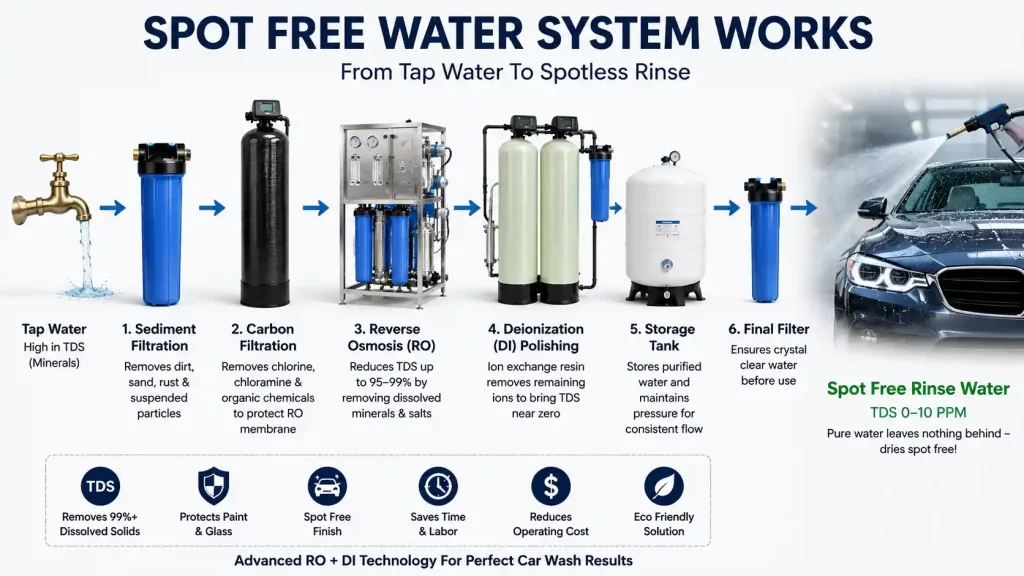
Most commercial systems follow a multi-stage process:
- Pre-filtration removes sediment, sand, and larger particles. Otherwise these particles would clog downstream membranes.
- Carbon filtration removes chlorine and chloramine. This protects RO membranes from chemical damage.
- Reverse osmosis (RO) forces water through a semi-permeable membrane. It rejects most dissolved minerals.
- Deionization (DI) polishing uses ion exchange resin to strip out remaining trace minerals. This brings TDS effectively to zero.
- Storage and delivery holds the treated water under pressure. It’s ready on demand during peak wash hours.
This staged approach is why RO-DI combination systems outperform single-stage units in commercial settings. We expand on this in our complete spot free rinse guide.
RO vs DI vs Spot-Free Systems
This is where many buying guides fall short. It’s worth breaking down clearly.
Reverse Osmosis (RO) pushes water through a membrane under pressure. It removes roughly 95–99% of dissolved minerals. It’s efficient for high-volume treatment. It also has a low operating cost per gallon. But it isn’t a perfect zero-TDS solution on its own, especially with harder source water.
Deionization (DI) uses ion exchange resin to attract and trap dissolved mineral ions. It produces near-zero TDS output. DI resin is highly effective, but it has a finite capacity. Once exhausted, it must be regenerated or replaced. Running raw tap water through DI alone depletes the resin quickly. This drives up ongoing cost.
Combined RO-DI systems use RO as a first-pass treatment. It strips out the bulk of the minerals. Then DI resin polishes the remaining trace amounts. This extends resin life while guaranteeing consistent zero-TDS output. That’s why most serious commercial installations, including our RO-DI resin deionized water systems, are built this way instead of as DI-only units.
Features to Look for Before Buying
Not every system marketed for car washes is built for commercial duty. Before buying, check for:
- Rated daily output (GPD) that matches or exceeds your peak-day car count, not just your average day.
- Pre-treatment stages (sediment and carbon) that protect the RO membrane and extend its service life.
- Resin volume, measured in cubic feet. Larger resin beds mean fewer replacements.
- A bypass valve. This lets operators switch off deionization for pre-rinse or soap stages, saving resin capacity for the final rinse.
- A built-in or compatible TDS meter, so staff can confirm output quality without guesswork.
- Food-grade or NSF-rated components. This matters most for tanks and fittings in contact with treated water.
Skipping any one of these is a common reason systems underperform once installed.
How to Choose the Right Size
Sizing is the single biggest mistake we see buyers make. A system needs to match two numbers: peak daily car volume and average feed water TDS.
As a starting reference point:
- Under 50 cars/day: a compact system producing 300–600 GPD is usually sufficient.
- 50–150 cars/day: mid-size commercial systems in the 1,000–2,000 GPD range are typical.
- 150+ cars/day or fleet operations: high-output systems above 4,000 GPD are necessary. These are often paired with a dedicated commercial RO stage to avoid bottlenecks during peak hours.
Feed water hardness also matters. A wash site on well water with high mineral content needs more RO capacity. It also needs larger DI resin volume than a site on softer municipal water, even at the same car count. For reference on national water quality benchmarks, operators can consult the Ministry of Ecology and Environment’s surface water quality standards. These outline the mineral and pollutant thresholds used across Chinese water monitoring programs.
Portable vs Commercial Spot Free Systems
Portable DI units are often mounted on a small cart or dolly. They’re designed for mobile detailers or low-volume home use. They’re inexpensive and easy to move. But their resin volume is small, so they need frequent cartridge changes under commercial workloads.
Commercial systems are stationary. They’re plumbed directly into the wash bay’s water supply. They’re built with larger pre-treatment, RO, and resin stages to handle continuous daily use. If your business washes more than a handful of vehicles a day, a commercial-grade spot free car wash system is almost always more cost-effective over a year. It beats repeatedly replacing portable cartridges.
Best Spot Free Water System for Small Car Wash Businesses
Small operators and independent detailing shops don’t usually need industrial-scale output. But they still benefit from a properly staged RO-DI unit rather than a bare DI cartridge kit. A compact commercial system with moderate resin volume and a bypass valve gives small businesses spotless results without excessive resin turnover costs. This tier is also where portable-to-stationary hybrid units shine. They’re easy to plumb into an existing hose bib and offer a good balance of upfront cost and performance.
Best Spot Free Water System for Large Commercial Car Washes
High-volume tunnels, flex-serve washes, and fleet washing operations need more robust systems. These are built around a dedicated commercial RO stage feeding a large DI resin bank. They also need enough storage capacity to handle rush-hour demand without a drop in output quality. At this scale, a full commercial car wash system integrated with pre-treatment softening and carbon filtration isn’t optional. It’s what keeps TDS readings at zero even during back-to-back peak hours.
Common Buying Mistakes
Even experienced operators make avoidable errors when purchasing a spot free system:
- Sizing by average daily volume instead of peak volume. This leads to bottlenecks during busy weekends.
- Ignoring feed water TDS before selecting resin volume. This causes resin to exhaust far sooner than expected.
- Buying DI-only systems for commercial use. This drives up resin replacement costs compared to RO-DI combinations.
- Skipping pre-filtration. This shortens RO membrane life and increases maintenance frequency.
- Underestimating storage tank size. This causes output pressure to drop during high-traffic periods.
Each of these mistakes is preventable with proper sizing guidance before purchase, not after installation.
Maintenance Costs
Ongoing maintenance for a commercial spot free system typically includes:
- Sediment and carbon filter changes, usually every 3–6 months depending on source water quality.
- RO membrane replacement, generally every 2–3 years under normal use with proper pre-treatment.
- DI resin replacement or regeneration. This varies based on feed water TDS and whether an RO pre-stage protects the resin bed.
- Periodic TDS meter calibration. This low-cost step prevents undetected quality drift.
Operators who pair RO with DI see resin costs drop substantially compared to running DI alone. That’s because the RO stage removes most of the mineral load before it ever reaches the resin.
Operating Cost Comparison
When comparing operating costs across system types, three factors dominate. These are resin consumption, membrane replacement frequency, and water recovery rate.
DI-only systems have the lowest upfront cost. But they carry the highest ongoing resin expense, since all dissolved minerals load directly onto the resin bed. RO-only systems have a low per-gallon operating cost. But they may not reach true zero-TDS output on harder water, risking occasional spotting. Combined RO-DI systems carry a higher initial investment. Still, they have the lowest blended cost per gallon over time, because the RO stage protects and extends the life of the DI resin.
For most commercial operations washing more than 30–40 cars a day, the RO-DI combination reaches payback faster than either technology used alone. This is especially true once labor savings from eliminating hand-drying are factored in.
Why RO + DI Systems Deliver Better Results
The core advantage of a combined system is consistency. RO alone can vary in rejection rate depending on feed pressure and membrane condition. It can occasionally let trace minerals through. DI alone works perfectly until the resin bed nears exhaustion. At that point, output quality drops sharply rather than gradually.
Pairing the two means the RO stage carries the bulk of the mineral load. The DI stage then acts as a final polishing step that’s rarely under heavy strain. This is also why RO-DI systems hold TDS near zero more reliably across long wash shifts. Most buying guides gloss over this distinction.
Why BasideWT Spot Free Water Systems Are Built for Commercial Use
Once the underlying technology is understood, the equipment decision becomes more straightforward. BasideWT’s Spotless Water System category is engineered specifically around the sizing and duty-cycle demands described above. It isn’t adapted from residential DI cartridge designs.
Systems are built with dedicated pre-treatment and properly sized RO membranes. Resin volumes are matched to real commercial car counts, not optimistic marketing figures. For operators who also need broader water treatment beyond the rinse stage, BasideWT’s commercial RO water filter systems and standalone deionized water cleaning units integrate into a single water treatment plan. Pre-treatment, RO, and DI stages work together instead of being sourced piecemeal. This approach reduces the sizing mistakes covered earlier. It also gives commercial buyers equipment rated honestly for the workload it will actually see.
Final Buying Recommendations
Before purchasing, confirm four things. Know your peak daily car count and your feed water TDS reading. Decide whether you need a portable or stationary installation. Check your available plumbing and space at the wash bay. Match these numbers against rated GPD output and resin volume, not price alone.
For most commercial operations, a combined RO-DI system delivers the lowest long-term cost per gallon. It also gives the most consistent spot-free results. Smaller operators can start with a compact commercial unit and scale up as car volume grows. High-volume tunnels and fleet operations should size for peak-hour demand from day one, rather than upgrading reactively.
If you’re comparing spot-free rinse against manual drying as a finishing step, our article on spot-free rinse vs hand drying breaks down the labor and quality tradeoffs. Our explainer on why cars get water spots after washing is useful background if you’re still validating the root cause at your site.
Conclusion
Selecting the best spot free water system for car wash operations comes down to one thing. Match real system capacity, RO-DI staging, and resin volume to your actual daily car count and feed water quality. Don’t chase the lowest sticker price. Buyers who size correctly and choose combined RO-DI equipment consistently see lower operating costs. They also get more reliable spotless finishes than those who choose DI-only or undersized units. If you’re ready to move forward, BasideWT’s commercial cleaning system lineup and full Spotless Water System range are built around the sizing and durability standards covered in this guide.
RELATED POSTS
UV Water Sterilizer Pretreatment: What Filtration Is Needed Before UV?
Water Filter Housing for Well Water: How to Choose the Right Setup
UV Water Sterilizer vs RO: What’s the Difference and Which Is Better?
RO Membrane Size Guide: 1812, 2012, 2812, 3012 & 3013 Explained
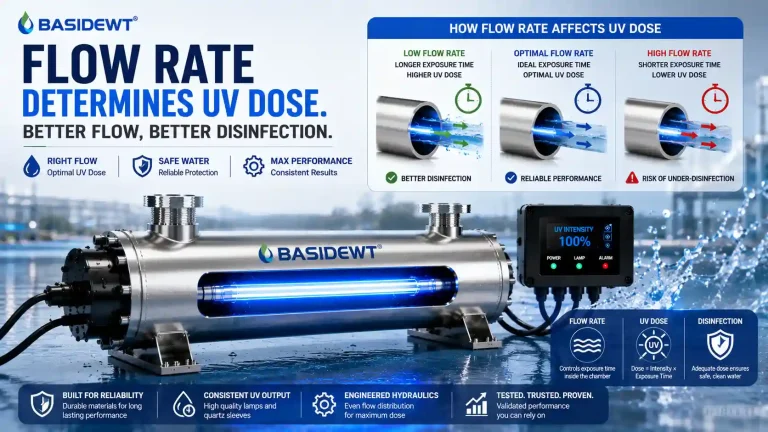
How Flow Rate Affects UV Dose and Disinfection Performance