BasideWT- Whole Home Water Filtration System & Replacement


How To Make Deionised Water
Do you need pure water for experiments, processes, or equipment? Learning how to make deionised water is the first step. You essentially need to remove mineral ions. Common methods include distillation and ion exchange. However, achieving consistent, high-purity results requires precision. This guide explores the ways to produce it. We’ll also show why BasideWT’s integrated systems are the smart choice for dependable purity.
Core Methods: How Is Deionised Water Produced?
Two primary techniques exist for creating deionised water. Each has distinct advantages and limitations.
- Distillation: This process involves boiling water and collecting the steam. Impurities are left behind. It effectively removes minerals, microbes, and most contaminants. But it is energy-intensive and slow. Interestingly, it doesn’t remove all volatile organic compounds.
- Ion Exchange: This is the most common method for producing deionised water. Water passes through resin beads that swap hydrogen and hydroxide ions for dissolved minerals. It’s highly effective for ion removal. Systems can be simple cartridges or complex mixed-bed units. This leads us to the detailed process.
The Ion Exchange Process: A Closer Look
Let’s break down the ion exchange method. It’s both simple and clever.
Water flows through special resin columns. These resins contain charged sites. Cations like calcium and magnesium are exchanged for hydrogen ions (H⁺). Meanwhile, anions like chloride and sulfate are traded for hydroxide ions (OH⁻). The released H⁺ and OH⁻ ions then combine. They form pure H₂O (water). The resins eventually exhaust and require regeneration or replacement.
Therefore, understanding this cycle is crucial for maintenance.
Factors Affecting Water Purity and Quality
Not all deionised water is equal. Output quality depends on several factors.
- Feed Water Quality: Highly contaminated source water will exhaust resins faster. Pre-filtration is often essential.
- Resin Type and Condition: Fresh, high-grade resins perform best. Exhausted or fouled resins compromise purity.
- System Design: Single-bed or mixed-bed? What is the contact time? Good design maximizes efficiency.
- Monitoring: How do you measure success? Regular resistivity testing is non-negotiable for quality control.
However, it’s noteworthy that DIY methods often lack control over these variables. This can lead to inconsistent results.
Why Choose BasideWT Professional Systems?
Building a reliable deionised water source is complex. Our systems solve this problem completely.
We engineer automated, all-in-one solutions. Think of them as your on-demand purity partner. You no longer need to worry about how to make deionised water manually. Our units combine pre-filtration, advanced ion exchange, and polishing stages. They include real-time purity monitors. Alerts tell you when maintenance is needed. This ensures every drop meets your specified standard.
Contrary to intuition, a professional system often has a lower long-term cost than constant cartridge replacements. It boosts productivity and protects your sensitive work.
DIY vs. Professional: Making the Right Choice
Should you build a small setup or invest in a system? Consider your needs.
For occasional, non-critical use, a small resin cartridge might suffice. But for daily lab work, manufacturing, or electronics, reliability is everything. Inconsistent water can ruin products and invalidate research. BasideWT systems deliver peace of mind. They guarantee the purity you need, exactly when you need it. This is the modern way to generate deionised water.
FAQ: Your Production Questions Answered
Q: Can I make deionised water at home?
A: Yes, but with limits. Small ion exchange cartridges can produce modest amounts. Do not expect the ultra-pure grade needed for science or industry.
Q: What is the difference between deionised and distilled water?
A: Both are pure. Distillation uses heat and condensation. Deionisation uses chemical ion exchange. For learning how to make deionised water, the ion exchange method is more common and scalable in professional settings.
Q: How do I maintain a deionised water system?
A: It requires regular resin replacement or regeneration. It also needs filter changes and system sanitization. BasideWT systems simplify this with smart service indicators.
RELATED POSTS
Water Fed Pole Equipment: What You Need for Professional Window Cleaning
What Is the Best Home Water Filter?
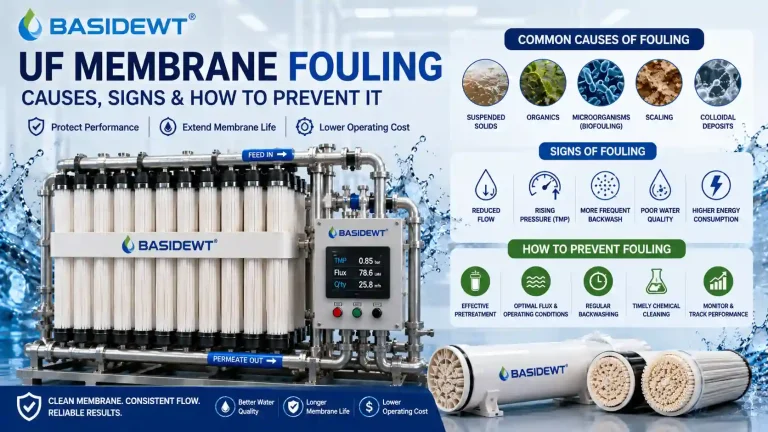
UF Membrane Fouling: Causes, Signs & How to Prevent It
Reverse Osmosis Ro Water Storage Sank -BasideWT
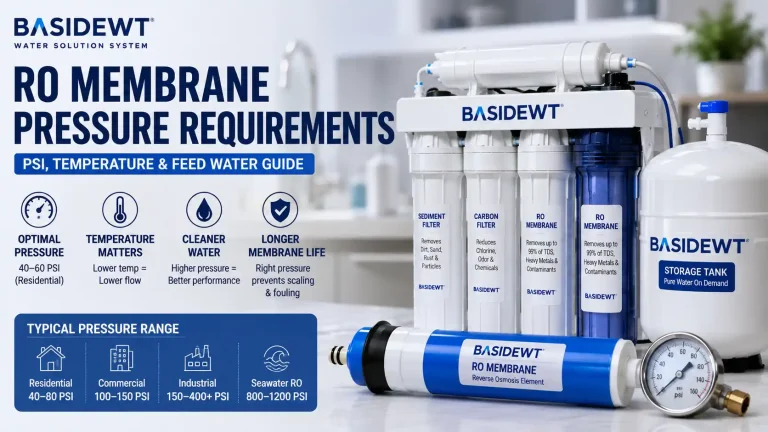
RO Membrane Pressure Requirements: PSI, Temperature & Feed Water Guide