BasideWT- Whole Home Water Filtration System & Replacement


High Flow Water Filter Housing: Benefits, Applications & Buying Guide
Water demand keeps rising across factories, hotels, hospitals, and municipal plants. Standard filter housings often struggle to keep up. That is where a high flow water filter housing comes in.
This equipment handles large volumes of water without slowing down your process. It uses oversized cartridges, a compact shell, and a design built for continuous, heavy-duty filtration.
If you already understand the basics of filter housings, you may want to start with our complete guide to water filter housing types, sizes, and materials. This article goes deeper into one specific category: high flow systems.
We will explain what makes these housings different, where they work best, and how to choose the right one for your operation.
What Is a High Flow Water Filter Housing?
A high flow water filter housing is a pressure vessel built to process large water volumes through oversized filter cartridges. Instead of using several small cartridges, it relies on one or a few large-diameter elements.
This design increases the total filtration surface area inside a single housing. More surface area means water moves through faster, with less resistance.
Most high flow housings accept cartridges ranging from 20 to 60 inches long, with diameters around 6.5 inches. Some models hold multiple cartridges side by side for even greater throughput.
Because of this structure, a single high flow unit can often replace several standard cartridge housings. If you are still comparing basic housing types, our article on what a water filter housing is covers the fundamentals in more detail.
The high flow cartridge itself is engineered differently too. It typically uses a pleated design that packs more filtration media into a smaller footprint, which boosts dirt-holding capacity without increasing pressure loss.
How Does a High Flow Water Filter Housing Work?
The working principle stays similar to any cartridge filtration system, but the scale changes significantly.
Water enters the housing through an inlet port. It then flows through the outer surface of the cartridge and moves inward, following an outside-in flow pattern in most designs.
As water passes through the pleated media, particles, sediment, and other contaminants get trapped on the cartridge surface. Clean water continues through the core and exits via the outlet port.
Because the cartridge offers a much larger filtration area, water moves through at higher speed without a major pressure drop. This is the core advantage of high flow technology.
For readers who want a broader explanation of this mechanism, our earlier post on how a water filter housing works breaks down the general filtration process step by step.
In high-demand systems, this efficient flow path prevents bottlenecks. Facilities avoid the pressure spikes and flow restrictions that standard housings often create under heavy load.
High Flow vs Standard Water Filter Housing
Choosing between a high flow filter housing and a standard housing depends mainly on your flow rate needs and available space. The table below compares both options across key factors.
| Factor | High Flow Water Filter Housing | Standard Water Filter Housing |
|---|---|---|
| Flow Rate | Handles 40–500+ GPM per housing | Typically 10–30 GPM per housing |
| Cartridge Size | Large diameter, 20″–60″ length | Standard 2.5″–4.5″ diameter cartridges |
| Pressure Drop | Lower, due to larger surface area | Higher under heavy load |
| Maintenance | Fewer, less frequent changeouts | More frequent cartridge replacement |
| Capacity | High dirt-holding capacity | Lower dirt-holding capacity |
| Installation Space | Compact for the flow it delivers | Requires multiple units for similar flow |
| Best Applications | Industrial, commercial, RO pretreatment | Residential, light commercial use |
As the table shows, a high flow housing is not simply a bigger version of a standard unit. It is engineered for continuous, high-volume operation.
Standard housings still make sense for smaller systems, such as residential setups or low-demand commercial buildings. However, once flow requirements climb, high flow housings become the more practical and cost-effective choice.
If your facility processes large water volumes daily, it is worth reviewing our comparison of clear vs blue water filter housings as well, since housing color and material also affect performance in high-demand environments.
Key Benefits of High Flow Water Filter Housing
High flow housings offer several practical advantages over conventional filtration setups. Understanding these benefits helps you decide if this technology fits your operation.
Higher throughput with less equipment. One high flow housing can often replace multiple standard units. This reduces the number of components your team needs to install, monitor, and maintain.
Lower pressure drop across the system. Because the cartridge surface area is larger, water flows through more easily. This means pumps work less hard, which can lower energy costs over time.
Extended cartridge life. High flow cartridges hold more contaminant load before they need replacement. Facilities typically see longer intervals between changeouts compared to standard cartridges.
Reduced maintenance frequency. Fewer cartridge changes mean less downtime and lower labor costs. For facilities running continuous operations, this translates directly into savings.
Smaller footprint for the flow delivered. Even though the housings themselves are larger, they take up less total space than an equivalent bank of standard housings.
Better protection for downstream equipment. Consistent, efficient filtration protects pumps, membranes, and other sensitive components from fouling and premature wear.
Together, these benefits explain why so many industrial buyers are shifting toward high flow systems. The upfront investment often pays off through lower operating costs and reduced maintenance labor.
Common Industrial and Commercial Applications
High flow water filter housings serve a wide range of industries. Each application has its own flow demands and water quality requirements.
Manufacturing
Manufacturing plants often need consistent water quality for cooling, cleaning, or process water. High flow housings handle these steady, high-volume demands without frequent interruptions.
Food & Beverage
Beverage production, food processing, and bottling operations require reliable filtration to protect product quality. High flow systems remove sediment and particulates before water reaches sensitive processing equipment.
Hotels
Large hotels and resorts consume significant water volumes daily, especially with laundry facilities, pools, and guest room plumbing. A high flow housing supports this demand while keeping equipment compact.
Hospitals
Hospitals need dependable water filtration for sanitation, sterilization, and general facility use. Consistent flow with minimal pressure loss supports critical equipment throughout the building.
Municipal Water Pretreatment
Municipal treatment plants often use high flow housings as a pretreatment step before disinfection or other advanced processes. This removes larger particulates early, protecting downstream equipment.
Reverse Osmosis Pretreatment
RO membranes are sensitive to particulate fouling. A high flow housing installed before the RO system filters out sediment and debris, extending membrane life and improving overall system efficiency.
Whole House High-Demand Systems
Some large residential properties, particularly those with well water or high fixture counts, benefit from high flow filtration too. This is different from a standard whole house filter, which may struggle under peak demand.
For a closer look at material selection across these applications, our comparison of plastic vs stainless steel water filter housings explains how housing construction affects long-term performance in demanding environments.
How to Choose the Right High Flow Water Filter Housing
Selecting the correct high flow housing requires more than picking the largest available unit. Several factors determine whether a housing will perform well for your specific application.
Flow rate. Calculate your peak flow demand, not just your average usage. Undersizing a housing leads to pressure problems and reduced filtration efficiency during high-demand periods.
Water quality. Consider the type and amount of contaminants in your source water. Heavily contaminated water may require pre-filtration or more frequent cartridge changes, even with high flow technology.
Pressure rating. Confirm the housing can handle your system’s operating pressure, including any spikes during startup or peak demand. Exceeding the rated pressure can damage the housing or cause leaks.
Cartridge compatibility. Not all high flow cartridges fit every housing brand. Check compatibility carefully, especially if you plan to source cartridges from multiple suppliers.
Housing material. Material choice affects durability, corrosion resistance, and lifespan. Stainless steel handles harsh environments well, while reinforced plastic works fine for many standard applications.
Installation requirements. Consider available space, mounting orientation, and connection sizes. Vertical and horizontal configurations each suit different facility layouts.
Buyers who want to explore available options can review our high flow cartridge filter housing product line for specifications and configurations suited to industrial and commercial use.
For those still comparing broader housing categories, our full water filter housing product range offers additional options beyond high flow systems.
Common Installation Mistakes
Even a well-built high flow housing can underperform if installed incorrectly. Avoiding these common mistakes protects your investment and keeps the system running smoothly.
Undersizing for peak demand. Many buyers size housings for average flow instead of peak flow. This leads to pressure problems exactly when the system needs to perform best.
Ignoring pressure rating limits. Installing a housing without checking system pressure against its rated maximum can cause premature failure or safety issues.
Poor cartridge seating. If cartridges are not seated correctly, unfiltered water can bypass the filtration media entirely. Always follow manufacturer installation instructions closely.
Skipping pre-filtration when needed. Heavily contaminated source water sometimes needs a coarse pre-filter stage before the high flow housing. Skipping this step shortens cartridge life significantly.
Inadequate support structure. Larger housings, especially when full of water, are heavy. Proper mounting and support prevent stress on piping connections.
Wrong orientation for the space. Horizontal and vertical housings each have advantages. Choosing the wrong orientation for your facility layout can create maintenance access problems later.
Maintenance Tips for Long Service Life
Proper maintenance extends the life of both the housing and its cartridges. These practices help facilities get the most value from their high flow filtration investment.
Monitor pressure differential regularly. A rising pressure drop across the housing signals that the cartridge is loading up with contaminants and likely needs replacement soon.
Establish a replacement schedule based on actual usage data, not just calendar time. Water quality and flow volume both affect how quickly cartridges reach capacity.
Inspect O-rings and seals during every cartridge change. Worn seals can allow bypass flow, which reduces filtration effectiveness even with a good cartridge installed.
Keep detailed maintenance records. Tracking pressure readings and replacement dates helps identify patterns and predict future maintenance needs more accurately.
Clean the housing interior during cartridge changes. Sediment buildup on interior walls can affect flow and create conditions for bacterial growth over time.
Train facility staff on proper changeout procedures. Incorrect installation during routine maintenance is a common cause of reduced filtration performance.
Expert Recommendations
Water treatment professionals generally recommend matching housing capacity to future growth, not just current demand. Facilities that expand operations often find their filtration system becomes the bottleneck if it was sized too conservatively.
Engineers also suggest reviewing total cost of ownership rather than upfront price alone. A slightly more expensive housing with lower maintenance needs often costs less over its full service life.
According to Hongtek Filtration’s technical overview of high flow filter housing systems, these units are widely used across water supply, desalination, and industrial wastewater treatment because they combine high flow capacity with lower long-term maintenance costs.
For facilities pairing high flow housings with broader filtration systems, our water filtration system category page shows how these housings integrate with other treatment stages. Buyers sourcing replacement cartridges can also check our water filter cartridge selection for compatible options.
Final Thoughts
A high flow water filter housing solves a specific problem: handling large water volumes without the equipment sprawl of multiple standard housings. It reduces maintenance frequency, lowers pressure drop, and protects downstream equipment.
This makes it a strong fit for manufacturing plants, food and beverage facilities, hotels, hospitals, and RO pretreatment systems. Even some high-demand residential properties benefit from this technology.
Choosing the right unit comes down to understanding your actual flow needs, water quality, and installation constraints. Take time to evaluate these factors before purchasing, since the right housing will serve your facility reliably for years.
If you are still building your understanding of filter housing fundamentals, our pillar guide to water filter housings is a good place to continue your research.
RELATED POSTS
Best Water Filter Housing for Well Water: Complete Buying Guide
How Much Does a UV Water Treatment System Cost?
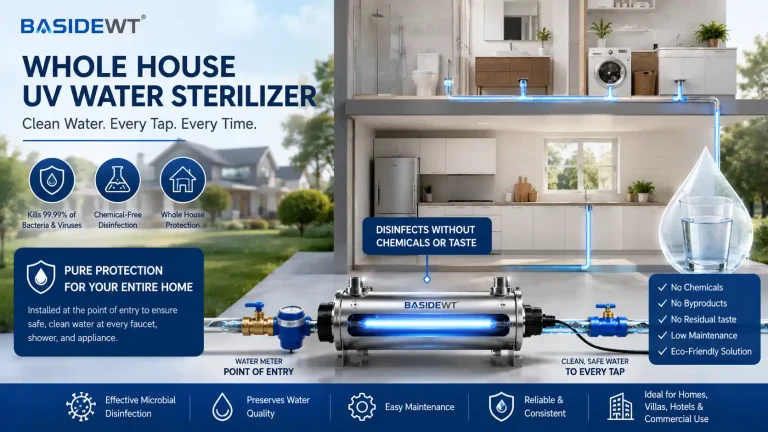
Whole House UV Water Sterilizer: How It Works and When You Need One
DI Water System For Window Cleaning
Reverse Osmosis Membrane | BasideWT