BasideWT- Whole Home Water Filtration System & Replacement


Water Treatment Plant: How It Works, Why It Matters, and What China’s Growth Demands
Water is not optional. Without clean, reliably treated water, industries shut down. In addition, public health deteriorates, and economic growth stalls. Yet, despite its importance, the infrastructure behind clean water — the water treatment plant — remains largely invisible. It only becomes noticeable when something goes wrong.
In China, water treatment has become one of the most strategically critical sectors of the past two decades. Rapid urbanization, industrial expansion, and tightening environmental enforcement have pushed demand for both municipal and industrial water treatment plants to levels few countries have experienced at this speed or scale.
Whether you are an engineer evaluating treatment technologies, a procurement manager sourcing components, an industrial operator managing discharge compliance, or simply someone trying to understand how the process works — this guide gives you a thorough, practical foundation. We cover how water treatment plants function, what makes them effective, where China’s market stands today, and what the next decade of water infrastructure investment looks like.
What Is a Water Treatment Plant?
A water treatment plant is a facility that processes raw water. This water comes from rivers, lakes, groundwater, or industrial discharge. It is then transformed into water meeting a defined quality standard. However, this standard varies depending on intended use. It may include drinking water, industrial process water, agricultural irrigation, or safe environmental discharge.
Two fundamentally different types of facilities fall under this term, and they are sometimes confused:
Drinking Water Treatment Plants
These facilities take raw water from natural sources — rivers, reservoirs, underground aquifers — and treat it to meet potable water standards. The process typically involves coagulation, sedimentation, filtration, and disinfection. Output is water safe for human consumption, delivered through municipal distribution networks.
Wastewater Treatment Plants (WWTPs)
Also called sewage treatment plants or effluent treatment plants, these facilities process water that has already been used — by households, factories, or agricultural operations. The goal is removing contaminants to a level safe for environmental discharge or, increasingly, water reuse. In China, wastewater treatment plants are central to the country’s broader pollution control strategy.
Both types share common process stages. They also use many of the same core technologies. However, the configuration depends on incoming water quality and required output standards.
How Does a Water Treatment Plant Work?
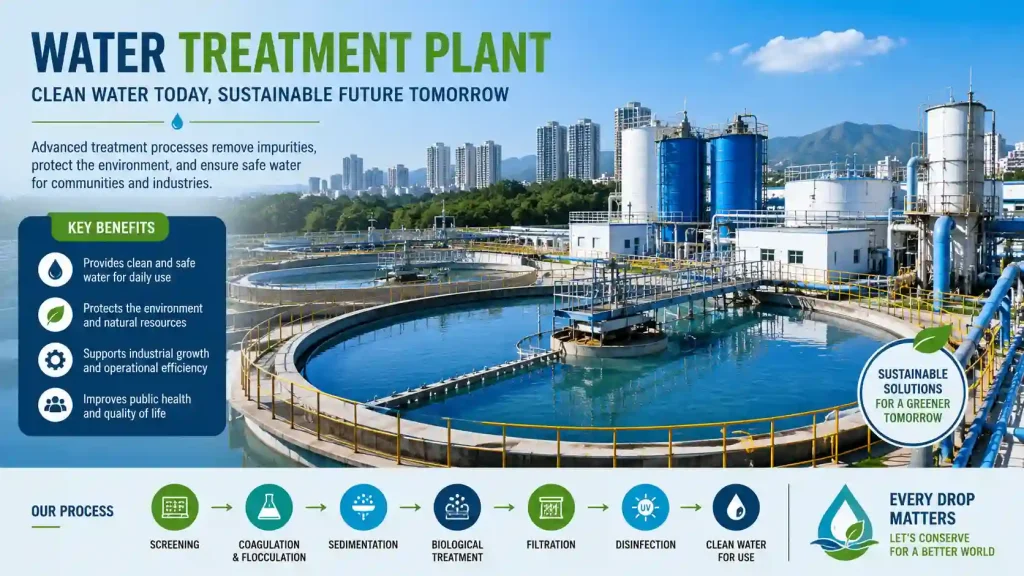
Understanding the treatment process helps in evaluating equipment specifications. It also helps in troubleshooting operational problems. In addition, it supports better procurement decisions. Modern water treatment plants follow a multi-stage approach, each stage targeting a specific category of contaminants.
| Treatment Stage | Process | What It Removes |
| Pre-Treatment | Screening, coagulation, sedimentation | Large debris, suspended solids, turbidity |
| Primary Treatment | Physical settling in clarifiers | Settleable solids, BOD reduction |
| Secondary Treatment | Biological processing (activated sludge, MBR) | Dissolved organics, nitrogen, phosphorus |
| Tertiary Treatment | Filtration, UV, RO membranes | Fine particles, pathogens, dissolved salts |
| Disinfection | Chlorination, UV sterilization, ozonation | Bacteria, viruses, pathogens |
| Sludge Treatment | Thickening, digestion, dewatering | Converts waste solids to manageable biosolids |
Pre-Treatment: The Foundation of Effective Processing
Before advanced treatment can occur, raw water must be prepared. Screens remove large debris. Coagulants and flocculants cause fine suspended particles to clump together, making them heavy enough to settle or be filtered. This stage protects downstream equipment from fouling and reduces the load on more expensive treatment stages — skipping it is one of the most costly mistakes an operator can make.
Biological Treatment: The Core of Wastewater Processing
For wastewater treatment, biological processing is typically the most critical stage. Microorganisms consume dissolved organic matter in the water under controlled conditions. Activated sludge systems, membrane bioreactors (MBR), and moving bed biofilm reactors (MBBR) are common configurations, each with different footprint, efficiency, and maintenance profiles.
China has seen rapid adoption of MBR technology. This is driven by tighter effluent standards. In addition, compact systems are needed in urban areas where land is limited and real estate costs are high.
Advanced Treatment: Membranes, UV, and Beyond
Tertiary treatment addresses what biological processing cannot remove: residual suspended solids, dissolved salts, trace pharmaceuticals, and pathogens. Reverse osmosis membranes, ultrafiltration membranes, activated carbon filters, and UV sterilizers are all used at this stage depending on the application and required output quality.
For industrial applications requiring consistently pure process water, high-performance RO water treatment systems provide reliable removal of dissolved solids, heavy metals, and biological contaminants — often as the final polishing stage before water enters a sensitive production process.
Benefits and Importance of Water Treatment Plants
The value of effective water treatment extends far beyond supplying clean water. The broader benefits touch public health, environmental protection, industrial productivity, and long-term economic stability.
Public Health on a Global Scale
Waterborne diseases — cholera, typhoid, dysentery, hepatitis A — are almost entirely preventable with effective water treatment. According to the World Health Organization’s drinking water quality guidelines, unsafe water, sanitation, and hygiene account for approximately 1.4 million deaths annually worldwide. As a result, water treatment infrastructure becomes one of the highest-return public health investments a society can make. Therefore, this has driven China’s sustained push to extend safe water access to both urban and rural populations.
Environmental Compliance in China
China’s discharge standards have tightened significantly under successive environmental protection laws and Ministry of Ecology and Environment enforcement campaigns. Factories, municipalities, and industrial parks that discharge inadequately treated wastewater face fines, operational shutdowns, and reputational damage. A properly designed and operated water treatment plant is no longer a discretionary investment — it is a compliance requirement with real consequences for non-compliance.
Industrial Process Reliability
Many manufacturing processes require water of a defined quality. Pharmaceutical manufacturing requires ultrapure water with near-zero conductivity. Semiconductor fabrication requires water free of ionic or organic contamination. Boiler systems need softened water to prevent scale buildup and premature equipment failure. Power generation, food processing, textile production, and chemical manufacturing all depend on treatment infrastructure that delivers consistent water quality day after day.
Water Security Through Reuse
In water-stressed regions — which include much of northern and western China — treated wastewater represents a recoverable resource. Advanced treatment to a standard suitable for industrial reuse or agricultural irrigation reduces dependence on groundwater extraction and improves regional water security. China’s national policy increasingly treats water recycling as a core component of sustainable urban planning rather than an optional add-on.
Applications and Industry Use Cases in China
China’s water treatment market is one of the largest and fastest-growing in the world, driven by both the scale of industrial activity and the intensity of regulatory pressure to address historical pollution. Several sectors stand out for the complexity and volume of their treatment requirements.
Municipal Water Treatment
China’s urban population has grown from roughly 36% in 2000 to over 65% today, adding hundreds of millions of city residents requiring reliable drinking water and wastewater services. Major cities have invested heavily in advanced treatment infrastructure. Smaller cities and county-level towns remain areas of significant ongoing investment need, with the gap between urban and rural treatment capacity still a policy priority.
Industrial Wastewater Treatment
China’s manufacturing base generates some of the world’s highest volumes of industrial wastewater. Textile and dyeing operations, electroplating facilities, chemical plants, paper mills, and food processing operations each produce wastewater with distinct contaminant profiles. Meeting China’s Class A discharge standards — among the strictest in the world for certain parameters — requires sophisticated, multi-stage treatment systems rather than basic settling ponds.
Power Generation and Boiler Systems
Thermal power plants, industrial boilers, and cooling tower systems require treated water to prevent scale, corrosion, and biological fouling. Softened and demineralized water systems protect equipment and extend operational life significantly.
Industrial water softening systems designed for high-throughput applications — such as Basidewt’s industrial water softening solutions — are widely used in power generation, chemical processing, and manufacturing facilities across China where scale protection is a continuous operational requirement.
Pharmaceutical and Electronics Manufacturing
China is the world’s largest manufacturer of active pharmaceutical ingredients and a major producer of semiconductors and electronics. Both industries require ultrapure water meeting international pharmacopoeial or SEMI standards. These applications drive demand for multi-stage RO, electrodeionization (EDI), and UV treatment systems that deliver and maintain water purity at the highest levels consistently.
Rural and Remote Water Supply
China’s rural water safety programs have connected hundreds of millions of rural residents to improved water supply over the past two decades. Compact, modular treatment systems — including small-scale RO plants and UV disinfection units — serve communities where centralized infrastructure is not economically or logistically feasible.
Key Components of a Modern Water Treatment Plant
Understanding which equipment does what helps procurement teams, engineers, and operators make better decisions about specification, sourcing, and long-term maintenance planning.
Filtration Systems
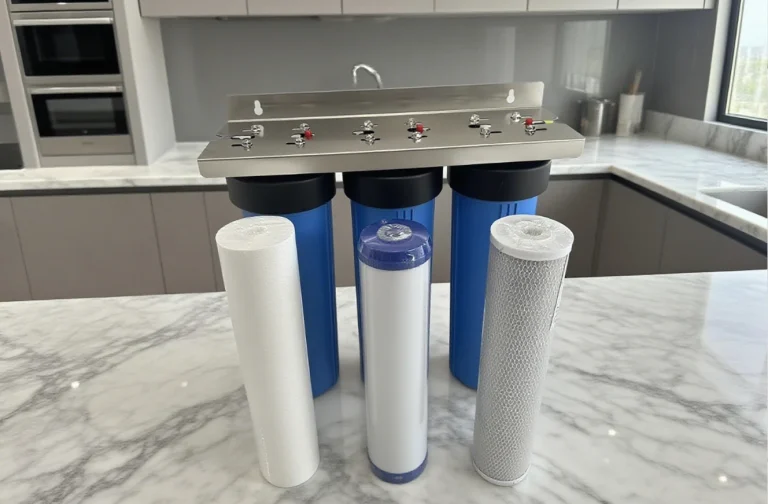
Multi-media filters, sand filters, activated carbon filters, and cartridge filters handle different particle size ranges and contaminant types. Pre-filtration protects downstream membrane systems. Post-filtration polishes water before disinfection or process use.
For industrial pre-treatment and final polishing stages, high-flow cartridge filter housings provide reliable particulate removal across a wide range of flow rates and operating pressures — a critical first barrier in any membrane-based treatment system.
Membrane Systems
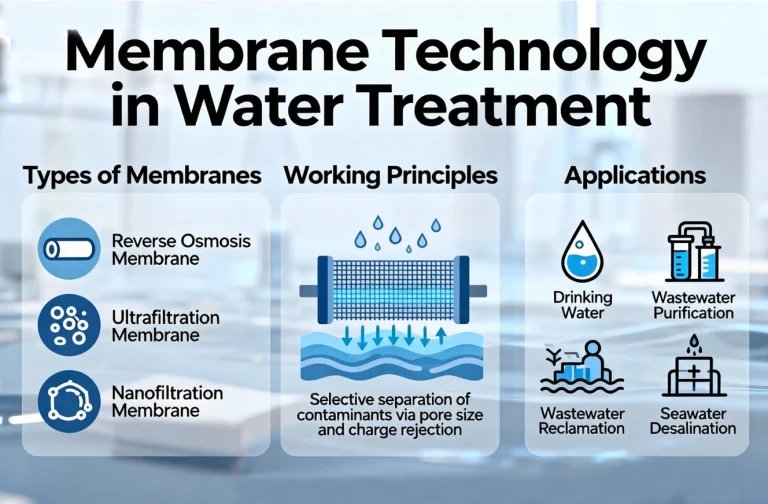
Membranes are at the heart of modern advanced water treatment. Ultrafiltration (UF) membranes remove suspended solids and pathogens. Nanofiltration (NF) targets divalent ions and organic molecules. Reverse osmosis (RO) achieves the highest level of dissolved solids removal, producing water suitable for even the most demanding process applications.
Membrane fouling — the gradual accumulation of contaminants on the membrane surface — is the primary operational challenge and the reason pre-treatment quality directly determines membrane lifespan and replacement cost.
UV Sterilization
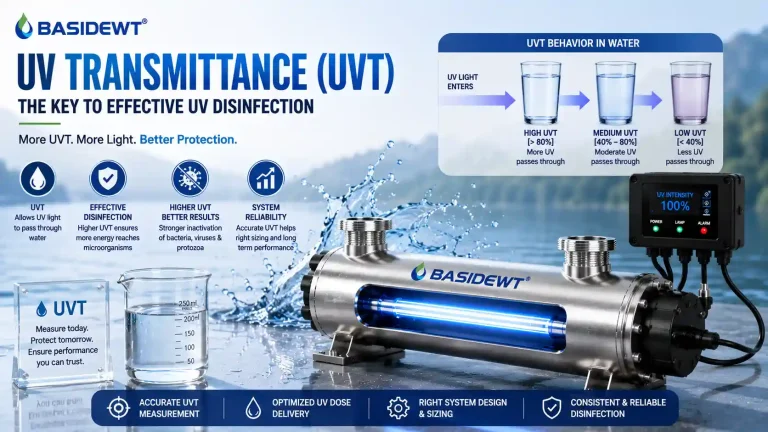
Ultraviolet disinfection is increasingly preferred over chlorination for final disinfection in drinking water and high-purity applications. UV treatment inactivates bacteria, viruses, and protozoa without introducing chemical residuals or creating disinfection byproducts. It is particularly valuable in pharmaceutical water systems, food and beverage processing, and any application where chemical-free treatment is required.
Chemical Dosing Systems
Precise chemical dosing is critical at multiple treatment stages: coagulation, pH adjustment, antiscalant protection for membranes, disinfection, and corrosion inhibition. Dosing systems must be accurate and reliable. Otherwise, inconsistent dosing can cause treatment failures. These problems often become visible only when compliance monitoring detects elevated discharge parameters.
Monitoring and Control
Modern water treatment plants use online monitoring systems that continuously track pH, turbidity, conductivity, dissolved oxygen, chlorine residual, and flow rates. SCADA platforms allow remote monitoring and control. In China, regulatory requirements for real-time monitoring and automatic data reporting to environmental authorities are increasingly standard for facilities above defined discharge thresholds.
Common Challenges in Water Treatment and How to Address Them
Membrane Fouling
Fouling is the most common and operationally expensive problem in membrane-based treatment. Biological fouling, scaling from mineral deposition, and particulate fouling all reduce membrane flux and increase operating pressure over time. The solution lies primarily in pre-treatment quality. Regular cleaning-in-place (CIP) protocols and appropriate antiscalant dosing extend membrane life. Operators who skip pre-treatment maintenance to reduce costs consistently spend far more on premature membrane replacement.
Meeting Tightening Discharge Standards
China’s environmental standards have become progressively stricter, and that trend is expected to continue through the current planning cycle. Facilities designed to meet previous standards may need to add treatment stages or upgrade capacity to meet current requirements. Modular system designs that allow staged capacity additions are increasingly specified for this reason — built-in flexibility to upgrade without full facility replacement.
Energy Consumption
Water treatment — particularly RO membrane systems and biological treatment with aeration — is energy-intensive. High-efficiency pumps, energy recovery devices on RO systems, and smart process control all reduce operating costs. China’s industrial energy efficiency mandates create additional regulatory incentive beyond the direct cost savings.
Private Operator Contracts and Compliance
Many municipalities and industrial parks in China operate water treatment plants under private operator contracts (BOT or TOT models). Under these arrangements, private operators assume responsibility for meeting discharge standards. The International Water Association provides detailed technical guidance and performance benchmarking frameworks that are increasingly referenced in contract design and performance monitoring for privately operated facilities in China’s water sector.
Common Mistakes to Avoid
Undersizing Pre-Treatment
The most common and costly mistake in RO system design is inadequate pre-treatment. Designers who minimize pre-treatment to reduce capital cost typically discover within months that membrane replacement expenses far exceed the initial savings. A silt density index (SDI) of 3 or below entering the RO system is the standard target — achieving this requires proper pre-treatment investment, not shortcuts.
Ignoring Feed Water Variability
Raw water quality changes seasonally, with rainfall events, industrial incidents, and agricultural runoff patterns. A treatment plant designed for average conditions but not for realistic worst-case scenarios will fail during exactly the moments when reliable operation matters most. Robust design accounts for the full range of expected feed water conditions.
Neglecting Operator Training
Water treatment equipment is sophisticated and requires trained operators to run effectively. China’s rapid expansion of treatment capacity has outpaced the supply of experienced operators in many regions. Investing in operator training alongside equipment procurement is essential — the most capable equipment performs poorly without people who understand how to run it.
Decisions Based on Capital Cost Alone
Procurement decisions based primarily on purchase price often result in higher total costs through excessive energy consumption, frequent membrane replacement, and high maintenance requirements. Total cost of ownership over a 10-year operational horizon — including energy, consumables, maintenance, and membrane replacement — is the correct basis for equipment comparison, not just the initial price tag.
Future Trends and Market Outlook in China
China’s water treatment market is projected to continue growing at above-average rates through 2030 and beyond, driven by converging regulatory, technological, and demographic forces.
National Planning: Infrastructure Investment Priorities
China’s five-year planning framework has consistently allocated significant capital to water infrastructure. The 14th Five-Year Plan (2021-2025) targeted major investments in urban wastewater treatment, sludge management, black-odorous water body remediation, and rural water safety. The 15th Five-Year Plan cycle will continue this with emphasis on water recycling, smart water management, and treatment of emerging contaminants including microplastics and pharmaceutical residues.
Smart Water Treatment
Digital transformation is arriving at water treatment plants. AI-driven process optimization, IoT sensor networks for real-time monitoring, predictive maintenance systems, and cloud-based SCADA platforms are deployed in new facilities and retrofitted into existing ones. Smart water management reduces energy consumption, extends equipment life, and improves regulatory compliance through automated data reporting — increasingly required by Chinese environmental authorities.
Decentralized and Modular Systems
Not every water treatment need requires a large centralized facility. Industrial parks, rural communities, and remote facilities increasingly deploy modular, containerized treatment systems that can be installed quickly, scaled incrementally, and operated with minimal staffing. This segment is growing rapidly in China as environmental enforcement extends beyond major urban centers to smaller industrial clusters.
Modular water filtration configurations — from compact commercial RO systems to complete industrial water treatment setups — offer the deployment flexibility that China’s distributed industrial geography increasingly demands.
Zero Liquid Discharge and Water Recycling
Zero liquid discharge (ZLD) — treating wastewater to the point where no liquid effluent is discharged at all — is becoming a regulatory requirement in certain industries operating in China’s most water-stressed regions. The technology combines biological treatment, RO, and thermal evaporation/crystallization. The economics remain challenging. However, regulatory pressure and water scarcity are steadily driving adoption. In addition, this is especially visible in sectors such as textiles, chemicals, and coal-to-chemicals processing.
Conclusion: Water Treatment Is Infrastructure, Not Optional
A water treatment plant is foundational infrastructure — as essential to industrial operation, public health, and environmental compliance as power supply or transportation networks. In China’s context, it is also a strategically critical sector. Therefore, it will continue attracting significant investment and regulatory attention throughout this decade.
The key takeaways from this guide:
- Water treatment plants cover both drinking water and wastewater treatment — related but distinct processes with shared core technologies
- China’s urbanization and industrial growth have created one of the world’s largest and most demanding water treatment markets
- Effective treatment requires a multi-stage approach — no single technology addresses all contaminant categories
- Membrane systems, UV disinfection, and biological treatment are the core technologies of modern advanced treatment
- Most operational failures trace back to inadequate pre-treatment, undertrained operators, and capital-cost-focused procurement decisions
- The future points toward smart systems, modular designs, water recycling, and treatment of emerging contaminants
Whether you are evaluating a new treatment facility, upgrading existing infrastructure, or sourcing components for a specific industrial application, it is important to start correctly. Therefore, getting technology and equipment selection right from the beginning determines operational performance for years to come.
For engineers and procurement professionals sourcing reliable water treatment components — from membranes and filter housings to complete RO systems — Basidewt’s comprehensive water filtration and treatment system range covers standard residential units through industrial-scale configurations, designed to meet the demands of China’s evolving water treatment requirements.