BasideWT- Whole Home Water Filtration System & Replacement


What Size Whole House Water Softener and Filtration System Do I Need for My Home?
Buying a whole house water softener and filtration system feels like it should be simple: pick a grain number, order it, install it, done. But most homeowners who’ve gone through this once will tell you the size is where things actually go wrong. Buy something undersized, and you’ll be refilling salt every week while your dishes still spot. Buy something oversized, and you’ll pay hundreds more for capacity that mostly sits idle — and in some cases, that idle capacity causes its own problems.
The good news is that sizing isn’t a guessing game. It comes down to a handful of measurable factors: how many people live in your home, how hard your water actually is, how many bathrooms you’re supplying at once, and whether you’re on a well or a municipal supply. Once you have those numbers, the right size becomes obvious rather than a coin flip between two options on a shelf.
This guide walks through exactly how professional water treatment dealers size a system, with the real formula, worked examples, and comparison charts you can check your own home against. You’ll also find the parts most sizing guides skip entirely — how iron quietly changes your hardness number, why bigger isn’t automatically better, and how to tell after the fact whether your system was sized correctly in the first place.
Quick Answer: What Size Whole House Water Softener and Filtration System Do You Need?
If you want a fast starting point before running the full calculation: a household of 4 people with water hardness around 10 GPG and 2 bathrooms typically does well with a 40,000–48,000 grain system. Smaller households (1–2 people) with moderate hardness usually need only 24,000–32,000 grains, while larger households (6 or more people) or very hard water (15+ GPG) often require 64,000 grains or more. Well water with noticeable iron content should be sized one tier larger than these baseline numbers. Use the step-by-step formula further down this guide to fine-tune your exact number.
Table of Contents
- Why Sizing Matters More Than Brand or Price
- Grain Capacity and Water Hardness Explained
- Calculating Daily Water Usage by Family Size
- Bathroom Count and Flow Rate: The Overlooked Variable
- Well Water vs. City Water: Different Sizing Rules
- Water Softener vs. Whole House Water Filter: Do You Need Both?
- Step-by-Step Sizing Formula (With a Real Example)
- Water Softener Size Chart
- Common Sizing Mistakes to Avoid
- Installation and Maintenance Guide
- Cost Considerations
- Pros, Cons, and Expert Buying Tips
- Buying Checklist and Final Recommendation
- Frequently Asked Questions
Why Sizing Matters More Than Brand or Price
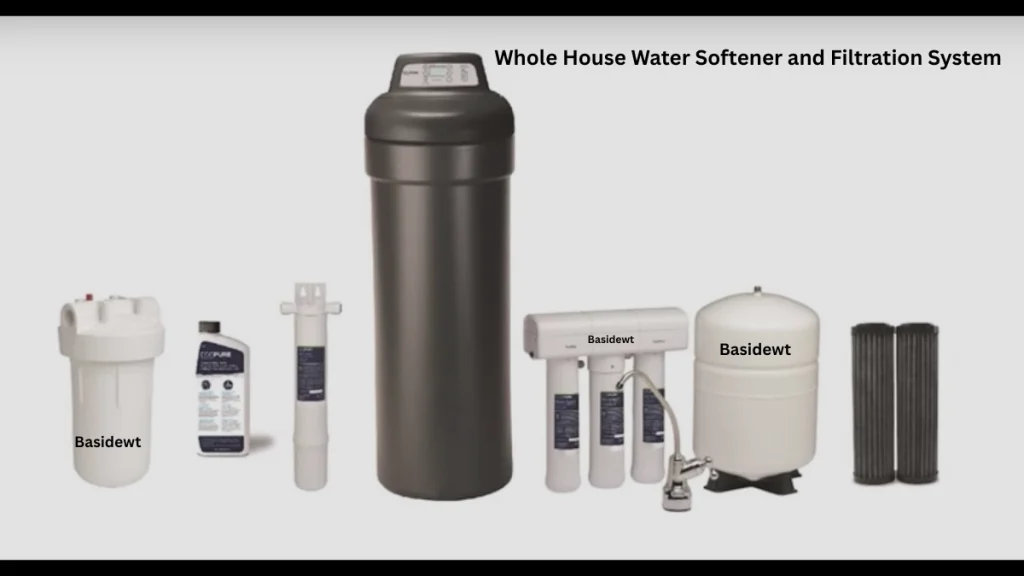
It’s easy to shop for a water softener the way you’d shop for most appliances — compare a few brands, read some reviews, pick something in your price range. But a softener isn’t sitting in a corner doing its own thing. It’s plumbed directly into your home’s main water line, and everything about its performance depends on whether its capacity actually matches what your household demands day to day.
An undersized system regenerates constantly. That means more salt, faster resin wear, and stretches where hard water sneaks through right before the next cycle. An oversized system has the opposite problem: it sits mostly idle, and stagnant water in an underused resin tank can lead to channeling, where water finds an easy path through the resin bed instead of contacting it evenly. Neither mistake announces itself on day one — both show up gradually, in your salt bill and in performance that never quite matches what you expected.
Grain Capacity and Water Hardness Explained
What Grain Capacity Actually Means
Grain capacity is the total amount of hardness a softener’s resin bed can remove before it’s exhausted and needs to regenerate. Residential units are sold in standard sizes — typically 24,000, 32,000, 40,000, 48,000, 64,000, and 96,000 grains.
A simple way to picture it: grain capacity works like a phone battery. A bigger battery lasts longer between charges, and a bigger resin bed lasts longer between regenerations. But an oversized battery you never fully drain isn’t gaining you much either — it’s just capacity sitting unused. The same logic applies here.
Water Hardness Levels and Why They Drive Everything
Water hardness measures dissolved calcium and magnesium, expressed in grains per gallon (GPG) or parts per million (ppm). To convert ppm to GPG, divide by 17.1.
| Hardness Level | GPG | PPM |
|---|---|---|
| Soft | 0–1 | 0–17 |
| Slightly hard | 1–3.5 | 17–60 |
| Moderately hard | 3.5–7 | 60–120 |
| Hard | 7–10.5 | 120–180 |
| Very hard | Over 10.5 | Over 180 |
Hardness is the single biggest lever in the entire sizing formula. Two households with identical family sizes can need completely different softener sizes simply because one sits on 5 GPG city water and the other on 18 GPG well water. Guessing at this number, rather than testing it, is the most common reason a sizing recommendation ends up wrong.
Iron Compensation: The Variable Most Guides Skip
If your water — especially well water — carries dissolved iron, your resin bed spends capacity removing that iron too, even though iron isn’t technically classified as hardness. The standard industry adjustment is to add 5 GPG of effective hardness for every 1 ppm of iron present. Skip this step, and an otherwise correctly sized softener will regenerate more often than expected and underperform relative to its rated capacity.
Calculating Daily Water Usage by Family Size
Family size is usually the first number people reach for, and it’s the right place to start, since it directly drives total daily water usage.
| Household Size | Estimated Daily Water Usage |
|---|---|
| 1–2 people | 150–180 gallons |
| 3–4 people | 225–320 gallons |
| 5–6 people | 375–480 gallons |
| 7+ people | 525+ gallons |
These figures assume roughly 75–90 gallons per person per day, which is the range most water treatment professionals use as a starting baseline. For a more precise number, pull a recent water bill and divide total gallons by the number of days in the billing period. Actual usage — especially with heavy laundry, long showers, or a home office running the dishwasher midday — often runs higher than a national average would suggest.
Bathroom Count and Flow Rate: The Overlooked Variable
Family size tells you your total daily grain requirement. Bathroom count tells you something different, but equally important: how much flow rate — measured in gallons per minute, or GPM — your softener needs to sustain without a pressure drop.
Picture a typical busy morning: two showers running, the dishwasher cycling, and a load of laundry filling at the same time. That’s peak demand, and homes with more bathrooms hit higher peak demand more often, regardless of how many people actually live there.
| Bathrooms | Recommended Minimum Flow Rate | Typical Grain Capacity Range |
|---|---|---|
| 1 | 7 GPM | 24,000–32,000 |
| 2 | 8–9 GPM | 32,000–40,000 |
| 3 | 9–12 GPM | 40,000–48,000 |
| 4+ | 12–15+ GPM | 48,000–64,000+ |
A common oversight: a small household in a larger home with three or four bathrooms often needs more flow capacity than family size alone would suggest. If you’re pairing the softener with a whole house water filtration system, check the combined flow rate of both units together rather than each in isolation — filtration media adds its own resistance, and the weaker-rated component sets your real-world water pressure.
Well Water vs. City Water: Different Sizing Rules
This is one of the most overlooked parts of sizing, and it can shift your final recommendation more than almost any other factor.
City (municipal) water usually comes with a published hardness number in your utility’s annual water quality report, giving you a reliable number without testing yourself. Pressure also tends to be steady, which simplifies flow rate planning.
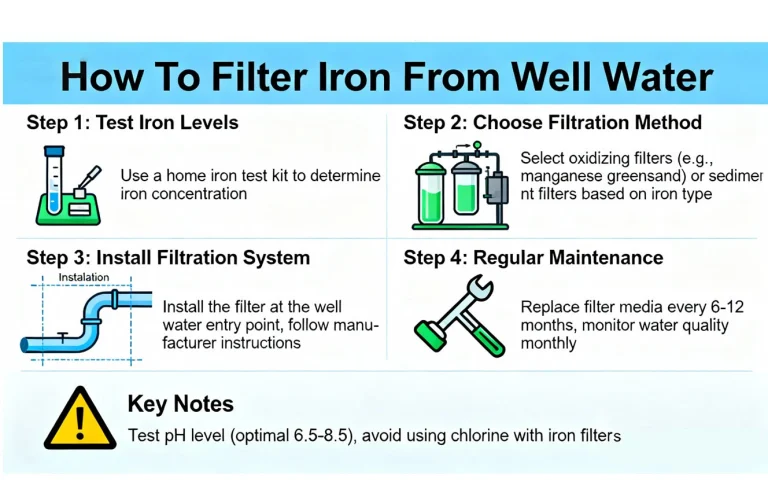
Well water requires direct testing, since there’s no utility report to check. Iron, manganese, tannins, and sediment are common in well water, and while they aren’t the same thing as hardness, they consume resin capacity just the same. Well pressure tanks can also create pressure swings, so it’s worth sizing flow rate toward the higher end of your household’s recommended range. If your test results show iron above roughly 1–2 ppm, it’s worth reading our detailed guide on how to filter iron from well water before finalizing your softener size, since iron removal often changes the equipment configuration, not just the grain capacity.
Guessing at hardness is the single most common reason a sizing calculation goes wrong, so before you run any formula, get a real number:
- Check your city’s water quality report if you’re on municipal water — hardness is usually listed there in ppm or mg/L.
- Use a home test kit for a quick reading, particularly important for well water.
- Send a sample to a certified lab for the most precise numbers, including iron and manganese content.
- Ask for a professional in-home water test, which many dealers offer as part of a proper consultation.
Water Softener vs. Whole House Water Filter: Do You Need Both?
This question comes up constantly, and it’s worth answering clearly before you buy anything: a water softener and a whole house water filter solve different problems, and in most homes, they work best together rather than as substitutes for each other.
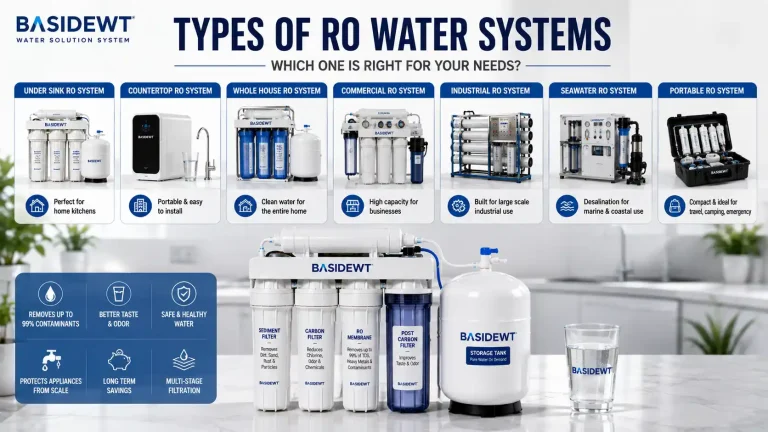
A softener uses ion exchange to remove calcium and magnesium — the minerals responsible for hardness, scale buildup, and the soap-resistant film on skin and fixtures. It isn’t designed to remove chlorine, sediment, bacteria, or dissolved organics. That’s a filtration system’s job, and depending on the media used, it targets a different set of concerns: sediment filters remove sand and rust particles common in well water, carbon filters reduce chlorine taste and odor common in municipal water, and reverse osmosis systems remove finer dissolved contaminants, typically at a single point of use like the kitchen tap.
If your only concern is hardness — scale on fixtures, dry skin, spotty dishes — a softener alone may be enough. But if your water also has chlorine taste, sediment, or well-water contaminants, pairing the two gives noticeably better results than either running alone. This is exactly why many households choose a combined configuration from the start. If that sounds like your situation, a water softener and reverse osmosis system handles both jobs from a single install, rather than requiring a second retrofit later.
One practical note worth remembering: when you combine a softener with a filtration system, don’t simply add their individual flow rate ratings together. Water passes through both in sequence, so the lower-rated component sets the ceiling for your whole house’s peak flow — size to the combined configuration’s actual rated output, not each part in isolation.
Step-by-Step Sizing Formula (With a Real Example)
Here’s the exact calculation professional dealers use, worked through with real numbers.
Step 1 — Daily water usage: Number of people × 80 gallons/day. Example: 4 people × 80 gallons = 320 gallons/day.
Step 2 — Confirm hardness in GPG. Example: 175 ppm ÷ 17.1 ≈ 10.2 GPG.
Step 3 — Add iron compensation if applicable. Example: 1.5 ppm iron × 5 = 7.5 GPG added → adjusted hardness ≈ 17.7 GPG.
Step 4 — Daily grain requirement: Daily gallons × adjusted GPG. Example: 320 × 17.7 ≈ 5,664 grains/day.
Step 5 — Weekly grain requirement: Daily grains × 7. Example: 5,664 × 7 ≈ 39,648 grains/week.
Step 6 — Add a 20–25% buffer for guests, seasonal spikes, and heavy-use days. Example: 39,648 × 1.25 ≈ 49,560 grains.
Step 7 — Round up to the nearest standard size. In this example, a 64,000-grain system is the right call, since the 48,000-grain unit falls just short of the buffered target.
For a more typical household — say, 4 people, 10 GPG hardness, no significant iron, and 2 bathrooms — the same math generally lands between 32,000 and 40,000 grains before the buffer, which rounds up cleanly to a 40,000–48,000 grain system. That’s the range most families of four with moderately hard water should be shopping in.
Water Softener Size Chart
Once you know your household size and hardness level, use this chart to cross-check your target grain capacity.
| Hardness (GPG) | 1–2 People | 3–4 People | 5–6 People | 7+ People |
|---|---|---|---|---|
| 3–7 (moderate) | 24,000 | 32,000 | 40,000–48,000 | 48,000–64,000 |
| 7–10.5 (hard) | 24,000–32,000 | 40,000 | 48,000–64,000 | 64,000 |
| 10.5+ (very hard) | 32,000–40,000 | 48,000 | 64,000 | 64,000–96,000 |
If your household lands between two rows or columns, size up rather than down. The price difference between adjacent standard sizes is usually smaller than the cost of premature resin wear from an undersized unit.
Common Sizing Mistakes to Avoid
- Sizing off family size alone, without factoring in hardness, iron, or flow rate.
- Using a national water-usage average instead of checking an actual water bill.
- Guessing at hardness rather than testing it directly — especially costly on well water.
- Ignoring iron content, which quietly increases the effective hardness a softener has to handle.
- Buying the largest available unit “just to be safe,” which increases upfront cost and can lead to channeling in an underused resin bed.
- Overlooking flow rate, resulting in weak water pressure during busy periods even with correctly sized grain capacity.
- Skipping pre-filtration on well water, which shortens resin life regardless of how well the softener itself is sized.
A quick way to check whether your existing system was sized correctly: track how often it regenerates. Cycles every 2–4 days usually mean it’s undersized; cycles beyond 12–14 days usually mean it’s oversized. Seven to ten days between regenerations is the target range for a correctly matched system.
Installation and Maintenance Guide
Installation Steps and Considerations
A whole house water softener and filtration system installs at the point where your main water line enters the home, ahead of the water heater, so both hot and cold lines throughout the house receive treated water.
Installation typically involves shutting off the main supply, installing a bypass valve so the unit can be serviced without cutting water to the entire house, connecting the resin tank, brine tank, and control valve, and running a drain line for backwash and regeneration discharge. Most straightforward installations take two to four hours; well-water setups with added pre-filtration, or older homes needing plumbing modifications, can take longer. If you’re installing new, a properly rated water softener control valve is worth specifying up front, since it governs regeneration frequency and salt efficiency for the life of the system.
The most common installation mistakes are avoidable with some planning: skipping the bypass valve (which then requires a full house shutoff for any future service), placing the unit too far from a suitable drain, skipping sediment pre-filtration on well water, and programming the control valve with estimated rather than tested hardness numbers. Confirm each of these with your installer before the appointment, not during it.
Maintenance Schedule
Even a correctly sized system needs consistent upkeep to perform at its rated capacity for its full expected lifespan.
Monthly: Check the brine tank’s salt level and refill when it’s about a third full; check for salt bridging, a hardened crust that stops salt from dissolving properly.
Every 3–6 months: Clean the brine tank if sediment builds up; check the venturi/injector for clogs, particularly important on well water.
Annually: Test water hardness at the tap to confirm the system is still softening effectively; have a professional review the control valve’s programming, especially after any change in household size.
Every 10–15 years: Plan for resin bed replacement, since capacity naturally declines with age even with good maintenance.
Cost Considerations
| Cost Item | Typical Range |
|---|---|
| Softener unit (equipment only) | $700–$3,500 |
| Professional installation | $500–$1,700 |
| Total installed cost | $1,200–$3,800 |
| Salt (40 lb bag) | $5–$10 |
| Annual maintenance | $150–$900 |
| Resin bed replacement (10–15 years) | $150–$500 |
| Well-water iron pre-filter add-on | $200–$500 |
Larger, correctly sized systems often cost more upfront but tend to be more salt-efficient over time, since they regenerate less frequently than an undersized unit forced to work overtime. In practice, the cheapest system to own over ten years is usually the correctly sized one — not the smallest or the largest available option. For a fuller regional cost breakdown, including how installation complexity affects pricing, see our detailed whole house water softener cost guide.
Pros, Cons, and Expert Buying Tips
Pros of a Correctly Sized Whole House Water Softener
- Reduces scale buildup in pipes, water heaters, and appliances, extending their working life.
- Improves soap and detergent efficiency, often reducing how much product you use.
- Reduces spotting on dishes and glassware, with a softer feel to skin and hair for many users.
Cons to Weigh Before Buying
- Adds a small amount of sodium (or requires potassium chloride) to treated water — a consideration for sodium-restricted diets.
- Requires ongoing salt refills and periodic maintenance.
- Regeneration cycles use some water and discharge brine, worth considering for septic systems or drought-restricted areas.
Expert Buying Tips
- Size to your actual water bill, not a national average — real usage can run 20–30% higher or lower depending on household habits.
- Always test for iron before finalizing hardness-based sizing on well water; it’s the most commonly missed variable in DIY calculations.
- Favor metered (demand-initiated) valves over timer-based ones for better salt efficiency and automatic adjustment to changing usage.
- When your numbers fall between two standard sizes, round up rather than down.
- Re-check your sizing whenever your household changes meaningfully — a new baby, an added bathroom, or a switch from city to well water all shift the calculation enough to matter.
- Build in modest headroom for future growth, but avoid dramatically oversizing for a hypothetical future household; an oversized system regenerating infrequently isn’t automatically the safer choice.
Buying Checklist and Final Recommendation
- Test your water hardness directly rather than estimating it.
- Test for iron if you’re on well water.
- Calculate daily usage from an actual water bill where possible.
- Match flow rate to your bathroom count and typical simultaneous fixture use.
- Calculate grain capacity with a 20–25% buffer, then round up to the nearest standard size.
- Confirm the system includes a bypass valve and accessible drain connection.
- Add pre-filtration if you’re on well water or have high sediment.
- Compare warranty terms for the resin, control valve, and tank separately.
- Get an itemized installation quote covering labor, materials, and any plumbing changes.
If you’ve worked through the formula and you’re still unsure which configuration fits your test results, our home water softener systems page breaks down current sizing options so you can match your numbers to a specific model rather than shopping by grain capacity alone. For background on how softening actually works before you compare models, our explainer on what a water softener is and how it works is a useful next read.
Conclusion
Choosing the right whole house water softener and filtration system is about more than just buying the biggest unit available. The best system is the one that matches your home’s water hardness, daily water usage, bathroom count, and water source. A properly sized system delivers better water quality, protects plumbing and appliances from scale buildup, reduces maintenance costs, and provides reliable performance for many years. Before making your final decision, always test your water, calculate the correct grain capacity, and compare systems based on performance rather than price alone. Investing in the right solution today will save money, improve water quality, and give your household cleaner, softer water for the long term.
If you’ve tested your water and worked through the numbers above and still aren’t sure which model fits, it’s worth a quick look at BasideWT’s current lineup of whole house softener and filtration configurations — matching a tested hardness and household number to a specific model is usually a five-minute conversation once you have the data in hand.
General water hardness classifications referenced in this guide align with standards published by the U.S. EPA’s WaterSense program and the Water Quality Association.
Frequently Asked Questions
Can a whole house water softener increase my home’s value?
A quality system can make a home more attractive to buyers, especially in areas with hard water.
How long does it take to install a whole house water softener and filtration system?
Most professional installations are completed within 2 to 6 hours, depending on the plumbing setup.
Is softened water safe for everyday household use?
Yes, softened water is safe for normal household use, including cleaning, bathing, and laundry.
How often should I replace the filters in a whole house system?
Most sediment and carbon filters should be replaced every 3 to 12 months, depending on water quality.
Can one system supply water to a large multi-bathroom home?
Yes, as long as the system is properly sized for your household’s flow rate and daily water demand.
Will a whole house system improve water pressure?
It won’t increase pressure, but it can help maintain consistent flow by reducing scale buildup inside plumbing.
What should I check before buying a whole house water softener?
Test your water hardness, check daily water usage, compare flow rates, and choose the correct grain capacity for your home.
RELATED POSTS
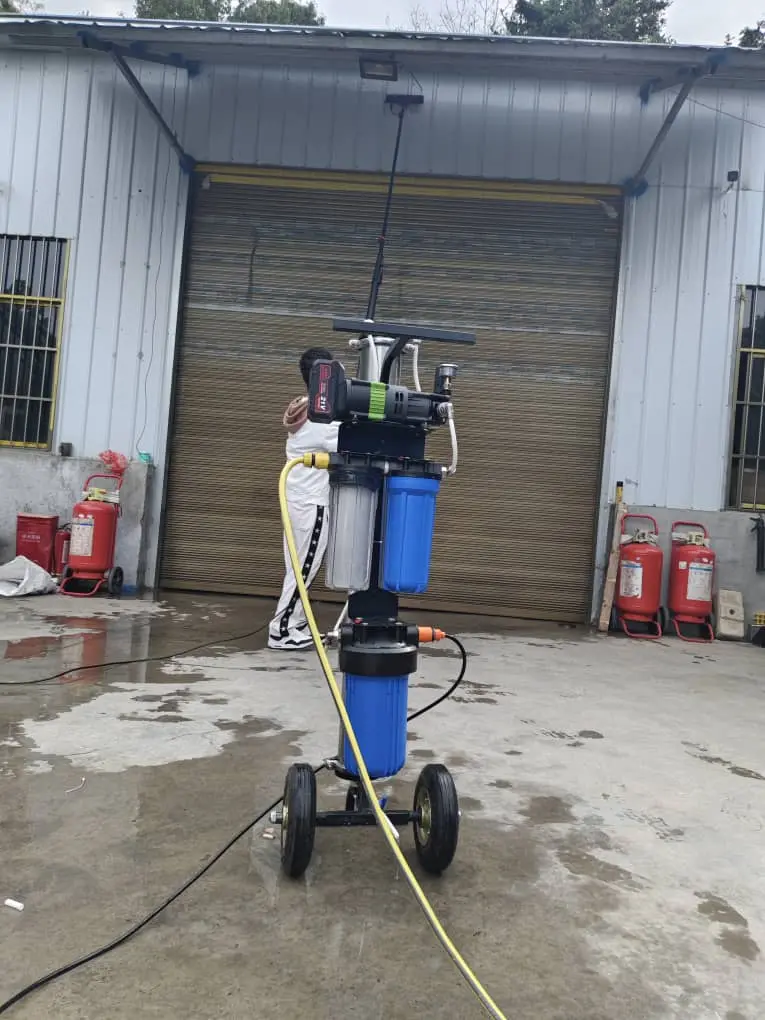
Water Fed Pole System: Complete Guide to Pure Water Window Cleaning
How To Filter Iron From Well Water
Types of RO Water Systems: Which One Is Right for Your Needs?
RO vs DI Water for Car Wash: Which System is Better?
Water Filter Housing Port Size Guide: NPT, BSP & Connection Sizes Explained