BasideWT- Whole Home Water Filtration System & Replacement


Spot Free Rinse vs Hand Drying: Which One Actually Protects Your Finish?
Every car wash owner, detailer, and fleet manager eventually asks the same question: spot free rinse vs hand drying — which one actually delivers a better result? The honest answer depends on your water source, your labor costs, and how much you value your paint finish. This guide breaks down exactly how each method works, where each one fails, and how to choose the right approach for a detailing shop, a commercial car wash, a fleet operation, or a window cleaning business in China. By the end, you’ll know precisely which drying method fits your situation — and why.
What Is Spot Free Rinse?
Spot free rinse is a final-stage rinse that uses water with almost zero dissolved minerals. Instead of tap water, the vehicle (or window, or panel) is rinsed with treated water that has had calcium, magnesium, silica, and other minerals stripped out. Because there’s nothing left to crystallize as the water evaporates, the surface air-dries without leaving behind the white, cloudy residue known as a water spot.
This isn’t a chemical trick. It’s a physical fact about how water spots form. Tap water always contains dissolved solids, measured in parts per million (ppm) of total dissolved solids, or TDS. When that water evaporates, the minerals stay behind on the surface. Spot free rinse water typically measures under 10 ppm TDS, sometimes closer to 0 ppm, so there’s essentially nothing to leave behind.
What Is Hand Drying?
Hand drying is the traditional method: after rinsing with regular tap water, a worker uses a microfiber towel, chamois, or air blower to manually remove water droplets before they evaporate and leave mineral deposits. It’s the method almost every wash used before spot free rinse technology became affordable for small and mid-sized operations.
Hand drying doesn’t remove minerals from the water — it removes the water itself before evaporation can happen. That distinction matters, because it means hand drying is only as effective as the person doing it. Miss a panel, a mirror edge, or a wheel well, and a spot will still form.
How Spot Free Rinse Actually Works
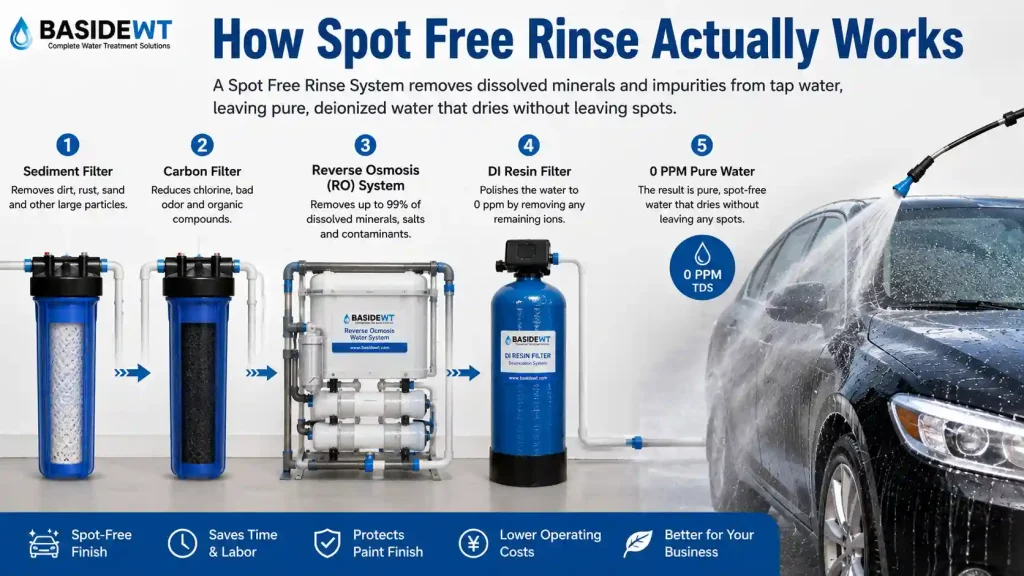
To understand why spot free rinse consistently outperforms towel drying on finish quality, it helps to know what’s happening inside the equipment.
Reverse osmosis (RO). Incoming water is pushed through a semi-permeable membrane under pressure. The membrane blocks dissolved salts, minerals, and most contaminants, letting only purified water pass through. RO alone typically brings tap water down from a regional average of 150–400 ppm TDS to somewhere between 5–15 ppm.
DI resin polishing. For a true 0 ppm finish, RO output passes through deionization (DI) resin beads. These beads exchange any remaining charged mineral ions for hydrogen and hydroxide ions, which simply recombine into more water. This step is what pushes TDS from single digits down to effectively zero. A properly sized RO/DI resin system is what separates a genuinely spot-free finish from a “mostly spot-free” one.
0 ppm TDS and mineral removal. At or near 0 ppm, there is nothing left in the water to precipitate out as it dries. This is the entire mechanism behind spot free rinse — not a coating, not a chemical additive, just the physical absence of dissolved solids.
Air drying. Once mineral-free water sheets off a surface, gravity and airflow finish the job. No manual wiping is needed because there’s nothing left to wipe away except plain water, which evaporates cleanly.
Spot Free Rinse vs Hand Drying: Complete Comparison
Spot Free Rinse vs Hand Drying in Numbers
| Factor | Spot Free Rinse | Hand Drying |
|---|---|---|
| Finish quality | Consistent, spot-free on every vehicle | Depends on worker skill and speed |
| Labor per vehicle | Near zero | 3–8 minutes per vehicle |
| Time per vehicle | 30–90 seconds | 5–10 minutes |
| Cost over time | Higher upfront, lower ongoing labor cost | Low upfront, high ongoing labor cost |
| Paint protection | No abrasive contact | Risk of swirl marks from grit trapped in towels |
| Water spots | Eliminated at the source | Possible if any area is missed |
| Swirl marks | None from the drying step itself | Common cause, especially with reused towels |
| Best for commercial use | High-volume car washes, detailing chains | Low-volume, boutique detailing |
| Best for home use | Optional, but increasingly common | Traditional default |
| Maintenance | Filters and resin need periodic service | Towel laundering, no equipment upkeep |
| Long-term value | Strong ROI at scale | Better for very low volume only |
The comparison isn’t close on finish consistency. A spot free rinse system treats every panel identically, every time. A worker drying a car by hand is racing against evaporation speed, especially in hot or dry climates common across much of China, where water can start spotting within minutes.
Where hand drying still competes is flexibility. A towel can dry a single vehicle perfectly with zero equipment investment. That’s why the honest comparison isn’t “which method is universally better,” it’s “which method fits your volume and your labor cost structure.”
Advantages of Spot Free Rinse
- Zero risk of induced scratches. Because nothing touches the paint during drying, there’s no chance of trapped grit causing swirl marks — a common complaint with reused microfiber towels.
- Scales without adding labor. A single spot free car wash system can process dozens of vehicles per hour without adding staff.
- Consistent results regardless of weather. Humidity, heat, and wind all affect how fast a worker can hand-dry a car before spots form. Mineral-free water doesn’t care about the weather.
- Lower long-term cost per vehicle. Once installed, the ongoing cost is filter replacement and resin regeneration — far cheaper than paying labor for every single wash.
- Works beyond cars. The same principle applies to window cleaning, solar panel maintenance, and equipment rinse-downs in manufacturing.
Advantages of Hand Drying
Hand drying still has a place, and a genuinely useful guide should say so.
- No equipment investment. For a mobile detailer washing two or three cars a day, buying an RO/DI system may not be cost-justified yet.
- Detail-level control. A skilled detailer can catch water trapped in emblem gaps, mirror housings, and trim seams that a rinse alone might not fully clear.
- Useful as a finishing step. Even shops running a full spot free rinse setup often keep a microfiber towel on hand for door jambs, fuel caps, and other low-exposure areas the rinse doesn’t reach directly.
- Works when water access is limited. In mobile or rural operations without a stable water source for an RO/DI unit, hand drying remains the practical choice.
For very low-volume operations, or as a supplementary step, towels still make sense. For anyone washing more than a handful of vehicles a day, the labor math shifts quickly in favor of spot free rinse.
Common Mistakes That Cause Water Spots
Most articles on this topic only mention “hard water causes spots” and stop there. The real causes are more specific, and most competing guides miss these:
- Running RO membranes past their service life. A worn membrane lets more TDS through, quietly degrading your “spot free” result until spots start reappearing.
- Ignoring resin exhaustion. DI resin has a finite capacity. Once it’s saturated, TDS readings creep back up even though the system still looks like it’s running normally. Regular TDS meter checks catch this before customers do.
- Mixing hose water into the final rinse. A single ordinary hose used for a “quick top-up” rinse reintroduces minerals and defeats the entire purpose of the system.
- Drying in direct sun with regular water. Fast evaporation under sunlight concentrates minerals faster, making spots worse, not better — a mistake many detailers make without realizing why.
- Reusing dirty towels. Grit trapped in towel fibers is one of the leading causes of fine swirl marks on dark-colored paint, often mistaken for “natural wear.”
- Underestimating regional water hardness. Groundwater in parts of northern China, including Shandong and Hebei, runs significantly harder than coastal supplies, meaning a system sized for one region may underperform in another.
When Should You Choose Spot Free Rinse?
- Car washes. High vehicle throughput makes manual drying labor cost prohibitive at scale.
- Detailing shops. Especially those working on luxury vehicles, where swirl marks on premium paint are a direct threat to repeat business.
- Fleet washing operations. Logistics and delivery fleets need fast turnaround with a consistent finish across dozens or hundreds of vehicles.
- Window cleaning companies. Streak-free glass on high-rise buildings depends entirely on mineral-free rinse water; towel drying tall glass facades isn’t practical.
- Solar panel cleaning. Mineral deposits on panels reduce light transmission and energy output, so a spot-free rinse directly protects performance, not just appearance.
- Manufacturing and commercial cleaning. Facilities that rinse components, tools, or surfaces before finishing or packaging benefit from a system built for consistent, spot-free results at volume — see this cleaning system overview for how this applies beyond vehicles.
If your operation touches more than a handful of surfaces a day, the case for spot free rinse strengthens quickly.
How BASIDEWT Spotless Water Systems Help
Choosing between spot free rinse and hand drying eventually comes down to equipment reliability. A system that under-delivers on TDS reduction will still leave spots, no matter how the marketing describes it.
BASIDEWT builds Spotless Water Systems designed around the realities of Chinese water conditions — from coastal municipal supplies to harder groundwater inland. The core setup combines RO pre-treatment with DI resin polishing to consistently reach near-0 ppm output, which is the actual technical requirement for a genuinely spot-free finish, not just a marketing claim.
For businesses scaling up from manual drying, a car wash system sized to daily vehicle volume removes the labor bottleneck entirely. For facilities that need mineral-free water across multiple applications — vehicle rinsing, glass cleaning, component washing — a broader deionized water cleaning setup covers those needs from a single source. Sizing correctly for your water hardness and daily volume is the difference between a system that pays for itself in months and one that underperforms from day one.
Conclusion
In the spot free rinse vs hand drying comparison, there’s no single universal winner — but for any operation washing more than a few vehicles a day, spot free rinse wins on consistency, labor cost, and paint safety. Hand drying still earns its place for low-volume work, detail finishing, and situations where equipment investment isn’t yet justified. The right move is matching the method to your actual volume and water conditions, not defaulting to tradition. For a deeper technical breakdown, our complete spot free rinse guide and our explainer on the working principle behind spotless water systems are good next reads if you’re evaluating equipment for your business.
FAQs
Does spot free rinse completely replace towel drying?
For most panels, yes. But detailers often keep a towel for tight spots like emblem gaps, mirror housings, and door jambs where full rinse coverage is harder to guarantee. Think of it as replacing 95% of hand drying, not all of it.
Which method do professional detailers actually recommend?
Most professional detailers recommend spot free rinse for the wash-and-rinse stage, reserving hand drying or microfiber buffing for the final polish step on high-end vehicles. The combination gives both speed and finish precision.
Can spot free rinse damage paint over time?
No. Because there’s no physical contact during drying, spot free rinse carries no abrasion risk. The only equipment-related risk is running the system past its filter or resin service life, which lets minerals back into the rinse.
How much does a spot free rinse system cost to run daily?
Ongoing costs come from membrane and resin replacement, which scale with water hardness and daily volume. Harder source water shortens component life, so operations in mineral-heavy regions should budget for more frequent servicing.
Is spot free rinse worth it for a small mobile detailing business?
It depends on volume and water access. A mobile detailer doing two or three cars daily may not recoup the equipment cost quickly, while a shop doing 15+ vehicles a day typically sees fast payback through labor savings.
Why do some spot free systems still leave occasional spots?
This usually points to resin exhaustion, a worn RO membrane, or contamination from mixing in untreated hose water. Regular TDS meter checks catch declining performance before it becomes visible on the vehicle.
Does hard water in China make spot free rinse more necessary?
Yes, particularly inland. Groundwater in parts of northern China carries higher mineral content than coastal municipal supplies, which means spots form faster and more visibly with tap water alone.
Is spot free rinse suitable for window and glass cleaning?
Very well suited. Streak-free glass depends on mineral-free rinse water, especially for high-rise window cleaning where manual squeegee work on every pane isn’t practical at scale.
Do touchless drying methods use the same principle as spot free rinse?
Touchless drying, typically airflow-based, relies on the same mineral-free water principle. Without dissolved solids in the rinse water, air alone can finish the drying process without leaving spots.
How do I know if my current rinse water is truly spot free?
A TDS meter is the only reliable test. Readings under 10 ppm generally produce spot-free results; readings climbing above that indicate it’s time to service the RO membrane or DI resin.
RELATED POSTS
How Often Should You Change Your Water Filter
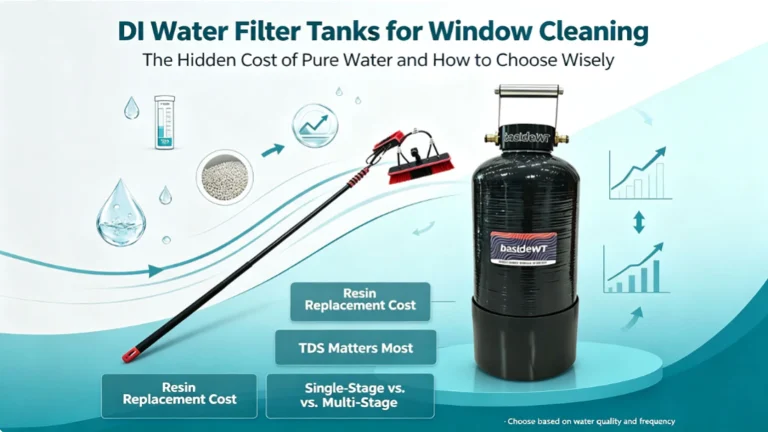
DI Water Filter Tanks for Window Cleaning: The Hidden Cost of Pure Water and How to Choose Wisely
Water Purifier Quick Connector RO Purifier System Water Filter Joint Accessory
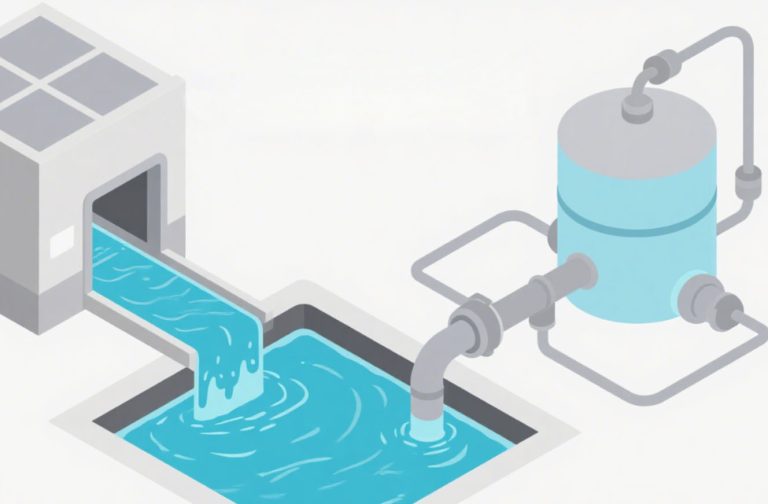
How Do Water Treatment Systems Work?
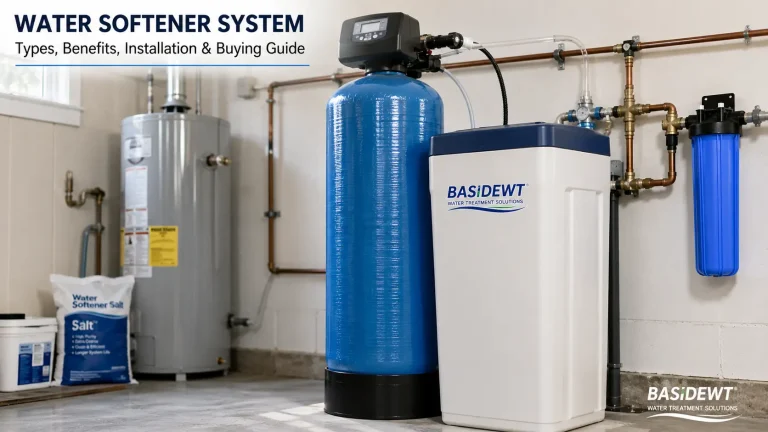
Water Softener System: Types, Benefits, Installation & Buying Guide