BasideWT- Whole Home Water Filtration System & Replacement

How to Choose the Best Water Fed Pole System for Your Cleaning Business
Choosing the best water fed pole system is not about picking the most expensive option or the one with the longest pole. It is about matching equipment to the work you actually do. A window cleaner who services three-story homes has very different needs than a contractor who cleans commercial buildings or solar farms every day.
This guide walks through the factors that actually determine whether a water fed pole system will perform well for your business. Instead of naming one universal winner, it gives you a practical framework so you can compare systems and pick the one that fits your workload, your water source, and your budget.
Start With Your Actual Cleaning Requirements
Before comparing specifications, define the job. The best water fed pole system for a residential cleaner working single-story homes looks nothing like the setup a commercial crew needs for high-rise glass. Ask yourself:
- How many jobs do you run per week, and how long does each one take?
- What is the average building height you clean?
- Do you work mostly in one location, or do you travel between sites?
- Is your local water supply low in dissolved solids, or does it need heavy purification?
These answers narrow the field quickly. A system built for occasional home use will wear out fast under daily commercial workloads, while an oversized commercial rig can be overkill and harder to manage for light, occasional jobs. If you want a broader refresher on how the whole process fits together, our water fed pole system guide covers the fundamentals before you get into buying decisions.
Cleaning Frequency and Workload
Frequency of use is one of the most overlooked buying factors. A system used a few hours a week can tolerate lighter components. A system used all day, five or six days a week, needs sturdier hoses, more durable pole sections, and a pump that can handle continuous operation without overheating.
If you run a cleaning business rather than doing occasional maintenance, plan for the heaviest week you expect, not the average one. Buying for average workload often means replacing parts within the first year.
Building Height and Working Reach
Pole reach determines what jobs you can take on. Manufacturers list maximum pole length, but usable working height is usually shorter because you need to control the pole safely from the ground rather than fully extending it at an awkward angle.
When comparing systems, check:
- Maximum extended length versus practical working length
- Number of telescopic sections, since more sections generally mean more flex
- Whether the pole tapers evenly or has weak points at section joints
If your work regularly involves higher windows, it is worth reading our dedicated breakdown on water fed pole equipment, which explains how reach interacts with brush design and hose routing.
Pole Weight and Handling
A longer pole is not automatically better. Weight and balance matter just as much as maximum reach. A heavy pole becomes tiring to hold at full extension, which slows down work and increases the risk of mistakes.
Look for:
- Carbon fiber or carbon-composite poles for lighter handling at height
- A center of balance that keeps weight manageable near the base
- Comfortable grip sections along the pole, not just at the handle
Operators who use their pole for a full shift will feel the difference in weight far more than someone doing occasional cleaning.
Water Purification Configuration
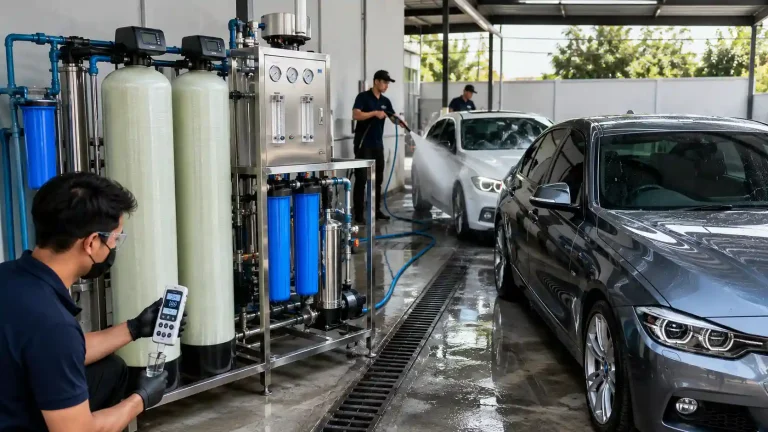
The purification setup is often the single biggest factor in system performance. Water fed pole cleaning depends on pure water, typically below 10 parts per million of dissolved solids, so the glass dries spot-free without wiping.
Two common approaches are deionization (DI) resin systems and reverse osmosis paired with deionization (RO/DI). DI-only systems are simpler and often more compact, which suits lower-volume or mobile work. RO/DI systems pre-treat water before deionization, which extends resin life and works better where source water has high mineral content.
| Requirement | Suitable System Characteristic | Key Trade-Off |
|---|---|---|
| Low-volume, mobile cleaning | Compact DI resin system | Resin depletes faster with hard water |
| High-volume commercial work | RO/DI system | Higher upfront cost, more setup space |
| Variable or unknown water quality | System with easy TDS monitoring | Requires regular testing habit |
If your local water is naturally hard or high in minerals, a pure DI system will need more frequent resin changes. Testing your source water with a reliable TDS meter before you buy helps you choose the right purification path instead of guessing.
Source Water Quality Comes First
Purification choice depends entirely on what you are starting with. Two businesses in different regions can need completely different setups even if they clean identical buildings. Before comparing systems, test your tap water or the water you plan to use on-site. This single step prevents buying an undersized purification unit that struggles to keep output below the target TDS level.
For a deeper look at how deionized and purified water setups work together, our DI cleaning system resources explain how the pieces connect in practice.
Water Flow and Delivery
Flow rate affects both cleaning speed and rinse quality. Too little flow means slower work and a higher chance of streaking on larger panes. Too much flow wastes purified water and can be harder to control on delicate surfaces.
Match flow rate to your typical job type:
- Lighter flow suits detail work and smaller residential windows
- Higher flow suits large commercial glass and faster rinse-and-move workflows
Pump-fed systems generally give more consistent flow than gravity-fed setups, but they add weight, cost, and a power source to manage.
Tank and Pump Requirements
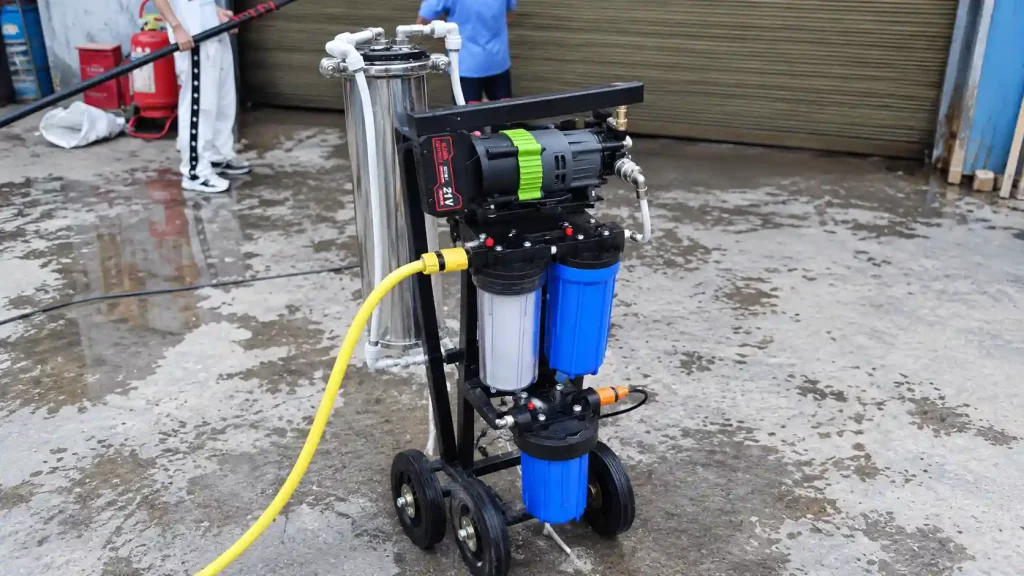
If your system relies on tank-fed water rather than a direct hose connection, tank size determines how long you can work before refilling. Larger tanks mean less downtime but more weight to transport and store. Smaller tanks are easier to move but require more frequent refills on longer jobs.
Pump-assisted systems help maintain steady pressure at height, which matters more as pole length increases. For ground-level or short-reach work, a pump may be unnecessary added cost.
Portability and Transport
Think about how the system moves between jobs, not just how it performs once set up. A system that is excellent on-site but awkward to transport will slow down your workday.
Consider:
- Whether tanks and poles fit your vehicle without disassembly
- Cart-mounted systems versus backpack or trolley setups
- How quickly the system can be loaded, unloaded, and set up at each stop
Our system setup guide is a useful reference here, since setup speed at each new location often depends on how the equipment was packed for transport.
Durability and Working Environment
Outdoor equipment faces sun exposure, temperature swings, and rough handling. Materials matter more than they might seem to on a spec sheet.
- UV-resistant hose material lasts longer under constant sun exposure
- Reinforced pole joints handle repeated extension and retraction better
- Corrosion-resistant fittings matter if you work near coastal areas or use harsher water sources
A system that looks similar on paper can perform very differently after a year of daily outdoor use, so ask about the materials used in poles, hoses, and fittings, not just the headline features.
Component Compatibility
Brushes, hoses, fittings, and purification units need to work together without constant adapters or workarounds. Before buying, check whether:
- The brush head connects directly to your chosen pole system
- Hose diameter matches your pump or gravity-fed setup
- Replacement parts are standard sizes rather than proprietary fittings that lock you into one supplier
Compatibility issues rarely show up until you need a replacement part quickly, so it is worth confirming before you commit to a system.
Maintenance and Consumables as a Buying Factor
Ongoing costs matter as much as the purchase price. DI resin, filters, and brush heads all wear out and need replacing. Before buying, ask how easily consumables are sourced and how often they typically need replacing for your water conditions and workload.
A system with a lower upfront price but hard-to-find replacement parts can end up costing more over time than a slightly pricier system with widely available consumables.
Professional Use Versus Occasional Use
Match the build quality to how often the system will actually run.
- Occasional or residential use: lighter poles, smaller tanks, and simpler purification are usually sufficient
- Daily professional use: prioritize durability, consistent flow, and easy access to replacement parts over minor weight savings
Buying beyond your actual needs adds cost without adding value. Buying below your needs leads to premature wear and downtime.
Common Buying Mistakes to Avoid
- Choosing based only on maximum pole length without checking practical working length
- Ignoring source water quality and buying an undersized purification unit
- Overlooking transport and storage requirements until after purchase
- Assuming a higher price always means better long-term durability
- Skipping a compatibility check between pole, brush, and hose components
How to Compare Two or More Systems
When you have narrowed your options to a few systems, compare them side by side using the same criteria rather than relying on marketing descriptions alone.
| Factor | What to Look For | Why It Matters |
|---|---|---|
| Working height | Practical extended reach, not just maximum length | Determines which jobs you can safely take on |
| Purification type | DI resin or RO/DI, matched to source water | Affects spot-free results and consumable cost |
| Pole weight | Balance and material, not just total length | Impacts fatigue during long shifts |
| Flow rate | Matched to typical glass size and job pace | Affects speed and rinse quality |
| Portability | Fits transport and storage setup | Affects daily setup and teardown time |
| Durability | Materials rated for your working environment | Determines lifespan under real conditions |
Reviewing options through the same categories, rather than comparing isolated features, makes it much easier to see genuine differences between systems.
Final Buyer Checklist
Before finalizing a purchase, confirm:
- You have tested your source water and know its starting TDS level
- The pole’s practical working height matches your typical jobs
- Purification method suits your water quality and workload
- Flow rate fits the glass sizes you clean most often
- Transport and storage fit your vehicle and workspace
- Replacement parts and consumables are easy to source
- The system is built for your actual usage frequency, not just your budget
If you are still deciding between purification setups, browsing our pure water systems or our broader window cleaning systems category can help you see how different configurations are typically built for different workloads.
Conclusion
There is no single best water fed pole system that works for every cleaning business. The right choice depends on your building heights, cleaning frequency, source water quality, and how much you move between job sites. A system that performs well for a small residential operation may fall short for a daily commercial crew, and the reverse is just as true.
Rather than choosing based on headline specifications alone, compare systems using consistent criteria: practical reach, purification method, flow rate, durability, and how easily you can source replacement parts. This approach leads to equipment that fits your actual work, not just equipment that looks impressive on paper.
For readers who want to go deeper into water purity standards used in professional cleaning, the Institute of Inspection, Cleaning and Restoration Certification publishes educational resources on water-based cleaning practices that are worth reviewing alongside your equipment research.
RELATED POSTS
What Is Reverse Osmosis Water Filter System
What is the Best Disinfection System for Water Treatment?
Why Is My Water Filter Not Working? Common Causes & Fixes
Clear vs Blue Water Filter Housing: Which One Should You Choose?
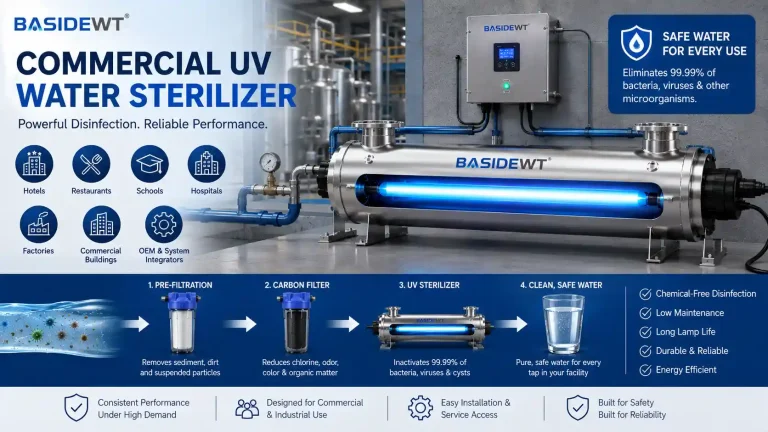
Commercial UV Water Sterilizer: Applications, Benefits and Selection Guide