BasideWT- Whole Home Water Filtration System & Replacement



Whole House Water Filter Housing: Benefits, Types & Buying Guide
A whole house water filter housing is the component that holds the filter cartridge for an entire property’s water supply. It sits where the main water line enters the building, so every tap, shower, and appliance receives filtered water. Choosing the right housing matters just as much as choosing the right cartridge. The wrong size or type can restrict flow, strain your plumbing, or leave your filtration system underperforming.
This guide focuses specifically on the housing itself. It explains how a whole house water filter housing works, how it differs from point-of-use housings, and how to match housing size, material, and connections to your actual water demand. If you want the full picture of housing types, sizes, and maintenance, our complete water filter housing guide covers the entire topic in depth.
What Is a Whole House Water Filter Housing?
A whole house water filter housing is a pressure-rated container that holds a filter cartridge at the point where water enters a home or building. Plumbers often call this a point-of-entry (POE) installation, because filtration happens before water splits off to individual fixtures.
The housing itself does not remove contaminants. That job belongs to the cartridge inside it. The housing’s role is to hold the cartridge securely, withstand water pressure, and let water pass through at a rate the household or facility needs.
According to NSF International, whole-house or point-of-entry systems treat water as it enters a property, typically near the water meter or pressure tank, and commonly address chlorine, taste, odor, and sediment before water reaches any fixture. That single housing and cartridge combination protects every downstream fixture at once.
Whole-House vs Point-of-Use Filter Housing
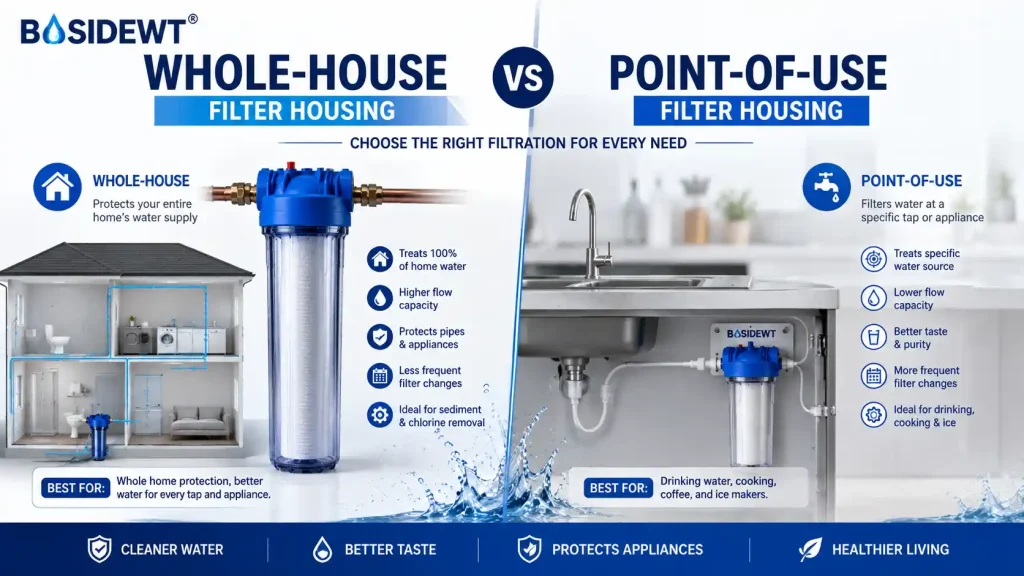
Many buyers confuse whole-house housings with point-of-use housings. They serve different jobs, and mixing them up leads to underperformance or wasted money.
| Feature | Whole-House Housing | Point-of-Use Housing |
|---|---|---|
| Installation point | Main water line, near entry | Single fixture (sink, fridge, etc.) |
| Typical housing size | 10 or 20 inch, often Big Blue | 10 inch standard |
| Flow capacity needed | High, serves whole property | Low, serves one outlet |
| Water treated | 100% of household supply | Water at one tap only |
| Common use case | General filtration, sediment, chlorine | Drinking water polishing |
A point-of-use housing only treats water at one location. A whole house water filter housing treats everything, which is why sizing and flow rate matter so much more at the point of entry.
Why Housing Size Matters in a Whole-House System
Housing size directly affects how much water can pass through without a pressure drop. A housing that is too small for your demand will restrict flow, especially when multiple fixtures run at once. A housing that is oversized for a low-demand property adds unnecessary cost without meaningful benefit.
Two dimensions define housing size:
- Diameter – determines internal filtration surface area
- Length – determines cartridge capacity and how often you need to replace it
Larger diameter and longer housings generally support higher flow rates and longer cartridge life, but only if the rest of the plumbing system can support that capacity.
Standard vs Big Blue Housings
“Big Blue” is the industry term for the larger housing format used in most whole-house setups. Standard housings work fine for point-of-use jobs, but whole-house systems usually need the extra capacity Big Blue housings provide.
| Factor | Standard Housing | Big Blue Housing |
|---|---|---|
| Typical diameter | 2.5 inch | 4.5 inch |
| Common length | 10 inch | 10 or 20 inch |
| Best suited for | Point-of-use, light-duty tasks | Whole-house, high-demand properties |
| Flow rate support | Lower | Higher |
| Cartridge replacement frequency | More frequent | Less frequent, due to larger media volume |
If you want a deeper breakdown of Big Blue sizing and applications, our guide on Big Blue water filter housing sizes and benefits walks through the options in more detail.
10-Inch vs 20-Inch Housings
Within the Big Blue category, length is the next decision. A 10-inch housing suits smaller households or lower daily water use. A 20-inch housing holds more filter media, so it handles higher volume and needs cartridge changes less often.
Property size, occupant count, and daily water consumption all influence this choice. Our comparison of 10-inch versus 20-inch water filter housings breaks down which properties suit each length.
How Housing Size Affects Flow Rate and Pressure
Flow rate describes how much water moves through the housing per minute, usually measured in gallons per minute (GPM). Every whole-house housing has a maximum flow rating. Exceeding it causes pressure drops throughout the property, which shows up as weak showers or slow-filling appliances.
To estimate the flow rate you need, add up the demand from fixtures that might run simultaneously. A typical household needs somewhere between 10 and 25 GPM, while commercial buildings often need more.
Matching housing size to flow rate protects two things at once:
- Water pressure stays consistent across the property
- Cartridge lifespan improves, because water is not forced through media too quickly to filter properly
For a full breakdown of pressure ratings, safe operating limits, and flow calculations, see our guide on water filter housing pressure and flow rate.
Cartridge Selection for Whole-House Housings
The housing and cartridge work as a pair. A housing that fits the wrong cartridge type wastes filtration potential, even if the housing itself is high quality.
Common whole-house cartridge types include:
- Sediment filters – remove sand, rust, and particulates
- Carbon filters – reduce chlorine, taste, and odor
- Combination cartridges – handle both sediment and chemical reduction in one step
Before buying a housing, confirm which cartridge micron rating and material match your water source. Municipal water and well water often need different filtration approaches. Our guide on cartridge compatibility for water filter housings explains how to match cartridges correctly.
Port Size, Connections, and Material Basics
Port size determines how the housing connects to your existing plumbing. Whole-house housings commonly use 1-inch NPT or BSP threads, though this varies by property size and regional plumbing standards. A mismatched port size means extra fittings, adapters, or a housing that cannot support your pipe’s flow capacity.
Housing material also matters at this scale. Whole-house housings are generally made from:
- Reinforced plastic (polypropylene) – lightweight, corrosion-resistant, cost-effective
- Stainless steel – higher pressure tolerance, longer service life, common in commercial settings
Both materials work well for whole-house use when sized and rated correctly for your water pressure.
Choosing the Right Housing Type
Housing type selection depends on where the system sits in your plumbing, how much sediment or debris your water source carries, and whether you need to see the cartridge condition without opening the housing.
Clear or semi-clear housings let you visually check cartridge condition, which helps with maintenance scheduling. Opaque housings often cost less and work well when UV exposure or light-sensitive media are not a concern. For a broader look at how housing types compare, our guide on types of water filter housings covers each option and its best-fit use case.
Residential Applications
In homes, a whole house water filter housing typically installs after the main shutoff valve and before the water heater. This protects appliances, plumbing fixtures, and every faucet in the house from sediment and chlorine.
Residential setups usually favor:
- 10-inch or 20-inch Big Blue housings, depending on household size
- Sediment or carbon cartridges, depending on the water source
- 1-inch port connections for standard residential plumbing
Homeowners on well water often add a dedicated sediment stage before a carbon stage, since well water tends to carry more particulate matter than municipal supply.
Commercial and Industrial Applications
Commercial buildings, facilities, and light industrial sites need higher flow capacity and often run multiple housings in parallel to handle demand without pressure loss.
Typical commercial considerations include:
- Larger diameter housings or multiple housings in a manifold configuration
- Stainless steel construction for higher pressure and longer service intervals
- Scheduled cartridge replacement to match higher throughput
Property managers, facility engineers, and water treatment companies typically size these systems based on peak simultaneous demand rather than average daily use, since commercial fixtures often run at the same time during business hours.
Benefits and Limitations of Whole House Filter Housings
Whole house filtration offers clear advantages, but it also has limits worth understanding before you buy.
Benefits:
- Protects every fixture and appliance from sediment and chlorine
- Reduces scale buildup in pipes and water heaters over time
- Requires only one filtration point instead of several point-of-use units
- Supports both residential and commercial water demand at scale
Limitations:
- Does not replace specialized treatment like reverse osmosis for drinking water
- Requires correct sizing, or performance drops noticeably
- Needs periodic cartridge replacement to maintain flow and filtration quality
Understanding these trade-offs helps set realistic expectations before installation.
How to Choose the Right Whole House Water Filter Housing
Selecting the right housing means working through your property’s actual requirements rather than picking the largest available option. Use this checklist:
- Calculate your peak simultaneous flow demand in GPM
- Confirm your existing pipe and port size
- Choose Big Blue for whole-house use; reserve standard housings for point-of-use tasks
- Match housing length (10 or 20 inch) to expected cartridge replacement frequency
- Select a material rated for your water pressure and application type
- Confirm cartridge compatibility before finalizing housing choice
- Factor in space available for installation and future maintenance access
The largest housing is not automatically the best choice. A housing sized well beyond your actual demand adds cost without improving filtration, while an undersized housing restricts flow no matter how good the cartridge inside it is.
Common Buying Mistakes
Buyers frequently make the same avoidable errors when selecting a whole-house housing:
- Choosing by budget alone, without checking flow rate requirements
- Assuming point-of-use and whole-house housings are interchangeable
- Skipping port size verification, leading to costly adapter fitting
- Ignoring material suitability for the property’s water pressure
- Overlooking cartridge availability for the housing size chosen
Avoiding these mistakes early saves time, money, and unnecessary plumbing rework later.
Conclusion
A whole house water filter housing protects your entire water supply from one central point, holding the cartridge that removes sediment, chlorine, and other common contaminants before water reaches any fixture. The right choice depends on matching housing size, flow rate, port connections, material, and cartridge type to your property’s real demand, not simply picking the biggest option available.
For residential properties, a correctly sized Big Blue housing usually covers household needs well. For commercial and industrial sites, higher flow capacity and durable materials become the priority. Whichever setup fits your situation, getting the housing right is the foundation of a whole-house filtration system that actually performs.
If you are ready to move forward, BasideWT’s range of water filter housings covers residential, commercial, and OEM requirements, with options suited to different flow rates, port sizes, and materials for whole-house installations.
RELATED POSTS
why is my water filter leaking?
RO Membrane vs RO Filter: What’s the Difference?
What Is a Water Filter Housing? Complete Guide to Uses, Types & Benefits
RO Membrane Compatibility: How to Match a Membrane With Your System
Residential vs Commercial RO Membrane: What’s the Difference?