BasideWT- Whole Home Water Filtration System & Replacement


Types of Water Filter Housings: Complete Guide to Choosing the Right Type
There are six main types of water filter housings: standard single-cartridge, multi-cartridge, clear, Big Blue, high-flow, and material-based types. Each type suits a different combination of flow rate, water pressure, and installation environment. So picking the wrong one usually shows up later as low flow or frequent cartridge changes. In some cases, a housing even cracks under pressure it was never rated for.
This guide walks through each of these housing types and explains where it fits best. In other words, it gives you a practical way to compare them before you buy. The focus stays specifically on housing types. Installation steps and maintenance schedules are covered elsewhere, so you can quickly find the category that matches your project here.
Main Types of Water Filter Housings and How They’re Classified
Manufacturers and buyers typically sort water filter housings along four practical lines:
- Cartridge configuration — single-cartridge or multi-cartridge
- Size and flow capacity — standard, Big Blue, or high-flow
- Material — plastic (polypropylene, SAN, polycarbonate) or stainless steel
- Transparency — clear or opaque body
These four categories overlap in real products. For example, a housing can be clear, single-cartridge, and standard-size. Another might be stainless, multi-cartridge, and high-flow instead. Once you understand these variables, comparing any two housings gets much simpler.
Want the basic components and terminology explained first? This beginner’s guide to water filter housings covers the fundamentals. It’s a good starting point before you move on to comparing types.
Standard Cartridge Housings: Single vs Multi-Cartridge
Standard cartridge housings are the most common starting point for residential and light commercial systems. A single-cartridge housing holds one filter element and handles one water line at a moderate flow rate. So it’s the typical choice for a small home, an apartment, or a single point-of-use application such as an under-sink filter.
By contrast, a multi-cartridge housing groups two or more single housings, or one body with multiple cartridge slots, working in parallel. This raises total flow capacity without switching to oversized cartridges. As a result, it suits a line that needs to serve a larger household or a small office.
Choosing between single and multi-cartridge configurations, therefore, comes down to demand. A single-housing setup keeps costs and footprint low when daily flow rarely exceeds what one cartridge can process. However, splitting the load across parallel cartridges usually works better when peaks are common.
For a full breakdown of housing dimensions and sizing, the complete water filter housing buying guide covers this in more depth.
Clear vs Opaque Filter Housings
Clear filter housings use transparent materials such as styrene acrylonitrile (SAN) or polycarbonate for the housing bowl. The main advantage is visibility. In other words, you can see sediment build-up, cartridge condition, and water clarity without opening the housing. This makes clear housings popular for demonstration units and point-of-use filters.
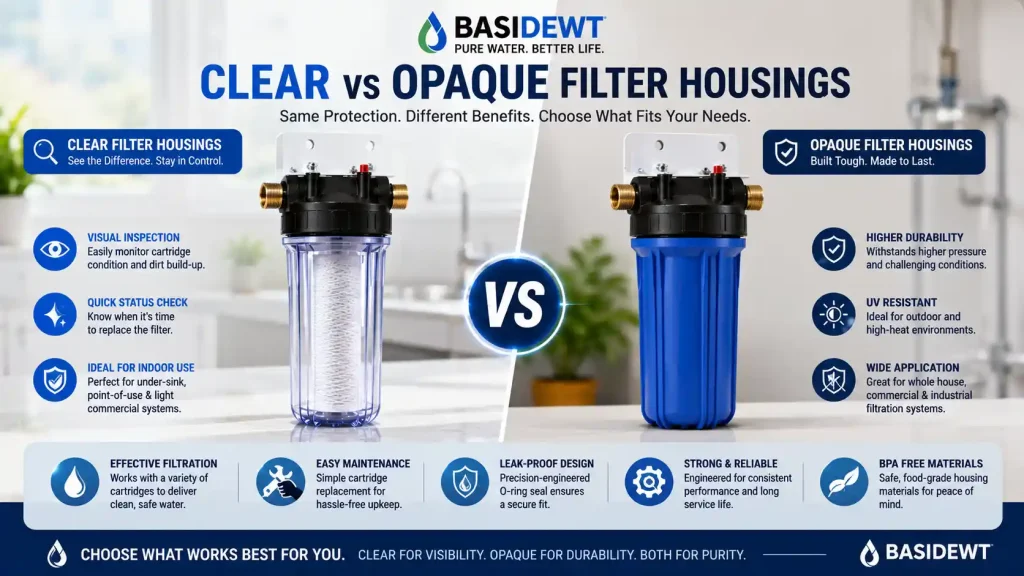
However, clear housings do have limits. Prolonged sunlight exposure can weaken the plastic over time, so these housings work best indoors. Pressure and temperature tolerances also tend to run lower than opaque housings. That matters most on hot-water or high-pressure lines.
Opaque housings, usually in blue, white, or black polypropylene, trade visibility for durability instead. Since outdoor exposure and higher pressure ranges suit them better, they dominate whole-house and commercial installations.
BasideWT’s clear cartridge filter housings are built for exactly this kind of visual inspection. They work well in indoor residential and light commercial systems.
Big Blue Filter Housings
“Big Blue” refers to a housing diameter standard rather than a single product. These housings use a wider body than standard slim housings. They’re typically paired with 4.5-inch diameter cartridges in 10-inch or 20-inch lengths. Because the cartridge volume is larger, you get more filter media and higher dirt-holding capacity.
This makes Big Blue a common upgrade path for whole-house sediment or carbon filtration. Light commercial buildings use it too, wherever a slim housing would otherwise need frequent changes. In short, it strikes a balance between residential simplicity and higher commercial capacity.
Even so, it isn’t a universal answer. Restaurants, hotels, and multi-unit residential buildings often push flow demand past what a single Big Blue housing can support. That’s exactly the gap high-flow housings are built to fill.
High-Flow Filter Housings for Commercial and Industrial Use
High-flow filter housings are built around larger-diameter pleated or wound cartridges. So they move significantly more water per minute than standard or Big Blue cartridges of similar length. Because of the higher pressure drop this creates, the housing body is typically wider and taller, with heavier-duty caps and seals.
These housings show up frequently in commercial kitchens, hotels, and laundries. Centralized filtration systems serving multiple apartment units also rely on them. This is a common setup in China’s urban residential and commercial buildings. Since a single high-flow housing can often replace several standard housings running in parallel, it simplifies plumbing layouts overall.
Does your flow demand exceed what a standard Big Blue setup can comfortably support? High-flow cartridge filter housings are built specifically to close that gap.
Choosing Between Plastic and Stainless Steel Housings
Housing material is a separate decision from size and configuration. Even so, it has a direct effect on where a housing can be used safely.
Plastic housings, usually polypropylene or reinforced nylon, are lightweight, corrosion-resistant, and cost-effective. So they cover most residential and general commercial applications, including cold and moderately warm water lines.
Stainless steel housings, on the other hand, handle higher pressure and higher temperature. Food and beverage production, pharmaceutical systems, and industrial process lines rely on them. Otherwise, plastic would degrade faster or fail to meet hygiene requirements.
| Housing Type | Typical Application | Main Advantage | Key Consideration |
|---|---|---|---|
| Standard single-cartridge | Residential, point-of-use | Low cost, compact footprint | Limited flow capacity |
| Multi-cartridge | Larger homes, small offices | Higher flow without oversized cartridges | More plumbing complexity |
| Clear housing | Indoor residential, demo units | Visual inspection of cartridge condition | Indoor use only, lower pressure rating |
| Big Blue | Whole-house, well water, light commercial | Higher dirt-holding capacity, fewer changes | Bulkier than standard housings |
| High-flow | Commercial kitchens, hotels, condo systems | Handles high volume with fewer housings | Higher upfront cost |
| Plastic housing | Residential, general commercial | Lightweight, corrosion-resistant, affordable | Lower temperature and pressure limits |
| Stainless steel housing | Industrial, food & beverage, pharma | High pressure and temperature tolerance | Higher cost, heavier installation |
BasideWT’s full range of water filter housings spans both plastic and stainless steel construction. So material choice doesn’t have to limit which configuration you pick.
Residential vs Commercial and Industrial Housing Types
Residential housings are usually single or small multi-cartridge units, sized for household flow rates. Installation is simple: a supply line in, a faucet or main line out. So ease of cartridge replacement matters more than raw capacity here.
Commercial and industrial buyers, however, work with a different set of priorities. Multi-round housing skids, high-flow units, and bag filter housings are common where downtime is costly. OEM buyers and water treatment companies also often need housings that fit into a packaged system. That shifts the decision toward customizable port sizes and mounting options.
As a result, distributors sourcing housings for China’s water treatment market frequently need both ends of this range. Compact housings serve apartment-scale systems. Higher-capacity units serve centralized filtration rooms in larger buildings.
Facility managers overseeing multi-building sites often standardize on one or two housing types. This holds even when individual buildings have different flow requirements. That trade-off is worth discussing with a supplier before finalizing a large order, since one oversized type isn’t always cheaper long-term.
Similarly, engineers specifying housings for new construction need to account for future load. A building that adds tenants or production lines later may outgrow a housing sized for day-one demand. So leaving room for a parallel housing addition tends to save on rework down the line.
How Housing Type Affects Cartridge and Micron Selection
Housing type and cartridge selection aren’t independent choices. A housing’s internal diameter and cap design decide which cartridge lengths and end-cap styles will fit correctly. So choosing a housing without checking cartridge compatibility first is a common mistake.
Micron rating also interacts with housing size. A tighter micron rating increases pressure drop across the cartridge. As a result, higher-flow housings paired with fine-micron cartridges need enough internal volume. Want the step-by-step mechanics of how water moves through a housing? This guide to how a water filter housing works covers that in detail.
In practice, it’s more efficient to pick the cartridge type first. Then choose a housing sized to fit it, rather than the other way around.
Sediment, carbon block, and pleated cartridges all behave differently inside the same housing size. For example, a coarse sediment cartridge allows more open flow. A tightly wound carbon cartridge, however, restricts flow more as it loads with contaminants. Housings ahead of a reverse osmosis system are often sized with extra flow margin for this reason. Otherwise, a housing with no spare capacity shows a pressure drop sooner than expected.
Matching cartridges correctly matters just as much as choosing the right housing. Browse filter cartridge options sized for standard, Big Blue, and high-flow housings to find the right combination.
How to Choose the Right Type of Water Filter Housing
A practical selection process usually follows these steps:
- Estimate your required flow rate. Peak demand, not average demand, determines whether a standard housing is sufficient or a high-flow unit is needed.
- Check available pressure and temperature. Confirm the housing’s rated limits match your supply line conditions, especially for hot water lines.
- Decide on material. Choose plastic for general use, or stainless steel where chemical resistance or hygiene standards demand it.
- Confirm port size and mounting. Housing ports need to match existing plumbing, and OEM projects may also require specific mounting brackets.
- Match the cartridge before finalizing the housing. Length, diameter, and micron rating all need to align with what the housing accepts.
Water quality and required filtration capacity also shape this decision. However, these factors are usually resolved before housing selection, once you know what the cartridge needs to remove.
Want a broader view of filtration standards across China’s water treatment sector? WATERTECH China’s industry overview is a useful reference for tracking how filtration practices are evolving.
Practical Examples of Water Filter Housing Types in Use
A few common scenarios show how these types play out in real projects:
- Apartment or small household: a single standard cartridge housing, plastic body, sized for typical residential flow.
- Villa or larger home with well water: a Big Blue housing for higher dirt-holding capacity between cartridge changes.
- Restaurant or hotel kitchen: a high-flow housing to keep up with continuous demand without frequent cartridge swaps.
- Centralized filtration room for a residential complex: multi-cartridge or high-flow housings arranged in parallel to serve many units from one filtration point.
- Food and beverage or pharmaceutical facility: stainless steel housings selected for pressure, temperature, and hygiene requirements.
- OEM water treatment package: housings chosen for compatibility with a manufacturer’s cartridge line and system layout rather than as a standalone purchase.
None of these examples call for the most expensive housing available. Instead, each one calls for the housing whose capacity and material actually match the job.
Conclusion
The main types of water filter housings, in the end, come down to a handful of practical variables. Configuration can be single or multi-cartridge. Capacity can be standard, Big Blue, or high-flow. Construction can be plastic or stainless steel, with a clear or opaque body. Because of this range, no single type of water filter housing is ideal for every system. Instead, the right choice depends on flow demand, water pressure, and cartridge compatibility.
Working through flow rate, pressure, material needs, and cartridge compatibility in that order beats comparing housings on price alone. BasideWT designs and supplies water filtration housings and cartridges across residential, commercial, and industrial applications. So reach out, and BasideWT can help match the right housing type to your specific project.
RELATED POSTS
How Water Turbidity Affects UV Water Sterilization
UF Membrane for Drinking Water: Benefits, Limitations & Applications
Water Filter Housing Pressure Rating: PSI, Flow Rate & Safety Guide
Home RO System: A Complete Guide to Clean and Safe Drinking Water at Home
RO Membrane: Types, Sizes, GPD, Working, Replacement & Buying Guide