BasideWT- Whole Home Water Filtration System & Replacement


RO Membrane vs RO Filter: What’s the Difference?
Many buyers use “RO membrane” and “RO filter” as if they mean the same thing. They don’t. Understanding the RO membrane vs RO filter difference helps you diagnose problems, buy the right part, and avoid unnecessary replacements.
Quick Answer
An RO membrane is a specific component inside a reverse osmosis system. It uses pressure to force water through a semipermeable layer, removing dissolved solids and most contaminants.
An RO filter, however, is a broader term. People often use it to describe any cartridge in the system, including sediment filters, carbon filters, and post-filters. These cartridges trap particles or chemicals, but they do not remove dissolved salts the way a membrane does.
So the membrane is one type of filtration stage. The RO filter is a general label people apply to the whole filter set, or sometimes to non-membrane cartridges specifically. That overlap in language is where the confusion starts.
What Is an RO Membrane?
An RO membrane is a thin, semipermeable sheet rolled inside a housing. Water enters under pressure, and the membrane separates it into two streams.
One stream is permeate, the purified water that passes through. The other is concentrate, the reject water carrying rejected contaminants away. This separation happens at a molecular level, not through simple straining.
Because of this, a membrane removes dissolved minerals, heavy metals, and many dissolved organics. For a deeper technical breakdown, our guide on what an RO membrane actually is covers structure, materials, and function in detail.
How the Membrane Physically Works
The membrane relies on applied pressure to overcome natural osmotic pressure. Water molecules pass through tiny pores. Dissolved ions and larger molecules cannot.
This process depends on several operating conditions working together. Feed pressure, water temperature, and TDS level all affect how much clean water the membrane produces. If you want the full mechanism explained step by step, see how an RO membrane works.
What Is an RO Filter?
“RO filter” is not one specific part. Instead, it usually refers to any cartridge-style filter within the RO system.
These filters work differently than a membrane. They trap particles or absorb chemicals as water flows through, without separating dissolved salts. Common examples include:
- Sediment filters, which remove sand, rust, and dirt
- Carbon filters, which remove chlorine, taste, and odor
- Post-filters, which polish water before it reaches the tap
Each cartridge protects the membrane or improves final taste. None of them reduce TDS the way a membrane does.
RO Membrane vs RO Filter: Key Differences
The core difference comes down to filtration method. A membrane uses pressure-driven separation at a molecular scale. A cartridge filter uses physical trapping or chemical adsorption.
Because of this, their jobs are not interchangeable. A sediment filter cannot remove dissolved salts. A membrane cannot efficiently trap large sediment without becoming clogged quickly.
This is why every RO system needs both. The cartridges protect the membrane. The membrane handles the fine, dissolved-level purification that cartridges cannot achieve.
How an RO System Uses Both
A typical residential RO system runs water through several stages in sequence. First, a sediment filter removes larger particles. Next, a carbon filter removes chlorine and organic compounds.
The membrane comes after these pre-filters. By the time water reaches it, most damaging particles and chlorine are already gone. This protects the membrane and extends its working life.
After the membrane, water often passes through a post-filter. This final stage improves taste before the water reaches the faucet. Each stage matters, but only the membrane performs true dissolved-solid separation.
What Does Each Filter Stage Do?
Understanding each stage makes the RO membrane vs RO filter comparison easier to apply practically. Every component has a distinct job inside the system.
Sediment Filters
Sediment filters remove visible particles like dirt, rust, and sand. They protect downstream components, especially the membrane, from physical damage and clogging.
These filters typically need replacement every few months. Replacement frequency depends heavily on feed water quality and sediment load.
Carbon Filters
Carbon filters remove chlorine, chloramine, and organic compounds that affect taste and odor. Chlorine can also degrade certain membrane materials over time.
Because of this, carbon filtration is essential before water reaches the membrane. Skipping this stage can shorten membrane lifespan significantly.
Post-Filters
Post-filters sit after the membrane, just before the storage tank or faucet. They remove any remaining odors or tastes that develop during storage.
This stage does not affect TDS reduction. Its purpose is purely about final water quality and taste.
RO Membrane vs Sediment Filter
A sediment filter and a membrane target completely different problems. Sediment filters catch visible particles using a simple mesh or fiber structure.
A membrane, in contrast, separates dissolved substances that are far too small to see. No amount of sediment filtration can replace what a membrane does chemically.
RO Membrane vs Carbon Filter
Carbon filters absorb chlorine and organic chemicals using activated carbon media. This protects the membrane and improves taste, but it cannot reduce dissolved salts.
A membrane, meanwhile, handles that dissolved-solid reduction directly. The two components work together, not as substitutes for each other.
RO Membrane vs Post-Filter
Post-filters only refine already-purified water. They do not interact with raw feed water or perform any dissolved-solid removal.
The membrane has already done the heavy purification work by this point. The post-filter simply ensures the water tastes clean at the tap.
Which Component Removes TDS?
Only the membrane reduces total dissolved solids in meaningful amounts. Cartridge filters do not perform this function, regardless of their material or design.
This is the clearest technical line in the RO membrane vs RO filter comparison. If TDS reduction is the goal, the membrane is the component doing the work.
Membrane performance depends on several linked factors. These include feed pressure, water temperature, membrane type, and overall feed-water quality. Our guide on RO membrane rejection rate explains how these factors influence actual TDS reduction in practice.
How to Tell Whether the Membrane or Filter Needs Replacement
Diagnosing the source of a problem saves money and avoids unnecessary parts replacement. The symptoms usually point clearly to one component or the other.
Signs Pointing to a Cartridge Filter Problem
- Reduced water flow with normal TDS readings
- Strange taste or odor despite low TDS
- Visible discoloration in incoming feed water
- Recent increase in sediment or turbidity
These symptoms usually mean a pre-filter or post-filter cartridge needs attention. The membrane itself may still be performing correctly.
Signs Pointing to a Membrane Problem
- Rising TDS in the permeate water
- Consistently low permeate output despite adequate pressure
- Membrane age beyond its typical service life
- No improvement after replacing pre-filters
When these symptoms appear, the membrane is the likely cause. Our detailed guide on RO membrane troubleshooting walks through diagnostic steps for low flow and high TDS issues.
Comparison Table: RO Membrane vs RO Filter
| Factor | RO Membrane | RO Filter (Cartridge) |
|---|---|---|
| Filtration method | Pressure-driven molecular separation | Physical trapping or chemical adsorption |
| Main purpose | Removes dissolved solids and contaminants | Protects membrane, improves taste and odor |
| Typical location | Center of the RO system | Before and after the membrane |
| TDS reduction | Yes, significant reduction | No meaningful TDS reduction |
| Particle removal | Limited; relies on pre-filters | Yes, primary function for sediment stages |
| Chlorine protection | Vulnerable without carbon pre-filtration | Carbon filters actively remove chlorine |
| Typical replacement interval | 2–3 years, condition dependent | Every 3–12 months, depending on stage |
| Performance factors | Pressure, TDS, temperature, feed quality | Sediment load, chlorine levels, usage volume |
This table highlights why the two components are not interchangeable. Each plays a distinct role in overall water quality.
Which One Should You Replace?
Replacement decisions should follow the diagnosis, not guesswork. Replacing the wrong component wastes money and does not solve the underlying issue.
If flow is low but TDS stays normal, start with the sediment and carbon filters. These cartridges clog faster and need more frequent attention.
If TDS rises steadily or output drops despite fresh pre-filters, the membrane likely needs replacement. Our complete guide on RO membrane replacement explains timing, warning signs, and step-by-step replacement guidance.
Feed water quality also affects how often each part wears out. Systems treating harder or more contaminated water usually need more frequent cartridge changes. Because operating pressure directly affects both flow rate and membrane stress, understanding your system’s pressure requirements helps you plan maintenance more accurately.
Practical Examples
Consider a home system where water tastes fine, but flow has slowed noticeably. This pattern usually points to a clogged sediment filter rather than membrane failure.
Now consider a system where flow feels normal, but the water tastes slightly salty or metallic. That symptom typically indicates rising TDS, meaning the membrane may be reaching the end of its service life.
These examples show why symptom-based diagnosis matters more than assumptions. The RO membrane vs RO filter distinction becomes practical, not just theoretical, when you’re troubleshooting a real system.
Residential Versus Commercial Applications
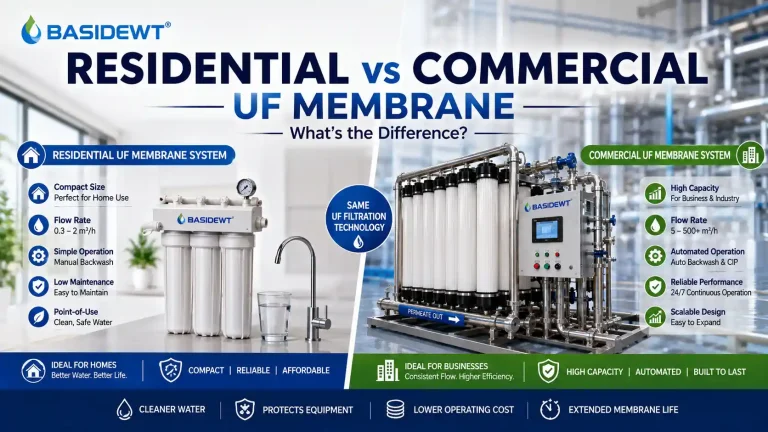
Residential systems typically use a single membrane alongside a small set of cartridge filters. Maintenance intervals are longer, and feed water is often municipally treated.
Commercial systems, in contrast, may use multiple membranes arranged in series or parallel. Different membrane types suit different water sources and output requirements. Our guide on types of RO membranes explains which configurations suit various applications and feed-water conditions.
Regardless of scale, the same principle applies. Cartridges handle protection and polishing, while the membrane handles the core purification work.
Buying and Replacement Considerations
When sourcing replacement parts, confirm exactly which component needs replacing. Ordering a membrane when only a sediment filter is clogged adds unnecessary cost.
Check membrane specifications carefully before purchase, including size and rated capacity. Mismatched components can reduce system performance or cause premature wear. Understanding basic principles of semipermeable membrane separation can also help buyers evaluate technical claims from different suppliers.
For bulk or commercial sourcing, working with a supplier who understands membrane specifications, sizing, and application requirements matters. This becomes especially important when selecting systems for varying water conditions across different regions and facility types.
Conclusion
The RO membrane vs RO filter comparison comes down to one core distinction. The membrane performs dissolved-solid separation, while cartridge filters handle particle removal, chlorine protection, and taste refinement.
Neither component replaces the other. A system needs sediment and carbon filters to protect the membrane, and it needs the membrane to actually reduce TDS and deliver purified water.
When diagnosing a problem, match the symptom to the right component. Flow issues with stable TDS usually point to cartridge filters. Rising TDS or declining output usually points to the membrane. Knowing this difference helps you maintain your system correctly and avoid replacing parts that don’t need replacing.