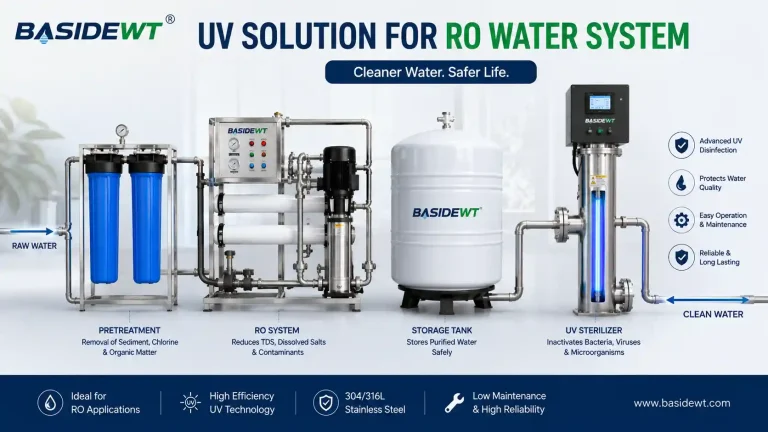
BasideWT- Whole Home Water Filtration System & Replacement


UV Water Sterilizer Pretreatment: What Filtration Is Needed Before UV?
UV water sterilizer pretreatment is the filtration and conditioning applied to water before it reaches the UV chamber. Its job is simple but critical. It improves water clarity, protects UV transmittance, and removes conditions that can shield microorganisms from UV light.
Without the right pretreatment, a UV water sterilizer can still run. But it may not disinfect as intended. This article explains what pretreatment is actually needed before UV, why it matters, and how to decide what your water requires.
We will focus only on pretreatment. For general background on UV disinfection itself, the complete beginner’s guide to UV water sterilizers is a useful starting point.
Why Pretreatment Matters Before UV Disinfection
A UV water sterilizer works by exposing water to UV-C light as it passes through a quartz sleeve. This light disrupts the DNA of bacteria and other microorganisms. The process depends on direct, unobstructed light exposure.
That last part is the key. UV light must physically reach each microorganism to be effective. Anything that blocks, scatters, or absorbs that light reduces disinfection performance.
This is why pretreatment exists. It is not about making a UV sterilizer “work better” in a marketing sense. It is about giving the UV system the water conditions it was designed to treat. For a detailed look at the exposure mechanism itself, see how a UV water sterilizer works step by step.
It also helps to understand what UV can and cannot do. UV does not remove particles, minerals, or chemicals from water. It only targets microorganisms exposed to enough UV dose. A full breakdown of this distinction is covered in what a UV water sterilizer actually removes from water.
How Suspended Solids and Turbidity Interfere With UV
Turbidity is a measure of water cloudiness caused by suspended particles. These particles scatter and absorb UV light before it reaches microorganisms.
There are two separate problems here, and both matter.
Light scattering. Suspended particles bend UV light away from its intended path. This lowers the effective UV dose reaching the water.
Microbial shielding. Some particles are large enough for bacteria to hide behind or inside them. UV light cannot reach a microorganism that is physically shielded by sediment, clay, or organic debris.
Even water that looks clear to the eye can carry enough fine particulate to reduce UV performance. This is why visual clarity alone should never be the deciding factor for whether pretreatment is needed.
Filtration Stages Commonly Used Before UV
There is no single filtration stage that fits every source water. The right combination depends on what is actually in the water. Below are the most common pretreatment stages used ahead of a UV water sterilizer.
Sediment Filtration
Sediment filtration is the most common and often the most necessary pretreatment step. It removes sand, silt, rust particles, and other suspended solids before water reaches the UV chamber.
Sediment filters are usually rated by micron size. Smaller micron ratings capture finer particles but may need more frequent replacement. Many systems use a combination of a coarser pre-filter and a finer secondary filter.
Sediment control also protects the UV lamp’s quartz sleeve. Particle buildup on the sleeve can reduce UV output over time, even if the lamp itself is functioning correctly.
Activated Carbon Filtration
Activated carbon is not always required before UV, but it plays a useful role in specific situations. It helps with:
- Dissolved organic matter that contributes to water color
- Certain taste and odor compounds
- Some chemical compounds, depending on the carbon type and contact time
Activated carbon does not remove hardness, iron, or manganese effectively. Its role is targeted, not universal. Whether it is needed depends on the source water composition, not a general assumption.
Iron and Manganese Treatment
Iron and manganese cause two distinct problems for UV systems. First, they can precipitate and coat the quartz sleeve, blocking UV transmission. Second, dissolved iron and manganese can discolor water and reduce UV transmittance directly.
Treatment options vary by concentration and water chemistry. Common approaches include oxidation followed by filtration, or specialized iron and manganese removal media. The correct method depends on lab-tested levels, not guesswork.
Hardness and Scale Considerations
Hard water contains dissolved calcium and magnesium. These minerals do not block UV light in the same way particles do, but they create a different problem.
Over time, hardness minerals can scale the quartz sleeve inside the UV chamber. Scale buildup reduces UV transmittance gradually, often without an obvious warning sign. In areas with high hardness, softening or scale-control pretreatment is frequently recommended alongside regular sleeve cleaning.
Color and Organic Matter
Water color, often caused by dissolved organic compounds or tannins, directly reduces UV transmittance. Even without visible turbidity, colored water can absorb UV light before it reaches microorganisms.
This is different from turbidity caused by suspended solids. Color is typically addressed through oxidation, specialized filtration media, or activated carbon, depending on the compounds involved.
UV Water Sterilizer Pretreatment Comparison Table
The table below summarizes common water-quality issues and how they typically relate to UV pretreatment decisions.
| Water-quality issue | Possible effect on UV | Common pretreatment approach |
|---|---|---|
| Suspended solids / turbidity | Scatters UV light, shields microorganisms | Sediment filtration |
| Iron | Coats quartz sleeve, lowers transmittance | Oxidation and filtration, or iron removal media |
| Manganese | Discolors water, reduces transmittance | Oxidation and filtration, or specialized media |
| Hardness | Scales quartz sleeve over time | Softening or scale-control pretreatment |
| Color / organic matter | Absorbs UV light before exposure | Activated carbon or targeted oxidation |
| Dissolved organics affecting taste/odor | Does not block UV directly, but affects water quality | Activated carbon filtration |
This table is a general reference, not a fixed formula. Actual pretreatment should always be based on tested water conditions.
Why Water Testing Comes Before Pretreatment Design
It is tempting to install a standard filter stack and assume it will work. This approach often fails because every water source is different.
Testing should identify:
- Turbidity level
- Iron and manganese concentration
- Hardness level
- Water color and organic content
- Microbial presence, where relevant
Municipal water, well water, and surface water often need completely different pretreatment strategies. Regulatory frameworks such as China’s national drinking water quality standards illustrate why parameters like turbidity limits are formally defined and monitored rather than estimated. The same principle applies at the system level: measured data leads to better pretreatment decisions than assumptions.
Pretreatment for Residential Systems
Residential UV water sterilizer pretreatment is usually simpler than commercial or industrial setups. Common residential configurations include:
- A sediment pre-filter to protect the UV chamber
- Optional activated carbon for taste, odor, or color
- Softening, if the home has known hardness issues
Homeowners on municipal water often need less pretreatment than those on well water. Well water is more likely to carry sediment, iron, or manganese that municipal treatment would normally address.
Pretreatment for Commercial Systems
Commercial applications typically involve higher flow rates and more variable water use patterns. Pretreatment needs to keep pace with demand while maintaining consistent water quality.
Common commercial pretreatment elements include:
- Multi-stage sediment filtration sized for higher flow
- Iron or manganese treatment where source water requires it
- Regular monitoring, since commercial systems often run more continuously than residential ones
For a look at how pretreatment fits within the larger system design, including how components interact, see UV water sterilizer parts and components explained.
Pretreatment for Industrial Systems
Industrial water sources are often more variable and may include process water, groundwater, or recycled water streams. Pretreatment decisions here usually involve more engineering analysis.
Industrial pretreatment considerations often include:
- Larger-capacity sediment and multimedia filtration
- Chemical treatment for iron, manganese, or organic loading
- Pretreatment sized specifically for the facility’s flow rate and water chemistry
Because industrial water sources vary so widely, a generic pretreatment package rarely applies. Site-specific testing and engineering review are standard practice.
Industrial facilities also tend to track water quality more formally, with routine sampling schedules and documented results. This makes it easier to catch a shift in source water before it affects UV performance downstream.
What Happens Without Suitable Pretreatment
Skipping pretreatment does not always cause immediate, visible failure. That is part of what makes it risky.
Common consequences of inadequate pretreatment include:
- Reduced UV transmittance, lowering the effective UV dose
- Microorganisms shielded by particles surviving UV exposure
- Faster fouling or scaling of the quartz sleeve
- Increased maintenance frequency and shortened lamp life
- Inconsistent water quality between testing intervals
None of these issues necessarily mean the UV sterilizer is defective. Often, the system is simply treating water it was not designed to handle without support.
A Practical Pretreatment Sequence Before UV
While every installation differs, many systems follow a similar general sequence:
- Initial sediment filtration to remove larger suspended particles
- Iron or manganese treatment, if testing shows elevated levels
- Softening, if hardness is a documented concern
- Activated carbon filtration, if color, taste, or odor issues are present
- Fine sediment or polishing filtration immediately before the UV chamber
- UV disinfection as the final barrier
This sequence protects UV transmittance at each stage. It also reduces the load on downstream components, which supports more consistent long-term performance.
It’s worth noting that UV disinfection is distinct from UV purification in scope. If you are comparing terminology, the difference between a UV water sterilizer and a UV water purifier explains this further.
How Pretreatment Supports Consistent UV Performance
UV dose depends on UV intensity, exposure time, and water clarity working together. Pretreatment directly supports the clarity component of that equation.
When turbidity, iron, manganese, and organic color are controlled, UV transmittance stays more stable. This means the UV system can deliver closer to its intended dose consistently, rather than only under ideal conditions. A deeper explanation of how UV dose for water disinfection is calculated and why it matters shows just how sensitive dose delivery is to water clarity.
Without pretreatment, a system may pass its rated UV dose on paper but still under-deliver in practice. This gap usually shows up gradually, through inconsistent water quality results rather than a single obvious failure. Regular testing after installation helps confirm that pretreatment is holding up as expected.
Pretreatment does not replace correct UV system sizing or dose calculation. Those are separate engineering considerations covered in the broader UV water sterilizer types, working, benefits, applications, and buying guide. Pretreatment simply ensures the water entering the UV chamber matches the conditions the system was designed for.
Expert Recommendations
A few practical principles apply across most installations:
- Always test water before designing pretreatment. Assumptions based on appearance are unreliable.
- Address sediment first. It is the most common and most disruptive issue for UV performance.
- Treat iron, manganese, hardness, and color based on actual test results, not general habit.
- Reassess pretreatment if source water changes, such as after well maintenance or seasonal shifts.
- Remember that UV is a disinfection step, not a filtration step. It relies on pretreatment to do its own job well.
Conclusion
UV water sterilizer pretreatment exists because UV disinfection depends on clear, well-conditioned water. Turbidity, suspended solids, iron, manganese, hardness, and organic color can all interfere with UV transmittance or shield microorganisms from exposure.
The right pretreatment approach is never one-size-fits-all. It depends on tested source-water conditions, intended use, and whether the system is residential, commercial, or industrial. Skipping this step does not always cause obvious problems right away, but it can quietly undermine disinfection performance over time.
Before selecting filtration equipment, test your water and match pretreatment to what the results actually show. BasideWT works with water-treatment professionals and system designers to help match pretreatment components to real water conditions ahead of UV installation. If you’re planning a UV water sterilizer project, getting pretreatment right from the start is the most reliable way to protect long-term disinfection performance.
RELATED POSTS
How to Replace a Water Filter Housing: Step-by-Step Installation Guide
How Much Does a UV Water Treatment System Cost?
Water Filter Housing Port Size Guide: NPT, BSP & Connection Sizes Explained
why is my water filter leaking?
RO Membrane Flow Rate: Permeate Flow, Recovery & Performance Explained