BasideWT- Whole Home Water Filtration System & Replacement


Industrial Water Filter Housing Applications: Industries, Benefits & Selection Guide
Industrial water filter housing applications are essential across modern industries where clean water is critical for production, equipment protection, and operational efficiency. From cooling towers to manufacturing lines, industrial plants rely on reliable filtration systems every day.
This is where industrial water filter housings step in. They protect machinery, support product quality, and keep operations running smoothly. However, not every housing fits every job. Therefore, understanding real-world applications helps buyers make smarter decisions.
This guide builds on our complete guide to water filter housing types, sizes, and materials by focusing specifically on industrial use cases. We will walk through the industries that rely on these systems, the housing types available, and how to choose the right one for your operating conditions.
What Is an Industrial Water Filter Housing?
An industrial water filter housing is a pressure vessel that holds filter cartridges or filter bags in place. Water flows into the housing, passes through the filter media, and exits clean on the other side.
Unlike residential units, industrial housings are built for higher flow rates, tougher operating pressures, and continuous duty cycles. They often handle thousands of gallons per hour without interruption.
If you’re new to the basic mechanics, our earlier post on how a water filter housing works explains the filtration process in more detail. In an industrial setting, that same principle scales up significantly, supporting entire production lines rather than a single tap.
Most industrial housings also include multiple ports, drain valves, and pressure gauges. These features allow operators to monitor performance and maintain the system without shutting down the whole line.
Why Industrial Water Filtration Is Important
Water quality directly affects production efficiency. When particles and contaminants enter a system, they can clog nozzles, damage pumps, and shorten equipment life.
Consequently, industrial filtration is not optional in most sectors. It is a core part of process control. Consider these common reasons plants invest in filtration:
- Equipment protection. Filters remove abrasive particles before they reach pumps, valves, and heat exchangers.
- Production efficiency. Clean water reduces downtime caused by clogged lines or fouled membranes.
- Consistent water quality. Many processes require stable water conditions to produce consistent output.
- Lower operating costs. Fewer breakdowns and less maintenance translate into real savings over time.
- Regulatory compliance. Certain industries must meet strict water quality standards before discharge or reuse.
Filtration also plays a supporting role in reverse osmosis pretreatment. Before water reaches an RO membrane, it typically passes through a cartridge or bag filter housing. This step removes suspended solids that would otherwise foul the membrane and reduce its lifespan.
Industries That Use Industrial Water Filter Housings
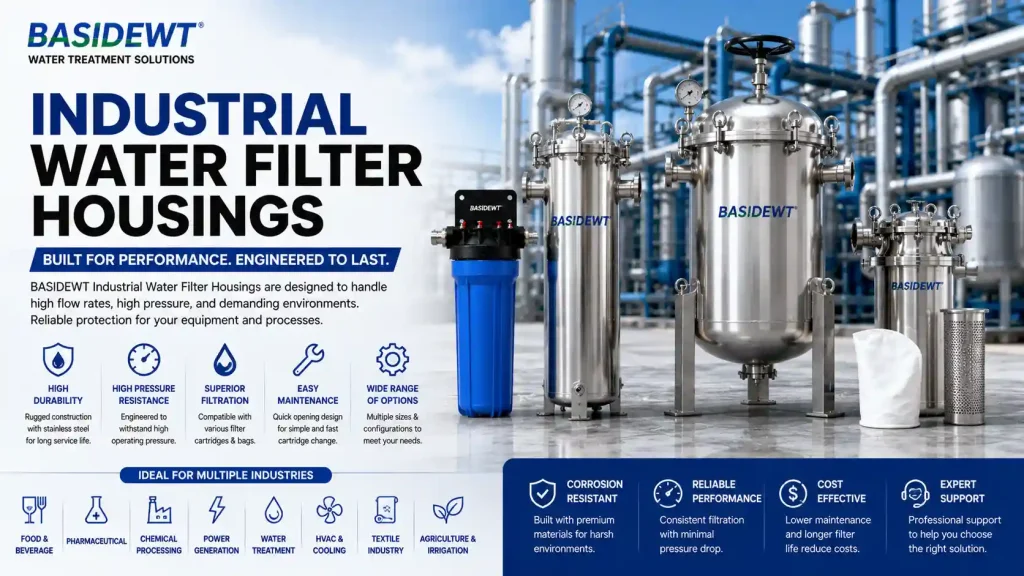
Different industries face different water challenges. As a result, filtration needs vary widely across sectors. Below, we look at ten industries where these systems play a critical role.
Food & Beverage Processing
Food and beverage plants need clean process water for washing, mixing, and cooling. Even small amounts of sediment can affect taste, appearance, or shelf life.
Bag filter housings are common here because they handle high dirt-loading capacity efficiently. Many facilities also add cartridge filtration as a polishing step before bottling or packaging.
Pharmaceutical Manufacturing
Pharmaceutical production demands extremely tight quality control. Water used in formulation, cleaning, or steam generation must meet strict purity standards.
Stainless steel housings are typically preferred in this sector. They resist corrosion, support sanitary design, and hold up well under repeated sterilization cycles.
Electronics & Semiconductor Production
Semiconductor manufacturing relies on ultra-pure water for wafer rinsing and chemical dilution. Even microscopic particles can cause defects in sensitive components.
Multi-stage filtration is standard practice here. Housings work alongside deionization and RO systems to achieve the purity levels this industry requires.
Chemical Processing
Chemical plants often deal with aggressive fluids that can corrode standard materials. Housing selection becomes especially important in this environment.
PVC, PVDF, and specialty-coated housings are frequently chosen for chemical resistance. Operators must also consider seal compatibility with the specific chemicals in use.
Power Generation
Power plants use large volumes of water for cooling and steam production. Boiler feed water must be carefully filtered to prevent scale buildup and corrosion inside boiler tubes.
High-flow filter housings are common in this setting because they manage large water volumes without creating excessive pressure drop. Our detailed high-flow water filter housing guide covers this application in greater depth.
Textile Industry
Textile dyeing and finishing processes require consistent water quality to achieve uniform color and fabric texture. Impurities in water can cause streaking or uneven dye absorption.
Cartridge and bag filter housings are both used here, often in combination, to remove fine particles before water reaches the dyeing baths.
Municipal Water Treatment
Municipal plants use filter housings as part of broader treatment trains. These systems handle pretreatment systems ahead of disinfection or advanced filtration stages.
Given the volume involved, high-flow and multi-cartridge housings are standard. Reliability and long service intervals matter greatly at this scale.
Hotels & Commercial Buildings
Large commercial buildings and hotels often install commercial water filter housing systems to protect boilers, cooling towers, and plumbing infrastructure.
These systems tend to be smaller than heavy industrial setups but still require dependable, low-maintenance performance across continuous operation.
Agriculture & Irrigation
Irrigation systems benefit from filtration by preventing clogged drip lines and sprinkler nozzles. Sediment and organic matter are common contaminants in agricultural water sources.
Bag filter housings work well here due to their high dirt-holding capacity and straightforward maintenance in field conditions.
Manufacturing Plants
General manufacturing facilities use filtration for cooling water, equipment washdown, and process support. Consistent water quality helps protect machinery and maintain product standards across shifts.
Because manufacturing environments vary so much, housing selection often depends on the specific process and available installation space.
Common Types of Industrial Water Filter Housings
Choosing the right housing type starts with understanding what each one offers. Here is a brief breakdown of the most common industrial options.
Cartridge Filter Housing
Cartridge housings hold one or more replaceable filter cartridges. They work well for moderate flow rates and fine filtration needs, particularly in pretreatment and polishing stages.
High Flow Filter Housing
Designed for large water volumes, high-flow housings use fewer, larger cartridges to reduce the physical footprint. They suit power plants, municipal systems, and other high-demand applications.
Bag Filter Housing
Bag housings use replaceable filter bags instead of cartridges. They offer excellent dirt-holding capacity and are often more economical for high-sediment water sources. Our industrial bag filter housings are built specifically for these demanding conditions.
Stainless Steel Filter Housing
Stainless steel housings handle higher pressures, higher temperatures, and corrosive environments better than plastic alternatives. For a deeper comparison, see our post on plastic vs. stainless steel water filter housing.
| Housing Type | Best For | Typical Industries |
|---|---|---|
| Cartridge Filter Housing | Fine filtration, moderate flow | Food & beverage, electronics |
| High Flow Filter Housing | Large volume, low footprint | Power generation, municipal |
| Bag Filter Housing | High dirt-loading, cost efficiency | Agriculture, textiles, chemical |
| Stainless Steel Filter Housing | High pressure, corrosive fluids | Pharmaceutical, chemical processing |
How to Select the Right Industrial Water Filter Housing
Selecting a housing involves more than picking a size off a catalog page. Several operating factors influence the right choice.
Flow rate determines how much water the housing must handle per hour. Undersized housings create excessive pressure drop, while oversized units add unnecessary cost.
Operating pressure affects material thickness and housing design. Higher-pressure systems typically require reinforced construction, often in stainless steel.
Water quality at the source shapes filtration strategy. Water with heavy sediment loads may need bag filtration first, followed by cartridge polishing.
Contaminant type matters just as much as contaminant volume. Fine particles, organic matter, and chemical residues each call for different filtration approaches.
Housing material should match the fluid’s chemical properties. Corrosive water demands corrosion-resistant materials to avoid premature failure.
Cartridge compatibility ensures the housing works with standard, widely available filter elements. This detail simplifies maintenance and reduces long-term costs.
Installation space limits which configurations are practical. Compact plants may need vertical high-flow designs rather than wide multi-cartridge arrangements.
For teams still comparing housing colors and visibility options, our article on clear vs. blue water filter housing covers that specific decision in more detail. Buyers exploring complete filtration setups can also review our industrial water filtration systems for integrated solutions.
Common Challenges in Industrial Filtration
Even well-designed systems face operational challenges. Recognizing these issues early helps prevent costly downtime.
Pressure drop increases as filters load with contaminants. If pressure drop climbs too high, flow rate drops and pumps work harder than necessary.
Fluctuating water quality at the source can overwhelm a system designed for stable conditions. Seasonal changes in raw water often require filtration adjustments.
Improper sizing remains a frequent mistake. A housing that’s too small forces frequent filter changes, while an oversized unit wastes capital.
Material incompatibility can lead to premature corrosion or seal failure, especially in chemical processing environments. Reviewing fluid compatibility before installation avoids this problem entirely.
Inconsistent maintenance schedules shorten equipment life. Without a clear maintenance plan, small issues often turn into larger, more expensive repairs.
Maintenance Best Practices
Regular maintenance keeps industrial filtration systems running efficiently. A few practical habits make a significant difference.
Monitor pressure differential across the housing regularly. A rising differential signals it’s time to replace the filter element.
Establish a replacement schedule based on water quality rather than guesswork. High-sediment sources may need weekly changes, while cleaner sources allow longer intervals.
Inspect seals and gaskets during every filter change. Worn seals are a common cause of bypass leaks that reduce filtration effectiveness.
Keep spare cartridges or bags on hand. Unplanned downtime often costs more than the filter elements themselves.
Document maintenance activity over time. This record helps identify patterns and supports better planning for future filtration needs.
Expert Recommendations
Experienced water treatment engineers generally recommend matching housing capacity to peak demand rather than average demand. This approach prevents bottlenecks during high-usage periods.
They also suggest running periodic water quality tests, even when a system seems to perform well. Small shifts in contaminant levels can indicate upstream issues before they cause equipment damage.
For facilities handling multiple contaminant types, layered filtration often works better than relying on a single stage. Combining bag pre-filtration with cartridge polishing tends to extend overall system life. According to a detailed overview from Filson Filter on bag filter housing components and applications, this staged approach is widely used across industrial fluid filtration setups because it balances dirt-holding capacity with filtration precision.
Finally, engineers recommend reviewing housing material choices whenever a process changes. A shift in chemical use or water source can quietly reduce the lifespan of an otherwise well-functioning system.
Final Thoughts
Industrial water filter housings support far more than clean water. They protect equipment, stabilize production, and reduce long-term operating costs across nearly every industrial sector.
Selecting the right housing depends on flow rate, water quality, material compatibility, and available space. Taking time to evaluate these factors upfront pays off through fewer breakdowns and more predictable performance.
If you’re ready to explore options suited to your operation, browse our full range of water filter housing solutions or check our high-flow cartridge filter housing for large-volume applications. For sediment-heavy water sources, our filter bag options offer a practical, cost-effective starting point.
RELATED POSTS
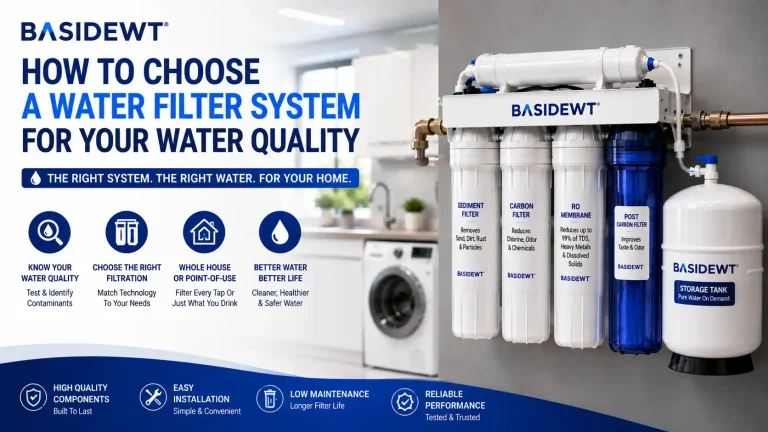
How to Choose a Water Filter System for Your Water Quality
Is Reverse Osmosis Water the Same as Distilled Water?
Water Filter Housing Installation Guide: Step-by-Step Process
UV Dose for Water Disinfection: How It Works and Why It Matters
Water Filtration Systems For Boats|BasideWT