BasideWT- Whole Home Water Filtration System & Replacement


How Does a Water Filter Housing Work? Step-by-Step Guide
A water filter housing works by receiving water through an inlet port, forcing it through a sealed filter cartridge under pressure, and releasing the treated water through an outlet port. The housing itself does not remove contaminants. That job belongs to the cartridge sitting inside it. The housing’s role is to hold the cartridge in place, seal the system against leaks, and control how water moves through it.
That sounds simple. In practice, the way a water filter housing works involves a chain of small mechanical details — seal compression, flow direction, pressure differential — that decide whether a filtration system performs well or fails quietly. This guide walks through that chain step by step, from the moment water enters the cap to the moment it leaves the outlet.
The Housing’s Job: Contain, Direct, and Seal
Before looking at the process, it helps to separate two jobs that often get confused.
The filter cartridge removes sediment, chlorine taste, or other contaminants, depending on the media inside it. The water filter housing does something different. It contains the cartridge, directs the flow path, and keeps the whole assembly sealed under working pressure.
If you’re still unclear on what a water filter housing actually is before diving into mechanics, our beginner’s guide to water filter housings covers the basic definition and terminology in more depth.
Once you understand that split — housing contains and directs, cartridge filters — the rest of the working principle becomes much easier to follow.
Step-by-Step: How Water Moves Through the Housing
Here is what actually happens, in order, from inlet to outlet.
- Water enters through the inlet port. This is usually located on the housing cap, sometimes labeled “IN.” Supply-line pressure pushes water into the chamber.
- Water flows down into the bowl. The cap threads onto a bowl (also called the sump), and water travels down the outer wall of the bowl, around the outside of the cartridge.
- Water passes through the cartridge from outside to inside. For most standard cartridges, filtration happens as water moves inward, through the filter media, toward a hollow core.
- Filtered water rises through the cartridge core. Once inside the hollow center, water travels upward, back toward the cap.
- Water exits through the outlet port. From there, it continues into your plumbing, appliance, or downstream filtration stage.
This inside-out flow path is the standard design for sediment and carbon block cartridges. A small number of specialty cartridges reverse this direction, but the outside-to-inside path is what you’ll find in the large majority of residential and commercial systems.
Inside the Housing: What Each Component Actually Does
Every water filter housing, regardless of size or material, relies on the same core parts working together. The table below breaks down what each one does during operation.
| Component | Function During Operation |
|---|---|
| Housing cap | Holds the inlet and outlet ports; seals onto the bowl |
| Housing bowl (sump) | Holds the cartridge and contains water under pressure |
| O-ring | Creates a watertight seal between cap and bowl |
| Inlet port | Where unfiltered water enters the housing |
| Outlet port | Where filtered water exits the housing |
| Filter cartridge | Physically captures contaminants as water passes through |
| Support post or standpipe | Positions the cartridge and directs the internal flow path |
| Pressure release button (some models) | Releases trapped pressure before the housing is opened |
None of these parts filter water on their own except the cartridge. But if any one of them fails — a worn O-ring, a cracked bowl, a misaligned support post — filtration performance drops even if the cartridge inside is brand new. If you’re comparing specific housing models and their build quality, our water filter housing product range shows the component differences across sizes and materials.
Where Filtration Actually Happens: The Cartridge’s Role
The housing creates the conditions for filtration. The cartridge does the filtering.
As water pushes through the filter media, physical filtration traps particles larger than the cartridge’s micron rating. A 5-micron sediment cartridge, for example, physically blocks particles above roughly 5 microns while allowing water molecules to pass through the spaces in the media.
Some cartridges also use adsorption. Activated carbon media pulls chlorine, certain organic compounds, and taste-and-odor causing substances onto its surface as water passes through, rather than physically blocking them by size alone.
This matters for understanding how a water filter housing works, because the housing’s internal geometry — chamber diameter, flow path length, cartridge fit — determines how much contact time water gets with the media. A housing that’s too large for its cartridge can let water find shortcuts around the filter instead of through it. Browsing the available filter cartridge options is worthwhile before assuming a housing problem is actually a cartridge mismatch.
Single-Stage vs. Multi-Stage Operation
A single-stage housing runs water through one cartridge before it exits. This works well for straightforward jobs, like removing sediment ahead of a water heater.
A multi-stage setup connects two or three housings in a series. Water exits the first housing’s outlet and flows directly into the next housing’s inlet. Each stage typically targets something different:
- Stage 1 often handles sediment and larger particles.
- Stage 2 often handles chlorine, taste, and odor using carbon media.
- Stage 3 (when present) often polishes the water with a finer micron rating.
The working principle inside each individual housing doesn’t change. What changes is that water passes through the same inlet-to-outlet cycle multiple times, with each cartridge tuned to a narrower job. Whole-home systems commonly use this staged approach so that every fixture in the building receives water that’s already passed through several filtration steps. Our whole house filtration systems page shows how these stages are typically configured for full-property coverage.
Pressure and Flow Rate: How They Shape Performance
Water filter housings are pressure vessels, so pressure and flow rate directly affect how well they work.
Flow rate is how much water moves through the housing per minute. Every cartridge has a maximum rated flow rate. Push more water through than the cartridge is rated for, and contact time with the filter media drops, which can reduce filtration quality even though water still looks clear.
Differential pressure (sometimes called pressure drop) is the difference between inlet pressure and outlet pressure. A clean cartridge causes a small, predictable pressure drop. As the cartridge loads with trapped particles, resistance increases and differential pressure climbs.
| Flow Condition | Likely Effect on the Housing |
|---|---|
| Flow rate within cartridge rating | Normal filtration, stable pressure drop |
| Flow rate exceeds cartridge rating | Reduced contact time, weaker filtration |
| Low inlet pressure | Reduced flow to fixtures, possible air pockets |
| Rising differential pressure over time | Cartridge is loading and approaching replacement |
| Sudden pressure spike | Possible seal stress or water hammer risk |
Regional water quality also plays a role here. Source water hardness, sediment load, and chlorine dosing vary significantly across Chinese municipalities, and these factors influence how quickly a cartridge loads and how differential pressure behaves over time. China’s national drinking water quality framework, summarized in a technical overview by the <cite index=”10-1″>Chinese Center for Disease Control and Prevention</cite>, gives useful context on how source water standards are set and revised, which helps explain why filtration performance can vary from one region to another.
What Happens as the Cartridge Loads With Contaminants
Filtration performance isn’t static. It shifts as the cartridge captures more material over its service life.
| Condition | Clean Cartridge | Loaded Cartridge |
|---|---|---|
| Differential pressure | Low and stable | Rising, sometimes sharply |
| Flow rate at fixtures | Normal | Gradually reduced |
| Filtration quality | At rated performance | May decline near end of life |
| Risk of bypass | Low | Higher if seals are compressed unevenly |
A heavily loaded cartridge doesn’t usually fail all at once. It typically shows a gradual drop in flow first, which is often the earliest sign that replacement is due — well before water quality visibly changes.
Seeing the Process: Why Clear Housings Are Useful
Because most of this process happens inside a sealed, opaque bowl, it’s easy to forget how much is going on during normal operation. Clear or translucent housings solve that visibility problem.
With a transparent bowl, you can watch sediment accumulate on the cartridge surface in real time. This is particularly useful for installers and facility managers who want to verify that water is actually flowing through the media correctly, rather than bypassing it. Our clear water filter housing line is built specifically for this kind of visual monitoring in light residential and point-of-use applications.
High-Flow Applications: Commercial and Industrial Behavior
The working principle stays the same in larger systems, but the scale changes considerably.
Commercial buildings — restaurants, hotels, office towers — often need housings that support significantly higher flow rates than a residential setup, since multiple fixtures may run simultaneously. Industrial facilities push this further, using housings for process water, cooling loops, or pretreatment ahead of reverse osmosis membranes.
In these settings, the housing has to maintain consistent differential pressure across a much wider flow range without letting water bypass a loading cartridge. Undersized housings in commercial settings are a common cause of pressure complaints that have nothing to do with the building’s plumbing. For applications where flow demand is the main constraint, high flow cartridge filter housings are engineered around larger cartridge diameters specifically to handle that demand.
When the Working Process Breaks Down
Understanding how a water filter housing works also means understanding how it stops working correctly. A few common failure points show up repeatedly in the field.
- Bypass around the cartridge. If the cartridge doesn’t seat correctly against the support post, water can slip around the media instead of through it. Water looks filtered, but part of the flow never actually passed through the cartridge.
- O-ring failure. A dry, cracked, or improperly seated O-ring lets water leak at the cap-to-bowl joint, sometimes slowly enough to go unnoticed for weeks.
- Reversed flow direction. Installing the housing with inlet and outlet swapped can force water through the cartridge backward, which most cartridges aren’t designed for.
- Wrong cartridge size for the housing. A cartridge that’s too short or too narrow leaves gaps for unfiltered water to travel around instead of through the media.
None of these problems are usually visible from the outside. They tend to show up first as a pressure or flow change, not a leak.
Recognizing Normal vs. Abnormal Operation
A housing that’s working correctly usually shows a few consistent signs: steady flow at the fixtures, no visible leaks at the cap or fittings, and a slow, predictable rise in pressure drop over the cartridge’s rated life.
Abnormal operation tends to show up as a sudden pressure drop increase, a noticeable flow reduction well before the cartridge’s expected service interval, visible moisture around the housing joint, or water that looks or tastes different from what the cartridge is rated to remove. Any of these point back to one of the failure modes above, rather than to the filtration media itself.
Practical Examples Across Applications
A single-stage housing under a kitchen sink, fed by household pressure around 40–60 psi, filters drinking water for one point of use with relatively low, steady flow demand.
A whole-house setup at the main line sees intermittent but higher-volume demand — a shower running at the same time as a washing machine, for instance — which is why housing and cartridge sizing matters more at this scale.
A commercial kitchen protecting an ice machine and espresso equipment needs steady filtration with minimal pressure drop, even during peak service hours, since equipment performance depends on consistent flow.
An industrial pretreatment line ahead of a reverse osmosis system needs housings that reliably protect downstream membranes from sediment, since RO membrane replacement is far more costly than a cartridge change. For a broader look at how housing size, material, and configuration should be matched to these different applications, the complete water filter housing buying guide covers selection criteria in more detail.
Conclusion
At its core, a water filter housing works through a straightforward mechanical sequence: water enters the inlet, flows around and through a sealed cartridge, and exits through the outlet as filtered water. The housing doesn’t remove contaminants itself — it creates the sealed, pressurized environment that lets the cartridge do that job correctly.
What determines whether this process actually performs well isn’t the housing alone. It’s the combination of cartridge type, micron rating, flow rate, pressure, and water quality working together inside that housing. A well-sealed housing with the wrong cartridge, or the right cartridge running at too high a flow rate, will both underperform in different ways.
If you’re specifying or troubleshooting a filtration system and want housings matched correctly to your flow, pressure, and cartridge requirements, BasideWT’s team can help you work through the sizing and configuration details for residential, commercial, or industrial applications.
RELATED POSTS
Water Filter System Maintenance: Complete Care Guide
Water Filter Housing Materials: Plastic vs Stainless Steel – Which Is Better?
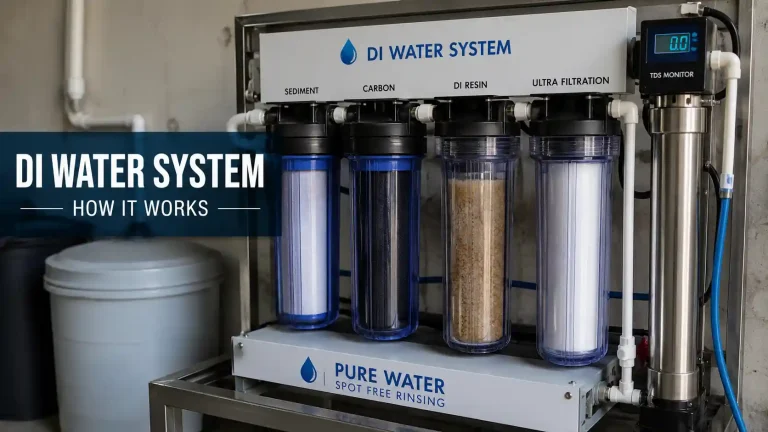
DI Water System Explained: How It Really Works
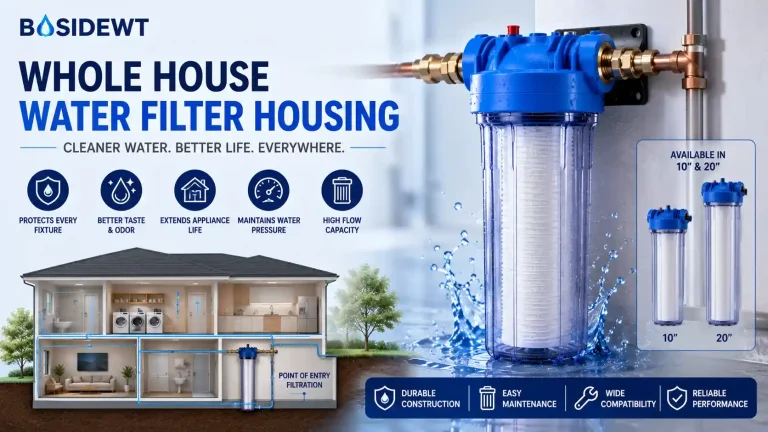
Whole House Water Filter Housing: Benefits, Types & Buying Guide
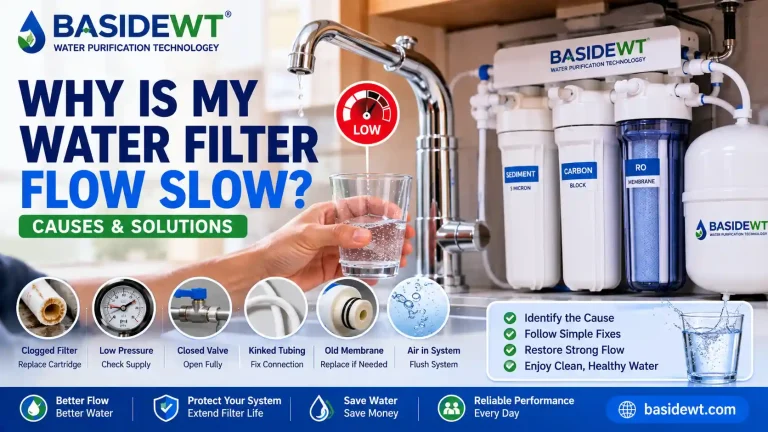
Why Is My Water Filter Flow Slow? Causes & Solutions