BasideWT- Whole Home Water Filtration System & Replacement


UV Water Sterilizer vs UV Water Purifier: What Is the Difference?
A UV water sterilizer and a UV water purifier are usually the same core technology sold under two different names. Both rely on ultraviolet light to inactivate bacteria, viruses, and other microorganisms in water. The real differences, when they exist, come from how a supplier packages the system, what pretreatment is included, and which market the term is popular in — not from a separate disinfection method. Understanding this distinction matters more for buyers, installers, and OEM specifiers than for the technology itself, since choosing the right system depends on UV dose, flow rate, and water quality rather than on which word appears on the label.
This article breaks down what each term actually means in practice, how UV disinfection works, what it can and cannot do, and how to evaluate a system correctly regardless of what it’s called.
Are UV Water Sterilizers and UV Water Purifiers Different Technologies?
In most cases, no. Both terms describe a system that passes water past a UV-C lamp inside a sealed reactor chamber. The UV-C light damages the genetic material of microorganisms so they can no longer reproduce or cause infection.
“Sterilizer” tends to appear more often in industrial, laboratory, and technical specification contexts, where the emphasis is on microbial inactivation performance. “Purifier” is more common in residential and consumer marketing, where buyers associate the word with an overall clean-water outcome.
The terminology gap matters because “purifier” can create a false impression. A system branded as a UV water purifier may still only disinfect water. It typically does not remove sediment, dissolved minerals, heavy metals, or chemical contaminants unless it is bundled with separate filtration stages. Reviewing our UV water sterilizer beginner’s guide is a useful next step if you’re new to how these systems are built.
How UV Disinfection Actually Works
UV-C light sits in the 200–280 nanometer wavelength range, with germicidal output concentrated around 254 nm. When water flows through the reactor, microorganisms pass close enough to the lamp to absorb this energy.
The UV-C radiation disrupts the DNA and RNA inside bacteria, viruses, and protozoa. This prevents the organism from replicating. It does not “kill” the microbe in a chemical sense; it deactivates its ability to cause infection. This is why UV treatment is described as inactivation rather than removal.
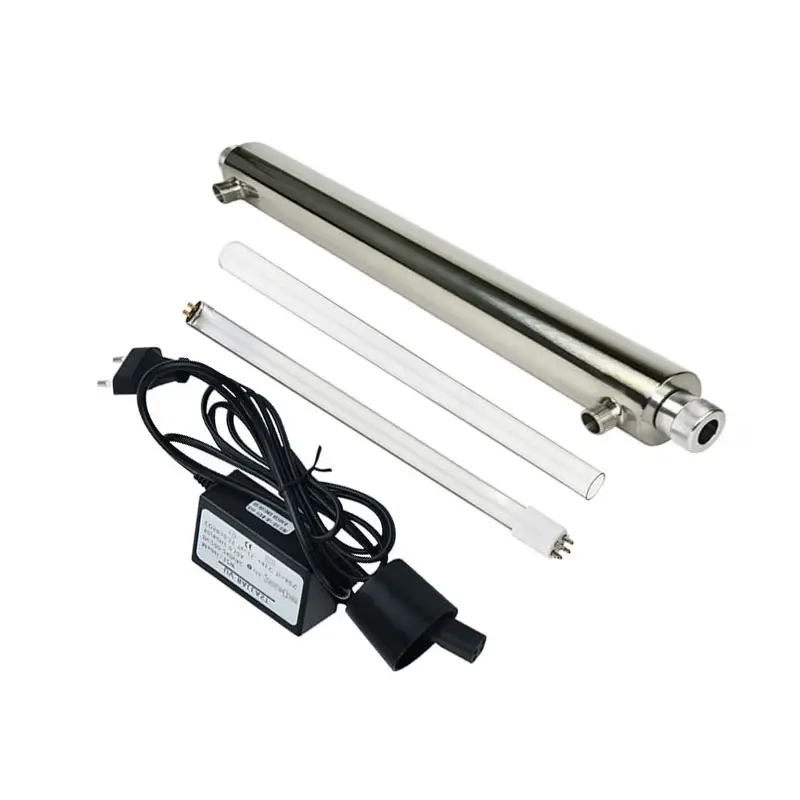
Key components in a typical reactor include:
- A UV-C lamp (low-pressure or medium-pressure)
- A quartz sleeve that protects the lamp while allowing UV light to pass through
- A stainless steel reactor chamber that directs water flow around the lamp
- A UV sensor and controller, on higher-end systems, to monitor output
None of these components physically filter the water. That distinction is central to understanding both terms.
UV Dose: The Factor That Actually Determines Performance
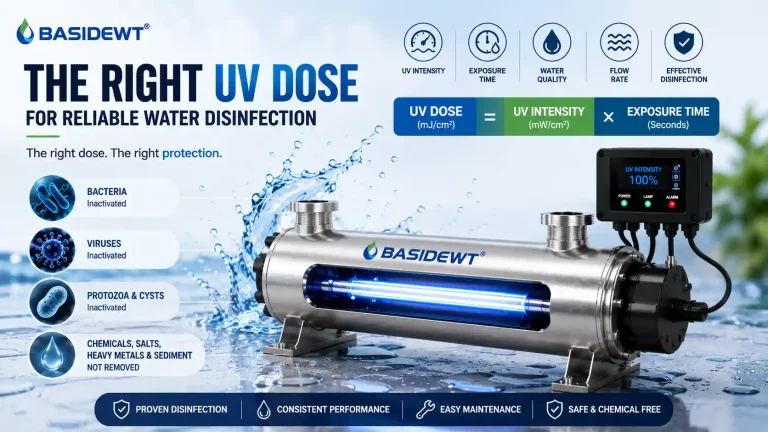
Marketing language aside, the number that matters is UV dose, sometimes called fluence. UV dose is a function of UV intensity and exposure time, and it is usually expressed in mJ/cm².
A higher dose generally achieves a greater log reduction of pathogens. However, actual dose requirements vary by microorganism, by regulatory standard, and by manufacturer design. There is no single universal dose that applies to every application, so credible suppliers publish dose ratings tied to specific flow rates and validated performance data rather than vague claims.
Buyers comparing a “UV sterilizer” against a “UV purifier” should ask for the manufacturer’s tested dose at the system’s rated flow rate. This single data point tells you more about real performance than either product name does.
Why Flow Rate Changes Everything
UV dose and flow rate are directly linked. As water moves faster through the reactor chamber, it spends less time near the lamp, which lowers the dose it receives.
This is why a UV system rated for a specific flow — say, a household point-of-entry unit — cannot simply be scaled up for a commercial kitchen or an industrial process line without recalculating dose delivery. Oversizing flow beyond a system’s rated capacity is one of the most common causes of underperformance in the field.
Our guide on how a UV water sterilizer works step by step walks through the flow and dose relationship in more depth.
Water Clarity and UV Transmittance
UV light needs a clear path to reach microorganisms. Two factors interfere with that path:
Turbidity and suspended solids — Particles in the water can shield microorganisms from UV exposure, sometimes called “shadowing.” Even organisms directly exposed to UV nearby may survive if they are shielded by debris.
UV transmittance (UVT) — This measures how much UV light actually passes through a given depth of water, expressed as a percentage. Lower UVT means less light reaches the far side of the reactor chamber, reducing effective dose even if the lamp output stays the same.
Because of this, water quality directly affects disinfection performance, independent of whether the system is called a sterilizer or a purifier.
Why Pretreatment Is Often Non-Negotiable
Most manufacturers specify a maximum turbidity and a minimum UVT for reliable operation. When raw water falls outside those limits, pretreatment becomes necessary before UV disinfection.
Common pretreatment steps include:
- Sediment filtration to reduce suspended solids
- Iron and manganese removal, since these minerals can foul the quartz sleeve and reduce light transmission
- Water softening, in cases of high hardness that contributes to scale buildup
- Carbon filtration, for taste, odor, or chlorine reduction ahead of the UV stage
Skipping pretreatment on poor-quality source water is one of the leading causes of UV system underperformance, regardless of the product name on the housing.
What UV Treatment Cannot Do
This point gets blurred often in consumer marketing, and it deserves direct clarification.
UV disinfection does not remove:
- Dissolved salts or minerals
- Heavy metals
- Chemical contaminants, including pesticides or PFAS
- Sediment, rust, or turbidity
- Taste, odor, or color issues
A system marketed as a UV purifier that also addresses these issues is doing so through additional filtration stages bundled into the same housing, not through the UV lamp itself. If a facility or household needs broader contaminant removal, technologies such as reverse osmosis, activated carbon, or ion exchange typically need to be paired with UV rather than replaced by it.
Practical Comparison: Terminology and Function
| Factor | “UV Water Sterilizer” (typical usage) | “UV Water Purifier” (typical usage) |
|---|---|---|
| Core technology | UV-C lamp and reactor chamber | Same UV-C lamp and reactor chamber |
| Common context | Industrial, commercial, technical specs | Residential, consumer marketing |
| Microbial disinfection | Yes, dose-dependent | Yes, dose-dependent |
| Physical filtration | Not included unless specified | Sometimes bundled with carbon or sediment stages |
| Dissolved contaminant removal | No | No, unless paired with RO or similar |
| Pretreatment requirement | Same UVT and turbidity limits apply | Same UVT and turbidity limits apply |
| Typical buyer | Engineers, OEMs, facility managers | Homeowners |
Suppliers do not apply this terminology consistently, so always confirm system scope through the technical datasheet rather than the product name alone.
Residential vs Commercial and Industrial Applications
Household systems usually sit at the point of entry or point of use, treating water for drinking, cooking, or general household supply. Flow rates are modest, and single-lamp reactors are common.
Commercial and industrial applications, including food and beverage processing, pharmaceutical water, and municipal reuse, often demand higher flow capacity, redundant lamps, UV intensity monitoring, and validated dose delivery under variable flow conditions. Facility managers and OEM buyers typically require documented performance data rather than general marketing claims, since regulatory and quality standards may apply.
Our UV water sterilizer pillar guide covers system types across both segments in greater detail.
When UV Treatment Is the Right Fit — and When It Isn’t
UV disinfection is a strong fit when:
- Microbial contamination is the primary concern
- Source water already meets turbidity and UVT requirements, or can be economically pretreated
- Flow rate stays within the system’s validated range
- Chemical-free treatment is preferred for taste or environmental reasons
Additional treatment is usually necessary when:
- Source water contains high sediment, iron, or hardness
- Dissolved contaminants such as salts, heavy metals, or chemicals are present
- Water needs aesthetic improvement, such as taste, odor, or color correction
Recognizing these boundaries prevents both underperformance and unnecessary spending on oversized systems.
How to Evaluate Supplier Specifications Correctly
When comparing systems labeled as either sterilizers or purifiers, request the following from the supplier:
- Validated UV dose at rated flow rate
- Maximum operating flow rate
- Minimum required UVT
- Maximum turbidity tolerance
- Lamp type and expected service life under normal operating conditions
- Whether a UV sensor or dose-monitoring system is included
According to the International Ultraviolet Association, regulatory bodies generally reference a UV dose around 40 mJ/cm² to achieve substantial pathogen inactivation, though exact requirements vary by application and jurisdiction. This kind of independent reference point is useful for sanity-checking supplier claims, though final system selection should always be based on your specific water quality report and application requirements.
Conclusion
A UV water sterilizer and a UV water purifier generally rely on the same underlying technology: ultraviolet light disinfecting water inside a sealed reactor. The difference is mostly one of terminology, shaped by market, audience, and how a supplier packages the system rather than by a fundamentally different treatment process.
What determines real-world performance is UV dose, flow rate, water clarity, and appropriate pretreatment — not the label on the unit. Buyers, installers, and facility managers get better outcomes by reviewing validated specifications rather than relying on product naming alone.
At BasideWT, we design UV water treatment systems around documented dose and flow performance. This helps customers choose the right solution for residential or commercial applications.
If you’re evaluating a UV water sterilizer or purifier, first review your water quality and flow requirements. Then compare them with the supplier’s tested specifications.
RELATED POSTS
UV Water Sterilizer for Well Water: Selection and Application Guide
Best Spot Free Water System for Car Wash: A Complete Buying Guide
UV Dose for Water Disinfection: How It Works and Why It Matters
How Much Is a Water Softener? Complete 2026 Cost Guide
Types of RO Water Systems: Which One Is Right for Your Needs?