BasideWT- Whole Home Water Filtration System & Replacement


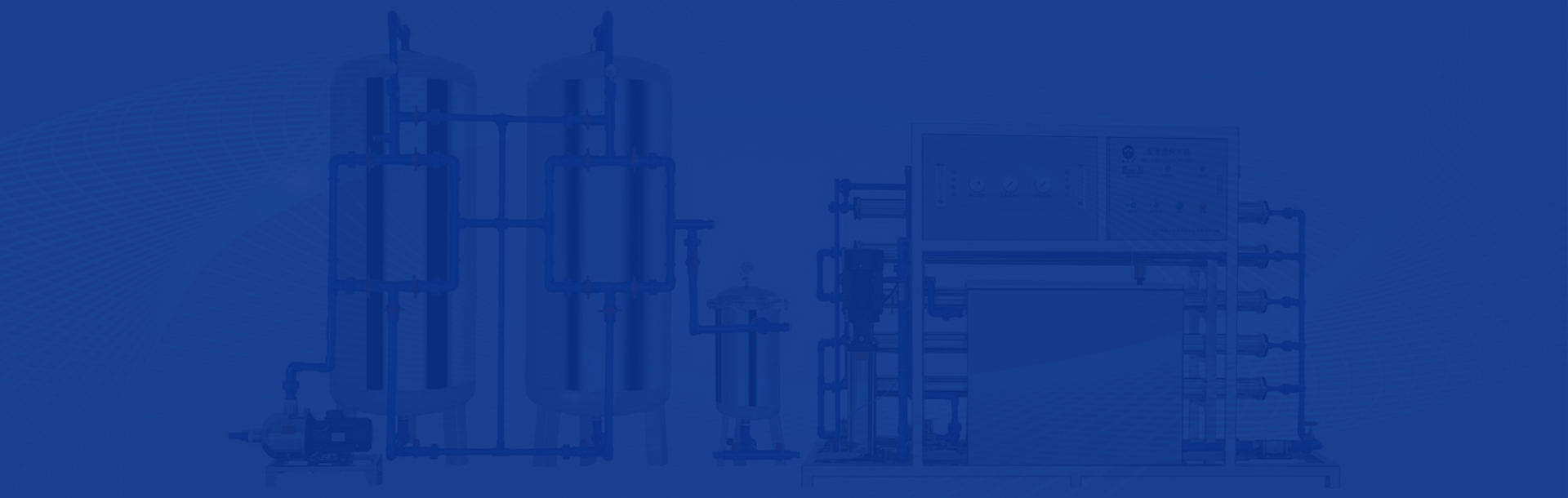
Water Softener System for Well Water: Benefits, Problems & How to Choose the Right One
A water softener system for well water solves a problem that city water users rarely face. Well water travels through rock and soil before it reaches your tap, and along the way it picks up calcium, magnesium, and often iron. This natural filtration process makes groundwater mineral-rich, which is why well owners deal with scale, stains, and appliance wear far more often than municipal water customers.
If you rely on a private well, understanding how hardness forms and how to treat it correctly can save you thousands of dollars in plumbing repairs. This guide explains why well water needs specialized treatment, what a softener can and cannot remove, and how to choose a system that actually matches your water quality.
Consider a family in a limestone-heavy region who noticed white crusting on faucets and a water heater that failed after only six years. A simple hardness test revealed 22 grains per gallon, well above the level standard fixtures are built to handle. Once they installed a correctly sized softener, the scaling stopped and their new water heater lasted far longer than the previous one.
Why Well Water Needs Special Treatment
Groundwater sits underground for years, sometimes decades, before it reaches a well. During that time, it moves through limestone, sandstone, and other mineral-rich formations. As a result, hard well water is the norm rather than the exception in most regions.
Unlike municipal supplies, well water receives no pretreatment before it reaches your home. Consequently, whatever minerals and contaminants exist in your local aquifer end up directly in your plumbing. This makes a water softener system for well water a practical necessity in many households, not just a convenience upgrade.
Common Well Water Quality Issues
Well owners typically encounter a mix of hardness minerals, dissolved metals, and occasional bacterial concerns. Calcium and magnesium are the most frequent culprits behind scale buildup. However, iron, manganese, and sulfur compounds also show up regularly in groundwater samples.
These issues rarely appear alone. For example, a well with high hardness often also carries measurable iron, which changes how you should approach treatment. Testing your water first, before buying equipment, prevents costly guesswork.
Seasonal changes can shift these readings too. Heavy rainfall or spring snowmelt sometimes raises sediment and turbidity temporarily, while dry summer months can concentrate dissolved minerals as the water table drops. Retesting periodically, rather than relying on a single sample from years ago, gives a more accurate picture of what your treatment system actually needs to handle.
Hard Water vs Other Contaminants
Hardness is a mineral concentration issue, while iron, manganese, and sulfur are considered separate contaminant categories. Each requires a different treatment approach, and confusing them leads to underperforming systems. A hard well water sample might look clear, yet still leave mineral deposits on fixtures.
Iron and sulfur, meanwhile, often bring visible staining or a rotten-egg odor. Recognizing which problem you actually have is the first step toward choosing the correct filtration equipment, whether that means a softener alone or a combination system.
How a Water Softener System Helps Well Water
A properly sized well water softener addresses the core mineral problem that causes most plumbing headaches. It works through ion exchange, swapping calcium and magnesium ions for sodium or potassium ions as water passes through resin beads. This process is well established and widely used across residential and commercial applications.
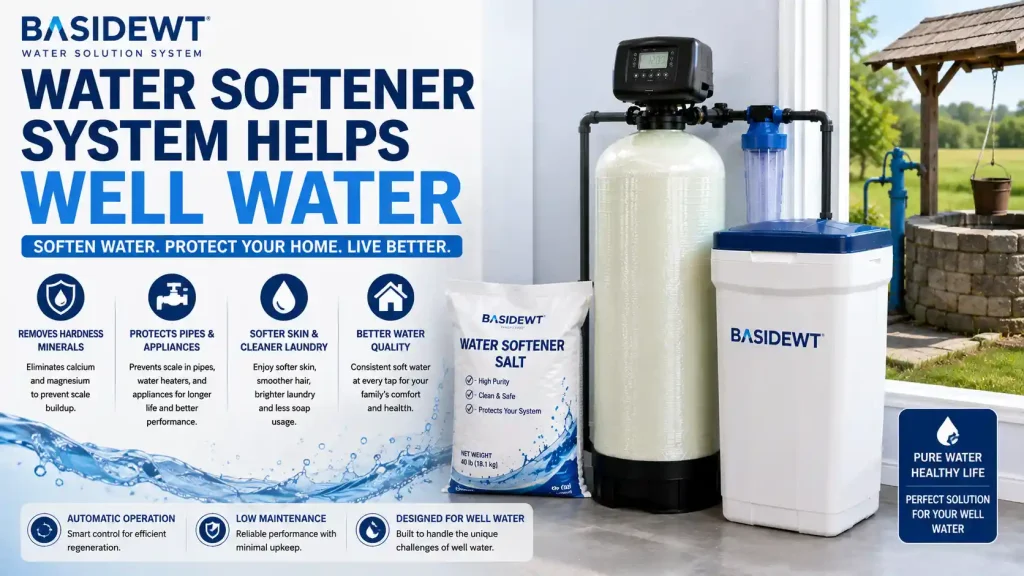
For well water specifically, softening also protects the pressure tank, pump components, and fixtures from scale accumulation. Because well systems already work harder to move water through the home, reducing mechanical strain matters even more than it does with municipal supplies.
Removing Hardness Minerals
The resin bed inside a softener captures calcium and magnesium as water flows through it. Once the resin reaches capacity, the system automatically regenerates using a brine solution, restoring its exchange ability. This cycle repeats continuously without manual intervention.
For homes on hard well water, this means consistently soft water at every tap. Soap lathers properly, dishes come out spot-free, and skin and hair feel noticeably different after switching from untreated water.
Protecting Plumbing and Appliances
Scale buildup narrows pipe diameter over time, which reduces water pressure and increases strain on your well pump. Water heaters suffer the most, since heated hard water accelerates mineral crystallization inside the tank. Reduced efficiency and shortened appliance lifespan often follow.
A whole house water softener prevents this deterioration by treating water at the point of entry. Every fixture, appliance, and pipe downstream benefits from the same protection, rather than relying on separate point-of-use filters scattered throughout the home.
Can a Water Softener Remove Iron, Manganese, and Sulfur?
This question comes up constantly among well owners, and the honest answer is: partially, and only under specific conditions. Standard softening resin can handle small amounts of dissolved iron, typically under 2 to 3 parts per million, alongside hardness removal. Beyond that threshold, performance drops significantly.
Manganese behaves similarly, but its acceptable removal range through standard resin is even narrower. Sulfur, on the other hand, generally requires an entirely different treatment method rather than a softener adjustment.
What It Can Remove
A quality softener can manage light to moderate iron in well water when the iron stays in its dissolved, clear-water form. The resin captures it alongside calcium and magnesium during the normal ion exchange cycle. This works well for wells with consistently low mineral readings.
However, once iron oxidizes and turns reddish or particulate, softening resin becomes far less effective. At that point, the iron coats the resin beads rather than passing through them cleanly, which reduces softening capacity over time.
What Requires Additional Filtration
High iron levels, visible manganese staining, or sulfur odor typically call for dedicated pretreatment equipment. Iron filters, oxidation systems, or aeration units address these contaminants before water reaches the softener. This sequencing protects the resin bed and extends its usable life.
According to the National Ground Water Association’s consumer resource on well water testing, annual testing helps homeowners catch changes in contaminant levels before they damage treatment equipment, which is a useful habit for any well owner planning a filtration upgrade (Wellowner.org, an NGWA program).
Choosing the Right Water Softener System for Well Water
Selecting the correct unit involves more than picking a popular brand. Well water conditions vary dramatically by region, so the right water softener system depends on your specific test results, household demand, and existing plumbing setup. Skipping this evaluation often leads to premature replacement.
Four factors matter most when narrowing down your options: capacity, resin quality, control valve technology, and confirmed water testing. Each one directly affects how well the system performs over its lifespan.
Capacity
Capacity determines how much hardness the resin can remove before regeneration is required. Well water with higher mineral content demands a larger capacity rating than typical municipal water. Undersizing a system leads to frequent regeneration cycles and premature resin wear.
If you want a deeper breakdown of sizing calculations based on household size and grain hardness, our sizing guide walks through the process step by step.
Resin Quality
Not all resin performs equally well against iron fouling. High-crosslink resin resists degradation better and tolerates occasional iron exposure more effectively than standard-grade resin. For well water applications, this durability difference translates into longer service intervals.
Cheaper resin may soften water initially, but it often loses capacity faster under well water conditions. Investing in quality resin upfront typically costs less than repeated replacements down the road.
Control Valve
The control valve manages regeneration timing and water flow through the system. Well water households benefit most from demand-initiated valves, which regenerate based on actual usage rather than a fixed schedule. This approach conserves salt and water while adapting to fluctuating well output.
Digital valves also allow more precise hardness settings, which matters when your well water tests show unusually high mineral concentrations compared to average municipal supplies.
Water Testing Before Purchase
Before buying any equipment, get a certified water test covering hardness, iron, manganese, pH, and total dissolved solids. This single step prevents the most common purchasing mistake: buying a softener sized for average water when your well produces something entirely different.
| Test Parameter | Why It Matters | Typical Well Water Range |
|---|---|---|
| Hardness (GPG) | Determines softener capacity | 7–25+ GPG |
| Iron (PPM) | Affects resin fouling risk | 0–10+ PPM |
| Manganese (PPM) | Signals need for pretreatment | 0–2 PPM |
| pH Level | Impacts equipment corrosion | 6.0–8.5 |
Do You Need Additional Filtration?
Many well owners assume a softener alone solves every water quality issue, but that is rarely the case. Sediment, chlorine byproducts, and pathogens fall outside a softener’s design purpose entirely. Layering the right filtration stages produces noticeably better results.
A sediment filter placed before the softener protects the resin from sand, silt, and debris common in well systems. Carbon filtration, meanwhile, addresses taste and odor concerns that softening cannot touch.
For wells with elevated iron or manganese, a dedicated iron filter installed upstream prevents resin fouling and extends softener lifespan significantly. UV sterilizers add a layer of protection against bacteria, which matters for wells without consistent chlorination. Households wanting the highest purity for drinking water sometimes add reverse osmosis at the kitchen tap as a final polishing step.
| Treatment Stage | Targets | Placement |
|---|---|---|
| Sediment Filter | Sand, silt, debris | Before softener |
| Iron Filter | Iron, manganese | Before softener |
| Water Softener | Calcium, magnesium | Whole house |
| Carbon Filter | Taste, odor, chlorine | After softener |
| UV Sterilizer | Bacteria, viruses | Point of entry |
| Reverse Osmosis | Dissolved solids, remaining contaminants | Point of use |
This staged approach mirrors what most water treatment engineers recommend for private wells, since each device handles a narrow contaminant category rather than attempting to do everything at once.
A rural homeowner with 4 PPM iron and moderate hardness learned this the hard way after installing a softener alone. Within four months, the resin had fouled and hardness readings crept back up at every faucet. Adding an iron filter ahead of the softener resolved the issue permanently and restored consistent soft water throughout the house.
Common Mistakes Well Water Owners Make
Buying without testing water first ranks among the most frequent errors. Homeowners often purchase a system based on neighbor recommendations or general assumptions about hardness, then discover their actual mineral content differs substantially. This mismatch shortens equipment lifespan and reduces performance.
Another common mistake involves ignoring iron levels entirely. A softener installed without iron pretreatment on iron-heavy water will foul quickly, leading to hard water breakthrough within months rather than years.
Undersizing capacity to save money upfront also backfires. Frequent regeneration cycles waste salt and water, and the extra wear shortens the resin’s functional life. Reviewing our guide on choosing the right water softener system can help you avoid these sizing pitfalls before you commit to a purchase.
Finally, some owners skip routine maintenance after installation, assuming the system runs indefinitely without attention. Salt levels, resin condition, and valve settings all need periodic checks to keep performance consistent over the years. Our maintenance guide outlines a simple schedule that keeps well water systems running efficiently.
Best Applications
Water softener systems for well water serve a wide range of settings beyond typical single-family homes. Understanding which application fits your situation helps clarify capacity and configuration needs.
Residential: Single-family homes on private wells represent the most common use case, typically requiring whole-house units sized for daily household demand.
Commercial: Small businesses, restaurants, and offices on well systems need higher-capacity units with demand-initiated regeneration to handle variable daily usage.
Agricultural: Livestock operations and irrigation systems sometimes require softening to protect equipment and improve water usability, though capacity needs scale dramatically with volume.
Light Industrial: Facilities using well water for processing or equipment cooling benefit from softening to prevent scale-related downtime and maintenance costs.
Distributors and OEM buyers sourcing equipment for these applications should pay close attention to build quality, since well water often runs harder and more mineral-dense than the municipal water most standard units are tested against. A system designed with well conditions in mind, rather than adapted from a municipal-only product line, tends to hold up better across all four use cases listed above.
Final Buying Recommendations
Choosing the right water softener system for well water ultimately comes down to matching equipment to your actual test results, not marketing claims on a product box. A softener rated for “average” hardness may perform poorly against your specific well chemistry.
Start with certified testing, then evaluate whether pretreatment for iron or manganese is necessary before the softener stage. From there, prioritize capacity, resin quality, and valve technology suited to your household or facility demand. For a broader overview of system types and buying considerations across the entire category, our pillar guide on water softener systems covers the full decision process in more depth.
Avoid choosing equipment based solely on price, since the cheapest unit rarely accounts for the mineral load typical of groundwater. Instead, compare warranty terms, resin specifications, and valve type across a few reputable manufacturers before deciding. If you already know a softener is fouling faster than expected or leaving residual hardness, our guide on common water softener problems can help diagnose the cause before you invest in a replacement.
If you are ready to explore equipment options built specifically for demanding well water conditions, our water softener systems are engineered for reliable performance across residential, commercial, and light industrial applications. Getting this decision right the first time saves both money and frustration for years to come.