BasideWT- Whole Home Water Filtration System & Replacement

DI Water System Explained: How It Really Works
Have you ever watched a car dry without a single water spot? Or seen a window cleaner skip the squeegee entirely? You’ve just seen a DI water system at work. Most people assume that result comes from special soap or a clever trick. It doesn’t. It comes down to what’s actually dissolved in the water itself.
A DI water system, short for deionized water system, removes the minerals that cause spotting in the first place. Once you understand this process, a lot about water treatment starts making sense. You’ll see why some tap water leaves chalky residue. You’ll also see why laboratories demand extremely pure water for their equipment. This guide walks through the mechanics behind it, along with the common points of confusion and the practical realities of owning one of these systems.
Quick answer: A DI water system uses ion exchange resin to strip dissolved minerals like calcium and magnesium from water. This produces water with near-zero total dissolved solids. Nothing remains behind to crystallize as the water evaporates, so surfaces rinsed with DI water dry completely spot-free.
What Exactly Is a DI Water System?
Deionization is a purification process, not filtration in the way most people picture it. Instead of straining particles out physically, a DI water system pulls dissolved ions out of the water chemically.
Those ions include calcium, magnesium, sodium, and a handful of others that make up what we casually call “hardness.” Once they’re gone, the water has almost nothing dissolved in it. Technicians often measure this at a TDS reading under 1 part per million.
This is why manufacturers sometimes market the same equipment under different names. Deionized water system, spot-free rinse system, and pure water cleaning system are a few examples. These labels all describe roughly the same underlying technology. They simply target slightly different markets.
It’s worth being clear about one thing early on: deionized water isn’t automatically “clean” in the way people assume. It’s mineral-free, not necessarily free of bacteria or organic material. This matters if your source water wasn’t properly pre-filtered before entering the resin tank.
Typical TDS Levels in Different Water Types
You can easily gauge a DI water system’s effectiveness by comparing TDS levels across different water sources. Lower TDS means fewer minerals and impurities remain in the water.
| Water Type | Typical TDS Level |
|---|---|
| Tap Water | 100–500 ppm |
| Hard Water | 300–1000+ ppm |
| RO Water | 5–50 ppm |
| Distilled Water | 0–5 ppm |
| DI Water | 0–1 ppm |
A DI water system removes nearly all dissolved ions. As a result, it consistently produces some of the purest water available for cleaning, laboratory, and industrial applications.
How Ion Exchange Actually Removes Minerals from Water
The core of any DI water system is a tank filled with resin beads. Those beads do something genuinely clever at a molecular level. Each bead carries a charge. As water passes through, it swaps unwanted mineral ions for hydrogen and hydroxide ions instead.
Those two ions combine almost immediately to form H2O. This means the exchange doesn’t just remove minerals — it actually converts them into more water in the process. That’s a neat bit of chemistry that a lot of people never realize is happening.
Most residential and commercial units use water treatment resin. This combines both cation and anion resin in a single tank. That single-pass design is part of why deionization works so much faster than distillation. Distillation requires boiling water into vapor and condensing it back down.
Eventually, the resin runs out of exchange sites and stops working effectively. At that point, the outgoing water starts to carry a higher TDS reading again. That’s the clearest signal that resin needs replacing or regenerating.
The DI Water Purification Process Step by Step
Although the chemistry happens inside a resin tank, the overall purification process is fairly simple:
- Source water enters the system.
- Sediment filtration removes dirt and larger particles.
- Carbon filtration reduces chlorine and other contaminants that can damage resin.
- Water passes through ion exchange resin.
- Dissolved minerals exchange for hydrogen and hydroxide ions.
- A TDS meter verifies water purity.
- Spot-free, mineral-free water exits the system.
This multi-stage process lets modern DI water systems consistently deliver ultra-pure water for demanding applications.
DI Water System vs RO System: What’s Actually Different
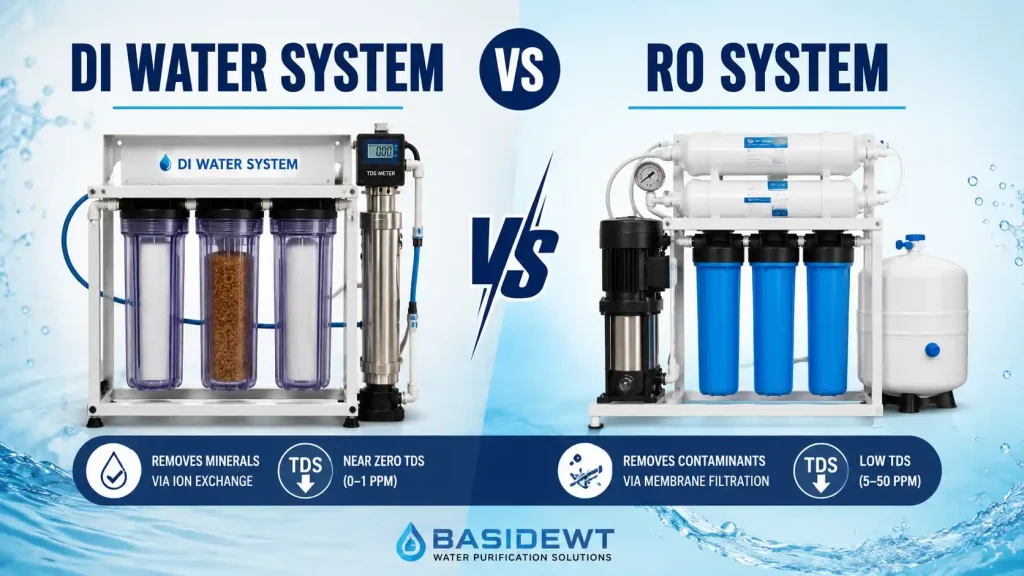
People confuse deionization with commercial RO water filter system constantly, and it’s an understandable mix-up since both produce very pure water. But they get there through completely different mechanisms.
Reverse osmosis forces water through a semi-permeable membrane under pressure, physically blocking most dissolved solids from passing through. It’s effective, but it isn’t quite as thorough as ion exchange. It also produces a stream of reject water as a byproduct.
| DI Water System | RO System | |
|---|---|---|
| Method | Ion exchange resin | Membrane filtration |
| Typical purity | Near 0 TDS | Low but non-zero TDS |
| Water waste | Minimal | Noticeable reject stream |
| Common role | Final purity stage | Pre-treatment stage |
In a lot of commercial setups, you’ll find both technologies working together. RO handles the bulk of the mineral load first. DI finishes the job, squeezing out whatever trace minerals the membrane didn’t catch. If you’re trying to work out which setup makes sense for a specific water hardness level, our piece on RO vs DI water for car wash goes into more depth. It covers where each technology earns its keep.
DI Water vs RO Water vs Distilled Water
| Feature | DI Water | RO Water | Distilled Water |
|---|---|---|---|
| Typical TDS | 0–1 ppm | 5–50 ppm | 0–5 ppm |
| Purity Level | Extremely High | High | Extremely High |
| Water Waste | Low | Higher | Low |
| Energy Usage | Low | Moderate | High |
| Common Uses | Spot-Free Cleaning, Labs | Drinking Water, Pre-Treatment | Laboratories, Medical Applications |
| Operating Cost | Moderate | Moderate | Higher |
Each technology has strengths and weaknesses. That’s why many commercial facilities combine multiple purification methods to achieve the desired water quality.
Where DI Water Systems Show Up in Everyday Life
Once you start looking, deionized water turns up in more places than most people expect. Laboratories rely on it because even trace minerals can throw off sensitive chemical reactions or contaminate test results.
Battery manufacturing depends on it too. Impurities in the water used during production can interfere with chemical processes at a meaningful scale. Pharmaceutical production has similarly strict purity requirements, often stricter than what a basic DI system alone can achieve.
On the more everyday end of the spectrum, deionized water cleaning has become common in car detailing, window washing, and solar panel maintenance. It shows up anywhere a spot-free finish actually matters to the outcome. Cooling systems and boilers use it as well. Mineral scale buildup inside pipes and heat exchangers is a slow, expensive problem, and DI water avoids it from the start.
What ties all of these together is the same underlying property. Nothing dissolved means nothing left behind once the water evaporates or drains away.
Industrial Applications of DI Water Systems
While car washing and window cleaning are common uses, many industries depend on deionized water every day.
Some of the most common industrial applications include:
- Semiconductor manufacturing
- Electronics production
- Pharmaceutical manufacturing
- Food and beverage processing
- Power generation facilities
- Medical laboratories
- Chemical processing plants
In these environments, even small amounts of dissolved minerals can affect product quality, equipment performance, or manufacturing accuracy. That makes DI water a critical part of many industrial operations.
Why Car Detailers and Window Cleaners Rely on DI Water Specifically
This is probably the fastest-growing use case for deionization. The logic behind it is simple once you see it laid out. Missed dirt doesn’t cause water spots on a freshly washed car. Minerals in the rinse water crystallize as it dries, and that’s what causes the spots.
A DI water system solves that at the source. It doesn’t just manage the problem afterward with faster drying or better towels. Vehicles can air-dry completely without anyone touching them with a cloth. This also removes the risk of fine swirl marks from repeated microfiber contact.
Window cleaning has followed a similar path. Professionals working with waterfed poles increasingly skip the squeegee altogether. DI water for car washing and similar pure-water setups leave glass streak-free without any manual finishing step. Detailers running several vehicles back to back benefit even more. Without DI water, consistent results across a full queue would mean constant manual touch-ups between jobs.
Many providers build filter setups specifically for this purpose. They’re sometimes called a DI water filter system. These setups keep pace with continuous rinsing, unlike the slower, lower-volume needs of a lab bench.
Spotless Water System vs DI Water System: Clearing Up the Confusion
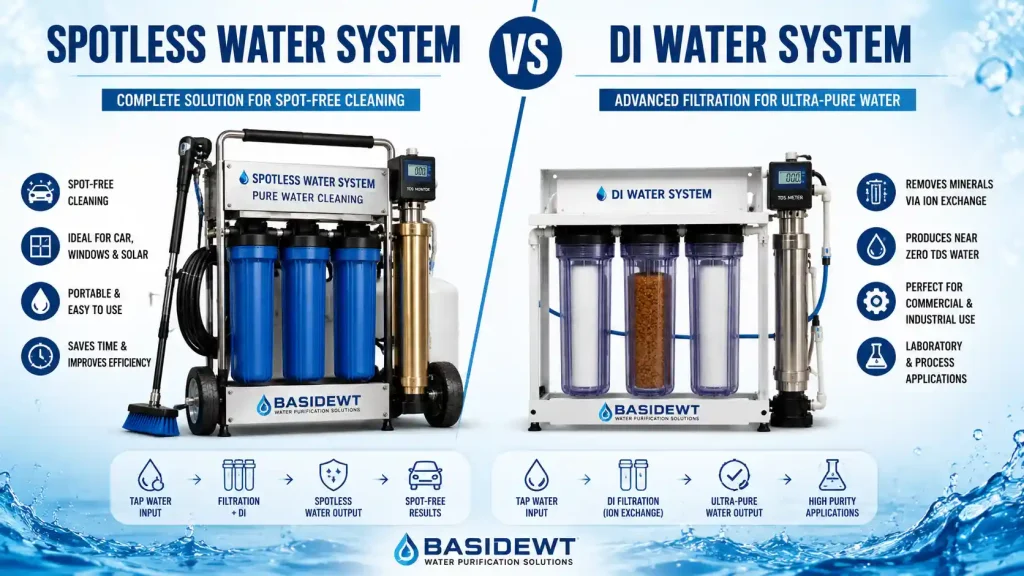
If you’ve spent any time researching this topic, you’ve probably noticed the terminology gets murky fast. People often use spotless water system, DI water system, and pure water cleaning system interchangeably. That’s not entirely wrong, but it’s not entirely precise either.
A DI water system refers specifically to the purification method: ion exchange resin removing dissolved ions. A spotless water system is a broader, outcome-based term. It describes any setup — DI, RO, or a combination of both — engineered to leave a surface completely spot-free after rinsing.
In practice, most spotless water systems sold today lean on deionization as the final purification stage. It’s simply the most effective way to guarantee a zero-residue result. So while the terms aren’t perfect synonyms, there’s a good reason people use them together so often.
Pros and Cons of a DI Water System
Like any water treatment technology, deionization has both advantages and limitations.
Advantages
- Produces near-zero TDS water
- Eliminates water spotting
- Requires minimal wastewater compared to RO systems
- Ideal for vehicle washing, window cleaning, and laboratory use
- Provides consistent cleaning results
Limitations
- Resin requires periodic replacement or regeneration
- Performance depends heavily on source water quality
- Not designed as a complete biological purification system
- Operating costs increase when treating extremely hard water
For most cleaning and industrial applications, the benefits significantly outweigh the limitations, especially when spot-free results are the primary goal.
What Determines How Long DI Resin Actually Lasts
Resin capacity isn’t a fixed number that applies the same way to every setup. It depends heavily on two things: how much dissolved mineral content is in your starting water, and how much volume you’re running through the system.
Harder source water saturates resin considerably faster than moderately soft water does. Depending on how extreme the hardness is, that factor can reach three or four times. This is one of the most common surprises for buyers. People often choose a system based on a general spec sheet without testing their actual water first.
Pre-filtration changes this equation significantly. Running water through an RO stage before it hits the DI resin removes the bulk of the mineral load upfront. The resin then only has to handle a small remaining fraction. That single change can extend resin life dramatically. It’s part of why combined systems have become standard for anyone using DI water at real volume, not just occasionally.
Temperature and flow rate play smaller, secondary roles too. Pushing water through faster than the system’s rated flow reduces its contact time with the resin. This can lower purification efficiency even before the resin technically runs out.
How Much Does a DI Water System Cost?
Costs vary depending on system size, resin capacity, and intended use.
| System Type | Typical Price Range |
|---|---|
| Portable DI Unit | $100–$300 |
| Residential DI System | $300–$1,000 |
| Commercial DI System | $1,000–$10,000+ |
The initial investment may seem significant. But many users find that reduced labor, fewer cleaning chemicals, and improved cleaning quality offset the ongoing cost of resin replacement over time.
Why Water Hardness Matters
The effectiveness and operating cost of a DI water system depend heavily on source water hardness.
For example, water with a TDS level of 500 ppm will exhaust resin much faster than water with a TDS level of 100 ppm. This means users in hard-water regions typically replace resin more frequently than users with softer water.
Testing source water before selecting a system helps ensure proper sizing and more predictable operating costs over time.
Signs Your DI Water System Needs Attention
The most reliable indicator that resin needs replacing is a rising TDS reading at the output. When a system is working properly, that number should stay close to zero regardless of how hard your source water is.
A basic TDS meter costs very little, and it’s genuinely the easiest way to catch this early. Otherwise you’re just waiting for visible spotting to reappear on whatever surface you’re cleaning. Checking readings periodically, rather than only when something looks wrong, turns maintenance into a predictable routine instead of a surprise.
Reduced flow rate is a secondary sign worth watching for. This matters especially in systems that have run a long time without a full inspection. Sediment buildup ahead of the resin tank, rather than the resin itself, is often the actual culprit in these cases. If you’re weighing whether it’s time to upgrade to more capacity, it helps to see how others make sizing decisions. Our comparison in best deionized water system for car washing lays out how usage volume and water hardness typically drive that choice.
Common Misunderstandings About Deionized Water
There’s a persistent myth that deionized water is somehow dangerous to drink. It’s worth addressing directly since it comes up often. It’s not toxic, but it isn’t ideal as a regular drinking source either. It lacks the beneficial minerals your body normally gets from everyday water intake.
Another common misunderstanding is that deionized and distilled water are the same thing. They’re both extremely pure, but they get there through entirely different processes: ion exchange versus boiling and condensation. Distillation also removes some biological contaminants that deionization doesn’t reliably touch.
There’s also a tendency to assume that any water labeled “purified” or “pure water cleaning system” output is automatically DI water. That’s not always accurate. Purified water is a much broader category. It can include distilled, RO-treated, or deionized water, so the specific method matters if purity level is important for your application.
Environmental and Practical Considerations of Using DI Water
Compared to reverse osmosis, deionization typically produces far less wastewater, since there’s no reject stream the way there is with membrane filtration. That efficiency is one reason DI has become the preferred final stage even in setups that use RO earlier in the process.
The Water Quality Association advises starting with a source water test before selecting a treatment approach. That’s better than assuming a generic solution will perform consistently across different conditions. It’s sound advice regardless of whether you’re weighing DI, RO, or a combination of both for a specific application.
Resin disposal is a smaller but real consideration too. Spent resin isn’t hazardous in most residential contexts. Larger commercial operations should still check regional guidelines, since disposal rules vary by location and resin formulation.
Maintaining a DI Water System Over Time
Long-term maintenance really comes down to consistency rather than complexity. Testing output water regularly, keeping pre-filtration stages clean, and replacing resin before it’s fully exhausted — these cover most of what a system needs. Do them consistently, and performance stays predictable.
Hoses, fittings, and connections deserve periodic attention too. A small leak upstream of the resin tank can introduce sediment or reduce pressure. Often you won’t notice until performance already starts slipping. A quick visual check every few weeks catches most of these issues before they become bigger problems.
For systems that see heavy daily use, logging TDS readings over time is far more useful. Don’t just rely on memory or a rough sense that “it’s probably fine.” A simple log turns a vague feeling into an actual trend line. Trend lines let you replace resin on your own schedule, instead of reacting only after a problem becomes visible on whatever you’re cleaning.
How to Choose the Right DI Water System
Choosing the right system depends on your intended application, water quality, and daily usage volume.
Before purchasing a system, consider:
- Source water TDS level
- Daily water consumption
- Portable vs fixed installation
- Required flow rate
- Resin replacement costs
- Whether an RO pre-treatment stage is needed
For occasional vehicle washing, a portable DI unit may be sufficient. For commercial operations, a larger system with RO pre-treatment often provides the best long-term value.
Frequently Asked Questions
Is deionized water the same as purified water?
Not exactly. Purified water is a broad category that includes distilled, reverse osmosis, and deionized water. Deionized water refers specifically to water treated through ion exchange resin.
Can you drink water from a DI water system?
Technically yes, in small amounts, but it isn’t recommended as a regular drinking source since the process removes beneficial minerals along with unwanted ones. It can also taste noticeably flat.
How is a DI water system different from a water softener?
A water softener typically swaps hardness minerals for sodium ions and leaves other dissolved solids behind. A DI system removes essentially all dissolved ions, producing much purer output overall.
Why does deionized water leave no spots after rinsing?
Water spots form when dissolved minerals in the water crystallize as it evaporates. Since deionized water has almost nothing dissolved in it, there’s nothing left behind once it dries.
Does a DI water system remove bacteria?
Not reliably. Ion exchange targets dissolved minerals, not biological contaminants, so pre-filtration or additional treatment is needed if bacteria removal is a concern for your application.
How often does DI resin need to be replaced?
It depends heavily on source water hardness and daily volume, but many systems need attention somewhere between 500 and 3,000 gallons of use. Monitoring TDS output is more reliable than guessing based on time alone.
Is a DI water system better than an RO system on its own?
DI produces purer water than RO alone, but the two are often used together rather than as competitors, with RO handling the bulk of mineral removal before DI finishes the job.
Conclusion
Understanding how a DI water system actually works takes a lot of the mystery out of spot-free rinsing. That’s true whether you’re dealing with a car, a window, or a piece of lab equipment. The chemistry is straightforward once you see it. Ion exchange resin swaps out dissolved minerals, and without those minerals, there’s simply nothing left to leave a mark.
Knowing this also makes it easier to spot the difference between similar-sounding technologies. It helps you troubleshoot performance issues too. And it prepares you for an informed conversation the next time you compare a deionized water system against reverse osmosis, or try to figure out why one setup outperforms another on the same source water. If you’re exploring which configuration fits a specific use case, it’s worth digging further into how professionals size and match these systems to real-world water conditions.
RELATED POSTS
What Is a Water Filter Housing? Complete Guide for Beginners
RO Water System Filter Replacement Guide: When & How to Change RO Filters
Water Filter Housing Buying Guide: How to Choose the Best Housing for Your Needs
What Is a Water Filter Housing? Complete Guide to Uses, Types & Benefits
Common RO Water System Problems & How to Fix Them