BasideWT- Whole Home Water Filtration System & Replacement


How Does a Water Filter Housing Work? Complete Step-by-Step Guide
Water passes through pipes every day, yet most people never stop to ask what happens inside a filter housing along the way. Understanding this process matters, though, especially if you are choosing equipment for a home, a workshop, or a full production line.
A water filter housing is the vessel that holds a filter cartridge and directs water through it under pressure. It looks simple from the outside, but several parts work together to make filtration possible.
This guide walks through the working principle of a water filter housing step by step. We already covered the basics in our article on what a water filter housing is. Here, we go further and explain exactly how water moves through the unit, how the cartridge captures contaminants, and what factors shape filtration performance.
How Does a Water Filter Housing Work?
A water filter housing works by forcing incoming water through a filter cartridge under pressure. The housing itself does not remove contaminants directly. Instead, it holds the cartridge in place, seals against leaks, and creates a controlled path for water to travel.
Water enters through an inlet port, gets pushed through the cartridge media, and exits through a separate outlet port. As it passes through the cartridge, particles, sediment, or chemical impurities get trapped or absorbed, depending on the cartridge type installed.
Pressure plays a central role here. City water systems and pumps typically supply water at a certain pressure, and this pressure pushes water through the tight pores of the filter media. Without adequate pressure, flow slows down and filtration becomes less efficient.
The design also matters. A well-engineered housing minimizes turbulence and pressure loss so that water flows smoothly from inlet to outlet. For a broader look at how housing types, sizes, and materials affect this design, our complete guide to water filter housings covers that ground in detail.
Understanding the Water Filtration Process
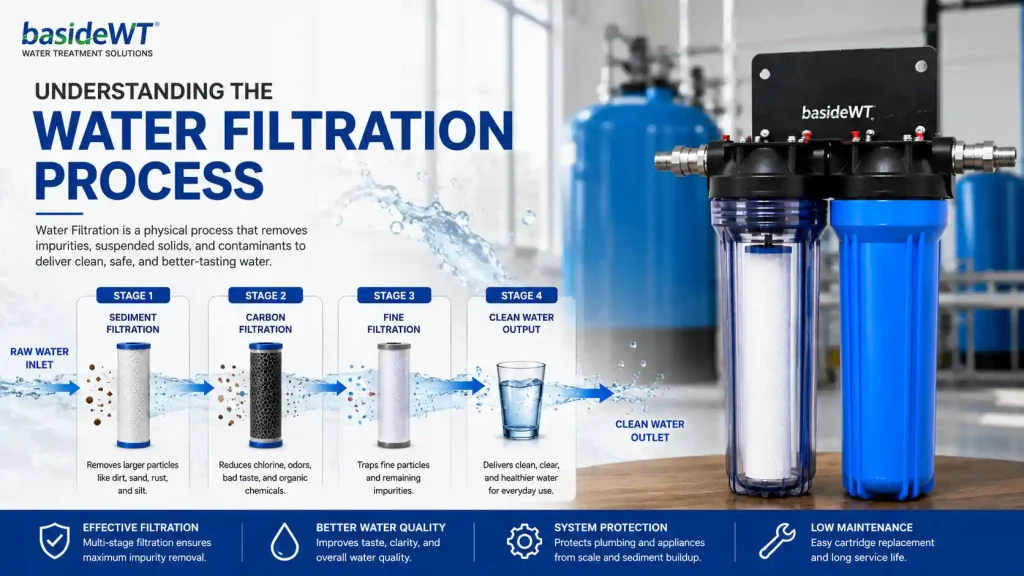
Filtration inside a housing happens through mechanical separation. The cartridge acts as a physical barrier with pores of a specific size, usually measured in microns.
As water flows through this barrier, particles larger than the pore size get trapped on or within the cartridge surface. Smaller particles and dissolved substances pass through unless the cartridge uses additional filtration methods, such as activated carbon adsorption.
Two things happen simultaneously during this process. First, clean water continues moving toward the outlet. Second, trapped particles accumulate on the cartridge, gradually building a layer that can actually improve filtration of very fine particles over time. This layer, however, also increases resistance, which is why cartridges eventually need replacement.
Flow rate and pressure drop are directly connected during this stage. As contaminants build up, the cartridge becomes harder to push water through, so pressure on the inlet side rises while the outlet side sees reduced flow. Monitoring this pressure difference is often how professionals judge when a cartridge needs changing, though maintenance scheduling is a topic we cover separately.
Main Components That Make the Housing Work
Every water filter housing relies on a handful of core parts. Each one plays a specific role in keeping the filtration process safe and effective.
Housing Head
The head sits at the top of the housing and contains the inlet and outlet ports. It connects to the plumbing system and directs water into the unit. Most heads also include the mounting bracket that holds the entire housing in place.
Housing Bowl
The bowl is the lower section that holds the filter cartridge. It is designed to withstand internal water pressure without cracking or deforming. Bowls come in clear or opaque versions, which we explain further below.
O-Ring
The O-ring creates a watertight seal between the head and the bowl. Even a small gap here can cause leaks or allow unfiltered water to bypass the cartridge entirely. Choosing the correct O-ring material, such as silicone or EPDM, matters for long-term reliability, particularly with hot water or aggressive chemicals.
Pressure Relief Button
Many housings include a small button or valve on the head. Pressing it releases trapped pressure before the bowl is removed for cartridge replacement. This small feature prevents sudden water discharge and protects the person performing the change.
Inlet and Outlet Ports
These ports control the direction of flow. Water always enters through the inlet and exits through the outlet, and the internal design ensures it cannot bypass the cartridge. Some housings mark these ports with arrows to avoid incorrect installation.
Filter Cartridge
The cartridge is the actual filtration element. It sits inside the bowl and does the real work of trapping contaminants. Housings are designed around standard cartridge sizes so that replacement remains straightforward, provided the correct micron rating and cartridge type are selected.
Step-by-Step Water Flow Inside a Water Filter Housing
Here is what happens, step by step, as water moves through a typical filter housing:
- Water enters the inlet port. Supply pressure pushes water into the housing head.
- Water travels down into the bowl. The internal channel directs flow around the outside of the cartridge, not straight through the center.
- Water passes through the cartridge wall. This is where mechanical filtration takes place, trapping particles based on the cartridge’s micron rating.
- Filtered water collects inside the cartridge core. Once water has passed through the filter media, it gathers in the hollow center of the cartridge.
- Water rises through the core toward the outlet. From the center, filtered water travels upward and exits through the outlet port.
- Clean water continues into the downstream plumbing. From here, it flows to a faucet, appliance, or the next stage in a multi-stage system.
This inside-out flow pattern is standard for most cartridge-style housings. It maximizes the surface area of the cartridge that contacts water, which improves filtration efficiency compared to a straight-through design.
How Different Filter Cartridges Work Inside the Housing
The housing provides the structure, but the cartridge determines what gets removed. Different cartridge types work in distinct ways once installed.
Sediment filters use a mesh or spun material to trap sand, rust, and other solid particles. They rely purely on mechanical straining and are usually the first stage in multi-step systems.
Carbon filters use activated carbon to adsorb chlorine, odors, and certain organic compounds. Instead of just blocking particles, the porous carbon surface chemically attracts and holds contaminants as water flows past.
Pleated filters fold the filter media into ridges, increasing surface area within the same housing space. This design allows higher flow rates and longer service life compared to a flat filter of the same size.
String wound filters wrap yarn tightly around a core, creating a gradient density that captures larger particles on the outside and finer particles closer to the core. This layered structure makes them effective for a wide range of particle sizes in one cartridge.
Selecting the right cartridge depends on the water source, the contaminants present, and the flow rate needed. Our product page for water filter cartridges offers more detail on matching cartridge types to specific applications.
Factors That Affect Water Filter Housing Performance
Several variables influence how well a housing performs in real conditions.
Flow rate determines how much water can pass through the housing per minute without excessive pressure loss. Housings rated for low flow will struggle in applications with high demand, such as commercial kitchens or industrial lines.
Pressure loss naturally occurs as water pushes through the cartridge media. A well-designed housing keeps this loss minimal at the start, though it increases as the cartridge collects debris over time.
Cartridge compatibility affects sealing and flow. A cartridge that does not match the housing’s internal dimensions can create gaps, allowing water to bypass filtration entirely.
Housing sealing relies on proper O-ring placement and bowl tightening. Even high-quality components will leak if assembled incorrectly.
Clear versus opaque housings also play a role in performance monitoring rather than filtration itself. Clear housings let users visually check cartridge condition and sediment buildup. Opaque housings, often made from reinforced or UV-resistant material, block light exposure, which helps prevent bacterial or algae growth inside the bowl during extended use.
High-flow housings use larger bowl diameters and cartridge surface areas to support greater water volume, which suits whole house water filter housing setups and light commercial applications. Meanwhile, standard housings remain common for point-of-use filtration under sinks or at single fixtures.
Typical applications range widely. Residential homes often use single or dual housings for whole-house filtration. Industrial facilities, on the other hand, may rely on multi-housing manifolds designed to handle continuous, high-volume flow across a production process.
Common Mistakes That Reduce Filtration Efficiency
Even a well-built housing can underperform if certain mistakes occur.
Installing the housing backward is a frequent issue. If inlet and outlet connections get reversed, water bypasses proper filtration and pressure imbalances can damage the cartridge.
Using an incompatible cartridge creates gaps around the seal. Water then flows around the filter media instead of through it, defeating the purpose of filtration entirely.
Overtightening or undertightening the bowl damages the O-ring seal. Too loose causes leaks; too tight can crack the housing or compress the O-ring beyond its effective range.
Ignoring pressure changes allows a clogged cartridge to remain in service too long. As resistance builds, flow drops and, in some cases, contaminants can push through a saturated filter.
Choosing the wrong housing size for the application also limits performance. A housing sized for residential use cannot handle industrial flow demands, no matter how good the cartridge inside it is.
Avoiding these mistakes largely comes down to matching the housing, cartridge, and application correctly from the start, which is often easier once the underlying flow mechanics are understood.
Final Thoughts
A water filter housing works through a straightforward but carefully engineered process: water enters, moves through a cartridge under pressure, and exits clean on the other side. The housing head, bowl, O-ring, and ports each play a specific role in keeping that process sealed, controlled, and efficient.
Cartridge type, flow rate, and housing design all shape how well the system performs in practice. Whether the setup involves a single residential unit or an industrial water filter housing system supporting continuous production, the underlying working principle stays the same.
For readers comparing housing types, sizes, and materials before choosing a system, our pillar guide on water filter housings offers a broader starting point. For a general introduction to what these units are and why they matter, the article on what a water filter housing is is a useful companion piece. JX Filtration also offers a helpful overview of cartridge filter housing technology for readers who want additional industry context.
RELATED POSTS
Water Filter System vs Bottled Water: Which Is Better?
How Often Should You Change a Water Filter? Signs It Needs Replacing
How Much Water Does an RO System Waste?
Water Treatment Products FAQ – Key Questions
DI Water for Car Washing: The Ultimate Guide to Perfect, Spot-Free Drying