BasideWT- Whole Home Water Filtration System & Replacement



Whole House Water Filter Housing Explained: Benefits, Types & How to Choose
Clean water should reach every tap in your home, not just the kitchen sink. That is the promise of a whole house water filter housing. It sits at the point where water enters your plumbing system and protects everything downstream.
Many homeowners only think about water quality when a problem shows up. Cloudy water, gritty sediment, or a metallic taste often points to filtration gaps. A whole house filter housing solves this at the source, rather than treating symptoms one faucet at a time.
This guide explains what a whole house water filter housing does, how it works, and which type fits different homes. If you already understand the basics of a water filter housing, this article goes further into whole-home applications, sizing, and long-term care.
What Is a Whole House Water Filter Housing?
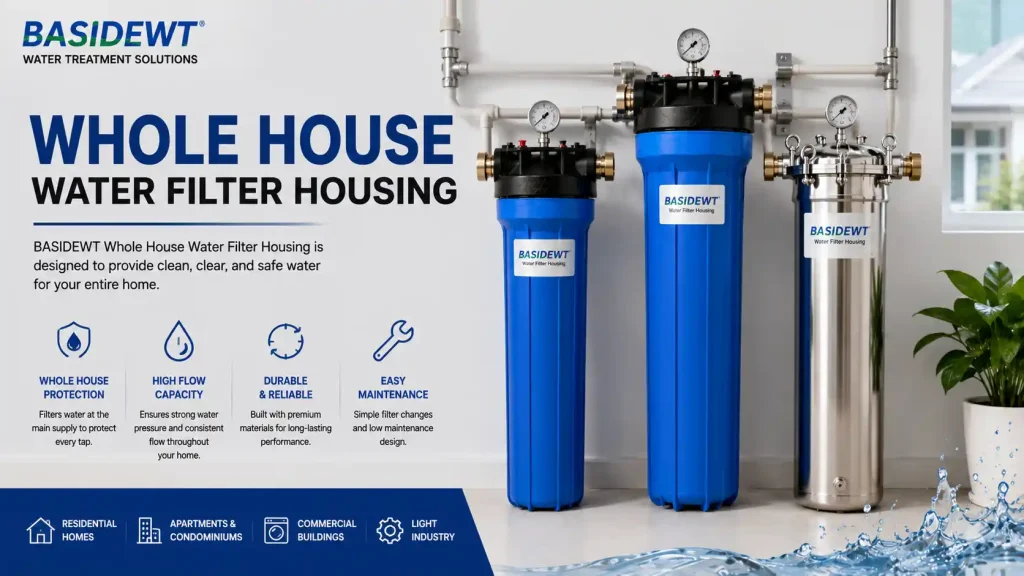
A whole house water filter housing is a plumbing component installed on the main water line. It holds a replaceable filter cartridge that treats all water before it reaches individual fixtures.
Unlike a countertop pitcher or a single faucet filter, this housing works at the point of entry. Consequently, every shower, washing machine, dishwasher, and sink benefits from the same filtered water supply.
The housing itself does not remove contaminants. Instead, it holds the cartridge in a sealed chamber, directs water flow through the media, and allows for easy cartridge replacement. For a deeper technical breakdown of housing components, our earlier article on how a water filter housing works covers the mechanics in detail.
Whole house housings typically use larger cartridges than point-of-use units. This size difference allows them to handle the full volume of water a household consumes daily.
How Does a Whole House Water Filter Housing Work?
Water enters the home through the main supply line. Before reaching any branch pipe, it passes through the filter housing.
Inside the housing, water flows around the outside of the cartridge and moves inward through the filter media. This design traps sediment, rust particles, and other debris while allowing clean water to exit through the center.
The process happens continuously, without any manual action from homeowners. As long as the cartridge remains within its service life, filtration continues at a consistent rate.
Flow rate matters here. If the housing cannot keep pace with household demand, water pressure drops noticeably. That is why sizing the housing correctly, based on gallons per minute (GPM), is essential rather than optional.
Pressure loss also increases as a cartridge collects debris over time. Homeowners often notice weaker shower pressure a few weeks before a scheduled filter change. This is a normal sign that the cartridge needs replacement soon.
Why Every Home Can Benefit from a Whole House Water Filter Housing
Water quality varies significantly by region, source, and even by season. A home connected to municipal water may still receive water carrying chlorine byproducts, sediment from aging pipes, or seasonal turbidity spikes.
Homes on well water face different challenges. Iron, manganese, sand, and mineral sediment often enter the plumbing system directly from the ground source.
In both cases, a whole house filtration approach offers protection that single-point filters cannot match. Consider a family with young children who bathe daily. Filtered water at the point of entry means every bath, not just drinking water, benefits from sediment reduction.
Appliance protection is another practical advantage. Water heaters, washing machines, and dishwashers all suffer reduced lifespan when sediment and scale build up internally. A whole house water filtration system reduces this wear before it starts.
Plumbing itself benefits too. Sediment-laden water gradually damages pipe interiors, valves, and fixtures. Over years, this shortens the service life of the entire plumbing network, not just visible fixtures.
Types of Whole House Water Filter Housings
Several housing styles exist, each suited to different water conditions and household needs. Understanding these options helps homeowners and contractors match the right housing to the right application.
Standard Housing
Standard housings are the most common choice for residential use. They typically use 2.5-inch diameter cartridges and fit homes with moderate water demand.
These housings work well for small to medium households where flow rate requirements stay below 10 GPM. Because they are compact, they suit tight installation spaces such as utility closets or crawl spaces.
Big Blue Housing
Big Blue housings use a larger 4.5-inch diameter cartridge. This increased surface area allows for higher dirt-holding capacity and longer intervals between cartridge changes.
Households with higher water usage, or those on well water with heavier sediment loads, often choose Big Blue housings. Larger families benefit from the extended service life these housings provide.
Clear Housing
Clear housings allow homeowners to visually monitor cartridge condition without removing the housing. This transparency helps identify when sediment buildup requires attention.
However, clear housings should generally avoid direct sunlight exposure, since UV light can encourage bacterial growth inside the sump over time. Our comparison of clear vs blue housings explains this tradeoff in more depth.
Blue Housing
Blue housings block light entirely, which prevents the bacterial growth risk associated with clear housings. Many installers recommend blue housings for outdoor installations or areas with natural light exposure.
Performance between clear and blue housings is otherwise similar. The choice often comes down to installation location and personal preference regarding cartridge visibility.
High Flow Housing
High flow housings support larger cartridges designed for households with significant water demand, or for properties with multiple bathrooms and high simultaneous fixture use.
These housings maintain steady pressure even during peak usage periods, such as mornings when several family members shower and run appliances at once. Our dedicated article on high flow water filter housings covers sizing and applications for larger residential and light commercial setups.
How to Choose the Right Whole House Water Filter Housing
Selecting the correct housing depends on several interconnected factors. Skipping any one of them often leads to underperformance or premature system wear.
Household water usage. Count bathrooms, major appliances, and typical simultaneous water use. A four-bathroom home with a family of five needs different capacity than a two-person household in a small apartment.
Flow rate. Match housing capacity to peak demand, not just average use. Most residential systems need housings rated between 10 and 25 GPM, depending on home size.
Water pressure. Existing pressure affects how much drop the household can tolerate. Homes with naturally lower pressure benefit from larger housings that minimize additional restriction.
Sediment levels. Well water with visible sediment usually requires housings paired with high-capacity sediment cartridges. Municipal water with lighter sediment loads may perform well with standard housings.
Well water vs municipal water. Well water often needs pre-filtration for iron and manganese alongside sediment control. Municipal water typically focuses more on chlorine taste and residual particulates.
Cartridge compatibility. Confirm that housing diameter and length match available cartridge options locally. Standardized sizing simplifies long-term maintenance and replacement sourcing.
Housing material. Polypropylene housings suit most residential budgets and applications. Stainless steel offers greater durability for demanding environments, though at a higher cost. Our comparison of plastic vs stainless steel housings walks through this decision in detail.
For homeowners still narrowing down options, browsing a whole house filtration category page can help compare configurations side by side before committing to a specific setup.
Common Installation Mistakes
Even well-chosen housings underperform when installed incorrectly. A few mistakes appear repeatedly in residential settings.
Installing the housing too close to the ceiling or wall creates problems. Technicians need clearance below the sump to remove and replace cartridges without disconnecting plumbing.
Skipping a bypass valve is another frequent oversight. Without one, homeowners cannot service the housing without shutting off water to the entire home, which becomes inconvenient during emergencies.
Some installers mount housings before the pressure tank on well systems, rather than after it. This placement can cause pressure fluctuations that shorten cartridge life and reduce filtration consistency.
Finally, ignoring flow direction arrows on the housing body leads to backward installation. This mistake reduces filtration efficiency and can damage the cartridge seal over time.
Maintenance Tips for Long-Term Performance
Routine maintenance keeps a whole house housing performing as designed. Most sediment cartridges need replacement every two to three months, though household water quality affects this timeline.
Watch for gradual pressure drops as a signal that cartridge capacity is reaching its limit. Waiting too long between changes strains the housing seals and reduces filtration effectiveness.
Clean the housing sump during each cartridge change. Sediment often accumulates at the bottom of the sump, even when the cartridge itself still has remaining capacity.
Inspect O-rings for wear or cracking at every service interval. A worn O-ring causes leaks that are easy to prevent with a simple visual check.
Keep a maintenance log, especially for larger households or rental properties. Recording change dates helps predict future service needs and avoids unexpected pressure loss.
For homes with well water, periodic water testing helps confirm the housing and cartridge combination still matches current water conditions. Source water can shift over time, particularly after seasonal changes or nearby construction activity.
Whole House Water Filter Housing vs Point-of-Use Filters
Homeowners often ask whether a whole house system or individual point-of-use filters make more sense. Each approach serves a different purpose, and many homes benefit from combining both.
| Feature | Whole House Housing | Point-of-Use Filter |
|---|---|---|
| Coverage | Entire home | Single fixture |
| Appliance protection | Yes | No |
| Plumbing protection | Yes | No |
| Installation complexity | Moderate to higher | Low |
| Best for | Sediment, chlorine, general water quality | Drinking water polishing, taste refinement |
| Maintenance frequency | Every 2–3 months typically | Varies, often more frequent |
| Upfront cost | Higher | Lower |
A whole house housing addresses water quality at the source, protecting pipes and appliances throughout the property. Point-of-use filters, by contrast, focus narrowly on drinking or cooking water, often adding a final polishing stage after whole house filtration.
Many households use both together. The whole house system handles sediment and general water quality, while an under-sink filter provides additional refinement for drinking water specifically.
Expert Recommendations
Plumbing contractors generally recommend sizing whole house housings slightly above calculated peak demand, rather than exactly matching it. This buffer accommodates future appliance additions or household growth without requiring a system upgrade.
For well water applications, professionals often suggest pairing sediment housings with additional stages for iron or manganese reduction when testing indicates elevated levels. A single sediment stage rarely addresses all well water concerns on its own.
Boshart’s technical guidance on installing a whole house water filter housing echoes this point, noting that housings should sit on the main line after the meter or pressure tank, with enough clearance for cartridge servicing and a location where any potential leak will not cause property damage.
Distributors and installers working across multiple properties benefit from standardizing on compatible cartridge diameters. This approach simplifies inventory management and reduces the chance of stocking mismatched replacement parts.
Final Thoughts
A whole house water filter housing offers protection that extends well beyond a single tap. It safeguards plumbing, extends appliance lifespan, and delivers more consistent water quality throughout the home.
Choosing the right housing depends on household demand, water source, and available installation space. Taking time to match these factors correctly prevents pressure issues and unnecessary maintenance down the road.
For homeowners, contractors, or distributors ready to compare specific configurations, our water filter housing collection and whole house housing options provide a practical starting point for matching housing specifications to real-world water conditions.
RELATED POSTS
How to Make FRP Tank?
UV vs Chlorine Water Disinfection: Which Is Better?
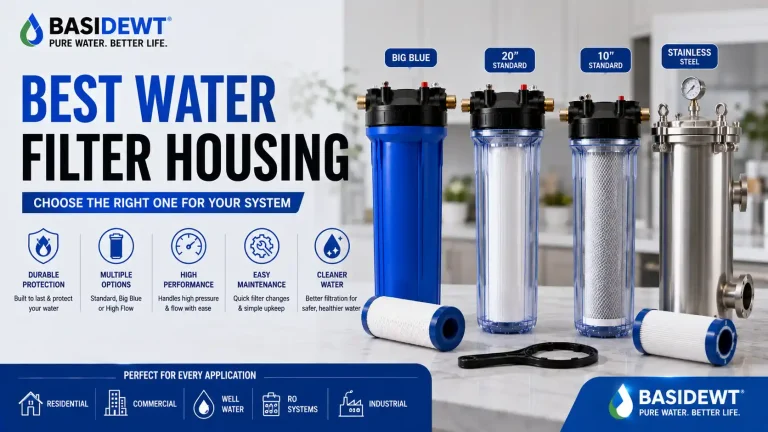
Best Water Filter Housing: How to Choose the Right One for Your System
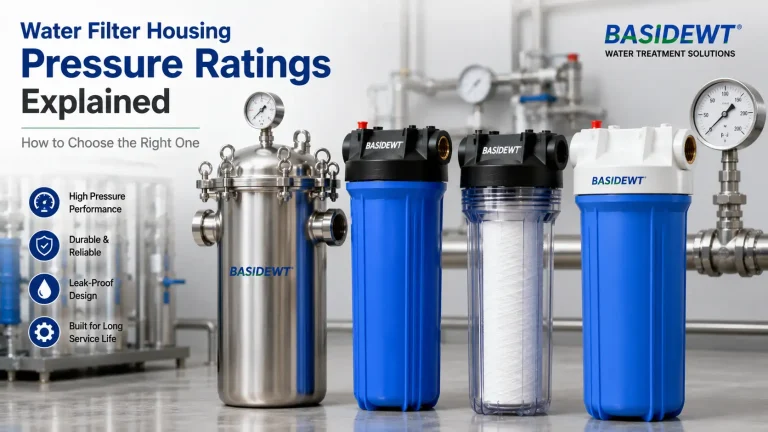
Water Filter Housing Pressure Ratings Explained: How to Choose the Right One
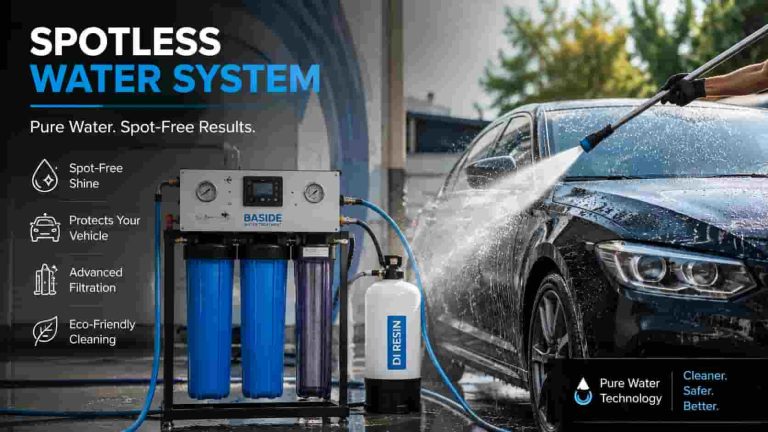
Spotless Water System: The Complete Guide to Spot-Free Car Washing