BasideWT- Whole Home Water Filtration System & Replacement


What Is an RO Water System? Everything You Need to Know
If you’ve ever wondered what is an RO water system and whether your home or business needs one, you’re not alone. Millions of households and companies now rely on reverse osmosis to turn ordinary tap water into clean, great-tasting drinking water. This guide breaks down exactly how these systems work, what they remove, and how to decide if one is right for you.
By the end of this article, you’ll understand the science behind reverse osmosis, the parts that make up a typical setup, and the practical benefits you can expect once you switch to filtered water at home or work.
What Is an RO Water System?
An RO water system, short for reverse osmosis water system, is a water purification system that pushes tap water through a series of filters and a semi-permeable membrane. This process removes dissolved solids, chemicals, and microscopic particles that ordinary filters often miss.
Unlike basic pitcher filters, an RO water system tackles a much wider range of contaminants. It combines several filtration stages, so water passes through sediment filters, carbon filters, and finally the RO membrane itself before reaching your glass.
Homeowners install these systems under the kitchen sink for drinking water. Businesses and factories use larger versions to treat water for production lines, equipment, or entire buildings. Either way, the goal stays the same: deliver consistently clean, safe water.
What Does RO Stand For?
RO stands for reverse osmosis. To understand this term, it helps to first understand regular osmosis.
In nature, osmosis happens when water moves through a membrane from an area of low mineral concentration to an area of high concentration. This is how plant roots absorb water from soil, for example.
Reverse osmosis flips that natural direction. Instead of letting water flow toward contaminants, the system applies pressure to force water away from dissolved salts, minerals, and chemicals. The result is purified water on one side of the membrane and concentrated waste on the other.
How Reverse Osmosis Works (Basic Overview)
Reverse osmosis technology sounds complex, but the actual process is straightforward once you break it into steps.
- Tap water enters the system and first passes through a sediment filter, which removes dirt, rust, and larger particles.
- Next, a carbon filter removes chlorine, taste, and odor.
- Water is then pushed under pressure through the RO membrane, which blocks dissolved solids, heavy metals, and many chemical contaminants.
- Clean water, called permeate, flows into a storage tank, while wastewater is flushed down a separate drain line.
- Before reaching the faucet, water often passes through one final polishing filter for extra clarity and taste.
This multi-stage approach is why a reverse osmosis water filter performs so much better than a single cartridge filter. Each stage targets different types of impurities, so very little gets through untreated.
Main Components of an RO Water System
Every RO water system, whether small or large, shares a similar set of core parts. Understanding these components makes it easier to choose the right system and maintain it properly.
- Sediment pre-filter: Captures dirt, sand, and rust before it reaches the membrane.
- Carbon pre-filter: Removes chlorine and organic compounds that could damage the membrane over time.
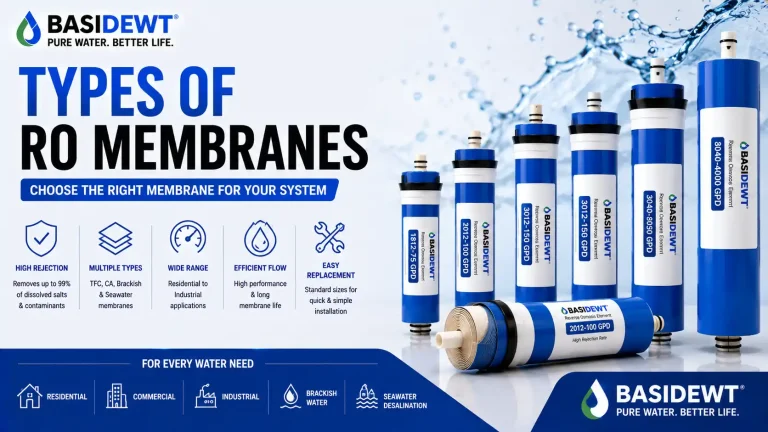
- RO membrane: The heart of the system, responsible for blocking dissolved solids and microscopic contaminants. You can browse a range of RO membranes built for different water conditions and flow rates.
- Membrane housing: Protects the membrane and keeps it sealed under pressure. Quality membrane housing helps prevent leaks and extends membrane life.
- Storage tank: Holds purified water so it’s ready on demand.
- Post-filter: Polishes water just before it reaches the tap for improved taste.
- Check valves and fittings: Regulate flow direction and prevent backflow into the membrane.
Together, these parts form a complete water treatment system capable of producing consistently clean water day after day.
Types of RO Water Systems
Not every RO water system looks or performs the same way. The right type depends on your water usage, space, and budget.
Under-Sink RO Systems
These compact units fit beneath a kitchen sink and are the most common choice for households. They’re ideal for anyone who wants a dedicated under-sink RO purifier for drinking and cooking water without taking up counter space.
Countertop RO Systems
Countertop units require no installation and are popular in rentals or small apartments. They connect directly to a faucet and are easy to move.
Whole-House RO Systems
These larger systems treat all water entering a home, not just the drinking water line. They suit households dealing with heavily contaminated well water.
Commercial and Industrial RO Systems
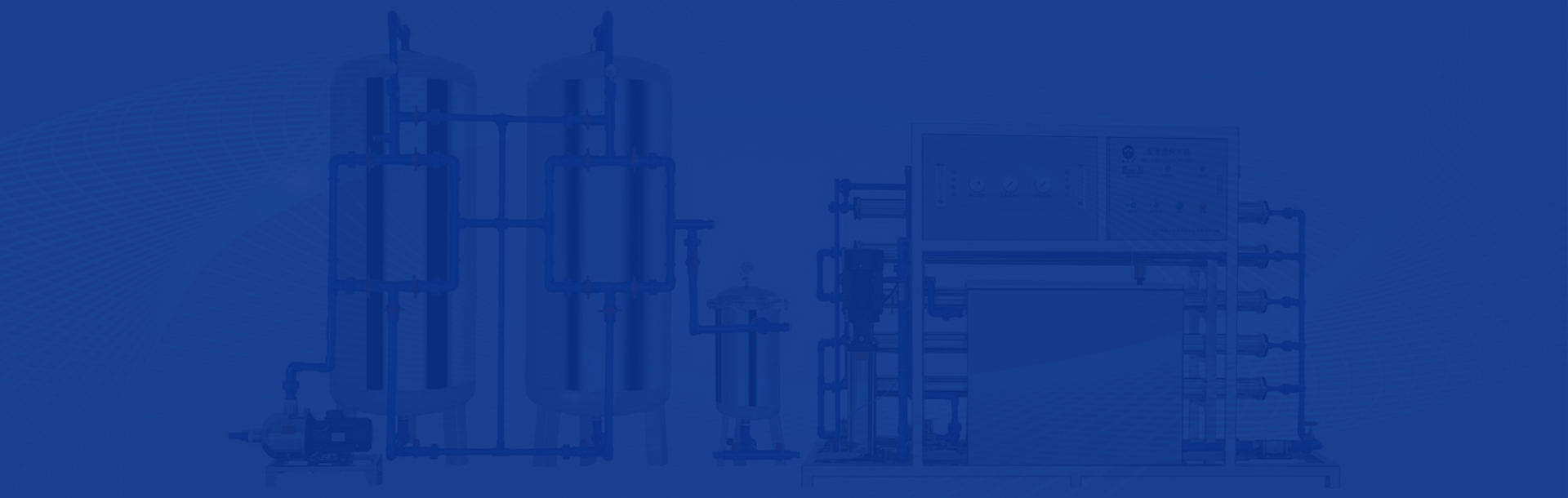
Businesses, restaurants, and factories often need higher-capacity equipment. A dedicated commercial RO system can handle much larger volumes while maintaining consistent water quality across a facility.
Residential vs Commercial RO Systems
Residential and commercial systems share the same basic technology but differ significantly in scale and complexity. The table below highlights the key differences.
| Feature | Residential RO System | Commercial RO System |
|---|---|---|
| Typical output | 50–100 gallons per day | Hundreds to thousands of gallons per day |
| Installation location | Under sink or whole house | Dedicated equipment room |
| Membrane size | Small, single or dual membrane | Multiple large membranes |
| Maintenance frequency | Every 6–12 months | Monthly to quarterly monitoring |
| Common users | Homeowners, apartments | Restaurants, factories, offices |
If you’re unsure which category fits your situation, exploring a full water filtration system lineup can help you compare capacity and features side by side.
Benefits of an RO Water System
The popularity of reverse osmosis isn’t accidental. Once installed, an RO water system offers several clear advantages.
- Cleaner drinking water: Removes a wide range of contaminants that standard tap water often contains.
- Better taste and odor: Chlorine and organic compounds are filtered out before they reach your glass.
- Cost savings over time: Reduces reliance on bottled water, which adds up quickly for families and businesses.
- Consistent water quality: Provides reliable purification regardless of fluctuations in municipal or well water quality.
- Protects appliances: Reduces scale buildup in coffee makers, ice machines, and other equipment that uses filtered water.
These benefits explain why so many households upgrade from basic filter pitchers to a full reverse osmosis system.
What Contaminants Does RO Remove?
One of the most common questions people ask is exactly what a reverse osmosis water filter removes. The membrane’s tiny pores block particles based on size, so most dissolved substances larger than a water molecule get filtered out.
Contaminants typically reduced by RO systems include:
- Lead and other heavy metals
- Arsenic
- Nitrates and nitrites
- Chlorine and chloramines
- Fluoride
- Sulfates
- Many dissolved salts and minerals
- Certain bacteria and viruses, depending on system configuration
According to the U.S. Environmental Protection Agency, point-of-use reverse osmosis systems are widely recognized as an effective household treatment technology, though the agency also notes they use more water than some alternative filtration methods. This trade-off is worth considering when choosing between a simple filter and a full RO setup.
Common Applications
Reverse osmosis technology isn’t limited to kitchen sinks. It shows up across many industries because of how reliably it purifies water.
- Homes: Drinking water, cooking, and ice makers.
- Restaurants and cafes: Coffee, tea, and food preparation that depends on consistent water quality.
- Offices: Break room water stations and coffee equipment.
- Manufacturing: Rinsing, cooling, and production processes that require purified water.
- Laboratories: Precise experiments that cannot tolerate mineral interference.
- Agriculture: Irrigation and livestock watering in areas with poor water quality.
Because the underlying reverse osmosis water filter technology scales up or down easily, it fits almost any setting where clean water matters.
Is an RO Water System Right for You?
Deciding whether to invest in an RO water system usually comes down to a few practical questions. First, consider your current water quality. If you notice odd taste, odor, or have received a water quality report showing elevated contaminants, an RO system is worth serious consideration.
Second, think about your daily water usage. A household of four drinking and cooking with filtered water has very different needs than a restaurant serving hundreds of customers daily.
Finally, factor in space and budget. Under-sink units are affordable and compact, while whole-house or commercial systems require a larger upfront investment but handle much greater volumes.
For a deeper breakdown of system types, installation steps, and long-term maintenance, our complete guide to RO water systems covers everything in far more detail than a single article can.
Frequently Asked Questions
What is an RO water system used for? An RO water system is used to purify drinking water by removing dissolved solids, chemicals, and other contaminants through a semi-permeable membrane.
How long does an RO membrane last? Most RO membranes last two to three years, though this depends on water quality and how well pre-filters are maintained.
Does an RO system remove healthy minerals too? Yes, reverse osmosis removes most dissolved minerals along with contaminants. Some systems add a remineralization filter afterward to restore beneficial minerals.
Is RO water safe to drink every day? Yes, RO water is considered safe for daily drinking and is used by millions of households worldwide.
How much water does an RO system waste? Older systems can waste several gallons for every gallon produced, though modern, efficient designs waste significantly less.
Can I install an RO water system myself? Under-sink and countertop units are often simple enough for a confident DIYer, while whole-house and commercial systems typically require professional installation.
Expert Tips
- Replace pre-filters on schedule, even if the water still looks and tastes fine, since sediment buildup can shorten membrane life.
- Test your water source periodically to confirm the system is performing as expected.
- Sanitize the storage tank annually to prevent bacterial growth.
- Match system capacity to actual daily usage rather than buying based on price alone.
- Keep spare filter cartridges on hand so replacements are never delayed.
Conclusion
So, what is an RO water system? At its core, it’s a multi-stage water purification system that uses reverse osmosis technology to deliver cleaner, better-tasting water for homes and businesses alike. From the sediment pre-filter to the RO membrane and final polishing stage, every component plays a role in producing safe drinking water.
Whether you’re a first-time buyer researching options or a business owner ready to upgrade your water treatment system, understanding these fundamentals puts you in a strong position to choose the right setup. Explore BasideWT’s full range of RO system solutions to find the option that fits your water quality needs, usage volume, and budget.
RELATED POSTS
20 x 2.5 Replacement Water Filters Cartridges | High-Capacity, Universal Fit
Types of RO Membranes: Complete Guide to Choosing the Right Type
Is RO Water Safe to Drink?

Spot Free Rinse: The Complete Guide to Spot-Free Car Wash Results
Whole House Reverse Osmosis System: A Complete Guide to Cleaner Water for Every Tap