BasideWT- Whole Home Water Filtration System & Replacement


What Is a UV Water Sterilizer? Complete Beginner’s Guide
A UV water sterilizer is a water-disinfection device that uses ultraviolet light, usually in the UV-C range, to inactivate microorganisms as water flows through a sealed UV chamber. It is a disinfection technology, not a filtration technology. A UV water sterilizer targets living microorganisms such as bacteria, viruses, and protozoa. It does not remove sediment, dissolved salts, hardness minerals, heavy metals, or most chemical contaminants.
This distinction matters more than most beginners realize. Many first-time buyers assume that “UV water sterilizer” means the same thing as a whole-house filter or a purifier that removes everything unwanted from water. It does not. Understanding what UV disinfection actually does — and what it leaves for other equipment to handle — is the first step to building a water system that actually works.
This guide explains what a UV water sterilizer is, how it works inside the chamber, what it can and cannot treat, and where it typically fits into a larger water treatment setup.
How a UV Water Sterilizer Works
A UV water sterilizer exposes water to ultraviolet light as it passes through a reactor chamber. The light source produces UV-C radiation, generally around the 254 nanometer wavelength, which is known for its germicidal effect.
When UV-C light strikes a microorganism, it penetrates the cell and damages its DNA or RNA. This damage prevents the organism from reproducing. A microorganism that cannot reproduce cannot cause infection, even though it may not be physically destroyed or removed from the water. Water treatment professionals call this inactivation, and it is the core mechanism behind every UV water sterilizer on the market.
The process happens as water flows past the lamp, not in a holding tank. Because of this, exposure time inside the chamber is short. Every design detail of a UV sterilizer exists to make that brief exposure effective.
UV Dose: The Real Measure of Performance
UV dose is the combination of UV intensity and exposure time. It is usually expressed in millijoules per square centimeter (mJ/cm²).
A higher UV dose generally inactivates a wider range of microorganisms more reliably. Dose depends on several interacting factors:
- Lamp output and age
- Distance from the lamp to the water
- Flow rate through the chamber
- Water clarity and UV transmittance
There is no single dose figure that applies to every UV water sterilizer. Actual performance depends on system design, manufacturer specifications, and the water conditions at the installation site. Anyone selecting a system should review the manufacturer’s validated dose rating rather than relying on general marketing claims.
What Happens Inside the UV Chamber
The UV chamber, sometimes called the reactor, is where disinfection actually takes place. Water enters through an inlet, flows around the UV lamp, and exits through an outlet after exposure.
Here is the general sequence:
- Water enters the stainless steel chamber through the inlet fitting.
- It flows past the quartz sleeve that surrounds the UV lamp.
- UV-C light passes through the quartz and into the water.
- Susceptible microorganisms absorb the UV energy and sustain DNA or RNA damage.
- Treated water exits through the outlet toward the next stage of the plumbing system.
This entire process happens continuously as water moves through the system. There is no separate treatment cycle or holding period, which is why flow rate has such a direct effect on how well the system performs.
Flow Rate and Exposure Time
Flow rate and UV dose are directly connected. Faster flow means water spends less time near the lamp, which lowers the effective dose it receives.
Every UV water sterilizer has a maximum rated flow rate. Running a system beyond that rating reduces exposure time below the level needed for reliable inactivation. This is one of the most common sizing mistakes among first-time buyers, and it is a major reason why matching flow rate to actual household or facility demand matters so much.
Correct sizing depends on peak flow demand, not average use. A whole-house system needs to handle the highest simultaneous flow the property is likely to produce.
Why Water Clarity Matters
UV light needs a clear path to reach microorganisms suspended in the water. Cloudy or turbid water blocks and scatters UV light before it can do its job.
Two related concepts explain this:
- Turbidity refers to the cloudiness of water caused by suspended particles.
- UV transmittance (UVT) measures how much UV light actually passes through a given depth of water.
Higher turbidity generally means lower UV transmittance, and lower UV transmittance means the water receives a weaker effective dose. Iron, manganese, and hardness scale can also coat the quartz sleeve over time, further reducing the amount of light reaching the water.
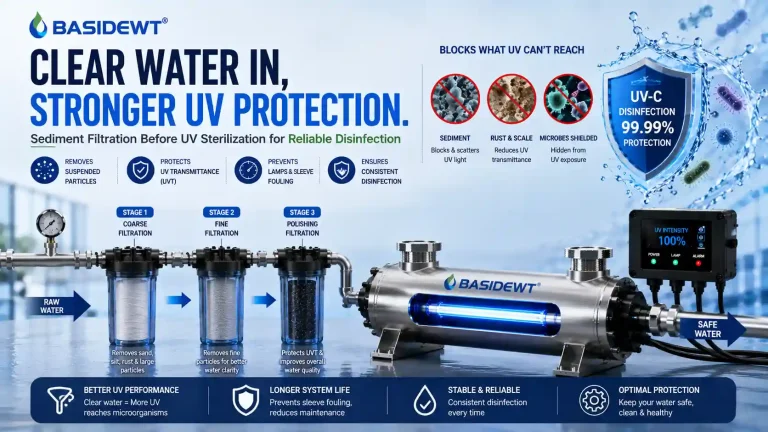
This is why pre-filtration is so often required ahead of a UV water sterilizer. Water that is visibly clear and reasonably low in iron, manganese, and hardness allows the UV lamp to work as designed.
What UV Water Sterilizers Do and Do Not Remove
This is the single most important beginner concept to understand. UV disinfection and contaminant removal are two different jobs.
| Category | Handled by UV Disinfection | Handled by Filtration/RO/Softening |
|---|---|---|
| Bacteria, viruses, protozoa | Yes, inactivated by UV-C exposure | Some physical filters can also remove larger organisms |
| Sediment and suspended solids | No | Yes, sediment filters |
| Dissolved salts and TDS | No | Yes, RO or deionization |
| Hardness minerals (calcium, magnesium) | No | Yes, water softeners |
| Heavy metals | No | Yes, specific media filters or RO |
| Taste and odor compounds | No | Yes, carbon filtration |
| Chlorine and chloramine | No | Yes, carbon filtration |
A UV water sterilizer does not act like a physical filter. It does not strain particles out of water. It inactivates microorganisms that pass through the treatment zone, while dissolved substances and suspended solids pass through largely unaffected.
Homeowners and facility managers who need broader contaminant removal typically pair UV disinfection with other stages, such as sediment filtration or reverse osmosis, rather than expecting UV alone to solve every water-quality issue.
Where UV Disinfection Fits Into a Water Treatment System
UV disinfection is rarely used as a standalone treatment. It typically sits near the end of a treatment train, after water has already been clarified.
A common sequence looks like this:
Sediment filtration → Carbon filtration → Softening or RO where required → UV disinfection
The exact order depends on the specific water source and the contaminants present. What stays consistent is the underlying logic: UV performs best on water that is already low in turbidity, iron, and manganese. Placing UV before adequate pre-filtration risks reduced UV transmittance and premature fouling of the quartz sleeve.
For a homeowner running well water, this might mean a sediment cartridge and iron reduction stage before the UV chamber. For a facility using reverse osmosis systems for process water, UV disinfection is often added after the RO stage as a final microbial-control step before use or storage.
Core Components of a UV Water Sterilizer
Every UV water sterilizer is built around a small set of core parts. Understanding what each one does helps explain why routine attention to the system matters.
| Component | Function | Why It Matters |
|---|---|---|
| Stainless steel chamber | Houses the lamp and directs water flow past it | Protects the lamp and ensures consistent exposure |
| UV lamp | Generates UV-C radiation at the germicidal wavelength | The actual disinfection source |
| Quartz sleeve | Separates the lamp from water while allowing UV light through | Keeps the lamp dry while transmitting light efficiently |
| Ballast/controller | Powers and regulates the UV lamp | Maintains stable lamp output |
| UV intensity sensor | Monitors real-time UV output where equipped | Alerts users if dose drops below a safe threshold |
| Flow sensor | Monitors water flow where equipped | Supports dose-control and alarm functions |
| Alarm indicator | Signals lamp failure or low UV intensity | Prevents unnoticed disinfection failures |
| Inlet/outlet fittings and seals | Connect the chamber to the plumbing system | Prevent leaks and maintain pressure integrity |
Not every UV water sterilizer includes sensors and alarms. Simpler residential units may rely on a basic power indicator, while commercial and industrial systems more commonly include UV intensity monitoring and flow-based alarms for added assurance.
Practical Examples
These examples are illustrative only and describe typical configurations rather than specific customer results.
A homeowner on well water often installs a sediment filter to reduce turbidity, followed by a UV water sterilizer as the final disinfection stage before water reaches household taps.
A small commercial kitchen may run incoming water through carbon filtration for taste and odor, then through a properly sized UV water sterilizer to manage microbial risk in food-preparation water.
An industrial facility producing pretreated process water might add UV disinfection downstream of an RO system, using it as an extra safeguard against microbial recontamination in storage or distribution lines.
In each case, UV disinfection is one stage within a broader system rather than a complete water treatment solution by itself.
Where UV Water Sterilizers Are Commonly Used
Residential applications include whole-house disinfection, well-water treatment, drinking water systems, and point-of-use units under a kitchen sink.
Commercial applications include hotels, restaurants, schools, offices, and other facilities that need consistent microbial control without adding chemical taste to water.
Industrial applications include food and beverage production, process water treatment, aquaculture systems, and pharmaceutical-related water systems where UV often works alongside RO or other pretreatment stages.
In China’s water-treatment market, UV disinfection appears across all these categories, from residential whole-house systems to OEM equipment built for commercial and industrial water-treatment projects. Requirements vary significantly by application, water source, and local water quality, so system specifications should always be matched to the actual site conditions rather than assumed from general use cases.
Benefits of UV Water Disinfection
- Chemical-free process. UV disinfection does not add chlorine or other chemical residuals to the water.
- Fast treatment. Inactivation happens as water flows through the chamber, without a holding or contact tank.
- No major taste change. Because no chemicals are introduced, treated water generally keeps its original taste.
- Compact footprint. Most UV chambers are small enough to fit into existing plumbing runs.
- Continuous operation. UV systems treat water on demand as it flows, rather than in batches.
- Straightforward integration. UV disinfection can usually be added to an existing filtration setup without major redesign.
Limitations to Understand Before Buying
- UV does not remove dissolved contaminants, sediment, or hardness minerals.
- Effective treatment depends on water clarity reaching the chamber.
- The system requires a continuous electrical supply to operate.
- Lamp output naturally decreases over its service life, even before failure.
- The quartz sleeve can develop mineral coating over time, reducing light transmission.
- Running water faster than the rated flow reduces the effective UV dose.
- Correct sizing for peak flow is essential; undersized or oversized units both create problems.
- UV provides no residual disinfection downstream, unlike some chemical methods that continue protecting water after initial treatment.
Recognizing these limitations early helps buyers set realistic expectations and plan appropriate pre-filtration and maintenance around the UV stage, rather than treating UV disinfection as a complete standalone solution.
A Note on Water Disinfection Standards
Because UV performance is closely tied to dose and exposure conditions, credible reference points from public health and drinking-water authorities can help buyers understand why validated system ratings matter more than generic percentage claims. The World Health Organization’s guidance on drinking-water quality outlines how disinfection technologies, including UV, are evaluated against microbial safety criteria rather than a single universal performance number.
Getting Started With the Right UV System
Choosing a UV water sterilizer starts with understanding your water source, your peak flow demand, and whether pre-filtration is needed ahead of the UV stage. These sizing and selection details go beyond what a beginner’s overview can cover, and they are addressed in more depth in dedicated sizing and selection resources.
For readers who want the fuller picture, including UV sterilizer types, working principles, applications, and maintenance, the UV water sterilizer types, working principles, applications, and maintenance guide covers the topic in complete detail.
Conclusion
A UV water sterilizer is a disinfection device that uses UV-C light to inactivate bacteria, viruses, and protozoa as water passes through a sealed chamber. It provides microbial disinfection, not contaminant removal, so it does not address sediment, dissolved salts, hardness, or most chemical contaminants on its own.
Real-world performance depends on flow rate, water clarity, UV dose, lamp condition, and overall system design, which is why pre-filtration and correct sizing matter as much as the UV chamber itself. Used correctly, alongside suitable pretreatment, a UV water sterilizer offers a reliable, chemical-free way to manage microbial risk in residential, commercial, and industrial water systems.
BasideWT designs water treatment equipment for exactly this kind of layered approach, matching UV disinfection with the filtration and pretreatment stages each water source actually requires. If you are evaluating options for a specific application, reviewing your water quality and flow requirements first will make it far easier to select a UV water sterilizer that performs as expected from day one.
RELATED POSTS
RO Water System Installation Guide: Step-by-Step Process for Home & Commercial Use
Sediment Filter Before UV Sterilizer: Why Is It Needed?
Industrial Water Treatment Equipment Manufacturer in China: What Buyers, Engineers, and Distributors Need to Know
Water Treatment Products FAQ – Key Questions
How Long Does an RO Membrane Last? Lifespan & Replacement Guide