BasideWT- Whole Home Water Filtration System & Replacement

Salt-Based vs Salt-Free Water Softener: Which Is Better?
Salt-based vs salt-free water softener is one of the most common questions homeowners and facility managers ask before investing in a water treatment system. Both systems tackle hard water, but they work in completely different ways and deliver different results. Choosing the wrong one can mean wasted money, scale buildup, or ongoing maintenance headaches.
In this guide, we break down how each system works, where each one shines, and how to decide which fits your water conditions and goals. Whether you manage a residential property, a commercial facility, or an industrial plant, this comparison will help you make a confident, informed choice.
Salt-Based vs Salt-Free Water Softener: Quick Comparison
Before diving into the details, here’s a quick snapshot of how these two technologies compare.
Salt-based water softeners use ion exchange to physically remove calcium and magnesium from water. As a result, they deliver true softened water. Salt-free systems, on the other hand, condition minerals so they can’t form scale, but they don’t actually remove hardness from the water.
| Feature | Salt-Based Softener | Salt-Free Softener |
|---|---|---|
| Technology | Ion exchange | Template Assisted Crystallization (TAC) |
| Removes hardness minerals | Yes | No, only conditions them |
| Prevents scale buildup | Yes | Yes |
| Requires salt refills | Yes | No |
| Water feels “soft” | Yes | No noticeable change |
| Wastewater discharge | Yes, during regeneration | No |
| Maintenance level | Moderate | Low |
| Best for | Very hard water | Mild to moderate hardness |
This table gives you the basics, but the right choice depends on your water hardness level, budget, and long-term goals. Let’s look at each system individually first.
What Is a Salt-Based Water Softener?
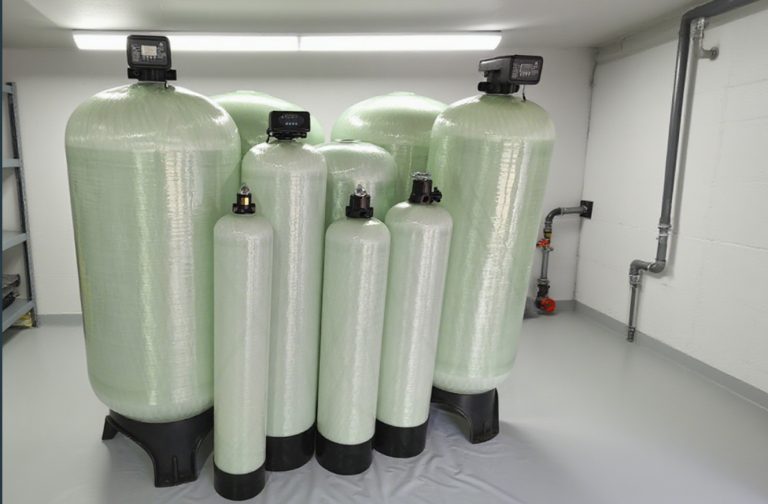
A salt-based water softener relies on a process called ion exchange. Inside the unit, a resin tank is filled with tiny resin beads. These beads carry a negative charge, which attracts positively charged hardness minerals like calcium and magnesium.
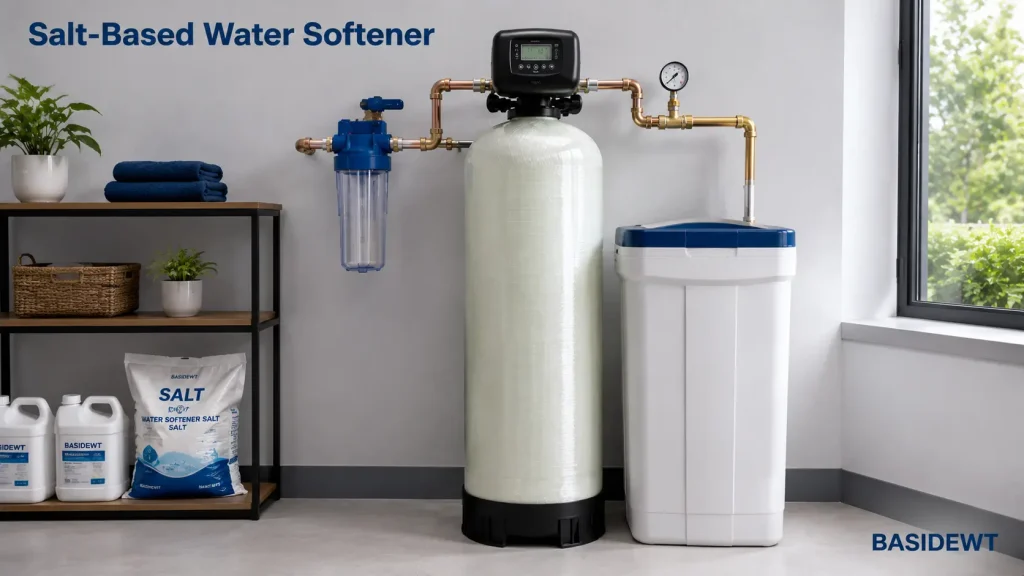
As hard water flows through the resin tank, the resin beads trap calcium and magnesium ions. In exchange, they release sodium or potassium ions into the water. This swap is why the process is called ion exchange, and it’s the same core mechanism explained in our guide on how a water softener system works.
Over time, the resin beads become saturated with hardness minerals. When this happens, the system automatically flushes itself with a concentrated salt brine solution. This regeneration cycle recharges the resin so it can keep removing hardness effectively.
Because salt-based softeners physically remove calcium and magnesium, they produce genuinely soft water. This is why many people notice smoother skin, softer laundry, and less soap scum after installation.
Salt-based systems are ideal for households or facilities dealing with very hard water, typically above 10 grains per gallon. They’re also a strong fit for areas where scale has already caused visible damage to pipes, water heaters, or appliances.
What Is a Salt-Free Water Softener?
A salt-free water softener doesn’t remove hardness minerals at all. Instead, it uses a technology called Template Assisted Crystallization, or TAC, to change how those minerals behave.
TAC media contains tiny polymer beads with nucleation sites. As hard water passes through, calcium and magnesium form microscopic crystals on these sites. These crystals become stable and lose their ability to stick to pipes, fixtures, or heating elements.
In simple terms, the minerals stay in the water, but they no longer cause scale. This process is often called water conditioning rather than true softening, since it prevents scale without actually removing hardness.
Because there’s no resin regeneration and no brine discharge, salt-free systems require no salt at all. They also don’t waste water during a regeneration cycle, which makes them a popular choice for eco-conscious buyers.
Salt-free water softeners work best for mild to moderate hardness levels, generally under 15 grains per gallon. They’re commonly chosen for homes on sodium-restricted diets, rental properties, and locations where brine discharge is restricted or regulated.
Salt-Based vs Salt-Free Water Softener: Key Differences
Now that you understand how each system works, let’s compare them across the factors that matter most.
Working Principle
Salt-based systems remove hardness minerals through ion exchange. Salt-free systems condition those minerals through crystallization, leaving them in the water but scale-resistant.
Hardness Removal
Only salt-based softeners actually reduce total water hardness. If you need a lower hardness reading on a test strip, salt-free systems won’t deliver that result.
Scale Prevention
Both technologies protect pipes and appliances from scale buildup. However, they achieve this goal through very different methods, as outlined above.
Water Taste
Some people notice a slight change in taste with salt-based water, especially if sodium levels increase. Salt-free systems don’t alter mineral content, so taste generally stays the same.
Maintenance
Salt-based softeners need regular salt refills and occasional resin bed checks. Salt-free systems require far less upkeep since there’s no brine tank or regeneration cycle to manage.
Salt Consumption
Salt-based units consume salt continuously, which adds an ongoing cost. Salt-free systems use zero salt, making them a lower-maintenance, additive-free option.
Environmental Impact
Because salt-based systems discharge brine wastewater during regeneration, they have a larger environmental footprint. Salt-free systems produce no wastewater, which is why some regions with drought concerns favor them.
Operating Cost
Salt-based systems have higher ongoing costs due to salt, water usage, and periodic resin replacement. Salt-free systems cost less to run day to day, though upfront pricing can vary by brand and capacity.
| Factor | Salt-Based | Salt-Free |
|---|---|---|
| Working Principle | Ion exchange | TAC crystallization |
| Hardness Removal | Yes | No |
| Scale Prevention | Yes | Yes |
| Water Taste | Slight sodium taste possible | Unchanged |
| Maintenance | Moderate to high | Low |
| Salt Consumption | Continuous | None |
| Environmental Impact | Higher, due to brine discharge | Lower, no wastewater |
| Operating Cost | Higher long-term | Lower long-term |
Advantages of Salt-Based Water Softeners
Salt-based water softeners remain the gold standard for eliminating hardness. Here’s why so many homeowners and businesses still choose them.
First, they deliver measurable results. A hardness test before and after installation will show a clear drop in calcium and magnesium levels. This matters for industries where water purity affects product quality, such as food processing or textile manufacturing.
Second, salt-based systems protect appliances more thoroughly. Since minerals are physically removed, there’s less risk of scale forming inside water heaters, boilers, and dishwashers. For example, a restaurant running high-volume dishwashers often relies on a whole house water softener to prevent costly equipment repairs.
Third, these systems improve soap and detergent efficiency. Softened water lathers better, so households often use less soap, shampoo, and laundry detergent over time. This translates into real savings on cleaning products.
Finally, salt-based softeners are highly customizable. Buyers can choose resin tank sizes, flow rates, and regeneration settings to match specific water demands, whether for a single-family home or a large commercial water softener application.
Advantages of Salt-Free Water Softeners
Salt-free systems offer a different but equally valuable set of benefits, particularly for buyers focused on low maintenance and sustainability.
First, there’s no salt to buy, carry, or refill. This alone makes salt-free units appealing to renters, elderly homeowners, or anyone who wants a low-maintenance water conditioning system.
Second, salt-free softeners don’t produce wastewater. Because there’s no regeneration cycle, these systems avoid the water waste associated with brine discharge. This is a major advantage in regions facing water restrictions or drought concerns.
Third, salt-free systems preserve natural mineral content. For buyers who prefer water without added sodium, TAC technology offers scale protection without changing the water’s mineral makeup.
Fourth, installation and operation are simpler overall. Since there’s no brine tank, salt-free units take up less space and require fewer components. A small office building, for instance, might choose a compact soft water system to protect plumbing without the complexity of a full ion exchange setup.
Which Water Softener Is Best for Your Home or Business?
The right system depends heavily on your water source, hardness level, and intended use. Here’s how the decision typically breaks down.
Hard Water Areas
If your water tests above 10 to 15 grains per gallon, a salt-based softener is usually the better choice. Only true ion exchange can bring hardness down to a level that noticeably improves water feel and appliance performance.
Municipal Water
Municipal supplies often have moderate hardness. In these cases, a salt-free system may be enough to prevent scale without the added maintenance of salt refills.
Well Water
Well water can vary widely in hardness and mineral content. Because well water sometimes contains higher calcium and magnesium levels, a salt-based system is often more reliable for consistent results.
Commercial Applications
Restaurants, hotels, and laundromats typically benefit from a commercial water softener with ion exchange technology. These businesses rely on consistent water quality to protect high-use equipment and maintain service standards.
Industrial Facilities
Manufacturing plants and industrial operations often require an industrial water softener capable of handling large volumes and strict water quality standards. In many cases, ion exchange remains the preferred method due to its precise, measurable hardness removal.
Industries like power generation, pharmaceuticals, and food and beverage production depend on consistent water chemistry. Even small variations in hardness can affect boiler efficiency, product consistency, or equipment lifespan. Because of this, engineers often specify salt-based systems with programmable regeneration cycles, allowing water quality to stay within tight, predictable ranges around the clock.
That said, some industrial operations pair a salt-based system with additional conditioning stages to balance performance with water and salt usage. This hybrid approach is becoming more common as facilities look for ways to reduce operating costs without sacrificing water quality standards.
For a deeper look at how different systems are categorized and selected, our complete guide to water softener system types, benefits, and installation walks through the full decision-making process.
Common Misconceptions
Several myths continue to confuse buyers comparing salt-based and salt-free systems. Let’s clear a few up.
Myth: Salt-free softeners are just weaker salt-based systems. In reality, they use entirely different technology. Salt-free units aren’t designed to remove hardness at all, so comparing them directly to ion exchange isn’t accurate.
Myth: Salt-based water is unsafe to drink. Softened water from a properly maintained system is safe for most people. However, those on strict sodium-restricted diets should consult a doctor or consider a potassium-based alternative.
Myth: Salt-free systems don’t work. TAC technology is backed by independent testing and widely used in both residential and commercial settings. It simply solves a different problem than ion exchange does.
Myth: All water softeners are the same. As this comparison shows, working principles, water quality outcomes, and maintenance needs vary significantly between salt-based and salt-free options.
For additional technical background on how ion exchange resin performs in different water conditions, the Purolite Resin Knowledge Center offers detailed, research-based resources worth exploring.
Final Recommendation
So, salt-based vs salt-free water softener: which one should you choose? The honest answer depends on your priorities.
Choose a salt-based water softener if you have very hard water, want measurable hardness removal, and don’t mind the ongoing salt and maintenance requirements. It remains the most effective solution for protecting appliances and improving everyday water quality.
Choose a salt-free water softener if you’re dealing with mild to moderate hardness, prefer a low-maintenance system, and want to avoid sodium and wastewater discharge. It’s a practical, eco-friendly option for many households and light commercial settings.
Neither system is universally better. Instead, the best choice comes down to your water hardness level, budget, and long-term goals. If you’re still weighing your options, our complete water softener system buying guide covers everything from system types to selection criteria in one place.
Once you’re ready to move forward, you can explore our full range of water softener systems designed for residential, commercial, and industrial applications. And if you’d like to compare softening against other treatment methods, our article on water softener vs. water filter differences is a helpful next read.
Whichever path you choose, understanding how each system treats water hardness puts you in a stronger position to protect your plumbing, your appliances, and your daily water quality for years to come.