BasideWT- Whole Home Water Filtration System & Replacement


What Does a Water Filter Remove? Contaminants, Sediment & More
What does a water filter remove depends entirely on the filtration technology inside it. A sediment filter traps sand, dirt, and rust particles, but it will not touch dissolved chlorine or heavy metals. A carbon filter reduces chlorine taste and odor, but it is not built to strip out dissolved salts. Reverse osmosis can reduce a much wider range of dissolved contaminants, but even that depends on membrane quality and feed-water conditions. No single water filter removes everything. Understanding which media targets which contaminant is the only way to match a filter to your actual water-quality concern.
Quick Answer
A water filter can remove or reduce sediment, dirt, and suspended particles through mechanical filtration. Carbon filters can reduce chlorine, certain taste and odor compounds, and some organic chemicals through adsorption. Depending on the technology, filters may also reduce certain microorganisms, heavy metals, or dissolved contaminants. Membrane-based systems, such as reverse osmosis, target a broader range of dissolved substances. No filter removes every contaminant, and actual performance always depends on the specific filter media, design, and manufacturer specifications.
What Can a Water Filter Remove?
Water filters work through a handful of core mechanisms: mechanical straining, adsorption, membrane separation, and disinfection. Each mechanism is suited to a different category of contaminant.
- Mechanical filtration catches physical particles based on size, using a rated micron pore.
- Adsorption (mainly activated carbon) attracts certain chemical compounds to the surface of the filter media.
- Membrane separation (ultrafiltration and reverse osmosis) pushes water through extremely fine membranes that can block dissolved substances as well as particles.
- Disinfection (typically UV light) inactivates microorganisms without physically removing them from the water.
Because these mechanisms work differently, a filter designed for one purpose usually cannot handle contaminants outside its intended scope. This is one of the key ideas explained in our water filter system how it works, types, and benefits guide.
Common Contaminants Found in Water
Household and commercial water supplies can contain a mix of physical, chemical, and biological contaminants. The list below is not exhaustive, and not every filter addresses every item.
Sediment and Dirt
Sand, silt, and general dirt often enter water supplies from aging pipes, source-water turbidity, or construction activity nearby. These particles are usually visible or cause cloudiness.
Rust and Suspended Particles
Corroding pipes or aging water infrastructure can shed rust flakes and other suspended solids. These particles vary widely in size, which is why micron rating matters when selecting a sediment filter.
Chlorine
Many municipal water systems add chlorine as a disinfectant. While necessary for public safety during distribution, it can leave a noticeable taste and odor at the tap.
Taste and Odor Compounds
Beyond chlorine, some water sources carry musty, earthy, or metallic tastes and smells caused by organic compounds or mineral content.
Some Microorganisms
Certain filters with a fine enough pore size, or paired with disinfection technology, can address specific bacteria, protozoa, or other microorganisms. Capability varies significantly by product and certification.
Certain Dissolved Contaminants
Some dissolved substances, including specific chemicals and select heavy metals, can be reduced by adsorption media or membrane technology, depending on the compound and the filter’s design.
Heavy Metals
Metals such as lead or copper can enter water through old plumbing or source contamination. Reduction generally requires filters specifically rated for the metal in question.
Other Specific Contaminants
Depending on local water quality, other concerns can include specific organic compounds, industrial byproducts, or agricultural residues. These require filtration media matched to the specific substance.
The right filter depends on your actual water-quality concern, not on assumptions. Testing your water is the most reliable starting point.
What Does a Sediment Filter Remove?
A sediment filter is a mechanical, size-based filter. It physically traps particles larger than its rated micron size as water passes through.
Sediment filters commonly reduce:
- Sand
- Dirt
- Silt
- Rust particles
- Suspended solids
- Other larger physical particles
Sediment filters generally do not remove dissolved chemicals, dissolved salts, or dissolved gases, because those substances are not physical particles that a mesh or pleated media can trap. A sediment filter is typically the first stage in a multi-stage system, protecting downstream filters from clogging with debris. This staged approach is covered in more detail in our how does a water filter system work step-by-step guide.
What Does an Activated Carbon Filter Remove?
Activated carbon works through adsorption. Its highly porous surface area attracts and holds certain chemical compounds as water flows past.
Activated carbon filters may reduce:
- Chlorine
- Some taste and odor compounds
- Certain organic compounds
- Some other contaminants, depending on the carbon type, contact time, and certification
Not all carbon filters perform identically. Granular activated carbon, carbon block, and specialty carbon blends each have different contact times and micron ratings, which affects what they can reduce. A carbon filter is not designed to remove dissolved salts, and it is not a substitute for a membrane system when broader dissolved-contaminant reduction is the goal.
What Does an RO Water Filter Remove?
Reverse osmosis (RO) uses pressure to push water through a semipermeable membrane. Because the membrane’s pores are extremely small, RO can reduce a wider range of dissolved contaminants than mechanical or carbon filtration alone, including many that pass straight through a sediment or carbon stage.
However, RO performance is not fixed or universal. It depends on several factors:
- Membrane quality and condition
- Feed-water conditions, including pressure and temperature
- System design and number of stages
- How well the membrane has been maintained over time
RO systems are typically paired with pre-filters, such as sediment and carbon stages, to protect the membrane and extend its working life. Because RO addresses a broad range of dissolved substances, it is often considered when a household’s water testing shows dissolved contaminants that sediment or carbon filtration cannot handle.
What Does a UF Filter Remove?
Ultrafiltration (UF) is another membrane-based technology, but its membrane pores are larger than those used in reverse osmosis. This means UF is generally effective at reducing suspended particles and certain microorganisms based on size, while allowing most dissolved minerals and salts to pass through.
The key distinction between UF and RO:
- UF targets particles and some microorganisms through a finer physical barrier, but does not typically reduce dissolved salts.
- RO targets a broader range of dissolved contaminants because its membrane pores are significantly smaller.
UF is sometimes chosen when a household wants particle and certain microorganism reduction without altering the mineral content of the water, since RO systems generally reduce dissolved minerals along with other dissolved substances.
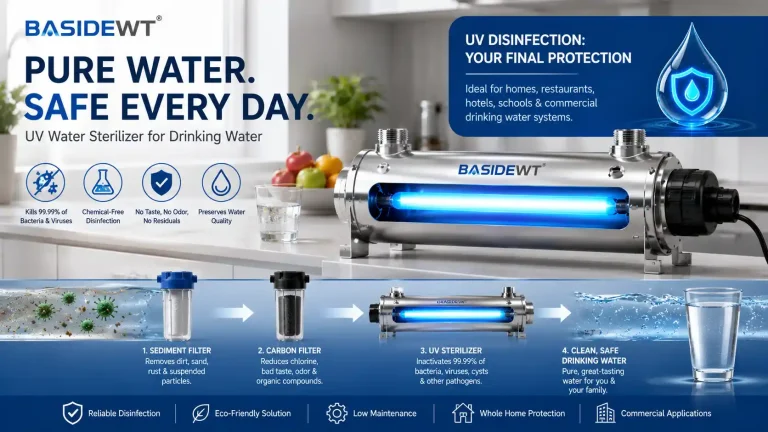
Does a UV Water Filter Remove Contaminants?
UV filtration works differently from every technology described above. Rather than physically removing anything, a UV filter uses ultraviolet light to disrupt the DNA of certain microorganisms as water passes through, reducing their ability to reproduce.
This means UV:
- Does not function like a sediment filter and does not trap physical particles
- Does not function like a carbon filter and does not adsorb chemicals
- Does not reduce dissolved contaminants such as salts or heavy metals
UV is best understood as a disinfection step, typically added after mechanical and adsorption stages have already addressed particles and certain chemicals. Cloudy or turbid water can also reduce UV effectiveness, since suspended particles can shield microorganisms from the light.
Water Filter Contaminant Removal Comparison
The table below offers a general, qualified comparison. Actual performance always depends on the specific product, its certification, and manufacturer specifications.
| Contaminant or Impurity | Sediment Filter | Carbon Filter | UF | RO | UV |
|---|---|---|---|---|---|
| Sand, dirt, silt | Commonly targeted | Not designed for | May reduce | May reduce | Not designed for |
| Rust particles | Commonly targeted | Not designed for | May reduce | May reduce | Not designed for |
| Chlorine taste/odor | Not designed for | Commonly targeted | Depends on system | Depends on system | Not designed for |
| Organic taste/odor compounds | Not designed for | May reduce | Depends on system | Depends on system | Not designed for |
| Certain microorganisms | Not designed for | Not designed for | May reduce | Depends on system | Commonly targeted (disinfection) |
| Dissolved salts | Not designed for | Not designed for | Not designed for | May reduce | Not designed for |
| Heavy metals | Not designed for | Depends on system | Depends on system | Depends on system | Not designed for |
| Hardness minerals | Not designed for | Not designed for | Not designed for | May reduce | Not designed for |
What Does a Water Filter NOT Remove?
Filtration limitations are just as important to understand as filtration capabilities. A filter built for one job will not automatically handle unrelated contaminants.
Common examples of what standard filtration may not remove:
- Dissolved salts — typically require membrane-based technology such as RO, and even then results vary
- Some dissolved minerals — mechanical and carbon filters generally do not target these
- Certain chemicals — removal depends heavily on the specific compound and the filter media’s design
- Specific microorganisms — not every filter or disinfection method addresses every organism
- Hardness minerals — standard sediment and carbon filtration do not soften water; that typically requires a different treatment approach entirely
A filter designed to catch particles by size simply cannot interact with a dissolved substance the same way. This is one of the most misunderstood aspects of water filtration, and it is why matching the filter to the actual contaminant matters more than picking a filter based on price or general reputation.
How to Know What Your Water Filter Removes
Instead of assuming, verify. A few practical steps:
- Read the manufacturer’s specifications. Look for the exact contaminants or contaminant categories the filter is rated to reduce.
- Check the filter media. Sediment, carbon, UF membrane, RO membrane, and UV each have different capabilities, as outlined above.
- Look for the rated micron size, especially for sediment and mechanical filters, since this determines the smallest particle size the filter can physically trap.
- Review relevant testing or certification information provided by the manufacturer for the specific contaminant you’re concerned about.
- Test your water if you have a specific concern, such as taste, odor, discoloration, or a known local water-quality issue. Testing tells you what’s actually in your water before you choose a filter to address it.
Skipping these steps often leads to buying a filter that doesn’t match the actual problem.
Why One Water Filter Cannot Remove Everything
Filtration technologies work through fundamentally different mechanisms, and each mechanism has a natural scope. A mechanical filter interacts with particle size. Adsorption media interacts with certain chemical structures. Membrane separation interacts with molecular and ionic size. Disinfection interacts with microbial DNA. None of these mechanisms overlaps completely with the others.
This is why many home and commercial systems combine multiple stages rather than relying on one filter type. A typical multi-stage approach might use a sediment filter to protect downstream components, a carbon stage to handle taste and odor, and a membrane or disinfection stage to address dissolved contaminants or microorganisms, depending on what the water testing shows is actually present.
How to Choose a Filter Based on the Contaminant
A practical way to think about filter selection is to start with the specific concern, not the filter type.
- If the concern is sediment or cloudy water → consider a sediment filtration stage sized to the particle range you’re dealing with.
- If the concern is chlorine taste or odor → consider an appropriately certified activated carbon stage.
- If the concern is dissolved contaminants, such as certain salts or specific chemicals → evaluate a membrane-based system such as RO, matched to what your water testing shows.
- If microbial disinfection is required → evaluate a disinfection technology such as UV, generally as part of a multi-stage setup rather than a standalone solution.
Water testing and reviewing actual system specifications remain the most reliable way to confirm a filter addresses your specific concern, rather than relying on general assumptions about filter type. If you’re weighing which combination fits a specific household’s needs, our guide on which water filter system is best for your home walks through that decision process in more depth.
Common Misunderstandings About Water Filters
A few misconceptions come up often enough to address directly:
- “All water filters remove everything.” Not true. Every filter has a specific scope based on its technology.
- “A sediment filter removes dissolved chemicals.” Sediment filters are size-based and do not interact with dissolved substances.
- “A carbon filter removes every contaminant.” Carbon primarily targets chlorine, taste, odor, and certain organic compounds, not the full range of possible contaminants.
- “UV removes particles.” UV disinfects; it does not physically remove particles or chemicals.
- “RO and every other filter work the same way.” Each technology uses a different mechanism, so their capabilities are not interchangeable.
- “A lower micron number automatically means the best filter.” A finer micron rating can improve particle capture, but it does not mean the filter addresses dissolved contaminants, and an overly fine sediment filter can also reduce flow rate unnecessarily if it’s not matched to your actual water conditions.
Why Filter Design Details Matter
Two filters using the same general technology can still perform very differently. Factors like pore size, contact time, flow rate, and the condition of the filter media all influence real-world results. According to general water treatment science, the effectiveness of membrane-based reverse osmosis filtration depends significantly on membrane integrity and operating pressure, which is one reason system design and maintenance matter as much as the underlying technology itself. This is true across filtration types, not just RO — a well-designed system with properly maintained media consistently outperforms an equivalent system that’s been neglected.
Conclusion
What a water filter removes always comes back to its underlying technology. Sediment filters handle physical particles. Carbon filters reduce chlorine, taste, and odor compounds through adsorption. UF and RO membranes target a broader range of particles and dissolved contaminants, with RO generally addressing more dissolved substances due to its finer membrane. UV disinfects rather than physically removing anything. No single filter removes every contaminant, which is why understanding your actual water quality — through testing and reviewing filter specifications — matters more than assuming one filter type will handle everything. If you’re ready to match a filtration solution to your household or business water-quality concerns, our water filtration system range is a useful starting point for comparing options suited to different contaminant concerns.
FAQs
What contaminants does a water filter remove?
It depends on the filter type. Sediment filters reduce physical particles like sand, dirt, and rust. Carbon filters reduce chlorine, taste, and odor compounds. Membrane systems like UF and RO can reduce a broader range of particles and dissolved contaminants, and UV disinfects certain microorganisms. No single filter addresses every category.
Does a water filter remove chlorine?
An activated carbon filter is generally the technology used to reduce chlorine taste and odor, through an adsorption process. Sediment filters and UV disinfection are not designed for this purpose, since chlorine is a dissolved chemical rather than a physical particle or microorganism.
Can a water filter remove heavy metals?
Some filters can reduce certain heavy metals, but this depends heavily on the specific filter media, its certification, and the specific metal involved. Not every carbon or membrane filter is rated for heavy metal reduction, so checking manufacturer specifications for the specific metal of concern is essential.
Does a water filter remove bacteria and viruses?
Reduction of microorganisms depends on the technology. Some filters with sufficiently fine pore sizes can physically block certain microorganisms, while UV disinfection targets microorganisms through a different mechanism entirely. Not all filters are designed or certified for microbial reduction, so this should be verified directly.
Does a water filter remove dissolved salts?
Standard sediment and carbon filters generally do not reduce dissolved salts, since these are dissolved rather than physical particles. Membrane-based systems, particularly reverse osmosis, are the technology typically evaluated when dissolved salt reduction is the specific concern, though actual results depend on membrane quality and system design.
RELATED POSTS
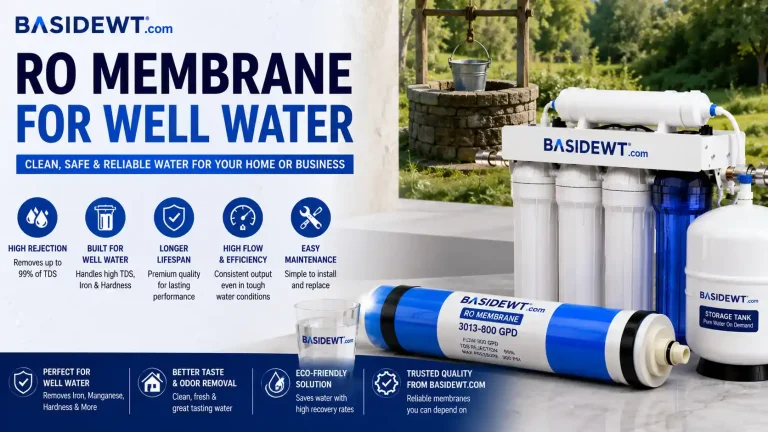
RO Membrane for Well Water: Selection, Performance & Maintenance Guide
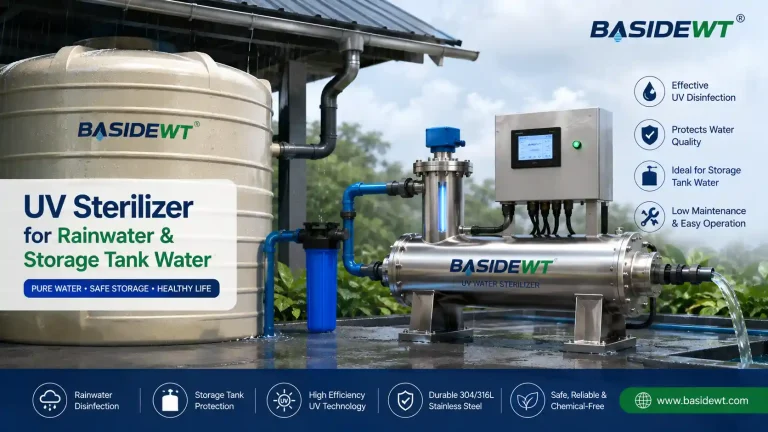
UV Sterilizer for Rainwater: How to Safely Treat Collected Water
DI Water Filter Tanks for Window Cleaning: The Hidden Cost of Pure Water and How to Choose Wisely

Can You Drink Softened Water? Safety, Health Benefits & Common Myths
How Does an RO Membrane Work? Step-by-Step Guide