BasideWT- Whole Home Water Filtration System & Replacement



Whole House Water Filter System: Is It Worth It?
A whole house water filter system treats water at the point where it enters your home, so every tap, shower, and appliance receives filtered water instead of just one faucet. Homeowners consider one when sediment, chlorine taste, or inconsistent water quality shows up throughout the property, not just at the kitchen sink. Whether a whole house water filter system is worth it depends on your water source, the specific problem you’re trying to solve, how much water your household uses, and how much ongoing maintenance you’re willing to take on. For some homes it’s a clear upgrade. For others, a smaller point-of-use filter solves the problem just as well for less money.
Quick Answer
A whole house water filter system is worth it when a household wants treated water at every fixture and the system is matched to the actual water-quality problem. Key factors include the water source (municipal or well), the contaminants present, household flow rate and peak demand, filter capacity, installation space, and ongoing maintenance and replacement costs. If you only care about drinking or cooking water, a point-of-use filter under the sink or on the countertop is often more practical and less expensive than treating your entire home’s water supply.
What Is a Whole House Water Filter System?
A whole house water filter system, sometimes called a point-of-entry (POE) filter, installs on the main water line where it enters your home. This is typically near the water meter, pressure tank, or main shutoff valve.
Because it sits at the entry point, every fixture connected to that line receives filtered water — kitchen taps, bathroom sinks, showers, washing machines, water heaters, and outdoor spigots. This is the main structural difference from filters installed at a single fixture, which is covered in more detail in our guide to how water filter systems work and the types available.
A whole house filter is not one single technology. It’s a category that can include sediment filters, carbon filters, and sometimes additional stages like water softeners or UV units, depending on what the home needs.
How Does a Whole House Water Filter System Work?
Water enters the home through the main line and passes through the filter housing before reaching any branch pipes. Depending on the configuration, this may happen in one stage or several.
A common setup starts with a sediment pre-filter that catches larger particles like sand, rust, and dirt. Water then moves through a carbon stage, where chlorine, certain chemicals, and taste-and-odor compounds are reduced through adsorption. Some systems add a final polishing stage or a separate treatment component for specific concerns, such as hardness or bacteria.
The exact process depends heavily on system design and the household’s water source. For a broader step-by-step explanation of filtration mechanics that applies across product types, see our detailed breakdown of how a water filter system works.
What matters for a whole house setup specifically is that filtration has to keep up with your home’s total water demand — not just the flow needed at one tap.
What Does a Whole House Water Filter System Remove?
Performance depends entirely on the filtration technology installed. There’s no single answer that applies to every system, and it’s important not to assume one filter handles every contaminant.
Common targets for whole house systems include:
- Sediment, sand, and dirt — removed by mechanical pre-filters based on micron rating
- Rust particles — common in older pipes or well systems with iron content
- Chlorine and chloramine — often reduced through carbon filtration, improving taste and odor
- Taste and odor compounds — addressed by carbon media adsorbing organic compounds
- Specific contaminants — only when the system includes a treatment stage designed for that contaminant, such as a dedicated media for iron, hardness, or certain chemicals
A whole house filter with only sediment and basic carbon stages will not remove everything a household might be concerned about, such as dissolved minerals, certain heavy metals, or biological contaminants. Matching the filter media to the actual water problem is essential. For a full breakdown of what different filtration technologies can and can’t remove, our article on what a water filter removes from contaminants to sediment covers this in depth.
Benefits of a Whole House Water Filter System
When matched correctly to the water problem, a whole house system offers several practical advantages:
- Filtration at the point of entry — treatment happens before water reaches any fixture
- Treated water at multiple outlets — showers, laundry, and every tap benefit, not just the kitchen sink
- Reduced exposure to certain unwanted substances where the system is designed to address them, such as sediment or chlorine
- Convenience — no need to install or maintain separate filters at every fixture
- Protection for plumbing and appliances — sediment removal can reduce buildup in pipes, water heaters, and fixtures over time
- Potential improvement in taste and odor throughout the home, where chlorine or organic compounds are the cause
These benefits depend on correct system selection. A whole house filter doesn’t automatically deliver every one of these outcomes — it delivers the outcomes its specific filter media is designed for.
Is a Whole House Water Filter Better Than an Under-Sink Filter?
Neither option is universally better. They solve different problems.
| Factor | Whole House Filter | Under-Sink Filter |
|---|---|---|
| Coverage | Entire home | One fixture |
| Installation | Main water line, often professional | Under a single sink, simpler |
| Flow requirements | Must handle whole-home peak demand | Only needs to handle one tap |
| Maintenance | Larger filters, less frequent changes, higher stakes if neglected | Smaller filters, more frequent but lower-cost changes |
| Upfront cost | Generally higher | Generally lower |
| Best suited for | Household-wide water quality concerns | Drinking and cooking water only |
If the water-quality issue affects the whole property — sediment in every faucet, chlorine smell throughout the house — a whole house system addresses it at the source. If the concern is limited to drinking water quality, an under-sink filter treats that specific need without the cost of protecting your entire plumbing system.
Whole House vs Point-of-Use Water Filtration
Whole-House Filtration
Installed at the main line, treating all water entering the home. Best when water-quality concerns are consistent across every fixture, or when a household wants centralized filtration rather than managing several individual units.
Under-Sink Filtration
Installed beneath a specific sink, typically serving one faucet. Often uses multi-stage cartridges and can target drinking-water-specific concerns more precisely, since it’s not required to filter the full household volume.
Countertop or Faucet Filtration
Attaches directly to a faucet or sits on the counter with minimal installation. Lowest upfront cost and easiest to set up or move, but limited to a single point of use and generally lower flow capacity.
Each type serves a different scope. A household might even combine a whole house sediment/carbon system for general water quality with a dedicated under-sink filter for more targeted drinking-water treatment.
Who Should Consider a Whole House Water Filter?
A whole house system tends to make more sense for households in situations like:
- Water-quality concerns that show up throughout the property, not just at one tap
- Visible sediment, cloudiness, or particulate buildup in multiple fixtures
- Chlorine taste or odor noticeable across the home’s water supply
- Water sources — municipal or well — that are known to require broader treatment
- Larger households with multiple simultaneous water-use points (showers, laundry, kitchen running at once)
- A preference for centralized filtration over managing several separate point-of-use units
Local water quality varies significantly by source and municipality, so these are general patterns rather than guarantees that apply to every home.
Who May Not Need a Whole House Water Filter?
A whole house system isn’t the right fit for every household. It may be unnecessary when:
- The only concern is drinking or cooking water quality
- Filtration needs are limited and narrow in scope
- Existing water quality doesn’t show signs requiring broad, household-wide treatment
- Installation space near the main line is limited or inaccessible
- The system being considered doesn’t actually match the contaminant present
In these cases, a smaller point-of-use solution can be more practical, less expensive to install, and easier to maintain — without sacrificing the specific outcome the household actually wants.
Whole House Water Filter System Pros and Cons
| Factor | Advantages | Potential Limitations |
|---|---|---|
| Coverage | Treats water at every fixture in the home | Doesn’t allow different treatment for different rooms |
| Convenience | One system instead of several separate filters | Requires access to the main water line |
| Installation | Centralized, handled once | Often needs professional installation and available space |
| Maintenance | Fewer filter locations to manage | Missed changes affect the entire home’s water, not just one tap |
| Cost | Can reduce need for multiple smaller filters | Higher upfront investment than a single point-of-use unit |
| Flow | Designed to serve whole-home demand | Must be sized correctly or it can restrict water pressure |
| Filter replacement | Larger filters, less frequent changes | Replacement cartridges can cost more per change |
| Space | Installs in one location (basement, utility room, garage) | Not always feasible in homes with limited mechanical space |
How Much Does a Whole House Water Filter System Cost?
There’s no single universal price, since cost depends on several variables specific to each home and system. Rather than quoting a fixed number, it’s more useful to understand what actually drives cost:
- System type — single-stage sediment filters cost less than multi-stage systems with carbon and additional media
- Filtration stages — more stages generally mean higher upfront cost but potentially broader treatment
- Flow capacity — systems built to handle higher household demand typically cost more
- Housing size — larger filter housings and cartridges cost more than compact models
- Filter media — specialty media for specific contaminants adds to both upfront and replacement cost
- Installation — professional plumbing work adds labor cost on top of the equipment
- Replacement cartridges — an ongoing cost that varies by filter type and household water usage
- Maintenance — periodic servicing, especially for multi-stage systems
- Water usage — higher household consumption means more frequent filter changes
- Additional treatment equipment — softeners, UV units, or specialty stages add separately
The upfront cost covers the system and installation. The ongoing cost — replacement filters, occasional servicing, and possible added components — continues for as long as the system is in use. Both should factor into whether the investment makes sense for your household.
What Should You Check Before Buying?
Before purchasing a whole house water filter system, confirm the following:
- Water testing — know what’s actually in your water before choosing a filtration technology
- Water source — municipal water and well water often carry different concerns
- Contaminant target — the filter media must match the specific problem you’re solving
- Flow rate — the system needs to handle your home’s typical and peak water demand without restricting pressure
- Peak household demand — consider how many fixtures might run simultaneously
- Pressure requirements — filtration adds some resistance; verify the system won’t drop pressure below usable levels
- Filter capacity — how much water the filter can process before it needs replacing
- Micron rating where relevant — determines what size particles the filter physically captures
- Replacement availability — confirm replacement filters are easy to source long-term
- Maintenance requirements — understand the change schedule before committing
- Installation requirements — available space, access to the main line, and whether professional installation is needed
- Total ownership cost — combine upfront price with expected replacement and maintenance costs over several years
Independent research on activated carbon filtration notes that this widely used technology is effective against chlorine, certain organics, and taste-and-odor compounds, but is not effective against microbial contaminants, metals, or many inorganic substances — which is why matching filtration technology to the actual contaminant present in the water matters more than the number of filtration stages a system advertises.
Is a Whole House Water Filter Worth It for Your Home?
There’s no single answer that applies to every household. A practical way to think about it:
A whole house system may make sense if:
- You need treated water at multiple fixtures, not just one
- The water-quality concern affects the entire home, not a single tap
- The filtration technology you’re considering actually matches the contaminant
- The system can handle your household’s peak flow demand without pressure loss
- You’re comfortable with the maintenance schedule and replacement costs
A point-of-use system may make more sense if:
- Only drinking or cooking water needs treatment
- The concern is limited to one or two outlets
- You want a lower installation commitment and upfront cost
- Your existing water quality doesn’t show signs of broader household-wide issues
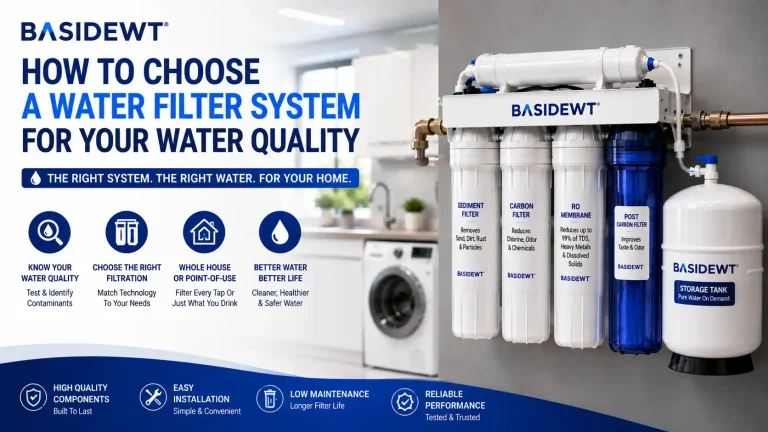
Reviewing your options against your home’s specific water quality and needs is worth doing before committing either way. Our guide on choosing the right water filter system for your home walks through that comparison in more detail.
Common Mistakes When Buying a Whole House Water Filter
Avoid these frequent missteps:
- Buying based only on price — the cheapest system may not match your actual water problem
- Choosing a filter without knowing the water problem — test first, then select filtration media
- Ignoring flow rate — an undersized system restricts pressure across the whole home
- Ignoring replacement costs — some systems have low upfront prices but expensive ongoing cartridges
- Choosing an undersized system — capacity should match household size and peak usage
- Assuming every filter removes the same contaminants — filtration performance depends on media type
- Ignoring installation requirements — confirm space and plumbing access before buying
- Focusing only on the number of filtration stages — more stages don’t guarantee better results if the media doesn’t match the contaminant
Practical Whole House Water Filter Buying Checklist
- [ ] Test your water source to identify actual contaminants
- [ ] Confirm whether your water source is municipal or well
- [ ] Match filtration media to the identified contaminants
- [ ] Calculate your household’s peak water flow demand
- [ ] Check the system’s rated flow capacity against that demand
- [ ] Confirm available installation space near your main water line
- [ ] Review filter replacement frequency and cost
- [ ] Ask about total cost of ownership, not just the purchase price
- [ ] Confirm replacement filters are readily available
- [ ] Compare whole house filtration against point-of-use alternatives for your specific need
Conclusion
A whole house water filter system is worth it when your household wants treated water at every fixture and the filtration technology genuinely matches your water’s actual contaminants. It’s less worthwhile when your real concern is limited to drinking or cooking water, since a smaller point-of-use filter can often solve that more efficiently. The decision comes down to your water source, the specific contaminants present, your home’s flow demand, installation space, and the ongoing maintenance and replacement costs you’re prepared to manage. If you’re weighing your options, our water filtration system category is a useful starting point for comparing configurations suited to different household needs.
FAQs
Is a whole house water filter system worth it?
It depends on your water quality and household needs. It’s generally worth it when water-quality concerns affect the entire home and the system you choose matches the specific contaminants present. If your concern is limited to drinking water, a point-of-use filter may be more practical.
What are the benefits of a whole house water filter?
Benefits include filtration at the point where water enters your home, treated water at every fixture, reduced exposure to certain unwanted substances the system is designed to address, and the convenience of one centralized system instead of several separate filters.
Is a whole house water filter better than an under-sink filter?
Neither is universally better — they serve different purposes. A whole house filter treats water for the entire property, while an under-sink filter targets a single fixture, usually for drinking and cooking water. The right choice depends on whether your water-quality concern is household-wide or limited to one outlet.
How long does a whole house water filter system last?
This varies by system type, filter media, household water usage, and water quality. Sediment and carbon filters typically need periodic replacement based on capacity and usage, while the housing and overall system can last many years with proper maintenance.
Do I need a whole house water filter for my home?
That depends on your water source, test results, and whether water-quality concerns show up throughout your property or only at specific taps. Testing your water first is the most reliable way to determine whether whole-house or point-of-use filtration fits your situation.
RELATED POSTS

Water Fed Pole Window Cleaning: How the Pure Water Method Works
Deionized Water vs Distilled Water: What’s the Real Difference?
UV vs Chlorine Water Disinfection: Which Is Better?
How to Choose a Water Filter System for Your Water Quality
Spotless Water System: The Complete Guide to Spot-Free Car Washing